
koala73/worldmonitorConnectors
Real-time global intelligence dashboard. AI-powered news aggregation, geopolitical monitoring, and infrastructure tracking in a unified situational awareness interface
86k
Wikipedia MCP Server gives an agent live access to Wikipedia through the Model Context Protocol. It exposes tools for search, article retrieval, summaries, sections, links, related topics, and coordinates, plus options for language, country, caching, and transport mode.
Builders who want their agent to look up and ground answers in Wikipedia.
You can let your agent answer with current Wikipedia facts instead of relying on memory alone.
Find articles by query and return matching results with snippets and metadata.
Get the full text of a Wikipedia article along with summary, sections, links, and categories.
Return a short article summary, a query-focused summary, or a summary of one section.
Discover links inside an article and topics related to its content.
Look up latitude and longitude data for articles with location information.
Switch Wikipedia editions with `--language` or `--country`, including language variants like `zh-hans` and `sr-latn`.
Run over `stdio`, `http`, `streamable-http`, or legacy `sse`, with optional static token or JWT auth.
Enable response caching and pass a Wikipedia access token to reduce rate limiting.
# Install pipx if you don't have it
pip install pipx
pipx ensurepath

# Install the Wikipedia MCP server
pipx install wikipedia-mcp
npx -y @smithery/cli install @Rudra-ravi/wikipedia-mcp --client claude
pip install wikipedia-mcp
# Create a virtual environment
python3 -m venv venv

# Activate the virtual environment
source venv/bin/activate

# Install the package
pip install git+https://github.com/rudra-ravi/wikipedia-mcp.git

A Model Context Protocol (MCP) server that retrieves information from Wikipedia to provide context to Large Language Models (LLMs). This tool helps AI assistants access factual information from Wikipedia to ground their responses in reliable sources.
The Wikipedia MCP server provides real-time access to Wikipedia information through a standardized Model Context Protocol interface. This allows LLMs to retrieve accurate and up-to-date information directly from Wikipedia to enhance their responses.

--language or -l argument when running the server (e.g., wikipedia-mcp --language ta for Tamil).--country US, --country China, or --country TW instead of language codes. Automatically maps to appropriate Wikipedia language variants.zh-hans for Simplified Chinese, zh-tw for Traditional Chinese), Serbian scripts (sr-latn, sr-cyrl), and other regional variants.stdio, http, and streamable-http (with legacy sse compatibility).--auth-mode static or --auth-mode jwt.The best way to install for Claude Desktop usage is with pipx, which installs the command globally:
# Install pipx if you don't have it
pip install pipx
pipx ensurepath

# Install the Wikipedia MCP server
pipx install wikipedia-mcp
This ensures the wikipedia-mcp command is available in Claude Desktop's PATH.
To install wikipedia-mcp for Claude Desktop automatically via Smithery:
npx -y @smithery/cli install @Rudra-ravi/wikipedia-mcp --client claude
You can also install directly from PyPI:
pip install wikipedia-mcp
Note: If you use this method and encounter connection issues with Claude Desktop, you may need to use the full path to the command in your configuration. See the Configuration section for details.
# Create a virtual environment
python3 -m venv venv

# Activate the virtual environment
source venv/bin/activate

# Install the package
pip install git+https://github.com/rudra-ravi/wikipedia-mcp.git
# Clone the repository
git clone https://github.com/rudra-ravi/wikipedia-mcp.git
cd wikipedia-mcp

# Create a virtual environment
python3 -m venv wikipedia-mcp-env
source wikipedia-mcp-env/bin/activate

# Install in development mode
pip install -e .
# If installed with pipx
wikipedia-mcp

# If installed in a virtual environment
source venv/bin/activate
wikipedia-mcp

# Specify transport protocol (default: stdio)
wikipedia-mcp --transport stdio  # For Claude Desktop
wikipedia-mcp --transport http --host 0.0.0.0 --port 8080 --path /mcp
wikipedia-mcp --transport streamable-http --host 0.0.0.0 --port 8080 --path /mcp
wikipedia-mcp --transport sse    # Legacy compatibility transport

# Specify language (default: en for English)
wikipedia-mcp --language ja  # Example for Japanese
wikipedia-mcp --language zh-hans  # Example for Simplified Chinese
wikipedia-mcp --language zh-tw    # Example for Traditional Chinese (Taiwan)
wikipedia-mcp --language sr-latn  # Example for Serbian Latin script

# Specify country/locale (alternative to language codes)
wikipedia-mcp --country US        # English (United States)
wikipedia-mcp --country China     # Chinese Simplified
wikipedia-mcp --country Taiwan    # Chinese Traditional (Taiwan)
wikipedia-mcp --country Japan     # Japanese
wikipedia-mcp --country Germany   # German
wikipedia-mcp --country france    # French (case insensitive)

# List all supported countries
wikipedia-mcp --list-countries

# Optional: Specify host/port/path for network transport (use 0.0.0.0 for containers)
wikipedia-mcp --transport http --host 0.0.0.0 --port 8080 --path /mcp

# Optional: Enable caching
wikipedia-mcp --enable-cache

# Optional: Use Personal Access Token to avoid rate limiting (403 errors)
wikipedia-mcp --access-token your_wikipedia_token_here

# Or set via environment variable
export WIKIPEDIA_ACCESS_TOKEN=your_wikipedia_token_here
wikipedia-mcp

# Optional: Secure incoming MCP network requests with static bearer token
wikipedia-mcp --transport http --auth-mode static --auth-token your_mcp_token --host 0.0.0.0 --port 8080

# Optional: Secure incoming MCP network requests with JWT validation
wikipedia-mcp --transport http --auth-mode jwt --auth-jwks-uri https://issuer/.well-known/jwks.json --auth-issuer https://issuer

# Security note: prefer http/streamable-http + auth-mode for exposed network transport.

# Combine options
wikipedia-mcp --country Taiwan --enable-cache --access-token your_wikipedia_token --transport http --path /mcp --port 8080

### Docker/Kubernetes

When running inside containers, bind the HTTP MCP server to all interfaces and map
the container port to the host or service:

```bash
# Build and run with Docker
docker build -t wikipedia-mcp .
docker run --rm -p 8080:8080 wikipedia-mcp --transport http --host 0.0.0.0 --port 8080 --path /mcp
Kubernetes example (minimal):
apiVersion: apps/v1
kind: Deployment
metadata:
  name: wikipedia-mcp
spec:
  replicas: 1
  selector:
    matchLabels:
      app: wikipedia-mcp
  template:
    metadata:
      labels:
        app: wikipedia-mcp
    spec:
      containers:
        - name: server
          image: your-repo/wikipedia-mcp:latest
          args: ["--transport", "http", "--host", "0.0.0.0", "--port", "8080", "--path", "/mcp"]
          ports:
            - containerPort: 8080
---
apiVersion: v1
kind: Service
metadata:
  name: wikipedia-mcp
spec:
  selector:
    app: wikipedia-mcp
  ports:
    - name: http
      port: 8080
      targetPort: 8080
### Configuration for Claude Desktop

Add the following to your Claude Desktop configuration file:

**Option 1: Using command name (requires `wikipedia-mcp` to be in PATH)**
```json
{
  "mcpServers": {
    "wikipedia": {
      "command": "wikipedia-mcp"
    }
  }
}
Option 2: Using full path (recommended if you get connection errors)
{
  "mcpServers": {
    "wikipedia": {
      "command": "/full/path/to/wikipedia-mcp"
    }
  }
}
Option 3: With country/language specification
{
  "mcpServers": {
    "wikipedia-us": {
      "command": "wikipedia-mcp",
      "args": ["--country", "US"]
    },
    "wikipedia-taiwan": {
      "command": "wikipedia-mcp",
      "args": ["--country", "TW"]
    },
    "wikipedia-japan": {
      "command": "wikipedia-mcp",
      "args": ["--country", "Japan"]
    }
  }
}
To find the full path, run: which wikipedia-mcp
Configuration file locations:
~/Library/Application Support/Claude/claude_desktop_config.json%APPDATA%/Claude/claude_desktop_config.json~/.config/Claude/claude_desktop_config.jsonNote: If you encounter connection errors, see the Troubleshooting section for solutions.
docs/CLI.mddocs/API.mddocs/ARCHITECTURE.mddocs/USER_GUIDE.mddocs/DEVELOPMENT.mddocs/TESTING.mdThe Wikipedia MCP server provides the following tools for LLMs to interact with Wikipedia:
Each tool is also exposed with a wikipedia_-prefixed alias (for example, wikipedia_get_article) for improved cross-server discoverability.
search_wikipediaSearch Wikipedia for articles matching a query.
Parameters:
query (string): The search termlimit (integer, optional): Maximum number of results to return (default: 10)Returns:
get_articleGet the full content of a Wikipedia article.
Parameters:
title (string): The title of the Wikipedia articleReturns:
get_summaryGet a concise summary of a Wikipedia article.
Parameters:
title (string): The title of the Wikipedia articleReturns:
get_sectionsGet the sections of a Wikipedia article.
Parameters:
title (string): The title of the Wikipedia articleReturns:
get_linksGet the links contained within a Wikipedia article.
Parameters:
title (string): The title of the Wikipedia articleReturns:
get_coordinatesGet the coordinates of a Wikipedia article.
Parameters:
title (string): The title of the Wikipedia articleReturns:
title: The article titlepageid: The page IDcoordinates: List of coordinate objects with latitude, longitude, and metadataexists: Whether the article existserror: Any error message if retrieval failedget_related_topicsGet topics related to a Wikipedia article based on links and categories.
Parameters:
title (string): The title of the Wikipedia articlelimit (integer, optional): Maximum number of related topics (default: 10)Returns:
summarize_article_for_queryGet a summary of a Wikipedia article tailored to a specific query.
Parameters:
title (string): The title of the Wikipedia articlequery (string): The query to focus the summary onmax_length (integer, optional): Maximum length of the summary (default: 250)Returns:
summarize_article_sectionGet a summary of a specific section of a Wikipedia article.
Parameters:
title (string): The title of the Wikipedia articlesection_title (string): The title of the section to summarizemax_length (integer, optional): Maximum length of the summary (default: 150)Returns:
extract_key_factsExtract key facts from a Wikipedia article, optionally focused on a specific topic within the article.
Parameters:
title (string): The title of the Wikipedia articletopic_within_article (string, optional): A specific topic within the article to focus fact extractioncount (integer, optional): Number of key facts to extract (default: 5)Returns:
The Wikipedia MCP server supports intuitive country and region codes as an alternative to language codes. This makes it easier to access region-specific Wikipedia content without needing to know language codes.
Use --list-countries to see all supported countries:
wikipedia-mcp --list-countries
This will display countries organized by language, for example:
Supported Country/Locale Codes:
========================================
    en: US, USA, United States, UK, GB, Canada, Australia, ...
    zh-hans: CN, China
    zh-tw: TW, Taiwan
    ja: JP, Japan
    de: DE, Germany
    fr: FR, France
    es: ES, Spain, MX, Mexico, AR, Argentina, ...
    pt: PT, Portugal, BR, Brazil
    ru: RU, Russia
    ar: SA, Saudi Arabia, AE, UAE, EG, Egypt, ...
# Major countries by code
wikipedia-mcp --country US       # United States (English)
wikipedia-mcp --country CN       # China (Simplified Chinese)
wikipedia-mcp --country TW       # Taiwan (Traditional Chinese)
wikipedia-mcp --country JP       # Japan (Japanese)
wikipedia-mcp --country DE       # Germany (German)
wikipedia-mcp --country FR       # France (French)
wikipedia-mcp --country BR       # Brazil (Portuguese)
wikipedia-mcp --country RU       # Russia (Russian)

# Countries by full name (case insensitive)
wikipedia-mcp --country "United States"
wikipedia-mcp --country China
wikipedia-mcp --country Taiwan
wikipedia-mcp --country Japan
wikipedia-mcp --country Germany
wikipedia-mcp --country france    # Case insensitive

# Regional variants
wikipedia-mcp --country HK       # Hong Kong (Traditional Chinese)
wikipedia-mcp --country SG       # Singapore (Simplified Chinese)
wikipedia-mcp --country "Saudi Arabia"  # Arabic
wikipedia-mcp --country Mexico   # Spanish
The server automatically maps country codes to appropriate Wikipedia language editions:
enzh-hans (Simplified Chinese)zh-tw (Traditional Chinese - Taiwan)zh-hk (Traditional Chinese - Hong Kong)zh-sg (Simplified Chinese - Singapore)ja, DE→de, FR→fr, ES→es, IT→it, RU→ru, etc.If you specify an unsupported country, you'll get a helpful error message:
$ wikipedia-mcp --country INVALID
Error: Unsupported country/locale: 'INVALID'.
Supported country codes include: US, USA, UK, GB, CA, AU, NZ, IE, ZA, CN.
Use --language parameter for direct language codes instead.

Use --list-countries to see supported country codes.
The Wikipedia MCP server supports language variants for languages that have multiple writing systems or regional variations. This feature is particularly useful for Chinese, Serbian, Kurdish, and other languages with multiple scripts or regional differences.
zh-hans - Simplified Chinesezh-hant - Traditional Chinesezh-tw - Traditional Chinese (Taiwan)zh-hk - Traditional Chinese (Hong Kong)zh-mo - Traditional Chinese (Macau)zh-cn - Simplified Chinese (China)zh-sg - Simplified Chinese (Singapore)zh-my - Simplified Chinese (Malaysia)sr-latn - Serbian Latin scriptsr-cyrl - Serbian Cyrillic scriptku-latn - Kurdish Latin scriptku-arab - Kurdish Arabic scriptno - Norwegian (automatically mapped to Bokmål)# Access Simplified Chinese Wikipedia
wikipedia-mcp --language zh-hans
# Access Traditional Chinese Wikipedia (Taiwan)
wikipedia-mcp --language zh-tw
# Access Serbian Wikipedia in Latin script
wikipedia-mcp --language sr-latn
# Access Serbian Wikipedia in Cyrillic script
wikipedia-mcp --language sr-cyrl
When you specify a language variant like zh-hans, the server:
zh for Chinese variants)This approach ensures optimal compatibility with Wikipedia's API while providing access to variant-specific content and formatting.
Once the server is running and configured with Claude Desktop, you can use prompts like:
The server also provides MCP resources (similar to HTTP endpoints but for MCP):
search/{query}: Search Wikipedia for articles matching the queryarticle/{title}: Get the full content of a Wikipedia articlesummary/{title}: Get a summary of a Wikipedia articlesections/{title}: Get the sections of a Wikipedia articlelinks/{title}: Get the links in a Wikipedia articlecoordinates/{title}: Get the coordinates of a Wikipedia articlesummary/{title}/query/{query}/length/{max_length}: Get a query-focused summary of an articlesummary/{title}/section/{section_title}/length/{max_length}: Get a summary of a specific article sectionfacts/{title}/topic/{topic_within_article}/count/{count}: Extract key facts from an article# Clone the repository
git clone https://github.com/rudra-ravi/wikipedia-mcp.git
cd wikipedia-mcp
# Create a virtual environment
python3 -m venv venv
source venv/bin/activate
# Install the package in development mode
pip install -e .
# Install development and test dependencies
pip install -r requirements-dev.txt
# Run the server
wikipedia-mcp
wikipedia_mcp/: Main package
__main__.py: Entry point for the packageserver.py: MCP server implementationwikipedia_client.py: Wikipedia API clientapi/: API implementationcore/: Core functionalityutils/: Utility functionstests/: Test suite
test_basic.py: Basic package teststest_cli.py: Command-line interface teststest_server_tools.py: Comprehensive server and tool testsThe project includes a comprehensive test suite to ensure reliability and functionality.
The test suite is organized in the tests/ directory with the following test files:
test_basic.py: Basic package functionality teststest_cli.py: Command-line interface and transport teststest_server_tools.py: Comprehensive tests for all MCP tools and Wikipedia client functionality# Install test dependencies
pip install -r requirements-dev.txt
# Run all tests
python -m pytest tests/ -v
# Run tests with coverage
python -m pytest tests/ --cov=wikipedia_mcp --cov-report=html
# Run only unit tests (excludes integration tests)
python -m pytest tests/ -v -m "not integration"

# Run only integration tests (requires internet connection)
python -m pytest tests/ -v -m "integration"

# Run specific test file
python -m pytest tests/test_server_tools.py -v
The project uses pytest.ini for test configuration:
[pytest]
markers =
    integration: marks tests as integration tests (may require network access)
    slow: marks tests as slow running

testpaths = tests
addopts = -v --tb=short
All tests are designed to:
When contributing new features:
Problem: Claude Desktop shows errors like spawn wikipedia-mcp ENOENT or cannot find the command.
Cause: This occurs when the wikipedia-mcp command is installed in a user-specific location (like ~/.local/bin/) that's not in Claude Desktop's PATH.
Solutions:
Use full path to the command (Recommended):
{
  "mcpServers": {
    "wikipedia": {
      "command": "/home/username/.local/bin/wikipedia-mcp"
    }
  }
}
To find your exact path, run: which wikipedia-mcp
Install with pipx for global access:
pipx install wikipedia-mcp
Then use the standard configuration:
{
  "mcpServers": {
    "wikipedia": {
      "command": "wikipedia-mcp"
    }
  }
}
Create a symlink to a global location:
sudo ln -s ~/.local/bin/wikipedia-mcp /usr/local/bin/wikipedia-mcp
If you're experiencing empty search re
Sign in to join the discussion.
No comments yet. Be the first to say what this is good for.
Real-time global intelligence dashboard. AI-powered news aggregation, geopolitical monitoring, and infrastructure tracking in a unified situational awareness interface
High-performance code intelligence MCP server. Indexes codebases into a persistent knowledge graph — average repo in milliseconds. 158 languages, sub-ms queries, 99% fewer tokens. Single static binary, zero dependencies.
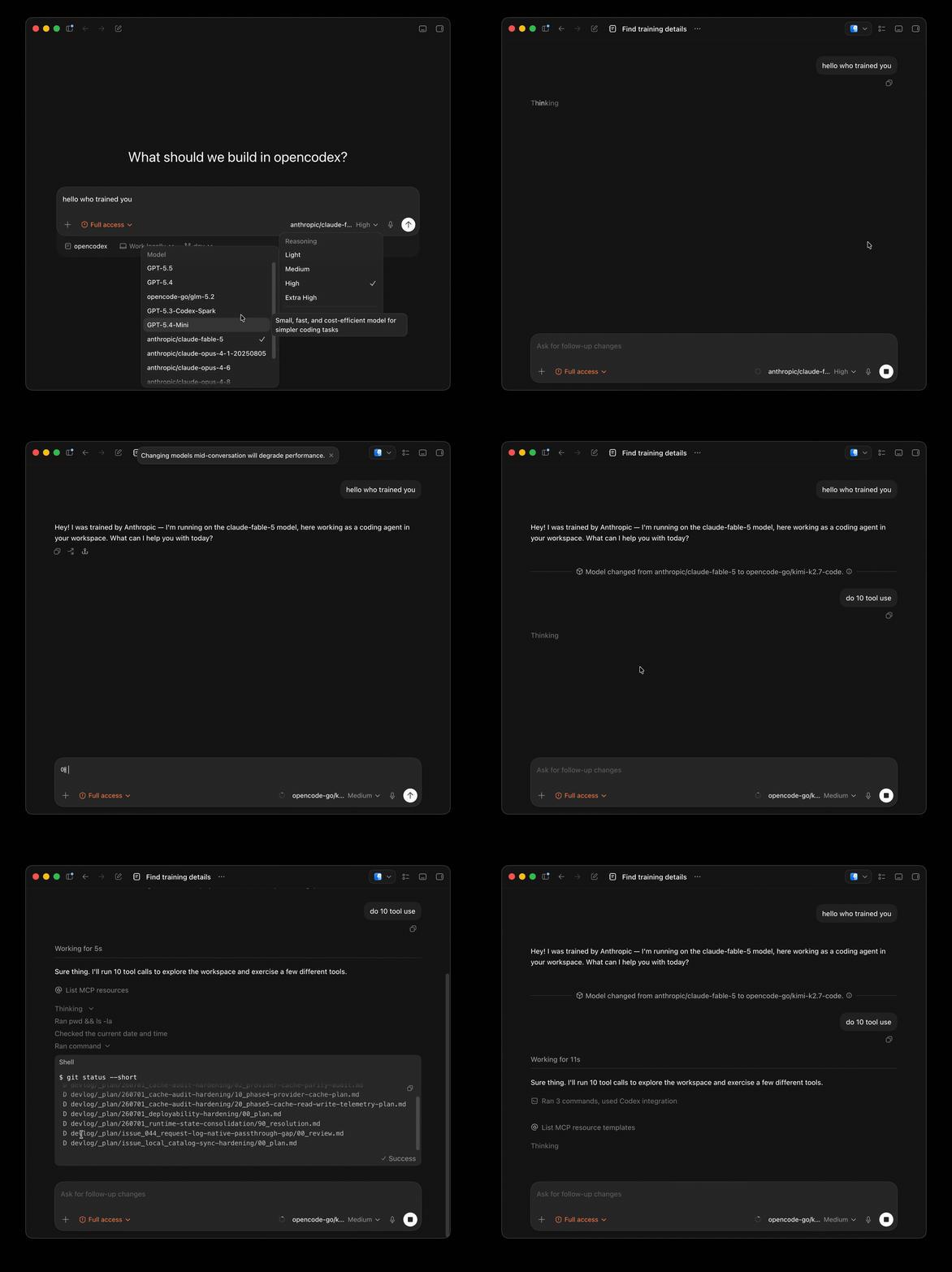
Universal provider proxy for OpenAI Codex & Claude Code — use any LLM (Claude, Gemini, Grok, DeepSeek, Ollama…) with Codex CLI, App, SDK, and Claude Code

Git-native persistent memory for AI coding agents. Implements Google OKF v0.2 with sub-300µs in-memory BM25 search, embedded MCP server, and progressive disclosure. Slashes token bloat by 80% with zero external databases or dependencies. Built in pure Go.

Stop your AI from making things up — it proposes, deterministic tools decide, every claim checked against ground truth with evidence. Grounded facts and context survive resets. Reverse engineering is the proving ground. MCP server + CLI.
x64dbg-MCP Server is a native MCP (Model Context Protocol) plugin for x64dbg that exposes the debugger's full functionality over HTTP. Connect any MCP-compatible AI assistant and control x64dbg programmatically: set breakpoints, step through code, read memory, dump registers, and more. Built with Zig — zero dependencies, single-binary output, cros