
koala73/worldmonitorConnectors
Real-time global intelligence dashboard. AI-powered news aggregation, geopolitical monitoring, and infrastructure tracking in a unified situational awareness interface
86k
BloodHound-MCP connects BloodHound’s Active Directory graph to an MCP client. Instead of writing Cypher by hand, you ask natural-language questions and the server maps them to BloodHound queries and tools.
Builders who use an agent to inspect BloodHound data and Active Directory attack paths.
You can ask for attack paths, privilege issues, and security reports without writing Cypher queries yourself.
Lets you ask questions in plain English and turns them into BloodHound-backed queries.
Includes tools for paths to Domain Admins, privilege escalation, Kerberoasting, AS-REP roasting, and other AD issues.
Can generate security reports from BloodHound data for sharing with stakeholders.
Runs as an MCP server that you point your client at with a Python command and Neo4j connection settings.
git clone https://github.com/your-username/MCP-BloodHound.git
cd MCP-BloodHound
pip install -r requirements.txt

BloodHound-MCP is a powerful integration that brings the capabilities of Model Context Procotol (MCP) Server to BloodHound, the industry-standard tool for Active Directory security analysis. This integration allows you to analyze BloodHound data using natural language, making complex Active Directory attack path analysis accessible to everyone.
🥇 First-Ever BloodHound AI Integration!
This is the first integration that connects BloodHound with AI through MCP, originally announced here.
BloodHound-MCP combines the power of:
With over 75 specialized tools based on the original BloodHound CE Cypher queries, BloodHound-MCP allows security professionals to:
Join our Telegram channel for updates, tips, and discussion:
Clone this repository:
git clone https://github.com/your-username/MCP-BloodHound.git
cd MCP-BloodHound
Install dependencies:
pip install -r requirements.txt
Configure the MCP Server
"mcpServers": {
    "BloodHound-MCP": {
        "command": "python",
        "args": [
            "<Your_Path>\\BloodHound-MCP.py"
        ],
        "env": {
            "BLOODHOUND_URI": "bolt://localhost:7687",
            "BLOODHOUND_USERNAME": "neo4j",
            "BLOODHOUND_PASSWORD": "bloodhoundcommunityedition"
        }
    }
}
Example queries you can ask through the MCP:
This tool is designed for legitimate security assessment purposes. Always:
This project is licensed under the MIT License - see the LICENSE file for details.

Note: This is not an official Anthropic product. BloodHound-MCP is a community-driven integration between BloodHound and MCP.
Sign in to join the discussion.
No comments yet. Be the first to say what this is good for.
Real-time global intelligence dashboard. AI-powered news aggregation, geopolitical monitoring, and infrastructure tracking in a unified situational awareness interface
High-performance code intelligence MCP server. Indexes codebases into a persistent knowledge graph — average repo in milliseconds. 158 languages, sub-ms queries, 99% fewer tokens. Single static binary, zero dependencies.
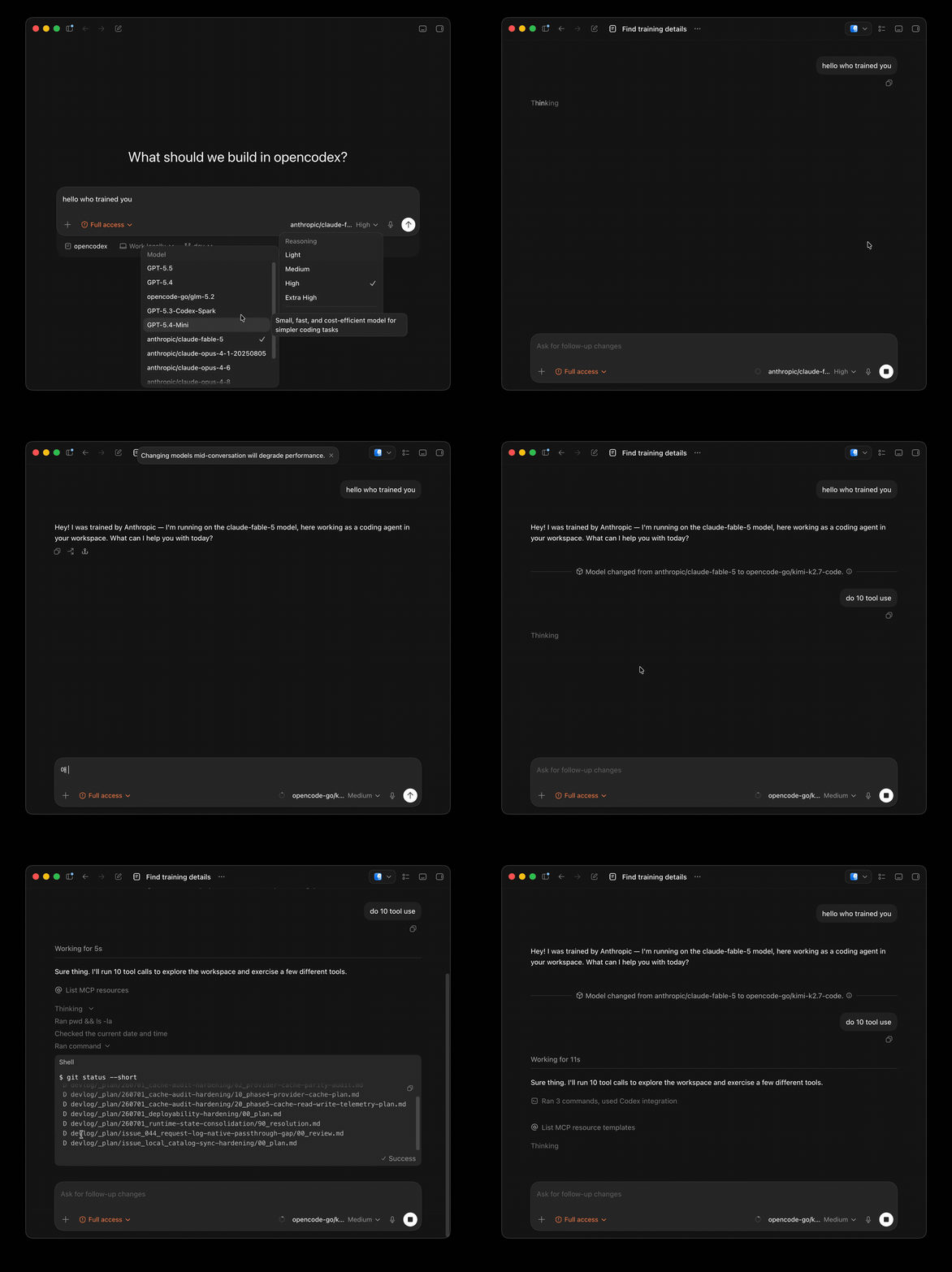
Universal provider proxy for OpenAI Codex & Claude Code — use any LLM (Claude, Gemini, Grok, DeepSeek, Ollama…) with Codex CLI, App, SDK, and Claude Code

Git-native persistent memory for AI coding agents. Implements Google OKF v0.2 with sub-300µs in-memory BM25 search, embedded MCP server, and progressive disclosure. Slashes token bloat by 80% with zero external databases or dependencies. Built in pure Go.

Stop your AI from making things up — it proposes, deterministic tools decide, every claim checked against ground truth with evidence. Grounded facts and context survive resets. Reverse engineering is the proving ground. MCP server + CLI.
x64dbg-MCP Server is a native MCP (Model Context Protocol) plugin for x64dbg that exposes the debugger's full functionality over HTTP. Connect any MCP-compatible AI assistant and control x64dbg programmatically: set breakpoints, step through code, read memory, dump registers, and more. Built with Zig — zero dependencies, single-binary output, cros