

koala73/worldmonitorConnectors
Real-time global intelligence dashboard. AI-powered news aggregation, geopolitical monitoring, and infrastructure tracking in a unified situational awareness interface
86k
This project is an MCP server that connects agent clients to Kagi search and Kagi summarization. It uses session tokens, so you do not need the official API key, and it works over stdio or HTTP.
Builders who want their agent to search the web and summarize URLs through Kagi inside Claude Desktop, Cursor, Windsurf, or another MCP client.
You can add Kagi search and summarization to your agent without wiring up the paid API.
Uses Kagi session tokens instead of an API key.
Accepts multiple tokens and rotates through them for higher throughput.
Applies a 5 requests per second bucket to each token.
Provides `kagi_search_fetch` for web search with Kagi operators like `site:` and `filetype:`.
Provides `kagi_summarizer` for summarizing a URL with selectable summary type and engine.
Runs over stdio by default and can also serve over HTTP.
Detects bad tokens and disables them so remaining tokens keep working.
pip install kagi-session2api-mcp
uvx kagi-session2api-mcp
Search for "Python async tutorial"
Summarize https://example.com/article
kagi-session2api-mcp
kagi-session2api-mcp --http --host 0.0.0.0 --port 8000
Free Kagi Search MCP server — session tokens, no API key needed




Access Kagi search and summarizer via session tokens — completely free. Works with Claude Desktop, Cursor, Windsurf, Cline, Hermes and any MCP-compatible AI coding assistant/agent.
⚠️ EndUser Warning: This project uses Kagi session tokens to access search and summarizer features without the official paid API. This may violate Kagi's Terms of Service. Potential consequences include account suspension or permanent ban. Use at your own risk. The authors assume no liability for any account actions taken by Kagi.
⚠️ Security Warning: Your Kagi session token provides full account access. Treat it like a password. Never share it or commit it to version control.
kagimcpkagi_search_fetch (web search) and kagi_summarizer (URL summarization)site:, lang:, filetype:, etc.)Works with any MCP-compatible client:
stdio or HTTP transportJust paste this prompt to your AI agent:
Install the Kagi Session2API MCP server from https://pypi.org/project/kagi-session2api-mcp/.
Then add it to my MCP:
`uvx kagi-session2api-mcp`
set env KAGI_SESSION_TOKEN to my token (ask me if you don't have it).
If I have multiple tokens, use KAGI_SESSION_TOKENS (comma-separated) instead,
or create a config file at ~/.config/kagi-session2api-mcp/config.toml with:
[kagi]
session_tokens = ["TOKEN_1", "TOKEN_2"]
summarizer_engine = "cecil"
[client]
timeout = 30
max_retries = 2
and set env KAGI_SESSION_CONFIG to that path.
pip install kagi-session2api-mcp
Or with uvx:
uvx kagi-session2api-mcp
{
  "mcpServers": {
    "kagi-session": {
      "command": "uvx",
      "args": ["kagi-session2api-mcp"],
      "env": {
        "KAGI_SESSION_TOKEN": "YOUR_SESSION_TOKEN_HERE"
      }
    }
  }
}
{
  "mcpServers": {
    "kagi-session": {
      "command": "uvx",
      "args": ["kagi-session2api-mcp"],
      "env": {
        "KAGI_SESSION_TOKENS": "TOKEN_1,TOKEN_2,TOKEN_3"
      }
    }
  }
}
Create ~/.config/kagi-session2api-mcp/config.toml:
[kagi]
session_tokens = [
    "YOUR_TOKEN_1_HERE",
    "YOUR_TOKEN_2_HERE",
]

summarizer_engine = "cecil"

[client]
timeout = 30
max_retries = 2
Then configure:
{
  "mcpServers": {
    "kagi-session": {
      "command": "uvx",
      "args": ["kagi-session2api-mcp"],
      "env": {
        "KAGI_SESSION_CONFIG": "/path/to/config.toml"
      }
    }
  }
}
https://kagi.com/search?token={THIS_PART}&q=testkagi_search_fetchSearch the web using Kagi:
Search for "Python async tutorial"
Supports Kagi search operators:
site:github.com - Restrict to domain-site:reddit.com - Exclude domainfiletype:pdf - File type filterintitle:python - Title filterlang:zh - Language filterbefore:2024-01-01 / after:2024-01-01 - Date filters"exact phrase" - Exact matchkagi_summarizerSummarize any URL:
Summarize https://example.com/article
Options:
summary_type: "summary" (prose) or "takeaway" (bullet points)engine: "cecil" (default), "agnes", "daphne", "muriel"target_language: Language code (e.g., "EN")⚠️ The summarizer is experimental — it uses Kagi's internal endpoint which may change.
Stdio (default, for Claude Desktop):
kagi-session2api-mcp
HTTP (for remote access):
kagi-session2api-mcp --http --host 0.0.0.0 --port 8000
MCP Client → FastMCP Server → TokenPool (round-robin) → httpx.AsyncClient → kagi.com
                                ↓
                          TokenBucket (5 req/s per token)
                                ↓
                          Auto-disable expired tokens
| Config | Rate Limit | Effective Rate |
|---|---|---|
| 1 token | 5 req/s | 5 req/s |
| 2 tokens | 5 req/s each | 10 req/s |
| N tokens | 5 req/s each | 5×N req/s |
When a token expires (detected via 401/403 or redirect to login), it is automatically disabled. Remaining tokens continue serving requests.
kagimcp| Aspect | Official kagimcp | kagi-session2api-mcp |
|---|---|---|
| Authentication | API key ($25/1000) | Session token (free) |
| Search endpoint | /api/v0/search | /html/search (HTML scraping) |
| Summarizer | /api/v0/summarize | /mother/summary_labs (internal) |
| Rate limiting | Server-side | Client-side (token bucket) |
api_balance | Returns balance | Always null |
| Cost | Paid | Free (uses existing session) |
Star this repo if you feel it useful, that would help me a lot :)
MIT
Sign in to join the discussion.
No comments yet. Be the first to say what this is good for.
Real-time global intelligence dashboard. AI-powered news aggregation, geopolitical monitoring, and infrastructure tracking in a unified situational awareness interface
High-performance code intelligence MCP server. Indexes codebases into a persistent knowledge graph — average repo in milliseconds. 158 languages, sub-ms queries, 99% fewer tokens. Single static binary, zero dependencies.
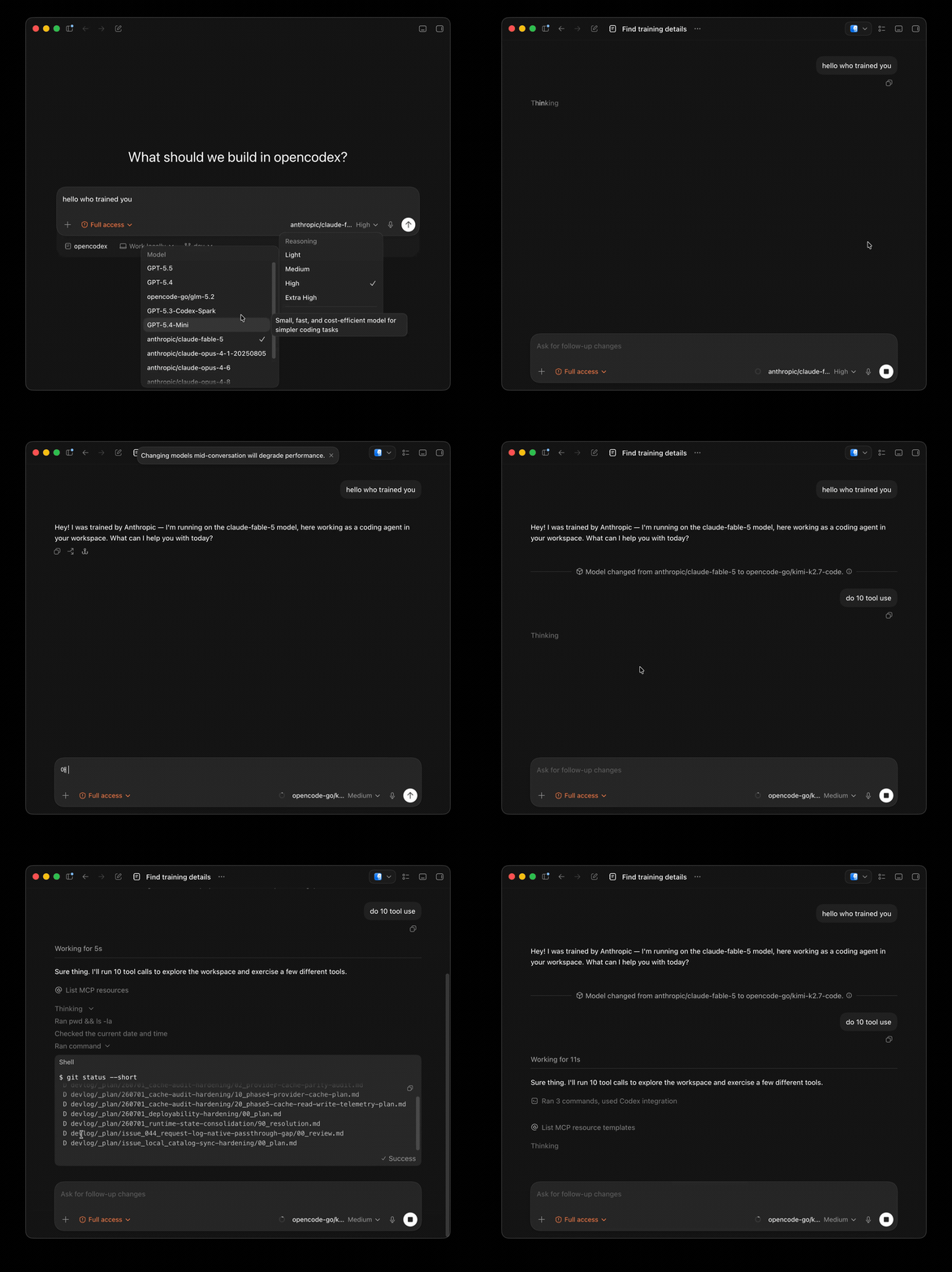
Universal provider proxy for OpenAI Codex & Claude Code — use any LLM (Claude, Gemini, Grok, DeepSeek, Ollama…) with Codex CLI, App, SDK, and Claude Code

Git-native persistent memory for AI coding agents. Implements Google OKF v0.2 with sub-300µs in-memory BM25 search, embedded MCP server, and progressive disclosure. Slashes token bloat by 80% with zero external databases or dependencies. Built in pure Go.

Stop your AI from making things up — it proposes, deterministic tools decide, every claim checked against ground truth with evidence. Grounded facts and context survive resets. Reverse engineering is the proving ground. MCP server + CLI.
x64dbg-MCP Server is a native MCP (Model Context Protocol) plugin for x64dbg that exposes the debugger's full functionality over HTTP. Connect any MCP-compatible AI assistant and control x64dbg programmatically: set breakpoints, step through code, read memory, dump registers, and more. Built with Zig — zero dependencies, single-binary output, cros