
koala73/worldmonitorConnectors
Real-time global intelligence dashboard. AI-powered news aggregation, geopolitical monitoring, and infrastructure tracking in a unified situational awareness interface
86k
Academia MCP connects an agent to research sources and document tools through MCP. It can search arXiv, ACL Anthology, Hugging Face datasets, and Semantic Scholar, then fetch web pages or PDFs, compile LaTeX, and run document QA or proposal helpers when you provide the needed keys.
Builders who want their agent to search papers, read PDFs, and assemble research notes.
You can move from paper search to paper analysis without switching tools or retyping context.
Search arXiv and ACL Anthology, then download arXiv papers for structured reading.
Find Hugging Face datasets and pull citations or references from Semantic Scholar.
Search the web with Exa, Brave, or Tavily and normalize web pages for the agent.
Read PDFs page by page, fetch LaTeX templates, and compile LaTeX into PDF in a workspace.
Run document QA, PDF review, and research proposal helpers when OpenRouter is configured.
Issue, list, and revoke tokens for HTTP transports when authentication is enabled.
pip3 install academia-mcp
uv venv .venv
make install
python -m academia_mcp --transport streamable-http
# OR
uv run -m academia_mcp --transport streamable-http
python -m academia_mcp --transport stdio
# OR
uv run -m academia_mcp --transport stdio




MCP server with tools to search, fetch, analyze, and report on scientific papers and datasets.
pip3 install academia-mcp
uv venv .venv
make install
python -m academia_mcp --transport streamable-http
# OR
uv run -m academia_mcp --transport streamable-http
python -m academia_mcp --transport stdio
# OR
uv run -m academia_mcp --transport stdio
Notes:
stdio, sse, streamable-http.host/port are used for HTTP transports; ignored for stdio. Default port is 5056 (or PORT).Academia MCP supports optional token-based authentication for HTTP transports (streamable-http and sse). Authentication is disabled by default to maintain backward compatibility.
Set the ENABLE_AUTH environment variable to true:
export ENABLE_AUTH=true
export TOKENS_FILE=/path/to/tokens.json  # Optional, defaults to ./tokens.json
Issue a new token:
academia_mcp auth issue-token --client-id=my-client --description="Production API client"

# Issue token with 30-day expiration
academia_mcp auth issue-token --client-id=test-client --expires-days=30

# Issue token with custom scopes
academia_mcp auth issue-token --client-id=admin --scopes="read,write,admin"
List active tokens:
academia_mcp auth list-tokens
Revoke a token:
academia_mcp auth revoke-token mcp_a1b2c3d4e5f6...
Include the token in the Authorization header with the Bearer scheme or as a query parameter apiKey.
Security Notes:
tokens.json file is automatically created with restrictive permissions (mode 600).{
"mcpServers": {
"academia": {
"command": "python3",
"args": [
"-m",
"academia_mcp",
"--transport",
"stdio"
]
}
}
}
arxiv_search: Query arXiv with field-specific queries and filters.arxiv_download: Fetch a paper by ID and convert to structured text (HTML/PDF modes).anthology_search: Search ACL Anthology with fielded queries and optional date filtering.hf_datasets_search: Find Hugging Face datasets with filters and sorting.s2_get_citations: List papers citing a given arXiv paper (Semantic Scholar Graph).s2_get_references: List papers referenced by a given arXiv paper.visit_webpage: Fetch and normalize a web page.web_search: Unified search wrapper; available when at least one of Exa/Brave/Tavily keys is set.exa_web_search, brave_web_search, tavily_web_search: Provider-specific search.get_latex_templates_list, get_latex_template: Enumerate and fetch built-in LaTeX templates.compile_latex: Compile LaTeX to PDF in WORKSPACE_DIR.read_pdf: Extract text per page from a PDF.download_pdf_paper, review_pdf_paper: Download and optionally review PDFs (requires LLM + workspace).document_qa: Answer questions over provided document chunks (requires LLM).extract_bitflip_info, generate_research_proposals, score_research_proposals: Research proposal helpers (requires LLM).Availability notes:
WORKSPACE_DIR to enable compile_latex, read_pdf, download_pdf_paper, and review_pdf_paper.OPENROUTER_API_KEY to enable LLM tools (document_qa, review_pdf_paper, and bitflip tools).EXA_API_KEY, BRAVE_API_KEY, TAVILY_API_KEY to enable web_search and provider tools.Set as needed, depending on which tools you use:
OPENROUTER_API_KEY: required for LLM-related tools.BASE_URL: override OpenRouter base URL.DOCUMENT_QA_MODEL_NAME: override default model for document_qa.BITFLIP_MODEL_NAME: override default model for bitflip tools.TAVILY_API_KEY: enables Tavily in web_search.EXA_API_KEY: enables Exa in web_search and visit_webpage.BRAVE_API_KEY: enables Brave in web_search.WORKSPACE_DIR: directory for generated files (PDFs, temp artifacts).PORT: HTTP port (default 5056).You can put these in a .env file in the project root.
Build the image:
docker build -t academia_mcp .
Run the server (HTTP):
docker run --rm -p 5056:5056 \
  -e PORT=5056 \
  -e OPENROUTER_API_KEY=your_key_here \
  -e WORKSPACE_DIR=/workspace \
  -v "$PWD/workdir:/workspace" \
  academia_mcp
Or use existing image: phoenix120/academia_mcp
make install: install the package in editable mode with uvmake validate: run black, flake8, and mypy (strict)make test: run the test suite with pytestmake publish: build and publish using uvOnly needed for LaTeX/PDF tools. Ensure a LaTeX distribution is installed and pdflatex is on PATH, as well as latexmk. On Debian/Ubuntu:
sudo apt install texlive-latex-base texlive-fonts-recommended texlive-latex-extra texlive-science latexmk
Sign in to join the discussion.
No comments yet. Be the first to say what this is good for.
Real-time global intelligence dashboard. AI-powered news aggregation, geopolitical monitoring, and infrastructure tracking in a unified situational awareness interface
High-performance code intelligence MCP server. Indexes codebases into a persistent knowledge graph — average repo in milliseconds. 158 languages, sub-ms queries, 99% fewer tokens. Single static binary, zero dependencies.
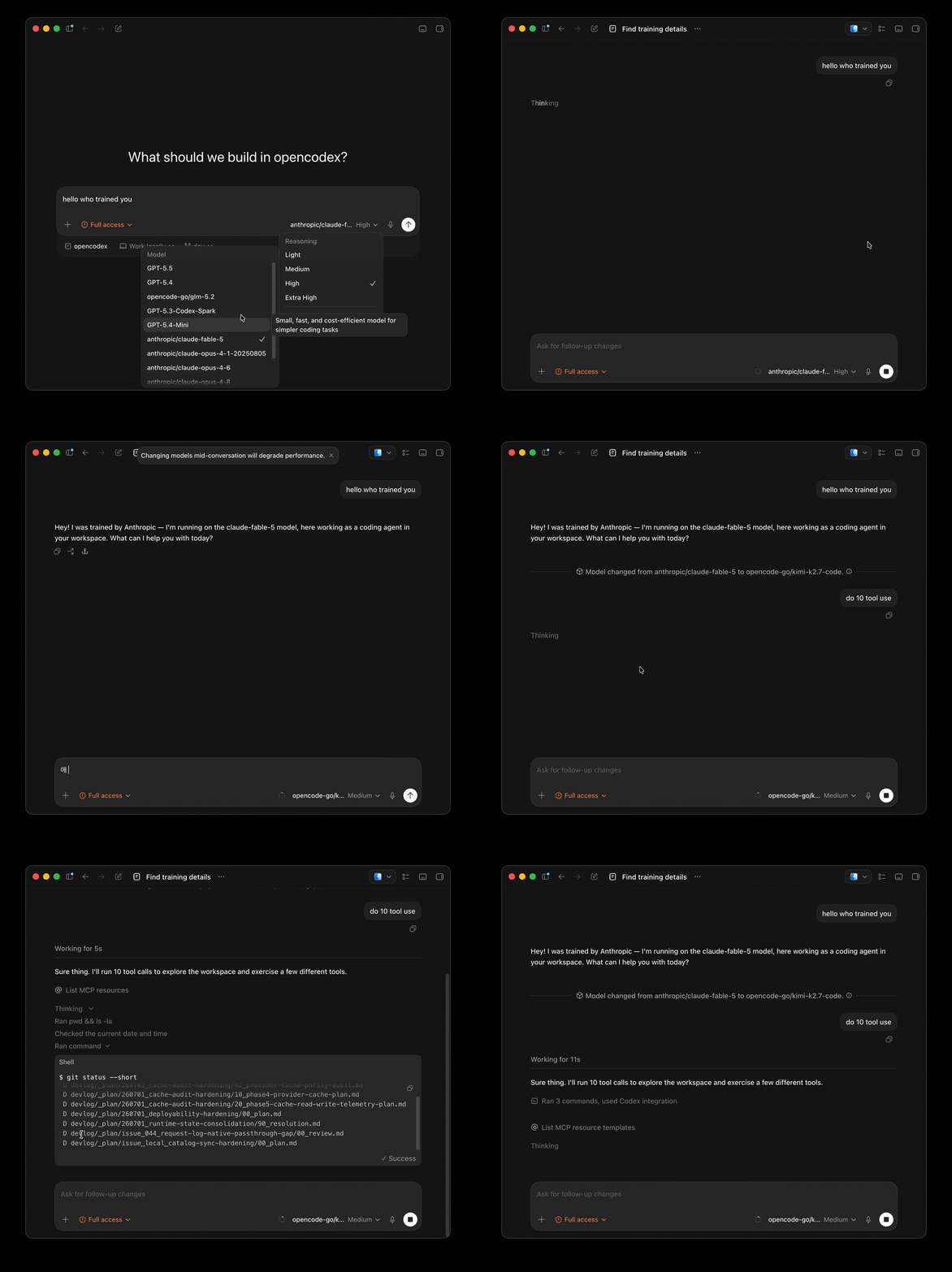
Universal provider proxy for OpenAI Codex & Claude Code — use any LLM (Claude, Gemini, Grok, DeepSeek, Ollama…) with Codex CLI, App, SDK, and Claude Code

Git-native persistent memory for AI coding agents. Implements Google OKF v0.2 with sub-300µs in-memory BM25 search, embedded MCP server, and progressive disclosure. Slashes token bloat by 80% with zero external databases or dependencies. Built in pure Go.

Stop your AI from making things up — it proposes, deterministic tools decide, every claim checked against ground truth with evidence. Grounded facts and context survive resets. Reverse engineering is the proving ground. MCP server + CLI.
x64dbg-MCP Server is a native MCP (Model Context Protocol) plugin for x64dbg that exposes the debugger's full functionality over HTTP. Connect any MCP-compatible AI assistant and control x64dbg programmatically: set breakpoints, step through code, read memory, dump registers, and more. Built with Zig — zero dependencies, single-binary output, cros