


heygen-com/hyperframesFrameworks & SDKs
Write HTML. Render video. Built for agents.
49k
SkillX is a Python framework for building reusable skill libraries from agent trajectories. It takes successful runs, extracts structured skills, merges and filters them, and can expand coverage by exploring tools and synthesizing new tasks.
Builders who want their agents to remember useful tool-use patterns and transfer them across tasks and environments.
You can turn past agent runs into a reusable skill library instead of relying on raw trajectories or one-off prompts.
Extracts planning, functional, and atomic skills from successful trajectories.
Clusters similar skills, filters low-quality ones, and updates the library over time.
Finds underused or failure-prone tools, explores the environment, and adds new skills from the results.
Builds a skill library that can be injected into different base agents without retraining.
Uses prompt templates and schema files to format skills, trajectories, and tool data.



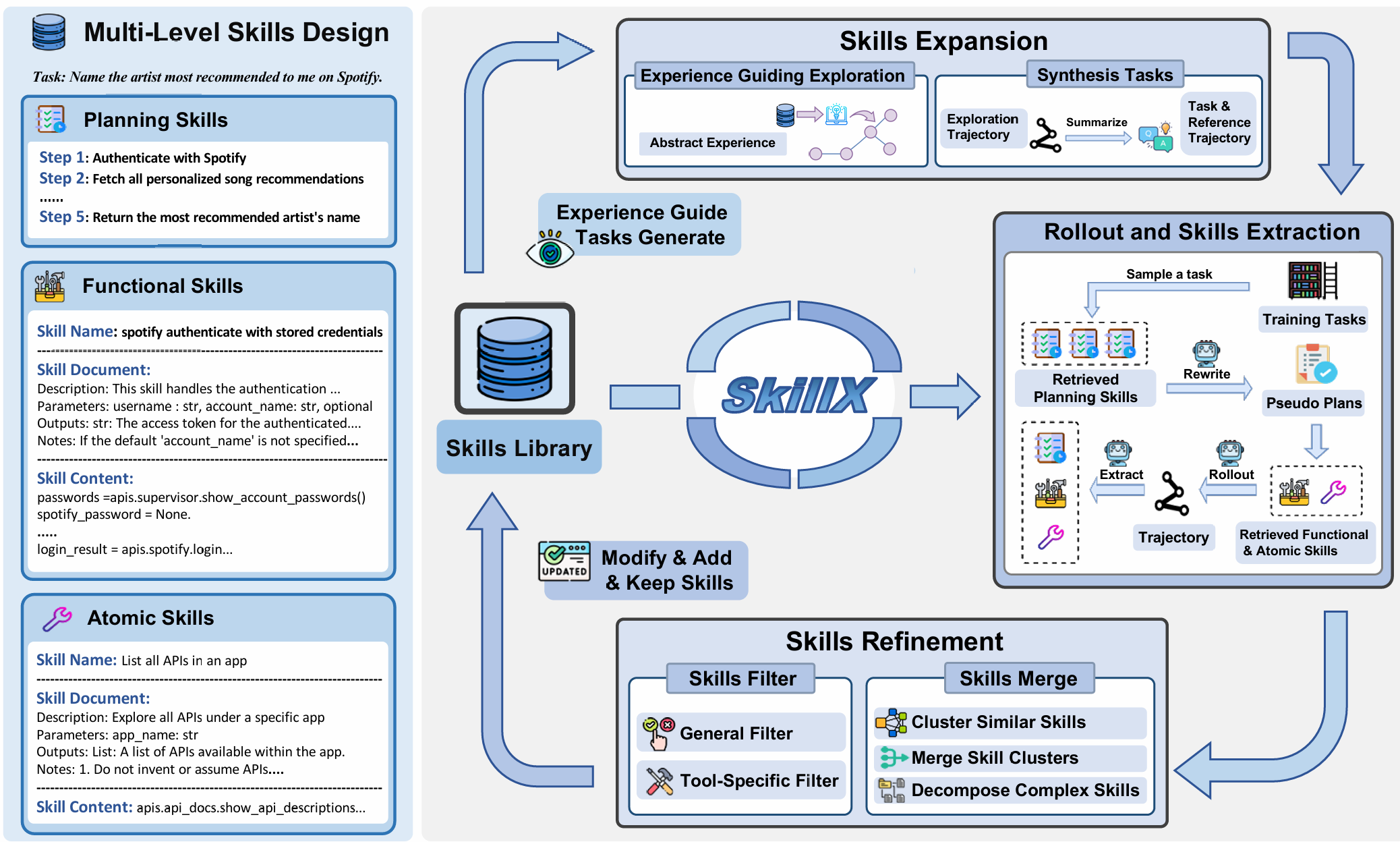
SkillX is a fully automated framework that constructs a reusable, plug-and-play skill knowledge base for LLM agents from experience.
Instead of storing raw trajectories, workflows, or loosely structured reflections, SkillX distills agent experience into a three-level skill hierarchy:
Built with a strong backbone agent, SkillX produces a transferable skill library that can be directly plugged into weaker base agents and new environments. Across challenging long-horizon, user-interactive benchmarks such as AppWorld, BFCL-v3, and τ2-Bench, SkillX consistently improves both task success and execution efficiency.
SkillX expects trajectories in the following schema:
{
  "trajectory_id": "traj_001",
  "task_id": "task_001",
  "user_task": "How many songs are in my Spotify library?",
  "task_history": [
    {"role": "system", "content": "You are a helpful assistant..."},
    {"role": "assistant", "content": "I'll help you count..."},
    {"role": "user", "content": "Output:\n```\n{\"songs\": 150}\n```"}
  ],
  "reward": 1.0,
  "metadata": {}
}
SkillX transforms raw trajectories into a structured three-tier skill space:
SkillX provides an end-to-end automated pipeline that:
SkillX continuously improves the skill library through:
Beyond seed demonstrations, SkillX proactively discovers new skills by:
The resulting skill library can be directly injected into different base agents, enabling strong-to-weak transfer without retraining the underlying model.
SkillX consistently improves:
Existing experience-learning methods often suffer from:
SkillX addresses these issues by building a structured skill knowledge base that is:
SkillX consists of three core components:
From successful trajectories, SkillX automatically extracts:
SkillX improves library quality through:
SkillX expands beyond observed demonstrations by:
SkillX improves agentic performance across multiple LLM backbones and benchmarks.
SkillX outperforms strong experience-learning baselines such as:
This shows that how experience is represented matters as much as, or more than, where it comes from.
Compared with prior experience formats:
In contrast, SkillX offers:
SkillX is especially useful for:
A realistic ecosystem of apps and APIs for long-horizon agent execution.
A challenging benchmark for multi-turn function calling and tool use.
A user-interactive benchmark focused on conversational tool-using agents.
We will publicly release:
We deeply appreciate the invaluable effort contributed by our dedicated team of developers, supportive users, and esteemed industry partners: Ant Digital Technologies, Ant Group. This repository builds upon code from ReMe and AgentEvolver. The baseline implementations are adapted from A-MEM, AWM, and Expel. We sincerely thank all contributors for their outstanding work!
If you find this work helpful, please consider citing:
@article{wang2026skillx,
  author     = {Chenxi Wang and
                Zhuoyun Yu and
                Xin Xie and
                Wuguannan Yao and
                Runnan Fang and
                Shuofei Qiao and
                Kexin Cao and
                Guozhou Zheng and
                Xiang Qi and
                Peng Zhang and
                Shumin Deng},
  title      = {SkillX: Automatically Constructing Skill Knowledge Bases for Agents},
  year       = {2026},
  eprint     = {2604.04804},
  archivePrefix = {arXiv},
  primaryClass = {cs.CL},
  url        = {https://arxiv.org/abs/2604.04804}
}
Sign in to join the discussion.
No comments yet. Be the first to say what this is good for.
Write HTML. Render video. Built for agents.
Ultra-lightweight, open-source, self-hosted personal AI agent framework in Python with WebUI, tools, memory, MCP, multi-agent workflows, automation, and chat apps

SkillOpt is a text-space optimizer that trains reusable natural-language skills for frozen LLM agents through trajectory-driven edits, validation-gated updates, and deployable best_skill.md artifacts.
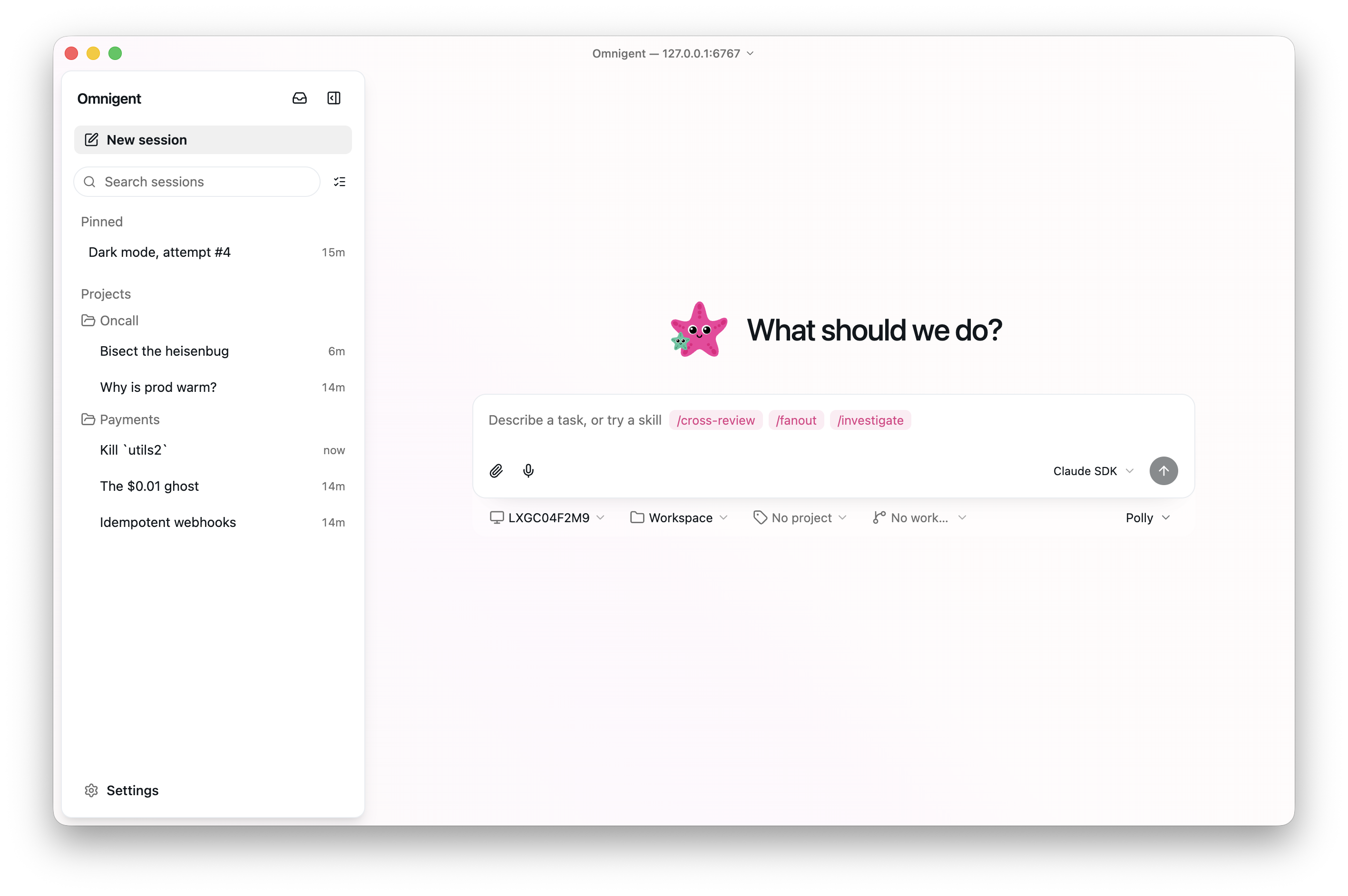
Omnigent is an open-source AI agent framework and meta-harness: orchestrate Claude Code, Codex, Cursor, Pi, and custom agents — swap harnesses without rewriting, enforce policies and sandboxing, and collaborate in real time from any device.

A theoretical reconstruction of the Claude Mythos architecture, built from first principles using the available research literature.
🕷️ An adaptive Web Scraping framework that handles everything from a single request to a full-scale crawl!