
koala73/worldmonitorConnectors
Real-time global intelligence dashboard. AI-powered news aggregation, geopolitical monitoring, and infrastructure tracking in a unified situational awareness interface
86k
Zapier Connectors packages app actions so agents can call them as skills, MCP tools, or TypeScript modules. It is built to run in compatible clients, in MCP servers, or inside Zapier, with support for user-held credentials when you do not want Zapier auth.
Builders who want their agent to work across the apps they already use instead of staying inside chat.
You can let your agent read, write, and act in external apps without building a one-off integration each time.
Each connector includes a `SKILL.md` shape that compatible clients can install and use.
Each connector is also shaped as an MCP `Tool`, so it can be registered in any MCP server.
You can import a connector package and call `scripts.<name>.run(...)` or named script exports in your own Node code.
You can run a script from stdin or argv with `npx @zapier/notion-connector run <script>` and pass auth with `--connection`.
The bundled CLI can expose all scripts over stdio with `npx @zapier/notion-connector mcp`.
Connectors support Zapier-managed connections or direct credentials through declared connection resolvers.
git clone --filter=blob:none --sparse https://github.com/zapier/connectors.git
cd connectors
git sparse-checkout set apps/notion apps/trello   # only the connectors you need

[!NOTE] Status: prototype. First-cohort connectors are being written to validate the artifact shape against eval, installation and consumption from various agent harnesses. Treat nothing here as a stable contract. Pre-1.0 (
0.x): breaking changes ship as a minor bump, features and fixes as a patch. Pin with a caret (^0.x.y) so you don't pick up a breaking minor automatically. Licensed under the Elastic License 2.0.
A growing catalog of agent-callable tools for the 9k+ apps Zapier integrates with. Each tool is simultaneously an agentskills.io-compliant skill artifact and an MCP Tool-shaped TypeScript module. The combined shape is the contribution: neither standard defines it alone.
The catalog is designed to run anywhere:
tools/listconnectionResolversA connector is one folder, many surfaces — there are four ways to reach for it:
SKILL.md and either (a) executes the connector's scripts directly when a task calls for it, or (b) uses the scripts + references/ as recipes when generating code..run(input, opts); the default import adds the structured object (scripts, connectionResolvers) for direct in-process calls. Pass auth as one [<resolver>:]<value> string: { connection: "env:NOTION_TOKEN" } (or { connections: { <slot>: ... } } for multi-slot scripts).echo '{...}' | npx @zapier/notion-connector run <script> parses JSON on stdin/argv and prints the upstream API response. Cron, GitHub Actions, Terraform, anything that shells out.npx @zapier/notion-connector mcp exposes every script as a native MCP tool over stdio, and the connector's SKILL.md + references/*.md as MCP resources, no consumer code required.Each connector documents its own scripts, auth modes, and setup in its own README.md (e.g. apps/notion/README.md).
import notion from "@zapier/notion-connector";

const result = await notion.scripts.search.run(
  { query: "Q4 planning" },
  { connection: "env:NOTION_TOKEN" },
);

// Or import one script's run function when you already know the name:
import { search } from "@zapier/notion-connector";
await search({ query: "Q4 planning" }, { connection: "env:NOTION_TOKEN" });
Auth is one [<resolver>:]<value> connection string per slot — env:NOTION_TOKEN reads the token from process.env.NOTION_TOKEN, zapier:<connection-id> routes through Zapier-managed auth, and a bare value is claimed by the first matching resolver.
This is what way 1 does under the hood, and — swapping node <script> for npx @zapier/notion-connector run <script> — also what way 3 (the CLI) does from the published package. Each script takes JSON on stdin or argv[1] and resolves auth from a --connection [<resolver>:]<value> flag against the connector's resolvers. The connection value is a selector (an env-var name or a connection id), not the secret itself, so it's safe to pass on argv; the env: resolver still reads the actual token from the named environment variable. Auth via a Zapier connection is the recommended path; direct mode is the fallback for callers who don't want a Zapier dep:
# With Zapier — Zapier connection UUID, auth handled by Zapier (recommended)
# Find a connection UUID with: zapier-sdk list-connections notion
echo '{"query":"foo"}' | node apps/notion/scripts/search.ts --connection zapier:<connection-id>

# Direct mode — your own 3P credentials (no Zapier needed); the token stays in env
echo '{"query":"foo"}' | NOTION_TOKEN=secret_xxx node apps/notion/scripts/search.ts --connection env:NOTION_TOKEN

# The `<resolver>:` prefix is optional — a bare value goes to the first resolver
# that claims it (a UUID → `zapier`, a set env-var name → `env`):
echo '{"query":"foo"}' | node apps/notion/scripts/search.ts --connection <connection-id>

# From the published package, `node <script>` becomes the bundled CLI (way 3) —
# same stdin/argv + `--connection` contract, no checkout needed:
echo '{"query":"foo"}' | npx @zapier/notion-connector run search --connection env:NOTION_TOKEN

# Run with `--help` to see each script's input schema and available resolvers:
node apps/notion/scripts/search.ts --help
The connector's SKILL.md describes the trade-offs between the two modes (setup steps, where the third-party credential lives, how revocation works).
Node (22.18+) runs the TypeScript directly — npm install the connector's deps first. Bun works too and auto-installs deps on first run.
You don't need to clone the source code for a connector to use it; various options for installing and/or using a connector directly are explained above. However, if you do want the actual source instead — to read a script's code, browse references/, run a connector's tests, or hack on it — clone with a path filter so you only fetch the apps/<slug> folders you care about, not the whole catalog:
git clone --filter=blob:none --sparse https://github.com/zapier/connectors.git
cd connectors
git sparse-checkout set apps/notion apps/trello   # only the connectors you need
Each apps/<slug> is standalone-installable — no root npm install or workspace bootstrap is required. Just cd apps/<slug> && npm install.
Sign in to join the discussion.
No comments yet. Be the first to say what this is good for.
Real-time global intelligence dashboard. AI-powered news aggregation, geopolitical monitoring, and infrastructure tracking in a unified situational awareness interface
High-performance code intelligence MCP server. Indexes codebases into a persistent knowledge graph — average repo in milliseconds. 158 languages, sub-ms queries, 99% fewer tokens. Single static binary, zero dependencies.
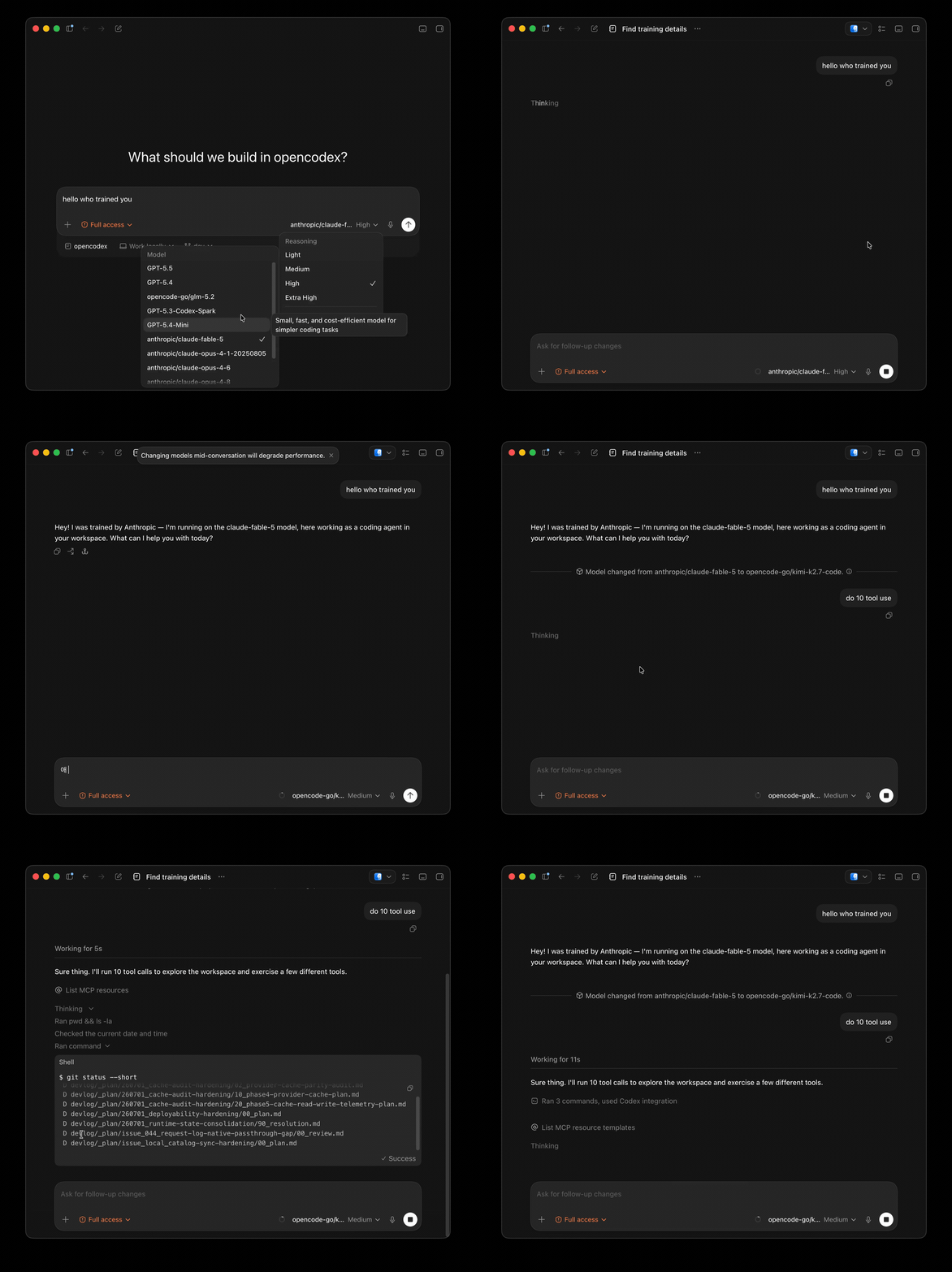
Universal provider proxy for OpenAI Codex & Claude Code — use any LLM (Claude, Gemini, Grok, DeepSeek, Ollama…) with Codex CLI, App, SDK, and Claude Code

Git-native persistent memory for AI coding agents. Implements Google OKF v0.2 with sub-300µs in-memory BM25 search, embedded MCP server, and progressive disclosure. Slashes token bloat by 80% with zero external databases or dependencies. Built in pure Go.

Local-first code intelligence graph for MCP and CLI. Builds a persistent map of your codebase so AI coding tools read only what matters, with benchmarked context reductions on reviews and large-repo workflows.

Stop your AI from making things up — it proposes, deterministic tools decide, every claim checked against ground truth with evidence. Grounded facts and context survive resets. Reverse engineering is the proving ground. MCP server + CLI.