

koala73/worldmonitorConnectors
Real-time global intelligence dashboard. AI-powered news aggregation, geopolitical monitoring, and infrastructure tracking in a unified situational awareness interface
86k
`flac-mcp` exposes FLAC documentation and execution tools over the Model Context Protocol. The server runs with `uvx flac-mcp`, and a small bridge started inside FLAC connects the live application to your agent.

Builders who want their agent to query FLAC docs, run simulations, and inspect task status from chat.
You can ask an agent to explore FLAC commands, execute code, and monitor long-running runs without leaving the conversation.
Browse and search FLAC commands, Python API docs, and reference material without needing the bridge.
Use an interactive REPL, submit tasks, watch progress, interrupt running jobs, and review task history.
Switch between FLAC 6.0, 7.0, and 9.0 docs with the `version` parameter.
A bootstrap guide in `docs/agentic/flac-mcp-bootstrap.md` walks an agent through configuration.
`addon.py` starts the bridge from the FLAC IPython console or GUI.
Fetch and follow this bootstrap guide end-to-end:
https://raw.githubusercontent.com/yusong652/flac-mcp/main/docs/agentic/flac-mcp-bootstrap.md
[!WARNING]
flac-mcpis deprecated and frozen. It is superseded byitasca-mcp— a single multi-engine MCP server covering FLAC, PFC, 3DEC, MPoint, and MassFlow. Update your MCP client config fromuvx flac-mcptouvx itasca-mcp(select FLAC docs via thesoftwareparameter). No further releases are planned here.


flac3d>model new ;now, with LLM.
flac-mcp connects AI agents to ITASCA FLAC through the Model Context Protocol — browse documentation, run simulations, and execute code, all through natural conversation.
flac3d>model solve ;LLM solves.
5 documentation tools — browse and search FLAC commands, Python API, and reference docs. No bridge required.
5 execution tools — interactive REPL, task submission, progress monitoring, interruption, and history. Requires bridge.
uvx)Copy this to your AI agent and let it self-configure:
Fetch and follow this bootstrap guide end-to-end:
https://raw.githubusercontent.com/yusong652/flac-mcp/main/docs/agentic/flac-mcp-bootstrap.md
1. Register the MCP server in your client config:
{
  "mcpServers": {
    "flac-mcp": {
      "command": "uvx",
      "args": ["flac-mcp"]
    }
  }
}
2. Start the bridge from inside FLAC:
Download addon.py, then use either of these two flows inside FLAC:
Restart your AI agent (Claude Code, Codex CLI, Gemini CLI, etc.) and ask it to call flac_execute_code to verify the connection.
Once first-time setup is done, each new FLAC session only needs the bridge re-started — run this in FLAC's IPython console and you're back online:
import itasca_mcp_bridge
itasca_mcp_bridge.start()
start() checks PyPI for a newer bridge release and self-upgrades before starting. The MCP client config persists.
version parameterSee Troubleshooting in the bootstrap guide.
See Developer Guide: Install and Run from Source.
PRs and issues are welcome! See the Developer Guide to get started.
MIT - see LICENSE.
Sign in to join the discussion.
No comments yet. Be the first to say what this is good for.
Real-time global intelligence dashboard. AI-powered news aggregation, geopolitical monitoring, and infrastructure tracking in a unified situational awareness interface
High-performance code intelligence MCP server. Indexes codebases into a persistent knowledge graph — average repo in milliseconds. 158 languages, sub-ms queries, 99% fewer tokens. Single static binary, zero dependencies.
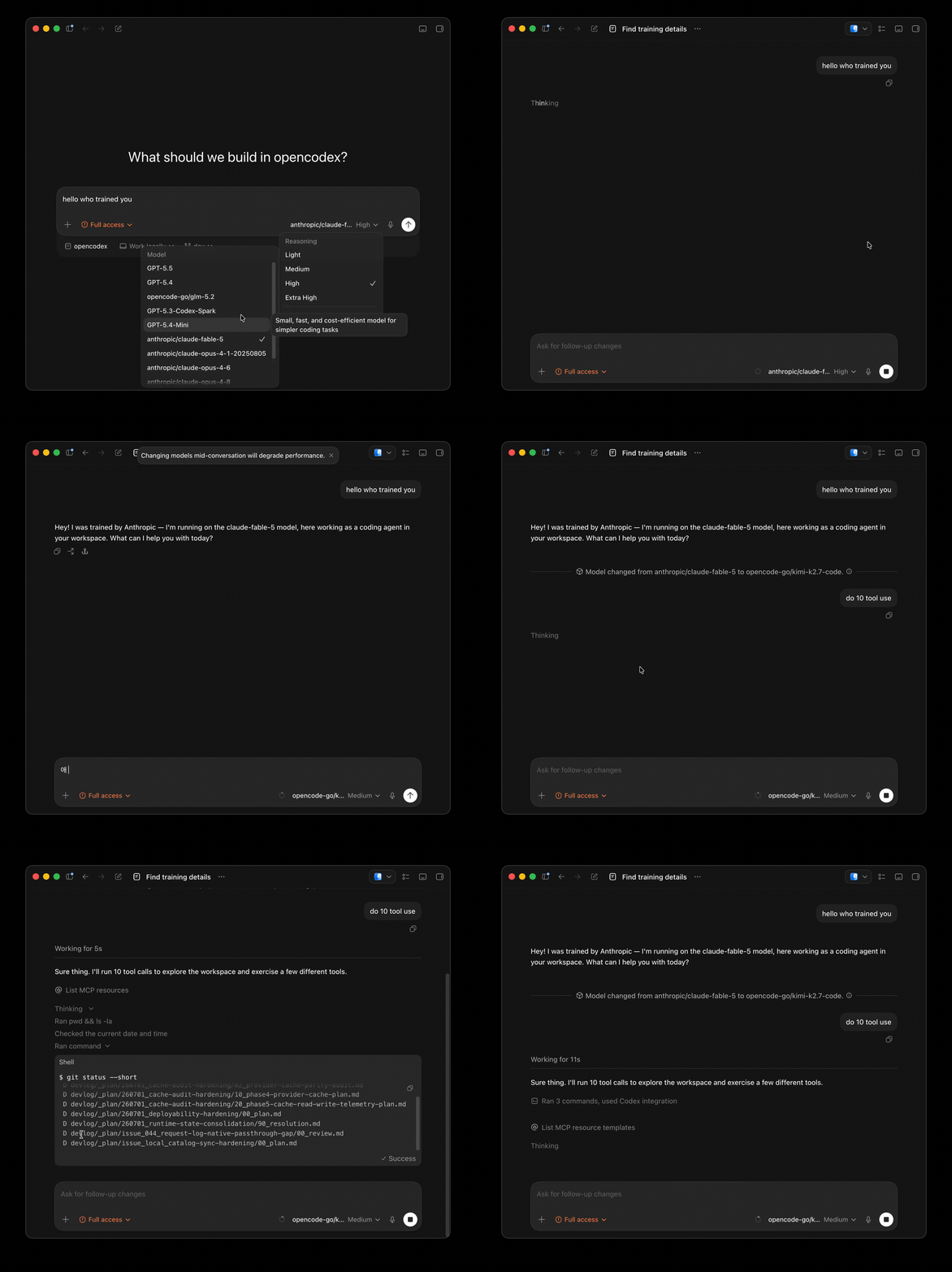
Universal provider proxy for OpenAI Codex & Claude Code — use any LLM (Claude, Gemini, Grok, DeepSeek, Ollama…) with Codex CLI, App, SDK, and Claude Code

Git-native persistent memory for AI coding agents. Implements Google OKF v0.2 with sub-300µs in-memory BM25 search, embedded MCP server, and progressive disclosure. Slashes token bloat by 80% with zero external databases or dependencies. Built in pure Go.

Local-first code intelligence graph for MCP and CLI. Builds a persistent map of your codebase so AI coding tools read only what matters, with benchmarked context reductions on reviews and large-repo workflows.

Stop your AI from making things up — it proposes, deterministic tools decide, every claim checked against ground truth with evidence. Grounded facts and context survive resets. Reverse engineering is the proving ground. MCP server + CLI.