

koala73/worldmonitorConnectors
Real-time global intelligence dashboard. AI-powered news aggregation, geopolitical monitoring, and infrastructure tracking in a unified situational awareness interface
86k
Matryoshka gives agents a way to query large documents through an MCP server instead of copying whole files into context. It loads documents, runs symbolic commands, and returns compact handles that you can expand only when needed.
Builders who want their agent to analyze long documents, logs, or code without burning context on full file reads.
You can inspect much larger documents while keeping the agent’s context focused on small, reusable handles.
Loads a document and lets the agent run Nucleus commands like `grep`, `filter`, `count`, and `sum` against it.
Stores large outputs server-side in SQLite and returns short stub handles instead of full arrays or blobs.
Supports `rlm_query` and `rlm_batch` for nested reasoning over parts of a document.
Lets the agent save and later expand arbitrary context with `lattice_memo` and `lattice_expand`.
Uses tree-sitter to list symbols, find references, and inspect code structure in supported languages.
Includes setup docs and scripts for Claude Code integration.
pnpm add -g matryoshka-rlm
npx matryoshka-rlm "How many ERROR entries are there?" ./server.log
git clone https://github.com/yogthos/Matryoshka.git
cd Matryoshka
pnpm install
pnpm run build
# Basic usage
rlm "How many ERROR entries are there?" ./server.log

# With options
rlm "Count all ERROR entries" ./server.log --max-turns 15 --verbose

# See all options
rlm --help
1. lattice_memo(content="<file summary>", label="auth module")  → $memo_auth_module stub
2. lattice_memo(content="<analysis>", label="perf bottlenecks") → $memo_perf_bottlenecks stub
3. # ... many turns later, need the auth context ...
4. lattice_expand("$memo_auth_module")                          → Full summary
5. lattice_memo_delete("$memo_auth_module")                     → Drop when stale
Process documents 100x larger than your LLM's context window—without vector databases or chunking heuristics.
LLMs have fixed context windows. Traditional solutions (RAG, chunking) lose information or miss connections across chunks. RLM takes a different approach: the model reasons about your query and outputs symbolic commands that a logic engine executes against the document.
Based on the Recursive Language Models paper.
Unlike traditional approaches where an LLM writes arbitrary code, RLM uses Nucleus—a constrained symbolic language based on S-expressions. The LLM outputs Nucleus commands, which are parsed, type-checked, and executed by Lattice, our logic engine.
┌─────────────────┐     ┌─────────────────┐     ┌─────────────────┐
│   User Query    │────▶│   LLM Reasons   │────▶│ Nucleus Command │
│ "total sales?"  │     │  about intent   │     │  (sum RESULTS)  │
└─────────────────┘     └─────────────────┘     └────────┬────────┘
                                                         │
┌─────────────────┐     ┌─────────────────┐     ┌────────▼────────┐
│  Final Answer   │◀────│ Lattice Engine  │◀────│     Parser      │
│   13,000,000    │     │    Executes     │     │    Validates    │
└─────────────────┘     └─────────────────┘     └─────────────────┘
Why this works better than code generation:
The LLM outputs commands in the Nucleus DSL—an S-expression language designed for document analysis:
; Search for patterns
(grep "ERROR")

; Filter results
(filter RESULTS (lambda x (match x "timeout" 0)))

; Aggregate
(sum RESULTS)    ; Auto-extracts numbers from lines
(count RESULTS)  ; Count matching items

; Final answer
<<<FINAL>>>13000000<<<END>>>
Matryoshka has two execution paths and not every primitive works in both:
| Feature | runRLM (CLI / programmatic) | lattice-mcp (MCP server) |
|---|---|---|
(grep …), (filter …), (map …), etc. | ✅ | ✅ |
(llm_query …), (llm_batch …) | ✅ | ✅ via MCP sampling protocol |
(rlm_query …), (rlm_batch …) | ✅ (concurrent rlm_batch) | ✅ — child Nucleus session spawns via the same MCP sampling bridge; M suspensions per rlm_query call. rlm_batch runs sequentially (children one at a time) because the multi-turn suspension protocol only carries one pending request at a time — concurrent children would lose suspensions. Round-trip count is the same; wall-clock is N×slower for non-sampling clients. |
(context N) selector | ✅ (multi-doc via runRLMFromContent(query, string[])) | partial — (context 0) works; multi-doc loading not exposed via lattice_load |
(grep "X" haystack) | ✅ | ✅ |
(show_vars) | ✅ | ✅ (internal _<name> bindings filtered out) |
FINAL_VAR(name) resolution | ✅ | N/A — MCP returns query results directly |
maxTimeoutMs / maxChars / maxErrors | ✅ | ❌ — MCP has its own session timeout |
compactionThresholdChars | ✅ | ❌ — MCP doesn't have a multi-turn FSM history |
The resource-limit features remain runRLM-only. The recursive primitives (rlm_query/rlm_batch) work in both paths — the MCP path spawns a child runRLMFromContent whose llmClient is the same sampling bridge as the parent, so each child turn flows through the existing MCP suspension/sampling protocol.
rlm_query spawns a child Nucleus session with its own FSM loop. The child runs to FINAL and returns a string — useful when a sub-task needs multi-turn reasoning over a structured handle:
; Child sees the resolved handle as its working document, NOT a
; JSON-stringified prompt blob. Lets the child use grep/lines/
; chunk_by_lines over arrays without JSON-syntax noise.
(rlm_query "extract dates" (context RESULTS))

; No (context …) → child's document is the prompt itself.
(rlm_query "summarize each error type")
rlm_batch runs the same per-item recursion across a collection. Each item produces one entry in the returned array, in input order. Per-item failures surface as "Error: rlm_batch item N failed — …" strings without aborting the rest of the batch:
(rlm_batch (chunk_by_lines 100)
  (lambda c (rlm_query "extract metrics" (context c))))
runRLM: children fan out concurrently via a worker pool capped at maxConcurrentSubcalls (default 4).lattice-mcp: children run sequentially because the multi-turn suspension protocol can carry only one pending request at a time. Round-trip count is identical to the concurrent path (N children × M turns each); only wall-clock differs.Pass string[] to runRLMFromContent to load multiple documents. Address them via (context N); index 0 is the default for primitives that don't specify a haystack:
(grep "DEPLOY" (context 0))   ; deploy.log
(grep "OUTAGE" (context 2))   ; comms.log

; (context N) is just a term — pipe it anywhere a string is expected
(rlm_query "scan" (context (context 1)))   ; child sees doc 1
Per-doc line numbers come back, so the LLM can cite "doc 0 line 4, doc 2 line 2" with confidence rather than inventing absolute offsets across a concatenation.
(show_vars)   ; Returns a string summary of every binding currently
              ; in scope. Useful before a (filter RESULTS …) or a
              ; FINAL_VAR(name) reference when the LLM lost track of
              ; what's bound. Same surface as the `lattice_bindings`
              ; MCP tool but reachable from inside a query.
Unknown FINAL_VAR markers surface a clear error rather than passing the literal text through:
<<<FINAL>>>FINAL_VAR(_99)<<<END>>>
→ "[FINAL_VAR error: unknown binding "_99". Available: _1, RESULTS]"
All optional. With none set, behavior is unchanged:
runRLM(query, file, {
  maxTimeoutMs: 30_000,    // wall-clock cap, propagates to children
  maxChars: 100_000,       // cumulative chars sent + received
  maxErrors: 5,            // consecutive parse/execution errors
  compactionThresholdChars: 50_000,  // summarize history when prompt grows past this
})
When a limit hits, the run terminates cleanly with a string of the form:
[aborted: timeout 32100ms of 30000ms]

Best partial answer:
<the most recent meaningful solver result>
The partial answer is always preserved when present — completed work is never silently lost on abort.
The Lattice engine (src/logic/) processes Nucleus commands:
lc-parser.ts) - Parses S-expressions into an ASTtype-inference.ts) - Validates types before executionconstraint-resolver.ts) - Handles symbolic constraints like [Σ⚡μ]lc-solver.ts) - Executes commands against the documentLattice uses miniKanren (a relational programming engine) for pattern classification and filtering operations.
For large result sets, RLM uses a handle-based architecture with in-memory SQLite (src/persistence/) that achieves 97%+ token savings:
Traditional:  LLM sees full array    [15,000 tokens for 1000 results]
Handle-based: LLM sees stub          [50 tokens: "$grep_error: Array(1000) [preview...]"]
How it works:
$grep_error, $bm25_timeout, $filter_status)Handle names are auto-generated from the Nucleus command: (grep "ERROR") produces $grep_error, (list_symbols "function") produces $list_symbols_function. Repeated commands get a numeric suffix ($grep_error_2, $grep_error_3).
The Lattice engine doubles as a context memory for LLM agents. Instead of roundtripping large text blobs in every message, agents stash context server-side and carry only compact handle stubs:
Agent reads file, summarizes → lattice_memo "auth architecture"
                              → $memo_auth_architecture: "auth architecture" (2.1KB, 50 lines)

20 messages later, needs it  → lattice_expand $memo_auth_architecture
                              → Full 50-line summary
Token math (30-message session, 3 source files stashed):
Memos persist across document loads (lattice_load clears query handles but keeps memos), support LRU eviction (100 memo cap, 10MB budget), and can be explicitly deleted when stale. No document needs to be loaded to use memos.
The LLM does reasoning, not code generation:
The LLM never writes JavaScript. It outputs Nucleus commands that Lattice executes safely.
Install from npm:
pnpm add -g matryoshka-rlm
Or run without installing:
npx matryoshka-rlm "How many ERROR entries are there?" ./server.log
The package provides several CLI tools:
| Command | Description |
|---|---|
rlm | Main CLI for document analysis with LLM reasoning |
rlm-mcp | MCP server with full RLM + LLM orchestration (analyze_document tool) |
lattice-mcp | MCP server exposing direct Nucleus commands (no LLM required) |
lattice-repl | Interactive REPL for Nucleus commands |
lattice-http | HTTP server for Nucleus queries |
lattice-pipe | Pipe adapter for programmatic access |
lattice-setup | Setup script for Claude Code integration |
git clone https://github.com/yogthos/Matryoshka.git
cd Matryoshka
pnpm install
pnpm run build
Copy config.example.json to ~/.config/matryoshka/config.json:
{
  "llm": {
    "provider": "ollama"
  },
  "providers": {
    "ollama": {
      "url": "http://localhost:11434/api/generate",
      "model": "qwen3-coder:30b",
      "options": { "temperature": 0.2, "num_ctx": 8192 }
    },
    "deepseek": {
      "url": "https://api.deepseek.com/chat/completions",
      "apiKey": "${DEEPSEEK_API_KEY}",
      "model": "deepseek-chat",
      "options": { "temperature": 0.2 }
    },
    "glm": {
      "url": "https://open.bigmodel.cn/api/paas/v4/chat/completions",
      "apiKey": "${ZHIPU_API_KEY}",
      "model": "glm-4-plus",
      "options": { "temperature": 0.2 }
    }
  },
  "rlm": {
    "maxTurns": 10
  },
  "grammars": {
    "ocaml": {
      "package": "tree-sitter-ocaml",
      "extensions": [".ml", ".mli"],
      "moduleExport": "ocaml",
      "symbols": {
        "value_definition": "function",
        "type_definition": "type",
        "module_definition": "module"
      }
    }
  }
}
llm / providers / rlm — LLM provider selection and RLM tuning (shown above with example providers). Each provider takes a full url (the complete API endpoint), an optional apiKey (supports ${ENV_VAR} interpolation), a model name, and options.grammars — custom tree-sitter language mappings for symbol extraction (see Adding Language Support for the full list of built-in languages). Use the tree-sitter playground to explore node types for your language.# Basic usage
rlm "How many ERROR entries are there?" ./server.log
# With options
rlm "Count all ERROR entries" ./server.log --max-turns 15 --verbose
# See all options
rlm --help
RLM includes lattice-mcp, an MCP (Model Context Protocol) server for direct access to the Nucleus engine. This allows coding agents to analyze documents with 80%+ token savings compared to reading files directly.
The key advantage is handle-based results: query results are stored server-side in SQLite, and the agent receives compact stubs like $grep_error: Array(1000) [preview...] instead of full data. Handle names are derived from the command for easy identification. Operations chain server-side without roundtripping data.
| Tool | Description |
|---|---|
lattice_load | Load a document for analysis |
lattice_query | Execute Nucleus commands on the loaded document |
lattice_expand | Expand a handle to see full data (with optional limit/offset) |
lattice_memo | Store arbitrary context as a memo handle (no document required) |
lattice_memo_delete | Delete a stale memo to free memory |
lattice_close | Close the session and free memory |
lattice_status | Get session status, document info, and memo usage |
lattice_bindings | Show current variable bindings and memo labels |
lattice_reset | Reset all bindings and memos but keep document loaded |
lattice_llm_respond | Respond to a pending (llm_query ...) suspension |
lattice_llm_batch_respond | Respond to a pending (llm_batch ...) suspension with all N responses |
lattice_help | Get Nucleus command reference |
{
  "mcp": {
    "lattice": {
      "type": "stdio",
      "command": "lattice-mcp"
    }
  }
}
1. lattice_load("/path/to/large-file.txt")   # Load document (use for >500 lines)
2. lattice_query('(grep "ERROR")')           # Search → $grep_error: Array(500) [preview]
3. lattice_query('(filter RESULTS ...)')     # Narrow → $filter_timeout: Array(50) [preview]
4. lattice_query('(count RESULTS)')          # Count without seeing data → 50
5. lattice_expand("$filter_timeout", limit=10) # Expand only what you need to see
6. lattice_close()                           # Free memory when done
Token efficiency tips:
lattice_expand with limit to see only what you needgrep → filter → count/sum to refine progressivelyRESULTS in queries (always points to last result)$grep_error) with lattice_expand to inspect specific resultsTwo primitive families power the paper's Ω(|P|²) semantic-horizon pattern:
Chunking — pre-slice a document that's too big to map over directly:
(chunk_by_size 2000)                ; 2000-character slices
(chunk_by_lines 100)                ; 100-line slices
(chunk_by_regex "\\n\\n")           ; Split on blank lines; capture groups ignored
Sub-LLM calls — (llm_query ...) invokes a sub-LLM with an
interpolated prompt. Works at the top level and nested inside
map / filter / reduce lambdas:
(llm_query "Summarize this")                                         ; bare
(llm_query "Classify: {items}" (items RESULTS))                      ; with binding
(map (chunk_by_lines 100)
     (lambda c (llm_query "summarize: {chunk}" (chunk c))))           ; OOLONG
(filter RESULTS (lambda x (match (llm_query "keep?: {item}" (item x)) "keep" 0)))
The last two patterns fire one sub-LLM call per item — classification or summarization over an entire document, one chunk at a time, without pulling any of it into the root model's context.
Batched sub-LLM — when per-item calls are independent, llm_batch
collapses N serial suspensions into one:
(llm_batch RESULTS (lambda x (llm_query "tag: {item}" (item x))))
Same surface syntax as map + llm_query, but fires a single
[LLM_BATCH_REQUEST id=... count=N] suspension. The client replies once
with a JSON array of N responses via lattice_llm_batch_respond.
~92% round-trip reduction on N=12, ~99% on N=100.
Constrain responses with (one_of ...) for classification tasks:
(llm_batch RESULTS
  (lambda x (llm_query "Rate: {item}" (item x)
                       (one_of "low" "medium" "high"))))
Validates responses case-insensitively against the allowed values,
making downstream (filter ...) / (count ...) reliable without
re-normalizing free-text output.
Add (calibrate) for subjective-judgment tasks:
(llm_batch RESULTS
  (lambda x (llm_query "Rate: {item}" (item x)
                       (one_of "low" "medium" "high")
                       (calibrate))))
Asks the model to scan all N prompts and establish a consistent relative scale before answering any. Useful when ratings depend on the distribution of the corpus rather than being absolute.
Multi-turn suspension protocol (works with any MCP client):
When (llm_query ...) is evaluated, execution suspends and returns a
[LLM_QUERY_REQUEST id=...] message. The MCP client responds via
lattice_llm_respond to resume execution. For queries with multiple
llm_query calls (e.g., inside map), each item triggers one
suspension — respond to each in turn until the final handle stub or
scalar is returned. No special client capabilities (like sampling)
are required.
For the native recursive sub-RLM implementation,
use runRLMFromContent(query, content, { subRLMMaxDepth: 1 }) directly
from the programmatic API — see the Programmatic section below.
1. lattice_memo(content="<file summary>", label="auth module")  → $memo_auth_module stub
2. lattice_memo(content="<analysis>", label="perf bottlenecks") → $memo_perf_bottlenecks stub
3. # ... many turns later, need the auth context ...
4. lattice_expand("$memo_auth_module")                          → Full summary
5. lattice_memo_delete("$memo_auth_module")                     → Drop when stale
Memos don't require a loaded document — they create a session automatically. Limits: 100 memos, 10MB total. Oldest evicted when exceeded.
import { runRLM } from "matryoshka-rlm/rlm";
import { createLLMClient } from "matryoshka-rlm";

const llmClient = createLLMClient("ollama", {
  url: "http://localhost:11434/api/generate",
  model: "qwen3-coder:30b",
  options: { temperature: 0.2 }
});

const result = await runRLM("How many ERROR entries are there?", "./server.log", {
  llmClient,
  maxTurns: 10,
  turnTimeoutMs: 30000,
});
(grep "pattern")              ; Regex search, returns matches with line numbers
(fuzzy_search "query" 10)     ; Fuzzy search, returns top N matches with scores
(bm25 "query terms" 10)      ; BM25 ranked keyword search (TF-IDF scoring)
(semantic "query terms" 10)   ; TF-IDF cosine similarity search
(text_stats)                  ; Document metadata (length, line count, samples)
(lines 10 20)                 ; Get specific line range (1-indexed)
Combine results from multiple search operations for better relevance:
;; Reciprocal Rank Fusion — merge results from different search signals
(fuse (grep "ERROR") (bm25 "error handling") (semantic "failure"))

;; Gravity dampening — halve scores for false positives lacking query term overlap
(dampen (bm25 "database error") "database error")

;; Q-value reranking — learns which lines are useful across turns
(rerank (fuse (grep "ERROR") (bm25 "error")))

;; Full pipeline: fuse → dampen → rerank
(rerank (dampen (fuse (grep "ERROR") (bm25 "error") (semantic "failure")) "error"))
For code files, Lattice uses tree-sitter to extract structural symbols. This enables code-aware queries that understand functions, classes, methods, and other language constructs.
Built-in languages (packages included):
Additional languages (install package to enable):
(list_symbols)                ; List all symbols (functions, classes, methods, etc.)
(list_symbols "function")     ; Filter by kind: "function", "class", "method", "interface", "type", "struct"
(get_symbol_body "myFunc")    ; Get source code body for a symbol by name
(get_symbol_body RESULTS)     ; Get body for symbol from previous query result
(find_references "myFunc")    ; Find all references to an identifier
Symbols include metadata like name, kind, start/end lines, and parent relationships (e.g., methods within classes).
When a code file is loaded, Lattice automatically builds an in-memory knowledge graph that tracks call relationships, inheritance, and interface implementations. This enables structural queries beyond simple text search.
(callers "funcName")            ; Who calls this function?
(callees "funcName")            ; What does this function call?
(ancestors "ClassName")         ; Inheritance chain (extends)
(descendants "ClassName")       ; All subclasses (transitive)
(implementations "IFace")       ; Classes implementing this interface
(dependents "name")             ; All transitive dependents
(dependents "name" 2)           ; Dependents within depth limit
(symbol_graph "name" 1)         ; Neighborhood subgraph around symbol
The graph is built using line-based heuristics (word-boundary matching for calls, syntax pattern matching for extends/implements), so it produces approximate but useful results without requiring a full language server.
Community detection and structural insights help you understand codebase architecture:
(communities)                   ; Detect communities with cohesion scores
(community_of "name")           ; Which community does this symbol belong to?
(god_nodes)                     ; Top 10 most-connected nodes (hubs)
(god_nodes 5)                   ; Top N most-connected nodes
(surprising_connections)         ; Cross-community or low-confidence edges
(bridge_nodes)                  ; Nodes bridging different communities
(suggest_questions)             ; Questions the graph can answer
(graph_report)                  ; Full analysis (all of the above)
Matryoshka includes built-in symbol mappings for 20+ languages. To enable a language, install its tree-sitter grammar package:
# Enable Rust support
pnpm add tree-sitter-rust

# Enable Java support
pnpm add tree-sitter-java

# Enable Ruby support
pnpm add tree-sitter-ruby

# pnpm 10+ blocks install scripts by default — the grammar packages
# need their native bindings built, so approve them after install:
pnpm approve-builds
Languages with built-in mappings:
Once a package is installed, the language is automatically availabl
Sign in to join the discussion.
No comments yet. Be the first to say what this is good for.
Real-time global intelligence dashboard. AI-powered news aggregation, geopolitical monitoring, and infrastructure tracking in a unified situational awareness interface
High-performance code intelligence MCP server. Indexes codebases into a persistent knowledge graph — average repo in milliseconds. 158 languages, sub-ms queries, 99% fewer tokens. Single static binary, zero dependencies.
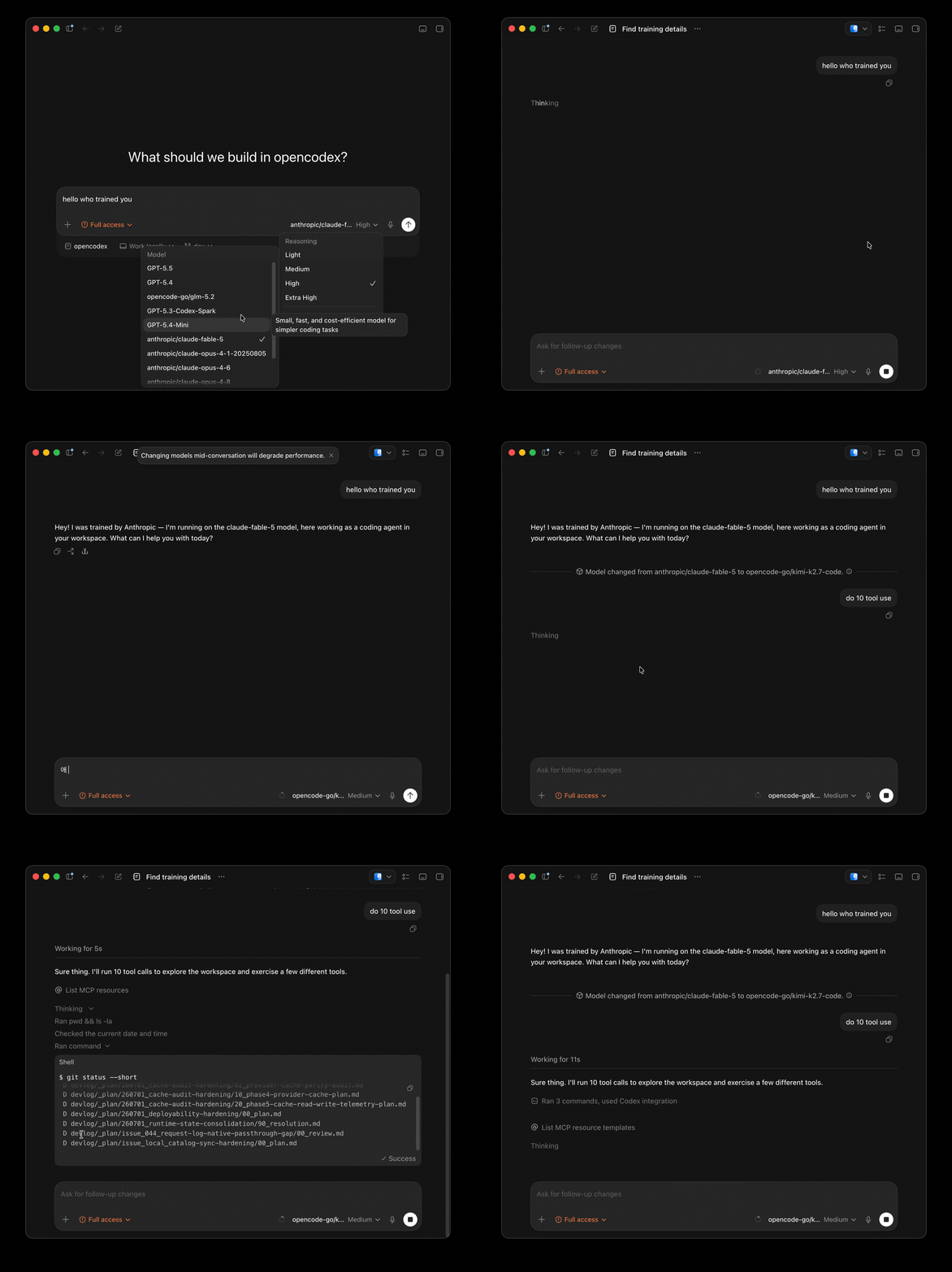
Universal provider proxy for OpenAI Codex & Claude Code — use any LLM (Claude, Gemini, Grok, DeepSeek, Ollama…) with Codex CLI, App, SDK, and Claude Code

Git-native persistent memory for AI coding agents. Implements Google OKF v0.2 with sub-300µs in-memory BM25 search, embedded MCP server, and progressive disclosure. Slashes token bloat by 80% with zero external databases or dependencies. Built in pure Go.

Local-first code intelligence graph for MCP and CLI. Builds a persistent map of your codebase so AI coding tools read only what matters, with benchmarked context reductions on reviews and large-repo workflows.

Stop your AI from making things up — it proposes, deterministic tools decide, every claim checked against ground truth with evidence. Grounded facts and context survive resets. Reverse engineering is the proving ground. MCP server + CLI.