

koala73/worldmonitorConnectors
Real-time global intelligence dashboard. AI-powered news aggregation, geopolitical monitoring, and infrastructure tracking in a unified situational awareness interface
86k
mcp-rquest plugs into Claude and other MCP clients as a request tool. It sends HTTP traffic with realistic browser fingerprints, handles common request types and auth, and can store large responses for later retrieval. It also converts HTML and PDF content to Markdown so agents can read it more easily.
Builders who want their agent to fetch sites, submit requests, and read web content in a more browser-like way.
You can have your agent access web pages and documents with less manual copying and fewer anti-bot blocks.
Supports GET, POST, PUT, DELETE, PATCH, HEAD, OPTIONS, and TRACE with realistic TLS, JA3, JA4, and HTTP/2 fingerprints.
Stores large responses in temp directories and lets you fetch them later, including line ranges.
Converts HTML and PDF responses to Markdown with `get_stored_response_with_markdown` for easier LLM reading.
Handles headers, cookies, redirects, query parameters, JSON, form data, multipart uploads, and authentication.
Includes `get_model_state` and `restart_model_loading` for the PDF conversion pipeline.
pip install mcp-rquest
python -m mcp_rquest



A Model Context Protocol (MCP) server that provides advanced HTTP request capabilities for Claude and other LLMs. Built on rquest, this server enables realistic browser emulation with accurate TLS/JA3/JA4 fingerprints, allowing models to interact with websites more naturally and bypass common anti-bot measures. It also supports converting PDF and HTML documents to Markdown for easier processing by LLMs.
HTTP Request Tools:
http_get - Perform GET requests with optional parametershttp_post - Submit data via POST requestshttp_put - Update resources with PUT requestshttp_delete - Remove resources with DELETE requestshttp_patch - Partially update resourceshttp_head - Retrieve only headers from a resourcehttp_options - Retrieve options for a resourcehttp_trace - Diagnostic request tracingResponse Handling Tools:
get_stored_response - Retrieve stored large responses, optionally by line rangeget_stored_response_with_markdown - Convert HTML or PDF responses to Markdown format for better LLM processingget_model_state - Get the current state of the PDF models loading processrestart_model_loading - Restart the PDF models loading process if it failed or got stuckmcp-rquest now supports PDF to Markdown conversion, allowing you to download PDF files and convert them to Markdown format that's easy for LLMs to process:
get_stored_response_with_markdown tool works for both HTML and PDF filesWhen using uv no specific installation is needed. We will
use uvx to directly run mcp-rquest.
Alternatively you can install mcp-rquest via pip:
pip install mcp-rquest
After installation, you can run it as a script using:
python -m mcp_rquest
Add to your Claude settings:
Using uvx:
{
  "mcpServers": {
    "http-rquest": {
      "command": "uvx",
      "args": ["mcp-rquest"]
    }
  }
}
Using pip:
{
  "mcpServers": {
    "http-rquest": {
      "command": "python",
      "args": ["-m", "mcp_rquest"]
    }
  }
}
Using pipx:
{
  "mcpServers": {
    "http-rquest": {
      "command": "pipx",
      "args": ["run", "mcp-rquest"]
    }
  }
}
mcp-rquest leverages rquest's powerful browser emulation capabilities to provide realistic browser fingerprints, which helps bypass bot detection and access content normally available only to standard browsers. Supported browser fingerprints include:
This ensures that requests sent through mcp-rquest appear as legitimate browser traffic rather than bot requests.
uv venv
# Unix/macOS
source .venv/bin/activate
# Windows
.venv\Scripts\activate
uv pip install -e ".[dev]"
Sign in to join the discussion.
No comments yet. Be the first to say what this is good for.
Real-time global intelligence dashboard. AI-powered news aggregation, geopolitical monitoring, and infrastructure tracking in a unified situational awareness interface
High-performance code intelligence MCP server. Indexes codebases into a persistent knowledge graph — average repo in milliseconds. 158 languages, sub-ms queries, 99% fewer tokens. Single static binary, zero dependencies.
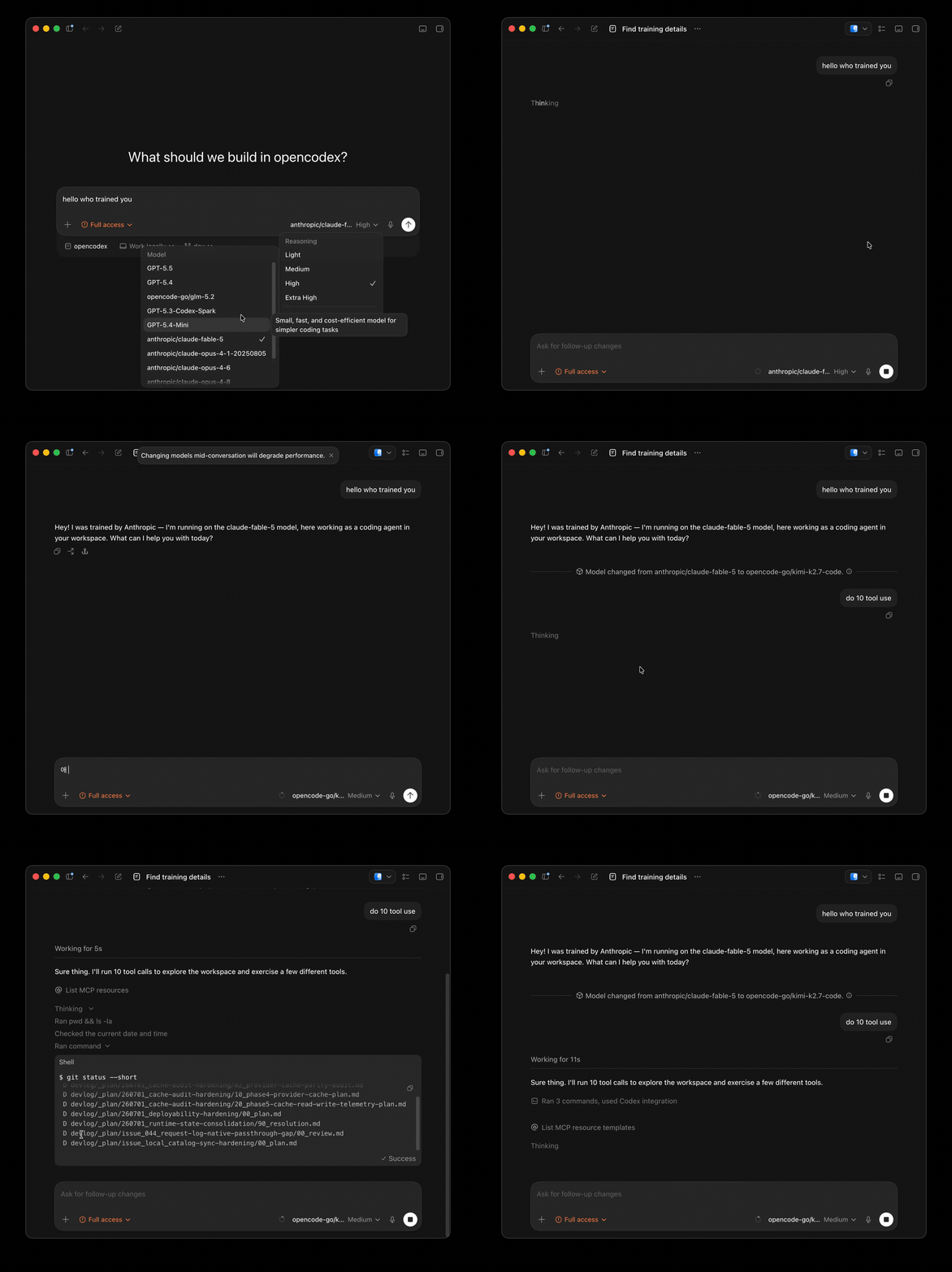
Universal provider proxy for OpenAI Codex & Claude Code — use any LLM (Claude, Gemini, Grok, DeepSeek, Ollama…) with Codex CLI, App, SDK, and Claude Code

Git-native persistent memory for AI coding agents. Implements Google OKF v0.2 with sub-300µs in-memory BM25 search, embedded MCP server, and progressive disclosure. Slashes token bloat by 80% with zero external databases or dependencies. Built in pure Go.

Local-first code intelligence graph for MCP and CLI. Builds a persistent map of your codebase so AI coding tools read only what matters, with benchmarked context reductions on reviews and large-repo workflows.

Stop your AI from making things up — it proposes, deterministic tools decide, every claim checked against ground truth with evidence. Grounded facts and context survive resets. Reverse engineering is the proving ground. MCP server + CLI.