

koala73/worldmonitorConnectors
Real-time global intelligence dashboard. AI-powered news aggregation, geopolitical monitoring, and infrastructure tracking in a unified situational awareness interface
86k
Perplexity MCP Zerver connects an MCP client to Perplexity through browser automation, so your agent can search, summarize, and retrieve documentation without API keys. It stores chat history locally and supports GitHub-aware content extraction and developer-oriented lookup tools.
Builders who want an MCP-compatible agent to do research, fetch docs, and inspect code through Perplexity’s web interface.
You can give your agent web research and documentation tools without managing API keys.
Runs research queries through Perplexity and returns raw text results.
Fetches technical docs with examples for agent use.
Finds relevant APIs and returns listings with descriptions.
Reviews code snippets for outdated patterns and returns an analysis report.
Parses web pages and handles GitHub repository URLs specially.
Keeps conversation history in local SQLite storage for follow-up questions.
Uses browser automation instead of API keys, with optional Pro account login.
git clone https://github.com/wysh3/perplexity-mcp-zerver.git
cd perplexity-mcp-zerver
bun install
bun run build
bun run build
bun run login
A minimalist research server implementing the Model Context Protocol (MCP) to deliver AI-powered research capabilities through Perplexity's web interface.



search)Perform research queries with configurable depth
Returns raw text results
get_documentation)Retrieve technical documentation with examples
Returns structured documentation
find_apis)Discover relevant APIs for development needs
Returns API listings and descriptions
check_deprecated_code)Analyze code snippets for outdated patterns
Returns analysis report
extract_url_content)Parse web content with automatic GitHub handling
Returns structured content metadata
chat_perplexity)Persistent conversations with context history
Returns conversation state in JSON format
git clone https://github.com/wysh3/perplexity-mcp-zerver.git
cd perplexity-mcp-zerver
bun install
bun run build
Add to your MCP configuration file:
{
  "mcpServers": {
    "perplexity-server": {
      "command": "bun",
      "args": ["/absolute/path/to/build/main.js"],
      "timeout": 300
    }
  }
}
Initiate commands through your MCP client:
Use your Perplexity Pro subscription for access to better models (GPT-5.1, Claude Sonnet 4.5) and higher limits.
bun run build
bun run login
A browser window will open. Log in using email (recommended for best compatibility), then close the browser. Your session is now saved!
Note: Google/SSO login may work but email login is more reliable with the browser automation.
| Variable | Default | Description |
|---|---|---|
PERPLEXITY_BROWSER_DATA_DIR | ~/.perplexity-mcp | Browser profile directory |
PERPLEXITY_PERSISTENT_PROFILE | true | Set to false for anonymous mode |
| Feature | This Implementation | Traditional APIs |
|---|---|---|
| Authentication | None required | API keys |
| Cost | Free | Usage-based |
| Data Privacy | Local processing | Remote servers |
| GitHub Integration | Native support | Limited |
| History Persistence | SQLite storage | Session-based |
Server Connection Issues
node -vContent Extraction
based on - DaInfernalCoder/perplexity-researcher-mcp
refactored from - sm-moshi/docshunter
Licensed under GNU GPL v3.0 - View License
This project interfaces with Perplexity via browser automation. Use responsibly and ethically. Stability depends on Perplexity's website consistency. Educational use only.
Sign in to join the discussion.
No comments yet. Be the first to say what this is good for.
Real-time global intelligence dashboard. AI-powered news aggregation, geopolitical monitoring, and infrastructure tracking in a unified situational awareness interface
High-performance code intelligence MCP server. Indexes codebases into a persistent knowledge graph — average repo in milliseconds. 158 languages, sub-ms queries, 99% fewer tokens. Single static binary, zero dependencies.
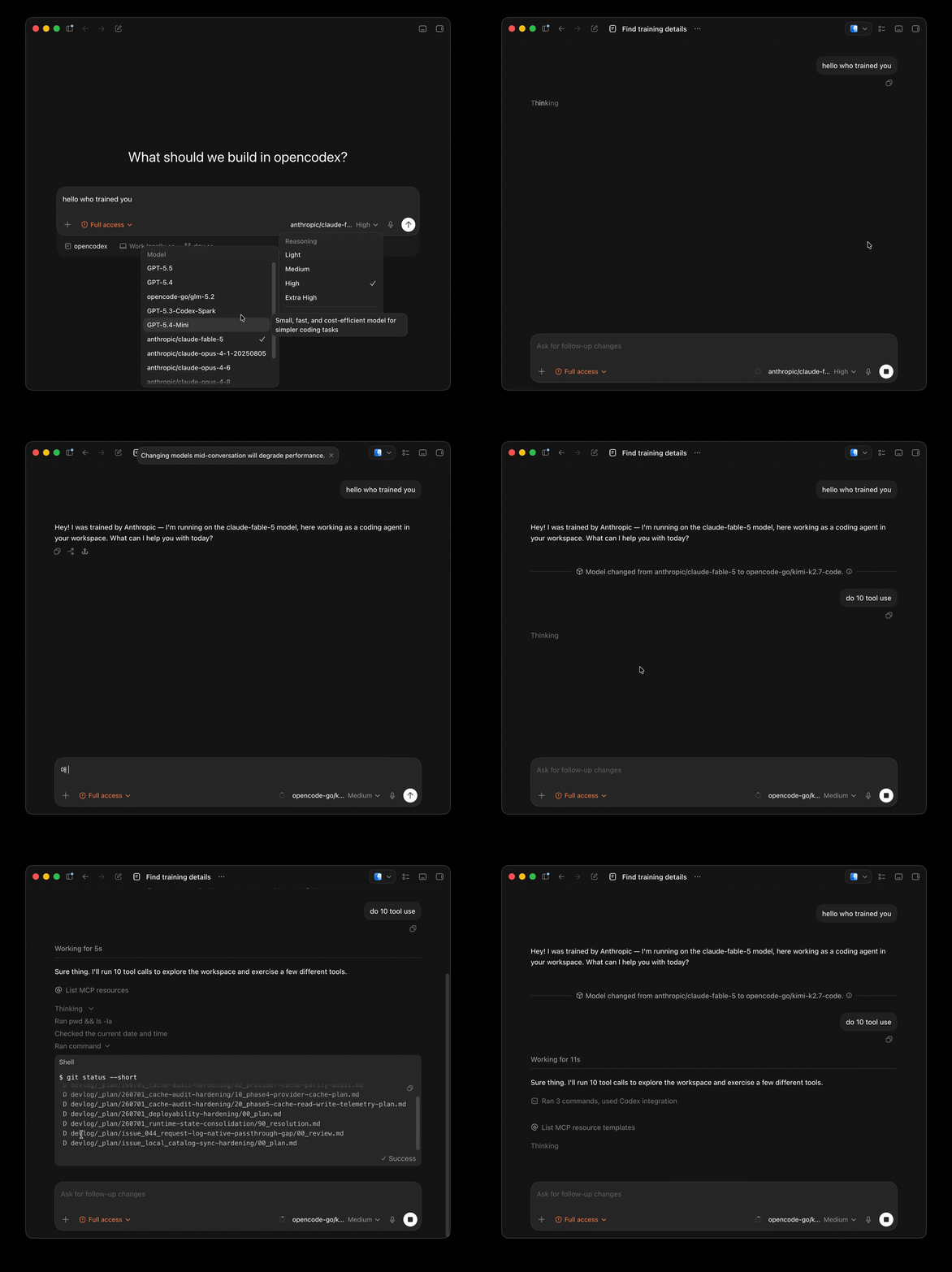
Universal provider proxy for OpenAI Codex & Claude Code — use any LLM (Claude, Gemini, Grok, DeepSeek, Ollama…) with Codex CLI, App, SDK, and Claude Code

Git-native persistent memory for AI coding agents. Implements Google OKF v0.2 with sub-300µs in-memory BM25 search, embedded MCP server, and progressive disclosure. Slashes token bloat by 80% with zero external databases or dependencies. Built in pure Go.

Local-first code intelligence graph for MCP and CLI. Builds a persistent map of your codebase so AI coding tools read only what matters, with benchmarked context reductions on reviews and large-repo workflows.

Stop your AI from making things up — it proposes, deterministic tools decide, every claim checked against ground truth with evidence. Grounded facts and context survive resets. Reverse engineering is the proving ground. MCP server + CLI.