

koala73/worldmonitorConnectors
Real-time global intelligence dashboard. AI-powered news aggregation, geopolitical monitoring, and infrastructure tracking in a unified situational awareness interface
86k
MaverickMCP gives MCP clients a local set of stock analysis tools: price history, quotes, indicators, screeners, portfolio tracking, and risk checks. Optional extras add backtesting and research, so you can keep more of your market workflow inside the agent.
Builders who want their MCP client to pull stock data, review portfolios, and run market research from a local server.
You can ask your agent to analyze tickers, screen setups, and review portfolio risk without switching to separate finance apps.
Fetch quote data, OHLCV history, fundamentals, market overview, and chart links from `yfinance` with caching.
Get RSI, MACD, support and resistance, or a full technical readout for a ticker.
Run bullish, bearish, and supply/demand screens over the tickers you have already queried.
Add positions, view live P&L, inspect risk, manage watchlists, and log trade journal entries.
Run strategy backtests, optimize parameters, compare strategies, and do walk-forward and Monte Carlo analysis.
Run web-search-backed company, sector, and sentiment research with optional BYOK LLM support.
Connect through STDIO or Streamable HTTP from Claude Desktop, Claude Code, Cursor, Copilot, Codex CLI, and other MCP clients.
# macOS/Linux
curl -LsSf https://astral.sh/uv/install.sh | sh

# Windows
powershell -ExecutionPolicy ByPass -c "irm https://astral.sh/uv/install.ps1 | iex"

# Alternative: via pip
pip install uv
# Streamable HTTP on port 8000 inside the container, mapped to 8003 here;
# --env-file is optional (core tools need no keys)
docker run --rm -p 8003:8000 --env-file .env ghcr.io/wshobson/maverick-mcp:1.1.0
make dev          # Streamable HTTP on http://localhost:8003/mcp
make dev-stdio    # STDIO on this terminal
# Streamable HTTP, against a running `make dev`
claude mcp add --transport http maverick-mcp http://localhost:8003/mcp

# STDIO. The `--` separator is required: without it, `claude mcp add`
# consumes `--transport stdio` as its own flag.
claude mcp add maverick-mcp -- \
  uv run --directory /path/to/maverick-mcp python -m maverick.server --transport stdio
"Show me the RSI and MACD analysis for NVDA"
"Identify support and resistance levels for MSFT"
"Get full technical analysis for AAPL"
"Run the Maverick bullish screen"
"Show me the top supply/demand breakout setups"


MaverickMCP is a personal-use FastMCP server that provides financial data analysis, technical indicators, stock screening, and portfolio tracking tools to any MCP client -- Claude Desktop, Claude Code, Cursor, VS Code, Codex CLI, Antigravity CLI, OpenCode, and others. Built for individual traders and investors, it runs entirely on your own machine with no authentication or billing complexity.
Core tools need no API key: market data comes from yfinance. Two optional
extras add more: [backtesting] (VectorBT-powered strategy backtesting) and
[research] (LangGraph-based deep research, bring-your-own LLM key).
Self-hosting MaverickMCP means Python, uv, and MCP client config (Redis and a research LLM key are optional). If you just want the analysis, Capital Companion is the hosted product built on the same engine: AI technical analysis, trade-plan review sheets with outcome tracking, and price alerts. 25 free analyses, no credit card.
Self-hosting instructions continue below.
Key Benefits:
make dev gets the server running; no database
migrations, no seed scripts, no API key required for core tools.uv for fast dependency management.pip install/uv sync extras.yfinance, no API key required).[backtesting] extra): VectorBT engine, 12 rule-based
strategy templates plus 8 ML strategy classes, optimization, walk-forward
analysis, and Monte Carlo simulation.[research] extra): LangGraph-based deep research over
companies, sectors, and market sentiment, backed by Exa web search and a
bring-your-own LLM.# macOS/Linux
curl -LsSf https://astral.sh/uv/install.sh | sh
# Windows
powershell -ExecutionPolicy ByPass -c "irm https://astral.sh/uv/install.ps1 | iex"
# Alternative: via pip
pip install uv
Note: The package is not on PyPI yet. The name
maverick-mcp-serveris held by a dormant, unrelated project, and a PEP 541 name-transfer request is pending with PyPI. Until this note is gone, do notpip install maverick-mcp-serveroruvx --from maverick-mcp-server: that name is not ours, and whatever its current owner publishes is what you would get. Use Option 1 (uvx from the release tag), Option 2 (the GHCR image), or Option 3 (from source).
# Runs the v1.1.0 tag straight from GitHub via uvx, invoking its
# maverick-mcp console script (no checkout, nothing from PyPI)
uvx --from "git+https://github.com/wshobson/maverick-mcp@v1.1.0" maverick-mcp --transport stdio

# With the backtesting and research extras
uvx --from "maverick-mcp-server[backtesting,research] @ git+https://github.com/wshobson/maverick-mcp@v1.1.0" maverick-mcp --transport stdio
# Streamable HTTP on port 8000 inside the container, mapped to 8003 here;
# --env-file is optional (core tools need no keys)
docker run --rm -p 8003:8000 --env-file .env ghcr.io/wshobson/maverick-mcp:1.1.0
Drop [backtesting,research] for a smaller, core-only install (37 tools,
no backtesting/research tools registered).
# Clone the repository
git clone https://github.com/wshobson/maverick-mcp.git
cd maverick-mcp

# Install dependencies and create virtual environment in one command
uv sync --extra dev
# Or, for the full tool surface:
uv sync --extra dev --extra backtesting --extra research

# Copy environment template
cp .env.example .env
# Configure DATABASE_URL / LLM_PROVIDER / EXA_API_KEY as needed (all optional)
make dev          # Streamable HTTP on http://localhost:8003/mcp
make dev-stdio    # STDIO on this terminal
Clients configured for STDIO launch the server themselves -- you do not need
make dev running for those.
MaverickMCP is a standard MCP server with no client-specific behavior. Any client that speaks the Model Context Protocol can use it: Claude Desktop, Claude Code, GitHub Copilot, Codex CLI, Cursor, OpenCode, Antigravity CLI, and others.
Setup is one decision -- which transport -- followed by pasting the right config shape for your client.
| STDIO | Streamable HTTP | |
|---|---|---|
| Who starts the server | Your client, as a subprocess | You, via make dev |
| Endpoint | n/a | http://localhost:8003/mcp |
| Best for | A single local client | Several clients sharing one server, or remote access |
| Config shape | command + args | url |
STDIO is the default and the simplest path for one local client. Use Streamable HTTP when several clients should share a single server process.
[!IMPORTANT] The HTTP endpoint has no trailing slash:
http://localhost:8003/mcp./mcp/returns a307redirect, and clients that do not follow redirects onPOSTwill fail to register tools.
| Client | STDIO | HTTP | Config location |
|---|---|---|---|
| Claude Desktop | Yes (incl. .mcpb) | Via mcp-remote | claude_desktop_config.json |
| Claude Code | Yes | Yes | claude mcp add |
| VS Code (Copilot) | Yes | Yes | .vscode/mcp.json |
| GitHub Copilot CLI | Yes | Yes | ~/.copilot/mcp-config.json |
| Codex CLI | Yes | Yes | ~/.codex/config.toml |
| Cursor | Yes | Yes | ~/.cursor/mcp.json |
| OpenCode | Yes | Yes | ~/.config/opencode/opencode.json |
| Antigravity CLI | Yes | Yes | ~/.gemini/config/mcp_config.json |
| Zed, LM Studio, Goose, Cline, Continue | Yes | Varies | Client-specific |
Clients not listed still work -- give them the STDIO command or the HTTP endpoint in whatever shape their config expects.
Full reference:
docs/runbooks/mcp-clients.mdcovers every client below in more depth, plus the.mcpbbundle, LAN binding, and per-client troubleshooting. The sections below are the common cases.
claude_desktop_config.json launches local STDIO servers only. Using the
release tag via uvx (no checkout needed, nothing from PyPI):
{
  "mcpServers": {
    "maverick-mcp": {
      "command": "uvx",
      "args": [
        "--from",
        "git+https://github.com/wshobson/maverick-mcp@v1.1.0",
        "maverick-mcp",
        "--transport",
        "stdio"
      ]
    }
  }
}
Running from a local source checkout instead:
{
  "mcpServers": {
    "maverick-mcp": {
      "command": "uv",
      "args": [
        "run",
        "python",
        "-m",
        "maverick.server",
        "--transport",
        "stdio"
      ],
      "cwd": "/path/to/maverick-mcp"
    }
  }
}
Config File Location:
~/Library/Application Support/Claude/claude_desktop_config.json%APPDATA%\Claude\claude_desktop_config.jsonAlways fully quit and restart Claude Desktop after making configuration changes.
[!WARNING] Do not paste
http://localhost:8003/mcpinto Claude Desktop's "custom connector" dialog. Custom connectors are brokered from Anthropic's cloud rather than from your machine, so they cannot reach your localhost. For Claude Desktop, local means STDIO or a.mcpbbundle (make bundle).
Claude Desktop's config file cannot express an HTTP server directly. To use the
HTTP transport there, bridge it with mcp-remote
(config). It is
the main client that still needs that bridge -- every client below speaks
Streamable HTTP natively, so do not wrap them in mcp-remote.
[!WARNING] Windows Claude Desktop Users Claude Desktop on Windows currently has a bug where it ignores the
"cwd"configuration parameter, which can cause the server to crash with aModuleNotFoundErrorwhen running viauv.To bypass this, wrap the command in
cmd.exeto force the directory change:"maverick-mcp": { "command": "cmd.exe", "args": [ "/c", "cd /d C:\\Path\\To\\maverick-mcp && uv run python -m maverick.server --transport stdio" ] }
# Streamable HTTP, against a running `make dev`
claude mcp add --transport http maverick-mcp http://localhost:8003/mcp

# STDIO. The `--` separator is required: without it, `claude mcp add`
# consumes `--transport stdio` as its own flag.
claude mcp add maverick-mcp -- \
  uv run --directory /path/to/maverick-mcp python -m maverick.server --transport stdio
Add --scope user to register the server outside the current project. Verify
with claude mcp list.
Config Location: ~/.cursor/mcp.json (global) or .cursor/mcp.json (project)
{
  "mcpServers": {
    "maverick-mcp": {
      "url": "http://localhost:8003/mcp"
    }
  }
}
Config Location: .vscode/mcp.json. The key is servers, not
mcpServers, and type is required.
{
  "servers": {
    "maverick-mcp": {
      "type": "http",
      "url": "http://localhost:8003/mcp"
    }
  }
}
Config Location: ~/.copilot/mcp-config.json (user) or .mcp.json in the
repository. tools filters which tools Copilot exposes; "*" is the default.
{
  "mcpServers": {
    "maverick-mcp": {
      "type": "http",
      "url": "http://localhost:8003/mcp",
      "tools": ["*"]
    }
  }
}
Or: copilot mcp add --transport http maverick-mcp http://localhost:8003/mcp
Config Location: ~/.codex/config.toml (global) or .codex/config.toml
(trusted projects). Shared by the ChatGPT desktop app, Codex CLI, and the IDE
extension.
[mcp_servers.maverick-mcp]
url = "http://localhost:8003/mcp"
Or: codex mcp add maverick-mcp --url http://localhost:8003/mcp
Config Location: ~/.config/opencode/opencode.json (global) or
opencode.json in the project root. Servers live under mcp, and each entry
declares type as remote or local.
{
  "$schema": "https://opencode.ai/config.json",
  "mcp": {
    "maverick-mcp": {
      "type": "remote",
      "url": "http://localhost:8003/mcp",
      "enabled": true
    }
  }
}
Google's replacement for Gemini CLI, which stopped serving individual accounts on 2026-06-18.
Config Location: ~/.gemini/config/mcp_config.json (global) or
.agents/mcp_config.json (workspace). Remote servers use serverUrl -- the
legacy Gemini CLI keys url and httpUrl are not used.
{
  "mcpServers": {
    "maverick-mcp": {
      "serverUrl": "http://localhost:8003/mcp"
    }
  }
}
Or: agy mcp add maverick-mcp http://localhost:8003/mcp
Nothing client-specific is required: supply either the STDIO command or the
HTTP endpoint above. See
docs/runbooks/mcp-clients.md
for the exact command/args values to paste.
MaverickMCP registers 37 core tools with a base install. Two optional
extras add more. Every tool is read-only (readOnlyHint: true) unless noted
otherwise. Full behavior detail lives in ARCHITECTURE.md,
docs/features/portfolio.md, docs/features/deep-research.md, and
docs/api/backtesting.md.
| Tool | Description |
|---|---|
market_data_get_price_history | OHLCV price history for a ticker, smart-cached. |
market_data_get_price_history_batch | Price history for multiple tickers at once. |
market_data_get_quote | A single quote, TTL-cached. |
market_data_get_stock_fundamentals | Valuation, financials, and trading stats. |
market_data_get_market_overview | Indices, sector performance, top movers, and volatility. |
market_data_get_chart_links | Static external chart links for a ticker. |
market_data_clear_market_cache | Clear cached quotes (mutates cache state). |
| Tool | Description |
|---|---|
technical_get_rsi_analysis | RSI reading and signal label. |
technical_get_macd_analysis | MACD reading, signal label, and crossover state. |
technical_get_support_resistance | Support/resistance levels. |
technical_get_full_technical_analysis | Full technical analysis: trend, outlook, every indicator. |
| Tool | Description |
|---|---|
screening_get_bullish | Top Maverick bullish-momentum results, latest snapshot. |
screening_get_bearish | Top bearish setup results, latest snapshot. |
screening_get_supply_demand | Top supply/demand breakout results, latest snapshot. |
screening_get_all | Latest snapshot across all three screens. |
screening_get_by_criteria | Bullish results filtered by arbitrary criteria. |
screening_run_screens | Recompute one screen (or all three) and persist it (mutates). |
Screens run over the local universe of tickers you've already queried via
market-data tools; there is no pre-seeded S&P 500 database. See
docs/runbooks/database-setup.md.
| Tool | Description |
|---|---|
portfolio_add_position | Add/average into a position (mutates). |
portfolio_get_my_portfolio | Full portfolio snapshot with live P&L. |
portfolio_remove_position | Remove shares from a position (mutates). |
portfolio_clear_portfolio | Remove every position; requires confirm=True (mutates). |
portfolio_risk_adjusted_analysis | ATR-based position sizing/stop/target. |
portfolio_compare_tickers | Side-by-side ticker comparison (auto-uses your portfolio). |
portfolio_correlation_analysis | Correlation matrix and diversification metrics. |
portfolio_get_risk_dashboard | Total value, sector exposure, and risk metrics. |
portfolio_check_position_risk | Pre-trade risk check for a hypothetical trade. |
portfolio_get_regime_adjusted_sizing | Position size scaled by detected market regime. |
portfolio_get_risk_alerts | Current sector/position/portfolio risk alerts. |
portfolio_watchlist_create | Create a named watchlist (mutates). |
portfolio_watchlist_add | Add a ticker to a watchlist (mutates). |
portfolio_watchlist_remove | Remove a ticker from a watchlist (mutates). |
portfolio_watchlist_brief | Intelligence brief for every symbol on a watchlist. |
portfolio_journal_add_trade | Log a new open trade (mutates). |
portfolio_journal_close_trade | Close an open trade; PnL computed automatically (mutates). |
portfolio_journal_list_trades | List journal trades, optionally filtered. |
portfolio_journal_review | Full detail for a single journal trade. |
portfolio_get_strategy_performance | Strategy performance analytics, with optional comparison. |
All analysis tools auto-detect your portfolio positions when no explicit
tickers are supplied. See docs/features/portfolio.md for the cost-basis
method and precision rules.
[backtesting] extra)| Tool | Description |
|---|---|
backtesting_run_backtest | Run a single-strategy backtest: metrics, trades, analysis. |
backtesting_optimize_strategy | Grid-search a strategy's parameters. |
backtesting_walk_forward_analysis | Rolling optimize/test windows to gauge robustness. |
backtesting_monte_carlo_simulation | Bootstrap-resample trades for a return/drawdown distribution. |
backtesting_compare_strategies | Backtest multiple strategies on the same symbol and rank them. |
backtesting_list_strategies | List every rule-based strategy template with default parameters. |
backtesting_backtest_portfolio | Backtest one strategy across multiple symbols. |
backtesting_parse_strategy | Parse a natural-language description into a strategy + parameters (BYOK LLM). |
backtesting_run_ml_strategy_backtest | Backtest an ML-enhanced strategy (adaptive, ensemble, regime-aware). |
backtesting_train_ml_predictor | Train a random-forest ML predictor for trading signals. |
backtesting_analyze_market_regimes | Detect bear/sideways/bull regimes for a symbol. |
backtesting_create_strategy_ensemble | Backtest a weighted ensemble of base strategies. |
12 rule-based strategy templates plus 8 ML strategy classes. Install with
uv sync --extra backtesting or pip install "maverick-mcp-server[backtesting] @ git+https://github.com/wshobson/maverick-mcp@v1.1.0".
Absent the extra, the server still boots and registers zero
backtesting_* tools.
[research] extra)| Tool | Description |
|---|---|
research_run_comprehensive | Comprehensive web-search-backed research on a financial topic. |
research_analyze_company | Comprehensive research on a specific company. |
research_analyze_sentiment | Market sentiment analysis for a topic or sector. |
Requires a search backend (EXA_API_KEY for Exa, the default, or
RESEARCH_SEARCH_BACKEND=searxng plus SEARXNG_BASE_URL for a self-hosted
SearXNG instance) and a configured BYOK LLM
(LLM_PROVIDER/LLM_API_KEY/LLM_MODEL; see Configuration).
Install with uv sync --extra research or
pip install "maverick-mcp-server[research] @ git+https://github.com/wshobson/maverick-mcp@v1.1.0". Absent the extra, the server
still boots and registers zero research_* tools.
portfolio://my-holdings - a passive AI-context snapshot of your default
portfolio, automatically available to the assistant.analyze_stock(ticker) - full technical + screening workflow for one ticker.review_portfolio(portfolio_name) - portfolio + risk review workflow.run_backtest_workflow(ticker, strategy) - strategy backtesting workflow
(registered only with the [backtesting] extra).Configure MaverickMCP via .env file or environment variables. See
.env.example for the complete, code-verified list.
Essential Settings:
DATABASE_URL - PostgreSQL connection or sqlite:///maverick.db for SQLite (default).REDIS_HOST - enables Redis caching when set; caching falls back to
in-memory/SQLite otherwise.LOG_LEVEL - Logging verbosity (default: INFO).No API key is required to run the core server; stock data comes from yfinance.
Optional (research extra, bring your own key):
LLM_PROVIDER - anthropic, openai, openrouter, or openai_compatible.LLM_API_KEY - API key for the configured LLM_PROVIDER.LLM_MODEL - Model name for the configured LLM_PROVIDER.LLM_BASE_URL - Base URL override, required when LLM_PROVIDER=openai_compatible.LLM_TEMPERATURE - Sampling temperature (default: 0.0).EXA_API_KEY - Web search for the research tools (get at exa.ai).RESEARCH_SEARCH_BACKEND - exa (default) or searxng.SEARXNG_BASE_URL - Base URL of a self-hosted SearXNG instance with the JSON format enabled; used when the backend is searxng.Migrating an older .env (legacy OPENROUTER_API_KEY-style auto-detection,
TIINGO_API_KEY, etc.)? See docs/runbooks/migrating-to-v1.md.
Once connected to Claude Desktop, use natural language:
"Show me the RSI and MACD analysis for NVDA"
"Identify support and resistance levels for MSFT"
"Get full technical analysis for AAPL"
"Run the Maverick bullish screen"
"Show me the top supply/demand breakout setups"
"Add 10 shares of AAPL I bought at $150.50"
"Show me my portfolio with current prices"
"Analyze correlation in my portfolio"  # Auto-detects your positions
"Get my risk dashboard"
"Add AAPL to my watchlist"
[backtesting] extra)"Run a backtest on AAPL using the momentum strategy for the last 6 months"
"Compare mean reversion vs trend following strategies on SPY"
"Optimize the RSI strategy parameters for TSLA"
[research] extra)"Research the current state of the AI semiconductor industry"
"Provide comprehensive research on NVDA"
"Analyze market sentiment for the energy sector"
make dev          # Start server (streamable HTTP transport)
make dev-stdio    # Start server (STDIO transport)
make stop         # Stop services

make test              # Unit tests (fast, default marker filter)
make test-all           # All tests, including integration/slow/external
make test-specific TEST=test_name
make test-watch         # Auto-run tests on file changes

make lint         # ruff check + lint-imports
make format       # ruff format + ruff check --fix
make typecheck     # ty (Astral), same gate as CI
make check          # lint + typecheck
make docs-check      # validate the documentation catalog
# Using uv directly
uv run pytest                 # Unit tests only
uv run pytest --cov=maverick  # With coverage
uv run pytest -m ""           # All tests (requires PostgreSQL/Redis for some)

uv run ruff check .    # Linting
uv run ruff format .   # Formatting
uv run ty check maverick   # Type checking (Astral's ty); same scope as CI
For containerized deployment:
# Copy and configure environment
cp .env.example .env

# Using uv in Docker (recommended for faster builds)
docker build -t maverick-mcp-server .
docker run -p 8003:8000 --env-file .env maverick-mcp-server

# Or start with docker-compose
docker-compose up -d
Note: The Dockerfile uses uv for fast dependency installation. The
image ships the [backtesting] and [research] extras by default; drop
--extra backtesting --extra research from the uv sync line in the
Dockerfile for a smaller, core-only image. There is no HTTP
Sign in to join the discussion.
No comments yet. Be the first to say what this is good for.
Real-time global intelligence dashboard. AI-powered news aggregation, geopolitical monitoring, and infrastructure tracking in a unified situational awareness interface
High-performance code intelligence MCP server. Indexes codebases into a persistent knowledge graph — average repo in milliseconds. 158 languages, sub-ms queries, 99% fewer tokens. Single static binary, zero dependencies.
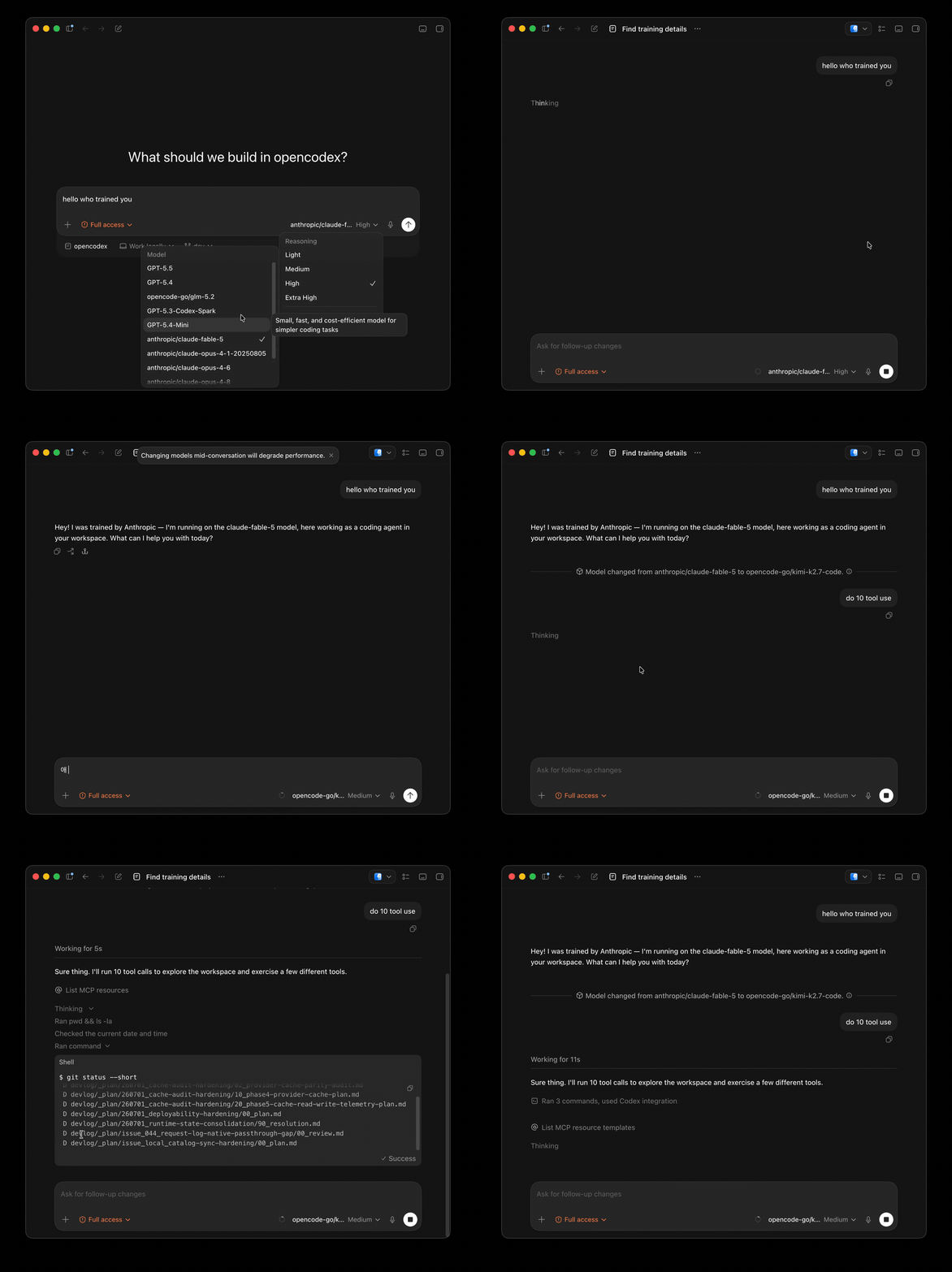
Universal provider proxy for OpenAI Codex & Claude Code — use any LLM (Claude, Gemini, Grok, DeepSeek, Ollama…) with Codex CLI, App, SDK, and Claude Code

Git-native persistent memory for AI coding agents. Implements Google OKF v0.2 with sub-300µs in-memory BM25 search, embedded MCP server, and progressive disclosure. Slashes token bloat by 80% with zero external databases or dependencies. Built in pure Go.

Stop your AI from making things up — it proposes, deterministic tools decide, every claim checked against ground truth with evidence. Grounded facts and context survive resets. Reverse engineering is the proving ground. MCP server + CLI.
20 MB lightweight cross-platform database client for 90+ databases, including MySQL, PostgreSQL, SQLite, Redis, MongoDB, DuckDB, SQL Server, and Dameng. Built-in AI, MCP Server, CLI, desktop and Docker. | 轻量级跨平台数据库管理工具,支持 MySQL、PostgreSQL、SQLite、Redis、MongoDB、达梦等 90+ 数据库,提供桌面端、Docker、CLI、内置 AI 助手和 MCP Server。