

koala73/worldmonitorConnectors
Real-time global intelligence dashboard. AI-powered news aggregation, geopolitical monitoring, and infrastructure tracking in a unified situational awareness interface
86k
Desktop Commander MCP plugs into MCP clients and gives them terminal commands, file search, file edits, and process control. It builds on filesystem tooling and adds search, replace, and interactive shell features so your agent can work on local code and documents.
Builders who want their agent to run terminal commands, inspect files, and make edits on their local machine.
You can let your agent do real terminal and file work instead of only suggesting changes.
Starts processes, streams output, interacts with running commands, and lists or kills sessions and processes.
Reads, writes, moves, and searches files and folders, with recursive listing and diff-style text edits.
Reads and writes Excel files, PDFs, and DOCX documents from the same MCP server.
Gets and updates server settings like blocked commands, shells, allowed directories, and line limits.
Records tool calls locally and includes command blocklists and symlink protection.
Includes setup paths for Claude Desktop, Claude Code, Cursor, Windsurf, Codex, Gemini CLI, and Docker.
npx @wonderwhy-er/desktop-commander@latest setup
npx @wonderwhy-er/desktop-commander@latest setup --debug
curl -fsSL https://raw.githubusercontent.com/wonderwhy-er/DesktopCommanderMCP/refs/heads/main/install.sh | bash
git clone https://github.com/wonderwhy-er/DesktopCommanderMCP.git
cd DesktopCommanderMCP
npm run setup
bash <(curl -fsSL https://raw.githubusercontent.com/wonderwhy-er/DesktopCommanderMCP/refs/heads/main/install-docker.sh)
iex ((New-Object System.Net.WebClient).DownloadString('https://raw.githubusercontent.com/wonderwhy-er/DesktopCommanderMCP/refs/heads/main/install-docker.ps1'))

Work with code and text, run processes, and automate tasks, going far beyond other AI editors - while using host client subscriptions instead of API token costs.
Want a better experience? The Desktop Commander App gives you everything the MCP server does, plus:
👉 Download the App (macOS & Windows)
The MCP server below still works great with Claude Desktop and other MCP clients — the app is for those who want a dedicated, polished experience.
All of your AI development tools in one place. Desktop Commander puts all dev tools in one chat. Execute long-running terminal commands on your computer and manage processes through Model Context Protocol (MCP). Built on top of MCP Filesystem Server to provide additional search and replace file editing capabilities.
get_recent_tool_callsDesktop Commander offers multiple installation methods for Claude Desktop.
📋 Update & Uninstall Information: Options 1, 2, 3, 4, and 6 have automatic updates. Option 5 requires manual updates. See below for details.
Just run this in terminal:
npx @wonderwhy-er/desktop-commander@latest setup
For debugging mode (allows Node.js inspector connection):
npx @wonderwhy-er/desktop-commander@latest setup --debug
Command line options during setup:
--debug: Enable debugging mode for Node.js inspector--no-onboarding: Disable onboarding prompts for new usersRestart Claude if running.
✅ Auto-Updates: Yes - automatically updates when you restart Claude
🔄 Manual Update: Run the setup command again
🗑️ Uninstall: Run npx @wonderwhy-er/desktop-commander@latest remove
curl -fsSL https://raw.githubusercontent.com/wonderwhy-er/DesktopCommanderMCP/refs/heads/main/install.sh | bash
This script handles all dependencies and configuration automatically.
✅ Auto-Updates: Yes
🔄 Manual Update: Re-run the bash installer command above
🗑️ Uninstall: Run npx @wonderwhy-er/desktop-commander@latest remove
✅ Auto-Updates: Yes - automatically updates when you restart Claude
🔄 Manual Update: Visit the Smithery page and reinstall
Add this entry to your claude_desktop_config.json:
~/Library/Application Support/Claude/claude_desktop_config.json%APPDATA%\Claude\claude_desktop_config.json~/.config/Claude/claude_desktop_config.json{
"mcpServers": {
"desktop-commander": {
"command": "npx",
"args": [
"-y",
"@wonderwhy-er/desktop-commander@latest"
]
}
}
}
Restart Claude if running.
✅ Auto-Updates: Yes - automatically updates when you restart Claude
🔄 Manual Update: Run the setup command again
🗑️ Uninstall: Run npx @wonderwhy-er/desktop-commander@latest remove or remove the entry from your claude_desktop_config.json
git clone https://github.com/wonderwhy-er/DesktopCommanderMCP.git
cd DesktopCommanderMCP
npm run setup
Restart Claude if running.
The setup command will install dependencies, build the server, and configure Claude's desktop app.
❌ Auto-Updates: No - requires manual git updates
🔄 Manual Update: cd DesktopCommanderMCP && git pull && npm run setup
🗑️ Uninstall: Run npx @wonderwhy-er/desktop-commander@latest remove or remove the cloned directory and MCP server entry from Claude config
Perfect for users who want isolation or don't have Node.js installed. Runs in a sandboxed Docker container with a persistent work environment.
Prerequisites: Docker Desktop installed and running, Claude Desktop app installed.
macOS/Linux:
bash <(curl -fsSL https://raw.githubusercontent.com/wonderwhy-er/DesktopCommanderMCP/refs/heads/main/install-docker.sh)
Windows PowerShell:
iex ((New-Object System.Net.WebClient).DownloadString('https://raw.githubusercontent.com/wonderwhy-er/DesktopCommanderMCP/refs/heads/main/install-docker.ps1'))
The installer will check Docker, pull the image, prompt for folder mounting, and configure Claude Desktop.
Docker persistence: Your tools, configs, work files, and package caches all survive restarts.
Basic setup (no file access):
{
  "mcpServers": {
    "desktop-commander-in-docker": {
      "command": "docker",
      "args": ["run", "-i", "--rm", "mcp/desktop-commander:latest"]
    }
  }
}
With folder mounting:
{
  "mcpServers": {
    "desktop-commander-in-docker": {
      "command": "docker",
      "args": [
        "run", "-i", "--rm",
        "-v", "/Users/username/Desktop:/mnt/desktop",
        "-v", "/Users/username/Documents:/mnt/documents",
        "mcp/desktop-commander:latest"
      ]
    }
  }
}
Advanced folder mounting:
{
  "mcpServers": {
    "desktop-commander-in-docker": {
      "command": "docker",
      "args": [
        "run", "-i", "--rm",
        "-v", "dc-system:/usr",
        "-v", "dc-home:/root",
        "-v", "dc-workspace:/workspace",
        "-v", "dc-packages:/var",
        "-v", "/Users/username/Projects:/mnt/Projects",
        "-v", "/Users/username/Downloads:/mnt/Downloads",
        "mcp/desktop-commander:latest"
      ]
    }
  }
}
macOS/Linux:
# Check status
bash <(curl -fsSL https://raw.githubusercontent.com/wonderwhy-er/DesktopCommanderMCP/refs/heads/main/install-docker.sh) --status

# Reset all persistent data
bash <(curl -fsSL https://raw.githubusercontent.com/wonderwhy-er/DesktopCommanderMCP/refs/heads/main/install-docker.sh) --reset
Windows PowerShell:
# Check status
$script = (New-Object System.Net.WebClient).DownloadString('https://raw.githubusercontent.com/wonderwhy-er/DesktopCommanderMCP/refs/heads/main/install-docker.ps1'); & ([ScriptBlock]::Create("$script")) -Status

# Reset all data
$script = (New-Object System.Net.WebClient).DownloadString('https://raw.githubusercontent.com/wonderwhy-er/DesktopCommanderMCP/refs/heads/main/install-docker.ps1'); & ([ScriptBlock]::Create("$script")) -Reset

# Show help
$script = (New-Object System.Net.WebClient).DownloadString('https://raw.githubusercontent.com/wonderwhy-er/DesktopCommanderMCP/refs/heads/main/install-docker.ps1'); & ([ScriptBlock]::Create("$script")) -Help
Troubleshooting: Reset and reinstall from scratch:
bash <(curl -fsSL https://raw.githubusercontent.com/wonderwhy-er/DesktopCommanderMCP/refs/heads/main/install-docker.sh) --reset && bash <(curl -fsSL https://raw.githubusercontent.com/wonderwhy-er/DesktopCommanderMCP/refs/heads/main/install-docker.sh)
✅ Auto-Updates: Yes - latest tag automatically gets newer versions
🔄 Manual Update: docker pull mcp/desktop-commander:latest then restart Claude
Desktop Commander works with any MCP-compatible client. The standard JSON configuration is:
{
  "mcpServers": {
    "desktop-commander": {
      "command": "npx",
      "args": ["-y", "@wonderwhy-er/desktop-commander@latest"]
    }
  }
}
Add this to your client's MCP configuration file at the locations below:

Or add manually to ~/.cursor/mcp.json (global) or .cursor/mcp.json in your project folder (project-specific).
See Cursor MCP docs for more info.
Add to ~/.codeium/windsurf/mcp_config.json. See Windsurf MCP docs for more info.
Add to .vscode/mcp.json in your project or VS Code User Settings (JSON). Make sure MCP is enabled under Chat > MCP. Works in Agent mode.
See VS Code MCP docs for more info.
Configure through the Cline extension settings in VS Code. Open the Cline sidebar, click the MCP Servers icon, and add the JSON configuration above. See Cline MCP docs for more info.
Add to your Roo Code MCP configuration file. See Roo Code MCP docs for more info.
claude mcp add --scope user desktop-commander -- npx -y @wonderwhy-er/desktop-commander@latest
Remove --scope user to install for the current project only. See Claude Code MCP docs for more info.
Use the "Add manually" feature and paste the JSON configuration above. See Trae MCP docs for more info.
Navigate to Kiro > MCP Servers, click + Add, and paste the JSON configuration above. See Kiro MCP docs for more info.
Codex uses TOML configuration. Run this command to add Desktop Commander:
codex mcp add desktop-commander -- npx -y @wonderwhy-er/desktop-commander@latest
Or manually add to ~/.codex/config.toml:
[mcp_servers.desktop-commander]
command = "npx"
args = ["-y", "@wonderwhy-er/desktop-commander@latest"]
See Codex MCP docs for more info.
In JetBrains IDEs, go to Settings → Tools → AI Assistant → Model Context Protocol (MCP), click + Add, select As JSON, and paste the JSON configuration above. See JetBrains MCP docs for more info.
Add to ~/.gemini/settings.json:
{
  "mcpServers": {
    "desktop-commander": {
      "command": "npx",
      "args": ["-y", "@wonderwhy-er/desktop-commander@latest"]
    }
  }
}
See Gemini CLI docs for more info.
Press Cmd/Ctrl+Shift+P, open the Augment panel, and add a new MCP server named desktop-commander with the JSON configuration above. See Augment Code MCP docs for more info.
Run this command to add Desktop Commander:
qwen mcp add desktop-commander -- npx -y @wonderwhy-er/desktop-commander@latest
Or add to .qwen/settings.json (project) or ~/.qwen/settings.json (global). See Qwen Code MCP docs for more info.
Use Desktop Commander from ChatGPT, Claude web, and other AI services via Remote MCP — no desktop app required.
👉 Get started at mcp.desktopcommander.app
How it works:
Ctrl+COptions 1 (npx), Option 2 (bash installer), 3 (Smithery), 4 (manual config), and 6 (Docker) automatically update to the latest version whenever you restart Claude. No manual intervention needed.
cd DesktopCommanderMCP && git pull && npm run setupThe easiest way to completely remove Desktop Commander:
npx @wonderwhy-er/desktop-commander@latest remove
This automatic uninstaller will:
If the automatic uninstaller doesn't work or you prefer manual removal:
~/Library/Application Support/Claude/claude_desktop_config.json%APPDATA%\Claude\claude_desktop_config.json~/.config/Claude/claude_desktop_config.json"desktop-commander" entry from the "mcpServers" sectionExample - Remove this section:
{
    "desktop-commander": {
      "command": "npx",
      "args": ["@wonderwhy-er/desktop-commander@latest"]
    }
}
Close and restart Claude Desktop to complete the removal.
If automatic uninstallation fails:
If Claude won't start after uninstalling:
Need help?
Once Desktop Commander is installed and Claude Desktop is restarted, you're ready to supercharge your Claude experience!
Desktop Commander includes intelligent onboarding to help you discover what's possible:
For New Users: When you're just getting started (fewer than 10 successful commands), Claude will automatically offer helpful getting-started guidance and practical tutorials after you use Desktop Commander successfully.
Request Help Anytime: You can ask for onboarding assistance at any time by simply saying:
Claude will then show you beginner-friendly tutorials and examples, including:
The server provides a comprehensive set of tools organized into several categories:
| Category | Tool | Description |
|---|---|---|
| Configuration | get_config | Get the complete server configuration as JSON (includes blockedCommands, defaultShell, allowedDirectories, fileReadLineLimit, fileWriteLineLimit, telemetryEnabled) |
set_config_value | Set a specific configuration value by key. Available settings: • blockedCommands: Array of shell commands that cannot be executed• defaultShell: Shell to use for commands (e.g., bash, zsh, powershell)• allowedDirectories: Array of filesystem paths the server can access for file operations (⚠️ terminal commands can still access files outside these directories)• fileReadLineLimit: Maximum lines to read at once (default: 1000)• fileWriteLineLimit: Maximum lines to write at once (default: 50)• telemetryEnabled: Enable/disable telemetry (boolean) | |
| Terminal | start_process | Start programs with smart detection of when they're ready for input |
interact_with_process | Send commands to running programs and get responses | |
read_process_output | Read output from running processes | |
force_terminate | Force terminate a running terminal session | |
list_sessions | List all active terminal sessions | |
list_processes | List all running processes with detailed information | |
kill_process | Terminate a running process by PID | |
| Filesystem | read_file | Read contents from local filesystem, URLs, Excel files (.xlsx, .xls, .xlsm), and PDFs with line/page-based pagination |
read_multiple_files | Read multiple files simultaneously | |
write_file | Write file contents with options for rewrite or append mode. Supports Excel files (JSON 2D array format). For PDFs, use write_pdf | |
write_pdf | Create new PDF files from markdown or modify existing PDFs (insert/delete pages). Supports HTML/CSS styling and SVG graphics | |
create_directory | Create a new directory or ensure it exists | |
list_directory | Get detailed recursive listing of files and directories (supports depth parameter, default depth=2) | |
move_file | Move or rename files and directories | |
start_search | Start streaming search for files by name or content patterns (searches text files and Excel content) | |
get_more_search_results | Get paginated results from active search with offset support | |
stop_search | Stop an active search gracefully | |
list_searches | List all active search sessions | |
get_file_info | Retrieve detailed metadata about a file or directory (includes sheet info for Excel files) | |
| Text Editing | edit_block | Apply targeted text repl |
Sign in to join the discussion.
No comments yet. Be the first to say what this is good for.
Real-time global intelligence dashboard. AI-powered news aggregation, geopolitical monitoring, and infrastructure tracking in a unified situational awareness interface
High-performance code intelligence MCP server. Indexes codebases into a persistent knowledge graph — average repo in milliseconds. 158 languages, sub-ms queries, 99% fewer tokens. Single static binary, zero dependencies.
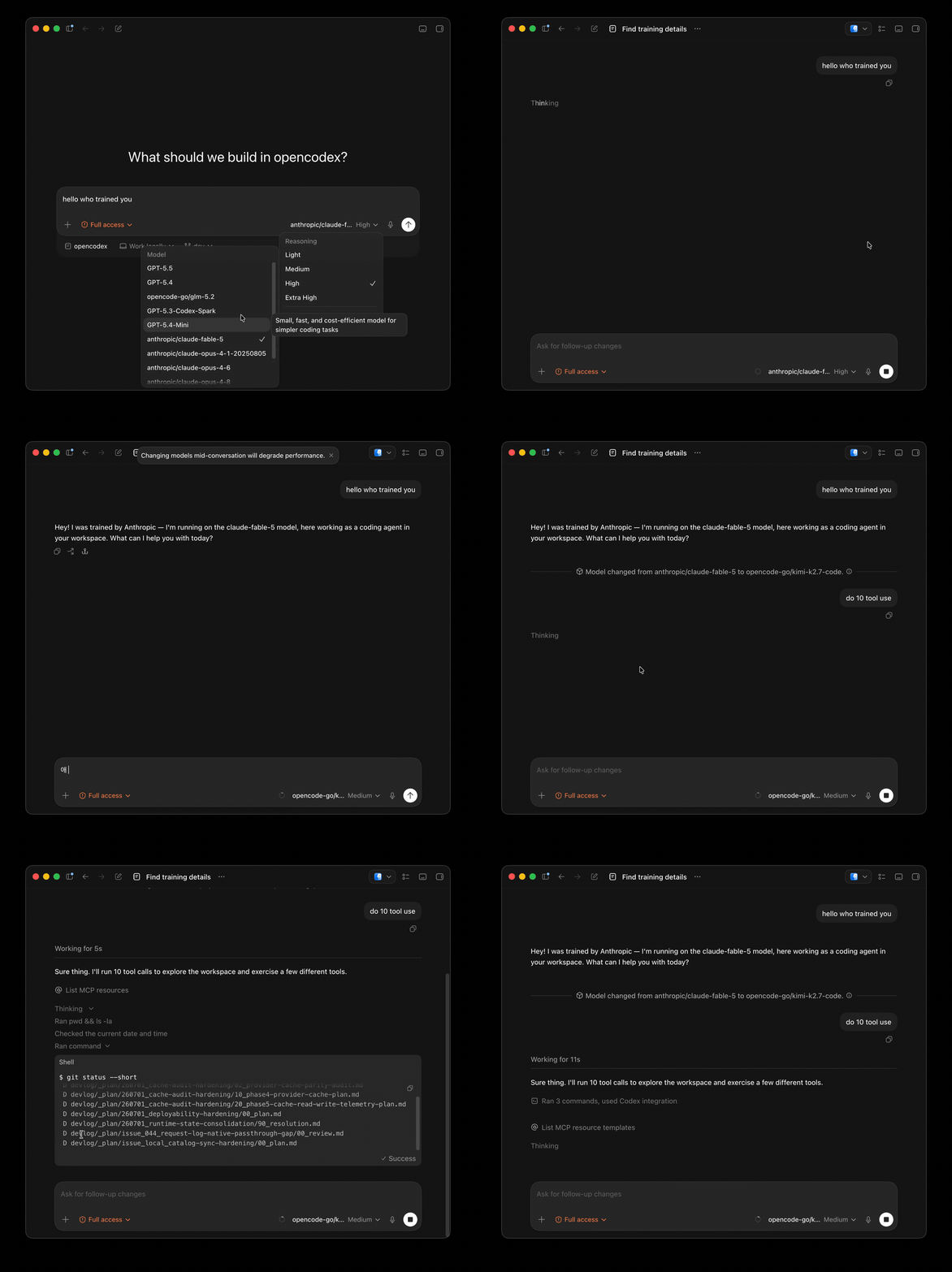
Universal provider proxy for OpenAI Codex & Claude Code — use any LLM (Claude, Gemini, Grok, DeepSeek, Ollama…) with Codex CLI, App, SDK, and Claude Code

Git-native persistent memory for AI coding agents. Implements Google OKF v0.2 with sub-300µs in-memory BM25 search, embedded MCP server, and progressive disclosure. Slashes token bloat by 80% with zero external databases or dependencies. Built in pure Go.

Local-first code intelligence graph for MCP and CLI. Builds a persistent map of your codebase so AI coding tools read only what matters, with benchmarked context reductions on reviews and large-repo workflows.

Stop your AI from making things up — it proposes, deterministic tools decide, every claim checked against ground truth with evidence. Grounded facts and context survive resets. Reverse engineering is the proving ground. MCP server + CLI.