

NousResearch/
hermes-agent

The agent that grows with you
245k
Voicetree puts agents, tasks, and markdown nodes into a shared graph so you can see work, context, and progress together. Agents can spawn subagents, pull nearby context, and write back into the same memory structure, while humans inspect and steer the graph directly.
Builders who want their agent work to live in a shared graph instead of scattered chat threads.
You can break work into connected agent tasks, keep context nearby, and resume without re-explaining the project.
Represents work as nodes and edges, with markdown files and folders as graph elements.
Humans and agents use the same API and graph, so context stays visible and reusable.
Agents can split work into subgraphs and spawn child terminals for parallel follow-up.
Agents collect nearby nodes and can semantic search local embeddings before acting.
Hooks let you trigger automations around agent actions and workspace events.
The workspace is built for terminal agents like Claude Code, Codex, Gemini, and OpenCode.
brew tap voicetreelab/voicetree && brew install voicetree
curl -fsSL https://raw.githubusercontent.com/voicetreelab/voicetree/main/install.sh | sh
docker run -d --rm -p 6080:6080 \
    -v voicetree-project:/home/vt/project \
    -v voicetree-claude:/home/vt/.config/claude \
    --shm-size=1g \
    -e ANTHROPIC_API_KEY="$ANTHROPIC_API_KEY" \
    ghcr.io/voicetreelab/voicetree:latest
# then open http://localhost:6080/vnc.html?autoconnect=1&resize=remoteVoicetree has two primitives: nodes and edges. A node is either a markdown file, a set of nodes (folder), or a terminal based agent (Claude code, Codex, OpenCode, Gemini etc. ).
There's a small API (& vt CLI) for interacting with them. From this, agent swarms, recursive task decomposition, shared human-agent memory, and self-improving workflows all fall out as consequences.
The system is expressive enough to restructure itself at runtime, and because agents and humans share the same API, that self-modification stays stable and observable.
Think of it as a game engine for agentic systems. Unity gives you GameObjects, a lifecycle, and an API you write C# against. Voicetree gives you nodes, edges, lifecycles, and hooks - but your agents can also write against it, meaning the systems you build can improve themselves.
You are now building an agentic factory, so you can move up to higher levels of abstraction, building the system that builds itself. Build the self-building factory.
(claim, p=0.4 - Markdown hypergraphs have become the de-facto programming language for agent cognition system swarms (augmented brains) in 2027)





| Challenge | Voicetree Solution |
|---|---|
| Manual agent coordination | Agents can breakdown tasks into subgraphs and recursively spawn children terminals |
| 4-10 agent terminals is overwhelming | Spatially organise agents, tasks and progress on the graph |
| Agents don't know what you know | You share the same memory graph with agents |
| Agents suffer context-rot and lack memory | Defaults to short, focussed sessions with automatic handover |
Early-beta: powerful but rough. We (the startup/lab building it) use Voicetree daily as our AI-forecasting and research tool — development is spiky as a result, and external contributors are very welcome.
A lightweight API (agent-first, local-only) for a set of operations on these primitives and their lifecycles (for all the interactions you would want for human-in-the-loop agent orchestration: defining workflows, context switching between agent+human contexts, seeing progress as graph etc.)
Obsidian meets Claude Code. Built from first principles for the most efficient human-AI interaction system possible.
Download links macOS (Apple Silicon) | macOS (Intel) | Windows | Linux
MacOS
brew tap voicetreelab/voicetree && brew install voicetree
Linux
curl -fsSL https://raw.githubusercontent.com/voicetreelab/voicetree/main/install.sh | sh
Windows: https://github.com/voicetreelab/voicetree/releases/latest/download/voicetree.exe
Docker (sandboxed — keeps agents off your host filesystem)
docker run -d --rm -p 6080:6080 \
    -v voicetree-project:/home/vt/project \
    -v voicetree-claude:/home/vt/.config/claude \
    --shm-size=1g \
    -e ANTHROPIC_API_KEY="$ANTHROPIC_API_KEY" \
    ghcr.io/voicetreelab/voicetree:latest
# then open http://localhost:6080/vnc.html?autoconnect=1&resize=remote
See docker/README.md for details. amd64 only for now.
Run VoiceTree in the browser (no Electron): a monorepo-only dev command (@voicetree/cli isn't published yet) — see docs/browser-mode.md.
Your agents (Claude Code, Codex, Opencode, Gemini etc.) live inside the graph, next to their tasks, plans, and progress updates.
Context retrieval: Agents see all nodes within a configurable radius and can semantic search against local embeddings.
Spatial layout: Location-based memory is the most efficient way to remember things.
Externalized working memory: Each node represents a concept at any level of abstraction. The graph structure mirrors your mental model - relationships between ideas are represented exactly as you think about them, offloading cognitive load to the canvas.
Nodes are markdown files, connections are wikilinks to the .md file paths. You open rich markdown editors directly within the graph by hovering over a node, (or use speech-to-graph mode).
You can spawn coding agents on a node, the contents of that node will become the agents task, and it will also be given all context within an adjustable distance around them, and can semantic search against local embeddings. This means agents see what you see. You share the same memory, the same second brain. The graph structure allows for context retrieval to be targeted to only what is most relevant rather than dumping entire conversation history - avoiding the 30-60% performance degradation from context rot1.
Agents can build their own subgraphs, decomposing their tasks into small connected chunks of work. You can glance at the high-level structure and progress of these, and zoom in to the details of what matters most. For example, ask a Voicetree agent to divide their plan into nodes of data-model, architecture, pure logic, edge logic, UI components, and integration. This lets you carefully track the planning to implementation for what matters most: the high level changes & core logic.
Agents can then spawn and orchestrate their own parallel subagents to work through these dependency graphs. In Voicetree, subagents are just native terminals so you have full transparency and control over them unlike with other CLI agents.
As your project & context grows, the Voicetree approach scales. You use your brains most efficient form of memory: remembering the location of where things are. Each node can represent any concept at any level of abstraction. You can see and reason about the structure between these concepts more easily as it is represented exactly as your brain represented them. This lets you externalise your working memory, freeing up cognitive load for the real problem-solving.
Capture ideas hands-free with speech-to-graph.
Why speaking works: Speaking activates deliberate (System 2) thinking - verbalizing forces you to think about what you are doing. Japanese train conductors use "point and calling" (shisa kanko) to reduce errors by 85% for the same reason. Speech also engages different brain regions than writing, with lower cognitive load for idea generation. It's usually messy and hard to store/retrieve, so we turn voice into a structured mindmap.
Backtracking without mental load: Go arbitrarily deep down a problem. The graph holds the chain of "why am I doing this?" so you don't have to.
Tangibility: Thought becomes visible and persistent. This isn't just documentation; Making progress tangible is a prerequisite for flow states.
A pnpm monorepo (app in webapp/) with a Python backend.
Prereqs: Node 22+, pnpm 10 (corepack enable); Python 3.13 + uv for python backend only. Run pnpm install once (and after deps change).
pnpm --filter voicetree-webapp run electron                   # Electron desktop app (the packaged build)
vt webapp --project <path> [--port <n>] [--lan] [--no-open]   # Browser webapp; <> required, [] optional
--port default 3000
--lan expose to phone/tablet on your network
--no-open don't auto-open browser.
Perf stack: Electron auto-attaches local profiling (Grafana/Tempo/Loki/Pyroscope, Go binaries) at the lite tier. Skip it with PERF_STACK=0. vt webapp never attaches it.
uv sync && uv run pytest
vt-sync                 # catch up (use instead of git pull)
git commit -am "..."    # commit as you go
vt-pr "feat: ..."       # push + open PR into dev
BSL 1.1, converts to Apache 2.0 after 4 years. See LICENSE.
We collect anonymous usage telemetry. You can disable this by setting VITE_DISABLE_ANALYTICS=true in webapp/.env. You can read more about this here.
Questions? Join the Discord. Feedback is valuable - ping us with thoughts, criticisms, or feature requests.
Chroma Research, "Context Rot: How Increasing Input Tokens Impacts LLM Performance" (July 2025). 30-60% performance gaps between focused (~300 token) and full (~113k token) prompts. https://research.trychroma.com/context-rot ↩
Sign in to join the discussion.
No comments yet. Be the first to say what this is good for.
The agent that grows with you

Open-source coding agent for your terminal, built in Rust and on a journey of continuous community improvement. Issues and PRs welcome.
A lightweight alternative to OpenClaw that runs in containers for security. Connects to WhatsApp, Telegram, Slack, Discord, Gmail and other messaging apps,, has memory, scheduled jobs, and runs directly on Anthropic's Agents SDK

OpenSquilla — Token-Efficient AI Agent with same budget, higher intelligence density
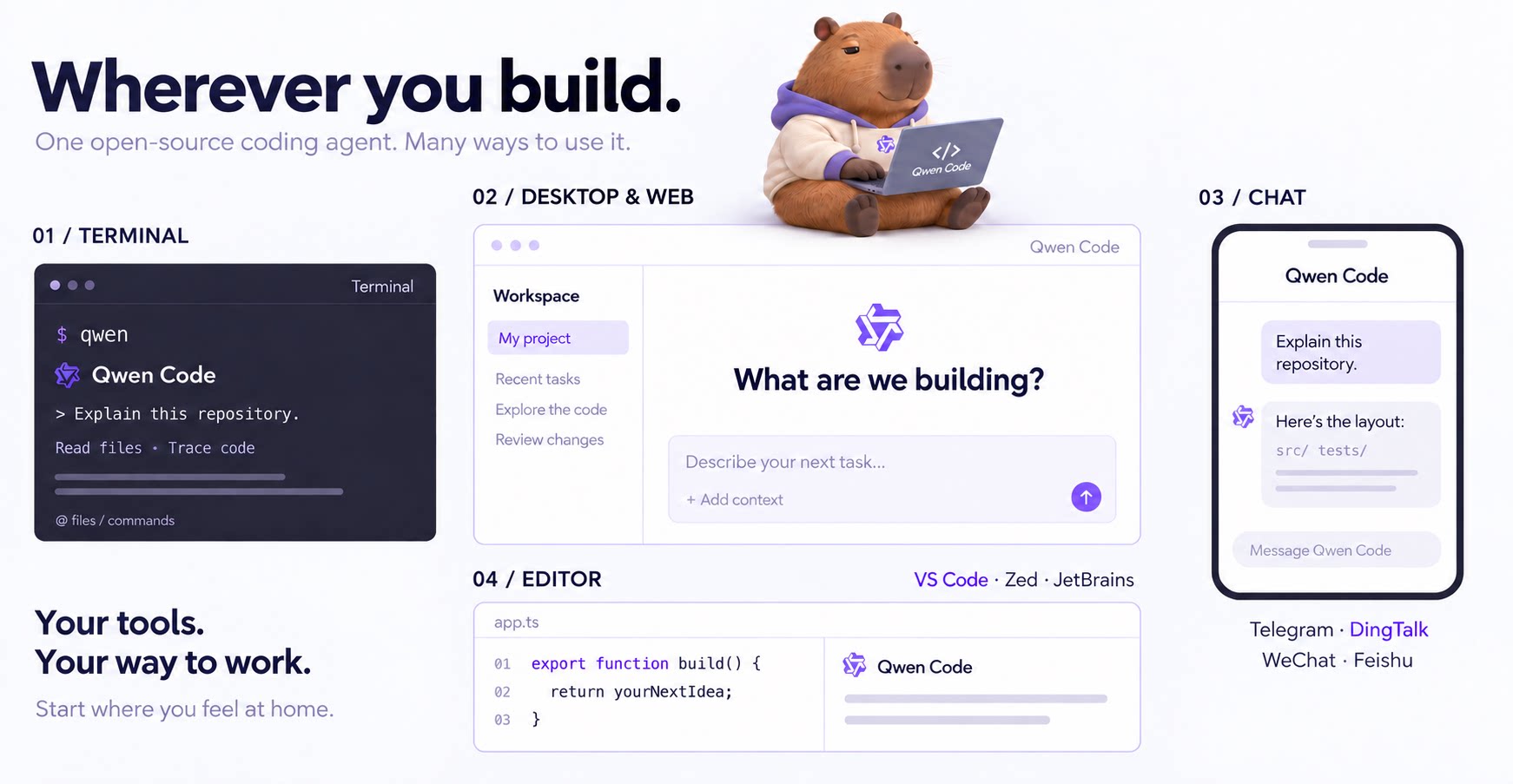
An open-source AI coding agent that lives in your terminal.

Run and supervise teams of coding agents from planning to merge. Any harness (Claude code, codex, +25 more). Desktop, web, mobile, and cloud agents.