

NousResearch/
hermes-agent

The agent that grows with you
245k
Agent Orchestrator is a local workspace for managing agent-driven development. You create workers for individual tasks, give them their own branch and worktree, and keep their conversation, terminal, files, browser preview, pull request, CI, and review state tied together. A project orchestrator can plan larger work, split it into tasks, and delegate to workers while the Kanban shows what is active, blocked, in review, or ready to merge.
Builders who want Claude Code, Codex, Cursor, and other coding agents coordinated in one project view.
You can split a repo into isolated agent tasks and follow each one from planning to merge without losing context.
Creates one task-specific worker with its own agent, model, interface, and isolated workspace.
Keeps a higher-level planning conversation for strategy, priorities, and task delegation across the repo.
Gives Git-backed workers their own branch and worktree to avoid branch collisions during parallel work.
Shows worker status from session, pull request, CI, and review signals on one shared board.
Lets you inspect a worker, review its changes, and send CI or review feedback back to the same task owner.
Keeps a worker's terminal, browser preview, changed files, and chat in the same session view.
Supports many coding agents, including Claude Code, Codex, Cursor, GitHub Copilot, and others.
git clone https://github.com/Untrivial-ai/agent-orchestrator.git
cd agent-orchestrator







Give every coding task its own agent, workspace, and feedback loop.
Plan and delegate larger outcomes with a project-aware orchestrator.
Follow every worker, pull request, CI run, and review in a live Kanban.
Download AO • Documentation • Releases • Contributing • Discord
English · 简体中文 · 日本語 · 한국어 · Español · Français · Deutsch · Português (Brasil)
One coding agent can handle a task. Running several across a project creates a different job: deciding what matters, splitting work cleanly, giving each agent the right context, preventing branch collisions, and following every change through review and merge.
AO is a local desktop workspace built for that job. Add a repository and create a worker session with the coding agent, model, and interface that fit the task. For Git-backed work, AO gives the worker its own branch and worktree. The task, conversation, terminal, changed files, browser preview, pull request, CI, and review state stay attached to that session from start to finish.
Behind the desktop app, AO's local daemon watches agent activity and source-control state. The result is a shared, live view of the project instead of a collection of disconnected terminals, branches, and browser tabs.
Download the latest AO desktop app for your platform. AO checks for updates automatically.
| Platform | Download |
|---|---|
| macOS (Apple silicon) | Download |
| macOS (Intel) | Download |
| Windows | Download |
| Linux (AppImage) | Download |
| Linux (Debian/Ubuntu) | Download |
| Linux (Fedora/RHEL) | Download |
Open Agent Orchestrator and point it at the repository you want AO to manage. The desktop app runs the daemon for you, so no CLI is required. See the installation guide for agent CLI setup and troubleshooting.
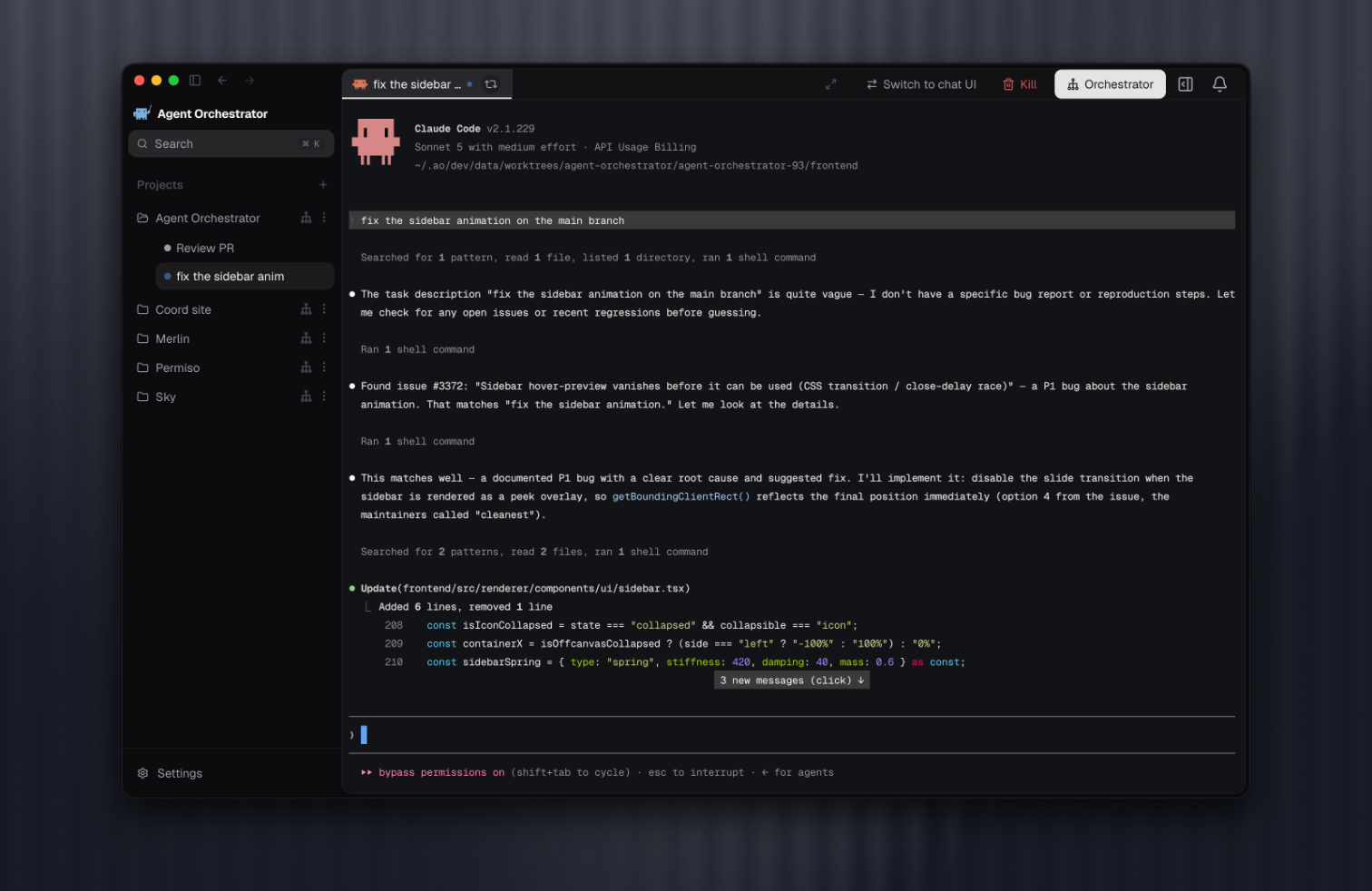
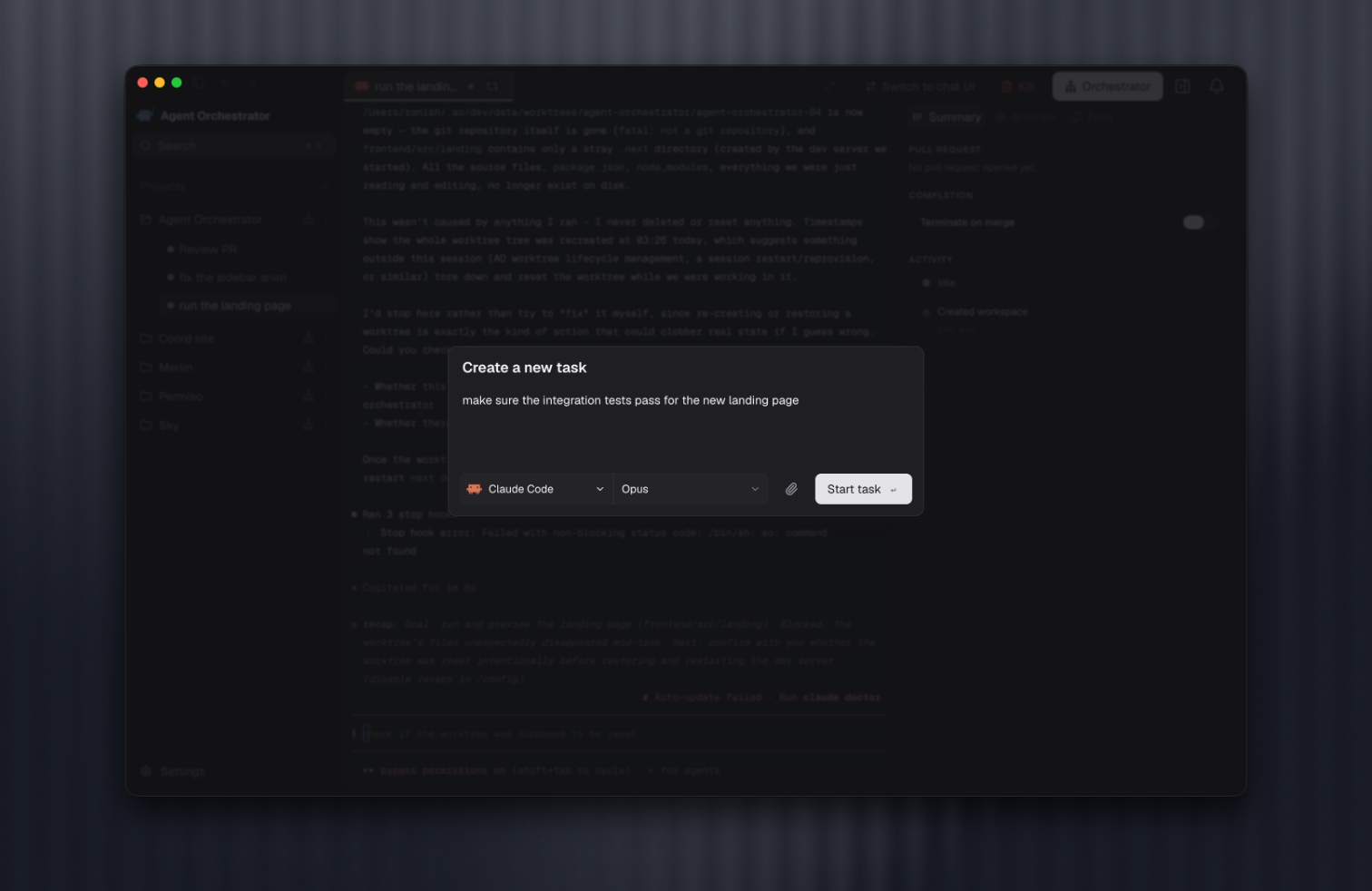
A worker is AO's unit of execution: one task, one coding agent, and one isolated workspace. Use New task when the work is already clear. Describe the outcome, choose an agent and model, attach relevant files, and work with the agent in structured Chat or its native terminal UI.
Open a worker at any time to continue the conversation, attach to its terminal, inspect its changes, use its isolated browser, review its pull request, or send CI and review feedback back to the same agent. This makes each task independently understandable and keeps parallel work from collapsing into one shared context.
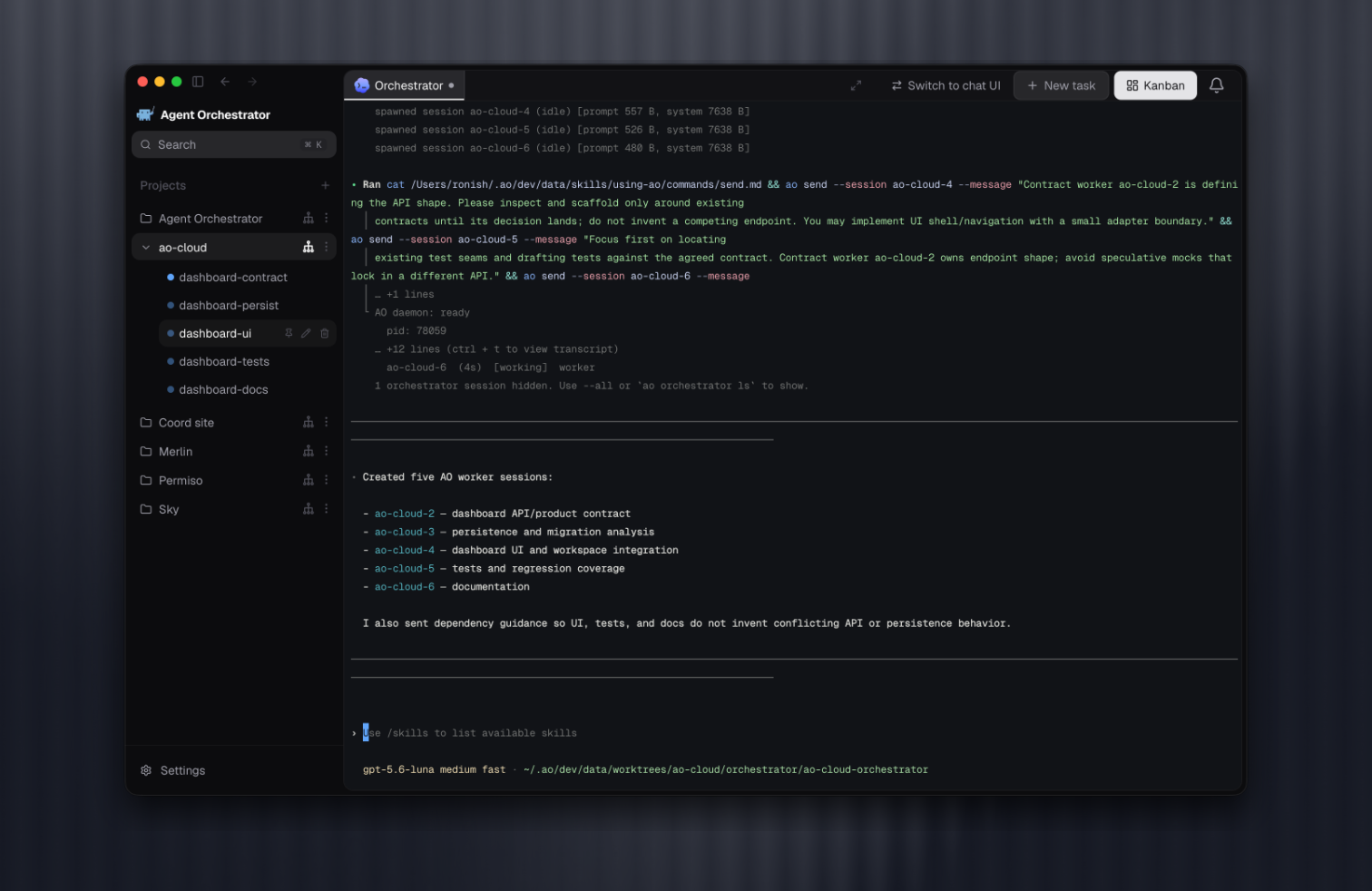
The project orchestrator is AO's persistent planning and coordination agent. It works at the level above individual tasks: the product direction, technical strategy, priorities, and sequence of work across the repository.
Use the orchestrator to explore an idea before implementation, brainstorm product and technical approaches, reason through tradeoffs, identify high-impact work, and turn an ambiguous outcome into a concrete plan. Its project-scoped conversation preserves goals, decisions, constraints, and earlier reasoning. It combines that planning history with repository context and live AO state, including active workers, ownership, pull requests, CI, and reviews. This keeps planning grounded in both the project and the work already underway.
When a plan becomes actionable, the orchestrator can break it into focused tasks, spawn or redirect workers, pass each worker the relevant context, follow their progress, and coordinate follow-up work. The orchestrator owns planning and delegation; workers own implementation, tests, commits, and pull requests.
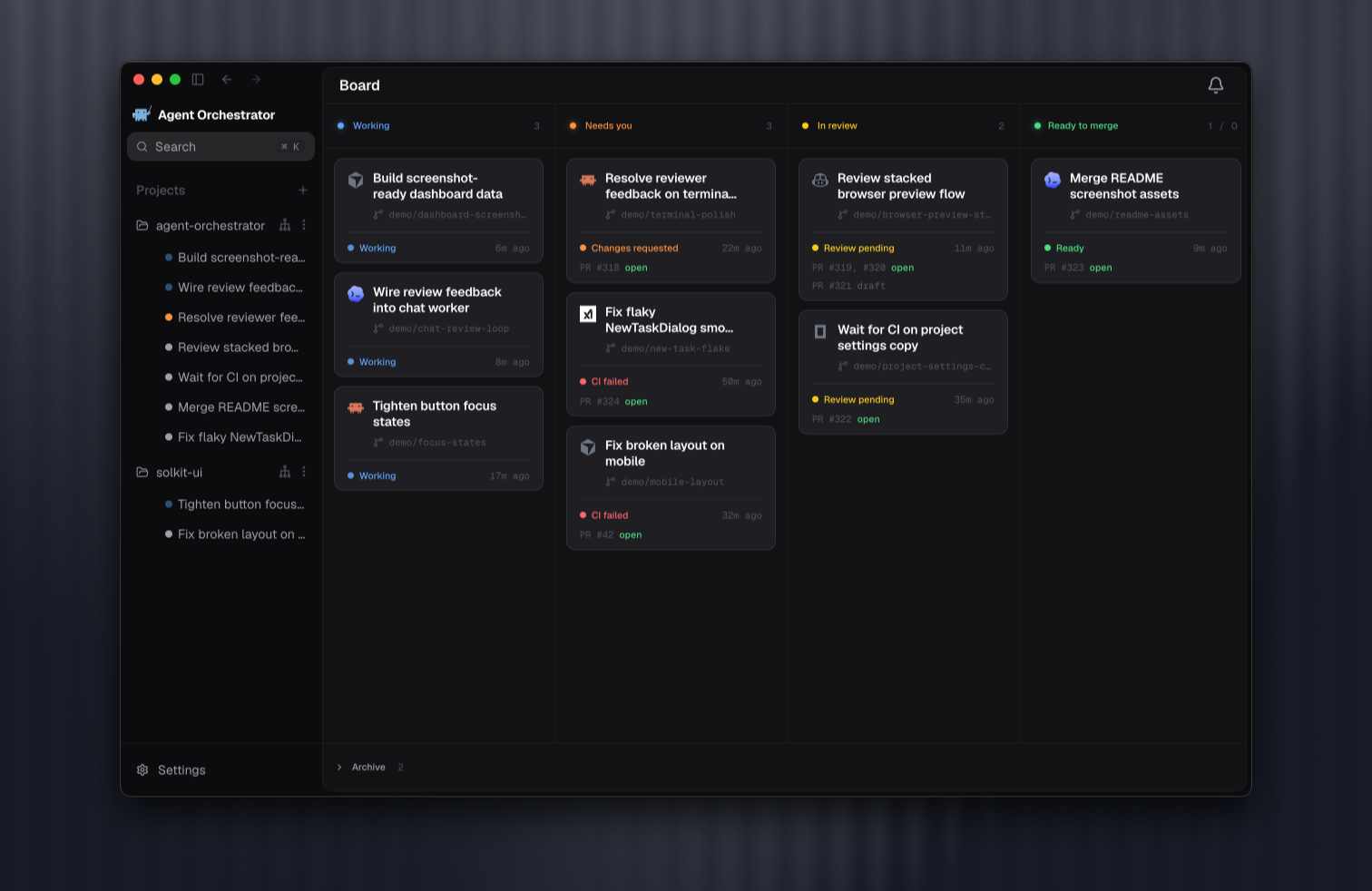
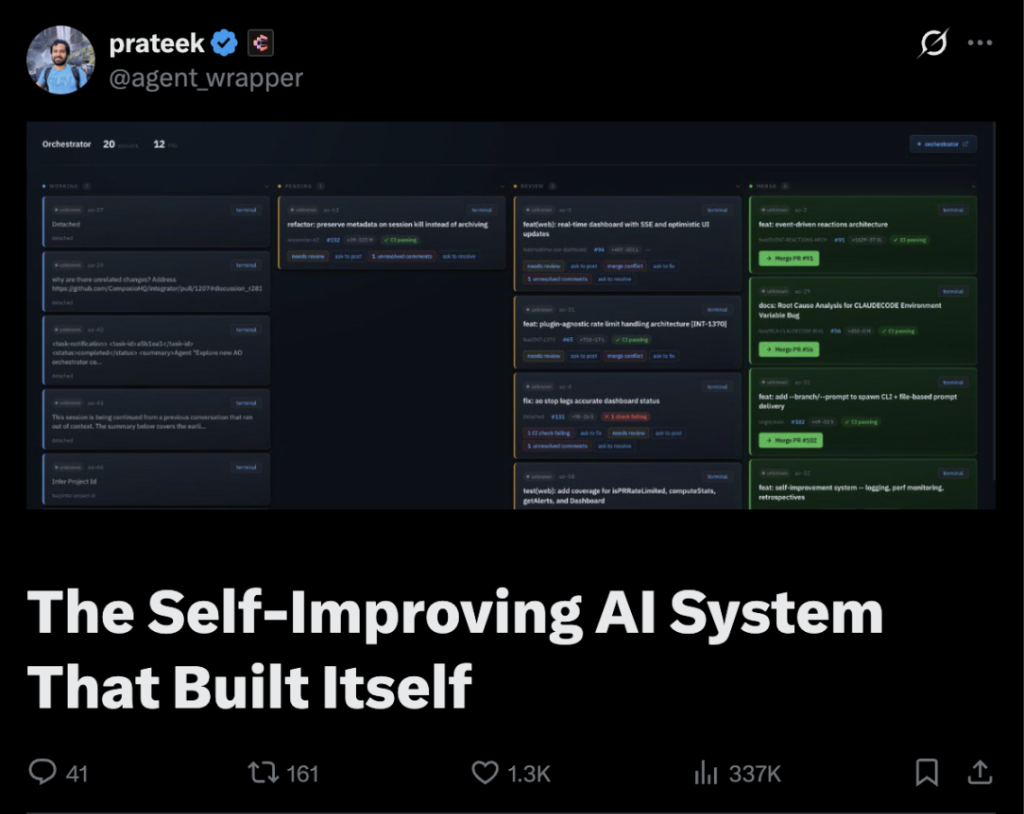
Every worker appears on the same live board, whether you started it from New task or the orchestrator delegated it. AO derives each card's position from session, pull request, CI, and review facts, turning the Kanban into an operational view of the project:
Each card keeps the task, agent, branch, activity, pull request, and status together. Open it to inspect the conversation or terminal, changed files, PR summary, reviews, and preview. The board shows what is moving, what is blocked, and where your attention will have the most impact.
AO works with the coding agents and source-control workflow you already use. Agents keep their native strengths; AO supplies the project context, isolated execution, coordination, and operational view that make them work as a system.
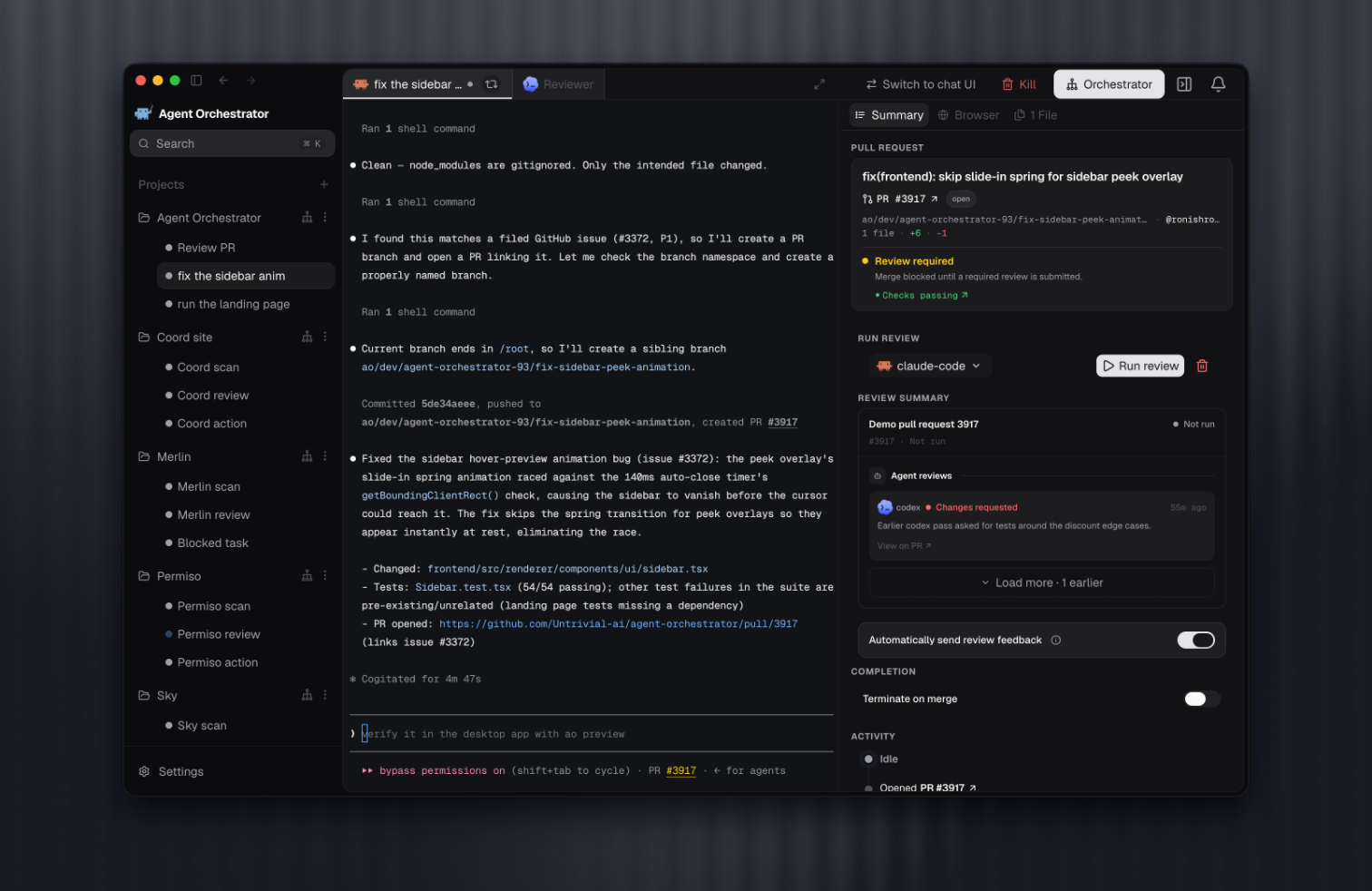
Pull requests and agent reviewsKeep CI, mergeability, reviewer state, and interactive agent reviews beside the worker, then return requested changes to the same owner. |
|
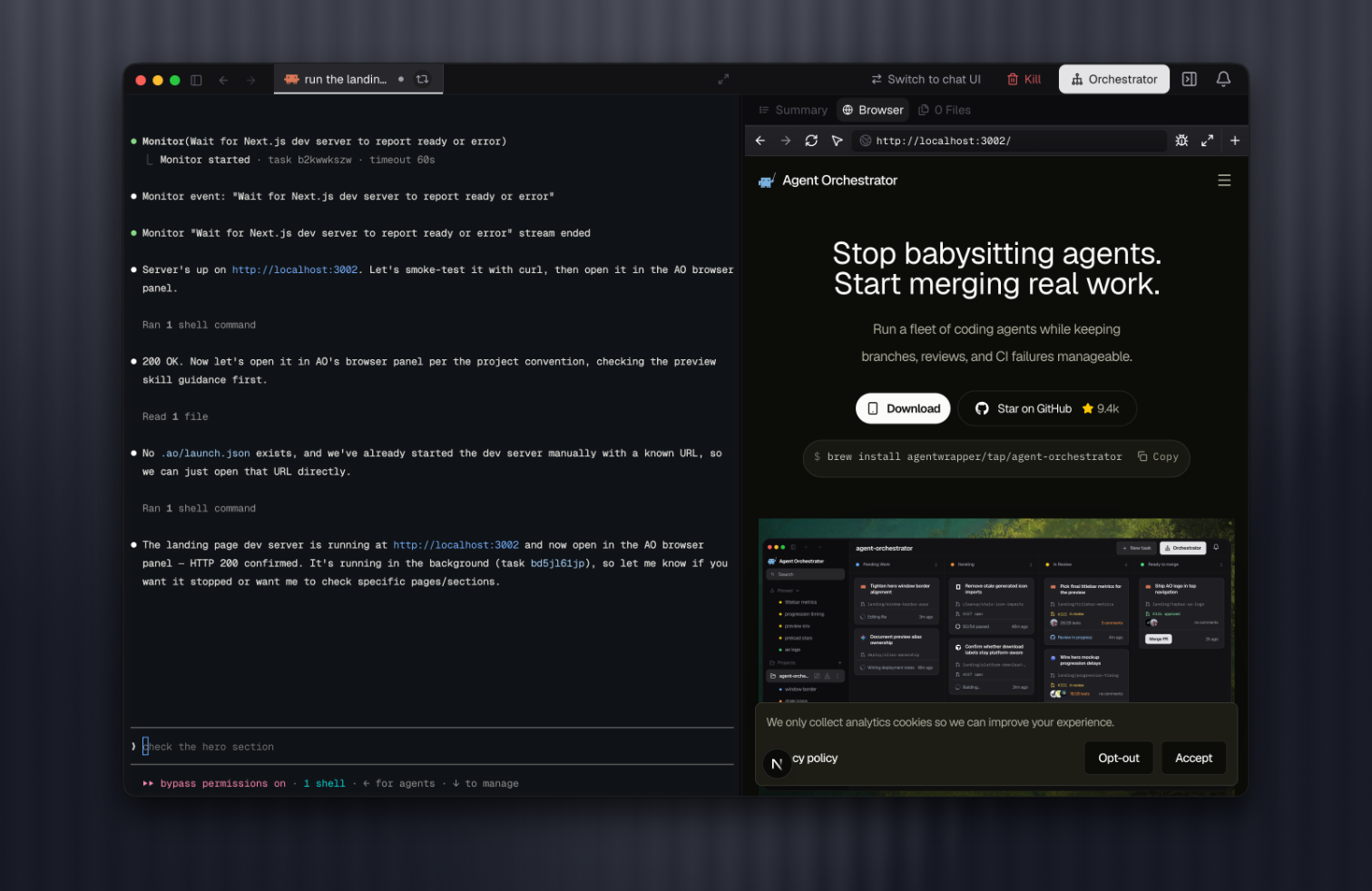
Agent-controllable browserPreview and inspect a worker's local app beside its interface. Browser profiles are isolated per worker so parallel UI tasks do not share state. |
|
Native interfaces, one supervisorUse structured Chat or the agent's native terminal UI while AO keeps task context, workspace state, and feedback in one place. |
|
27 coding agents supported through one supervised workflow.
 Claude Code Claude Code |  Codex Codex |  Cursor Cursor |
 opencode opencode |  Aider Aider |  GitHub Copilot GitHub Copilot |
 Grok Grok |  Kimi Kimi |  Pi Pi |
 Amp Amp |  Auggie Auggie |  Droid Droid |
 Crush Crush |  Cline Cline |  Goose Goose |
 Qwen Qwen |  Continue Continue |  Devin Devin |
 Kiro Kiro |  Kilo Code Kilo Code |  Vibe Vibe |
 Muse Muse |  Agy Agy |   Autohand Autohand |
 Kimchi Kimchi |  Prime Agent Prime Agent |  OMP OMP |
Use the interface that fits the moment: structured Chat or the agent's native terminal UI.
Open a bug report from your own GitHub account. A few sentences in your own words about what you did and what went wrong are enough. Add what you expected, reproduction steps, your AO version and OS, or a screenshot if you have them; these are helpful, not prerequisites.
A local coding agent can help you clarify the report and gather evidence using the bug-triage skill. Keep the issue body focused on your observations, with agent-collected logs, database excerpts, and investigation notes in separate attachments. Review any draft before submitting it under your own account. Please don't ask AO Bot to file issues on your behalf; reporter attribution matters.
For help describing a problem, join the bug-triaging channel on Discord. See contribution guidance for more detail.
Contributions are welcome across code, docs, triage, examples, and tests.
git clone https://github.com/Untrivial-ai/agent-orchestrator.git
cd agent-orchestrator
Start with the development guide for prerequisites, local setup, and test commands. Read CONTRIBUTING.md before opening a pull request, and use GitHub Issues for bugs and feature requests.
| Document | Start here when you need |
|---|---|
| Product documentation | Installation, agent setup, and day-to-day product usage. |
| docs/architecture.md | Backend mental model, lifecycle, persistence, CDC, status derivation, and daemon boundaries. |
| docs/backend-code-structure.md | Package ownership and where each backend concern belongs. |
| docs/cli/README.md | CLI behavior and daemon route mapping. |
| docs/development.md | Prerequisites, build steps, running tests, and troubleshooting for local development. |
| docs/STATUS.md | What currently ships on main and what remains in flight. |
|
|
Join Discord for help and contributor discussion, follow @ao_build for updates, or start a conversation in GitHub Issues.
AO uses privacy-preserving product usage and reliability metrics designed to exclude PII and project content. These metrics help us understand adoption and improve the product. To understand which teams and developers get the most value from AO, we also record the GitHub organization or account that owns a project (the owner segment only, never the repository, path, or URL); for a personal repository this is the owner's own username, so that single field is not anonymous. We use it to prioritize improvements and reach out for feedback. Learn more about telemetry and privacy.
Agent Orchestrator is available under the Apache License 2.0.
Sign in to join the discussion.
No comments yet. Be the first to say what this is good for.
The agent that grows with you

Open-source coding agent for your terminal, built in Rust and on a journey of continuous community improvement. Issues and PRs welcome.
A lightweight alternative to OpenClaw that runs in containers for security. Connects to WhatsApp, Telegram, Slack, Discord, Gmail and other messaging apps,, has memory, scheduled jobs, and runs directly on Anthropic's Agents SDK

OpenSquilla — Token-Efficient AI Agent with same budget, higher intelligence density
An open-source AI coding agent that lives in your terminal.

Orchestrate multiple coding agents from desktop and mobile