
NousResearch/
hermes-agent

The agent that grows with you
245k
Qwen Code is a coding agent for the terminal, with companion apps and integrations for editors, desktop, web, and chat. It supports skills, subagents, hooks, memory, MCP, and multiple model providers, so you can use one agent flow across different tools.
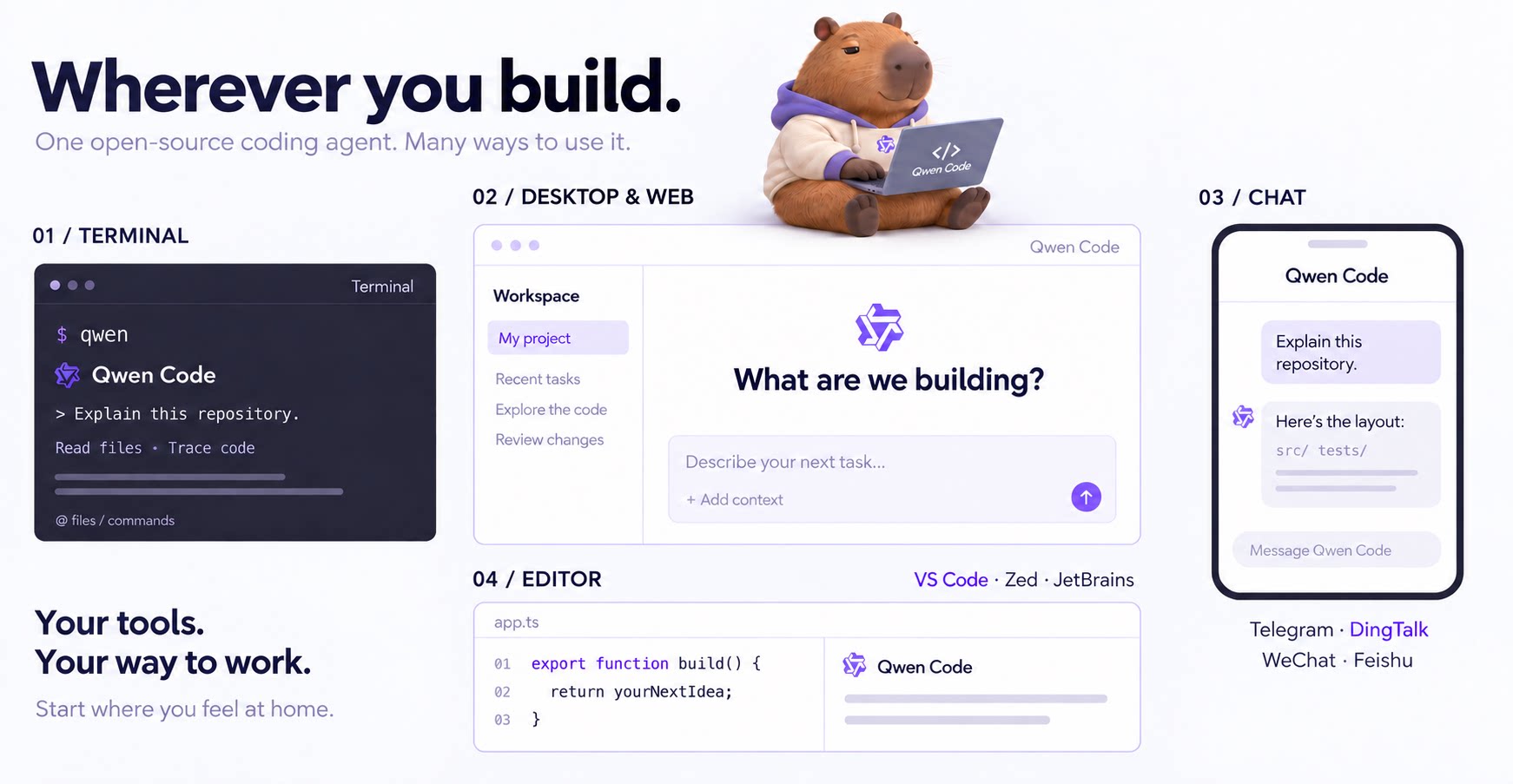
Builders who want an agent to work inside their terminal, editor, or connected chat tools.
You can ask an agent to inspect a repo, make changes, run tests, and review work without leaving your workflow.
Run `qwen` in a project and talk to the agent from your terminal.
Use built-in skills, Auto-Skills, subagents, and agent teams for structured coding workflows.
Add hooks, Auto-Memory, and session management to keep work consistent across runs.
Connect to tools and services through MCP, plus editor and chat integrations for VS Code, Zed, JetBrains, Telegram, DingTalk, WeChat, and Feishu.
Run `qwen -p "..."` for automation, or build on the TypeScript, Python, and Java SDKs.
Use `qwen serve` for HTTP + SSE clients, or `qwen serve --open` for the web UI.
curl -fsSL https://qwen-code-assets.oss-cn-hangzhou.aliyuncs.com/installation/install-qwen-standalone.sh | bash
irm https://qwen-code-assets.oss-cn-hangzhou.aliyuncs.com/installation/install-qwen-standalone.ps1 | iex
npm install -g @qwen-code/qwen-code@latest
brew install qwen-code
cd /path/to/your-project
qwen
Explain this repository and show me where to start.




The open-source AI coding agent for your terminal, editor, desktop, browser, and chat.
中文 | Deutsch | français | 日本語 | Русский | Português (Brasil) | 한국어
[!TIP] Qwen Code is actively iterating on itself — using its own agent and models to file issues, submit PRs, review code, and run tests. Powered by the community, driven by AI.
Linux / macOS:
curl -fsSL https://qwen-code-assets.oss-cn-hangzhou.aliyuncs.com/installation/install-qwen-standalone.sh | bash
Windows:
irm https://qwen-code-assets.oss-cn-hangzhou.aliyuncs.com/installation/install-qwen-standalone.ps1 | iex
Restart your terminal after installation to ensure environment variables take effect.
NPM (requires Node.js 22+):
npm install -g @qwen-code/qwen-code@latest
Homebrew (macOS / Linux):
brew install qwen-code
Open a terminal in your project and start Qwen Code:
cd /path/to/your-project
qwen
Inside the session, run /auth to configure your provider and API key. Then try:
Explain this repository and show me where to start.
See the Authentication Guide and Settings Reference for detailed setup.
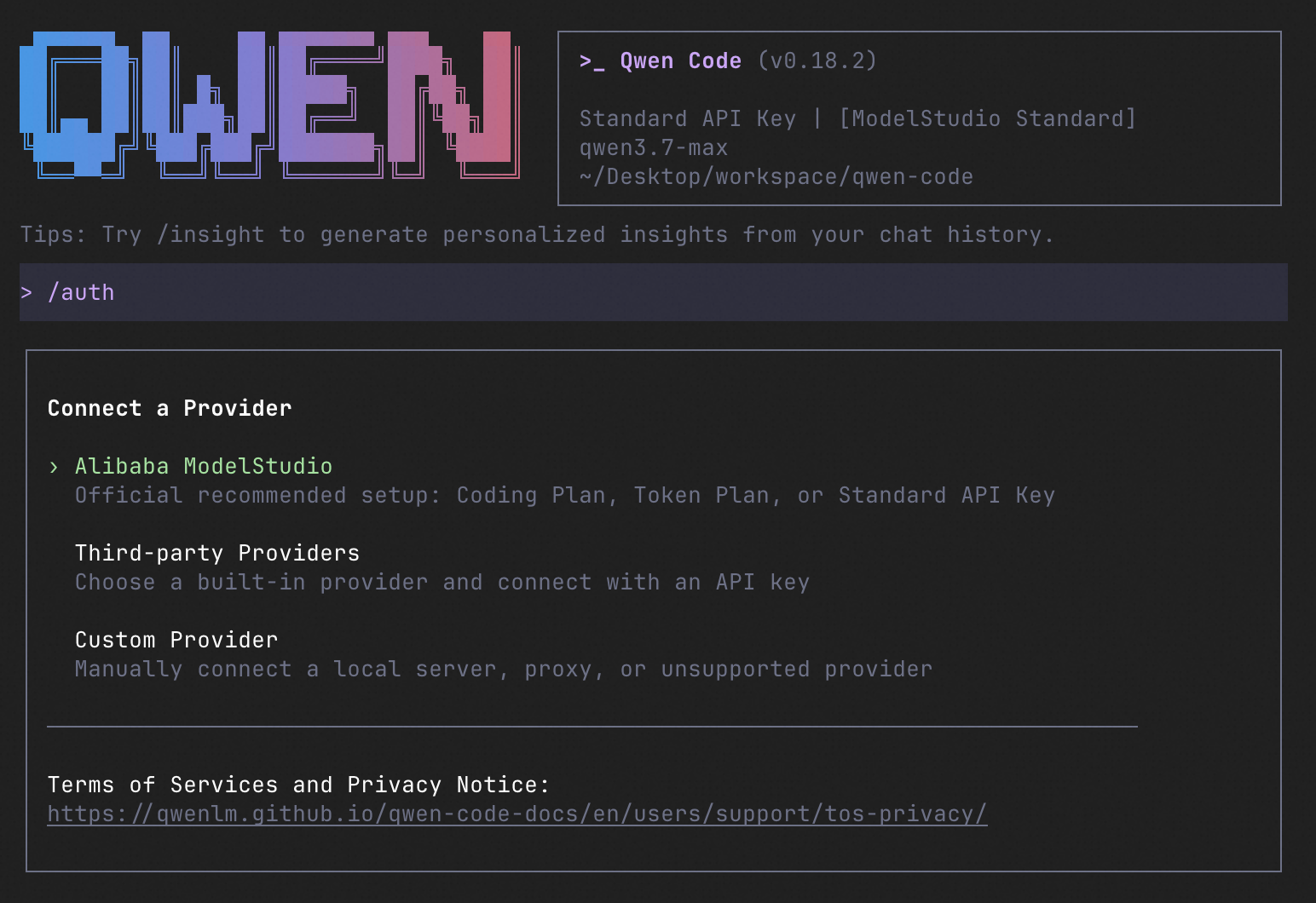
Choose the interface that fits your workflow:
| Interface | Get started |
|---|---|
| Terminal | Run qwen in your project — see Quick Start. |
| Desktop | Download Qwen Code Desktop for macOS, Windows, and Linux. |
| Web | Run qwen serve --open to open the Web UI in your browser. (experimental) |
| Editor | Set up VS Code, Zed, or JetBrains. |
| Chat | Connect Telegram, DingTalk, WeChat, or Feishu, then run qwen channel start. |
For automation and custom integrations:
qwen -p "..." in scripts, CI/CD, or batch jobs.qwen serve to connect clients over HTTP + SSE (ACP). (experimental) Daemon guide.import asyncio
from qwen_code_sdk import is_sdk_result_message, query
async def main() -> None:
result = query(
"Summarize the repository layout.",
{
"cwd": "/path/to/project",
"path_to_qwen_executable": "qwen",
},
)
async for message in result:
if is_sdk_result_message(message):
print(message["result"])
asyncio.run(main())
If you know Claude Code, you already know Qwen Code — and then some. We've put significant effort into bringing Qwen Code to feature parity with Claude Code, improving both breadth and reliability across the board.
| Feature | Qwen Code | Claude Code |
|---|---|---|
| SubAgents, Agent Teams, Dynamic Workflows | ✓ | ✓ |
| Auto-Memory, Auto-Skills, Hooks | ✓ | ✓ |
| Built-in Skills (/review, /batch, /loop, /bugfix…) | ✓ | ✓ |
| MCP, Plan Mode, LSP Integration | ✓ | ✓ |
| Auto Mode, Sandbox, Git Worktrees | ✓ | ✓ |
| Computer Use (desktop automation) | ✓ | ✓ |
| IDE Plugins (VS Code / JetBrains / Zed) | ✓ | ✓ |
| SDK | ✓ | ✓ |
| Headless Mode, Session Management | ✓ | ✓ |
| Open-source — model and framework | ✓ | — |
| Multi-protocol (OpenAI / Anthropic / Gemini / Qwen + any provider) | ✓ | — |
| Agent Arena (multi-model head-to-head on same task) | ✓ | — |
Daemon Mode — qwen serve (multi-client shared agent) | ✓ | — |
| IM Channels (Telegram / DingTalk / WeChat / Feishu) | ✓ | — |
| Configuration | Value |
|---|---|
| Dataset | princeton-nlp/SWE-bench_Verified, 500 cases |
| Runs | 3 trials per version, 1,500 jobs per version; 7 Qwen Code versions |
| Model | Qwen 3.7 Max |
| Sampling | temperature=1, top_p=0.95 |
| Thinking / Reasoning | interleaved_thinking=true, thinking_type=adaptive, reasoning_effort=high |
| Context / Output Limits | context_1m=true, model_context_length=1,000,000, max_tokens=64,000, model_max_tokens=65,535 |
| Harness Limits | max_iterations=500, runtime_timeout_sec=7,200, agent_timeout_multiplier=3.0 |
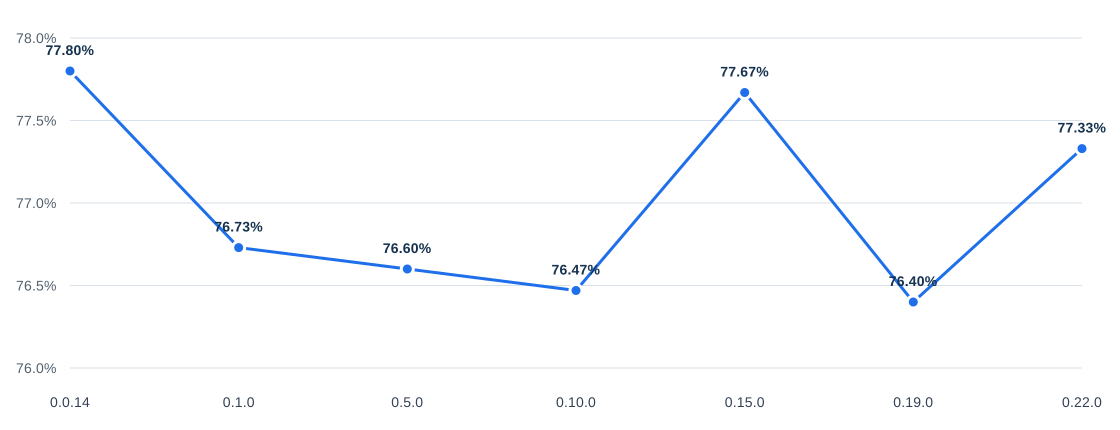
| Version | Avg Score | Pass Rate | pass@3 | pass^3 |
|---|---|---|---|---|
| 0.0.14 | 77.80% | 84.6% | 84.6% | 69.2% |
| 0.1.0 | 76.73% | 84.6% | 84.6% | 68.0% |
| 0.5.0 | 76.60% | 83.0% | 83.0% | 68.4% |
| 0.10.0 | 76.47% | 84.4% | 84.4% | 67.4% |
| 0.15.0 | 77.67% | 84.6% | 84.6% | 68.6% |
| 0.19.0 | 76.40% | 85.0% | 85.0% | 65.8% |
| 0.22.0 | 77.33% | 84.4% | 84.4% | 68.0% |
Qwen Code Desktop — Official desktop app for macOS, Windows, and Linux
AionUi — A modern GUI for command-line AI tools including Qwen Code
Gemini CLI Desktop — A cross-platform desktop/web/mobile UI for Qwen Code
🦞 Qwen Code Claw — Let other agents (Claude, Codex, etc.) delegate coding tasks to Qwen Code via ACP. Paste this prompt into your agent:
Use Qwen Code as a coding agent. First, fetch and read this skill reference:
https://raw.githubusercontent.com/QwenLM/qwen-code/refs/heads/main/.qwen/skills/qwen-code-claw/SKILL.md
Then follow the instructions inside to install, authenticate, and use Qwen Code via acpx for all coding tasks.
bailian-cli). Extends Qwen Code with image/video generation, knowledge retrieval, app orchestration, and model deploymentContributions are welcome! See CONTRIBUTING.md for guidelines.
This project was originally based on Google Gemini CLI v0.8.2. We gratefully acknowledge the Gemini CLI team's excellent work. Starting from Qwen Code v0.1, we stopped syncing with upstream and began independent development as a multi-protocol, multi-platform agent framework with deep integrations for Qwen models and beyond.
Sign in to join the discussion.
No comments yet. Be the first to say what this is good for.
The agent that grows with you

Open-source coding agent for your terminal, built in Rust and on a journey of continuous community improvement. Issues and PRs welcome.
A lightweight alternative to OpenClaw that runs in containers for security. Connects to WhatsApp, Telegram, Slack, Discord, Gmail and other messaging apps,, has memory, scheduled jobs, and runs directly on Anthropic's Agents SDK

OpenSquilla — Token-Efficient AI Agent with same budget, higher intelligence density

Run and supervise teams of coding agents from planning to merge. Any harness (Claude code, codex, +25 more). Desktop, web, mobile, and cloud agents.

Orchestrate multiple coding agents from desktop and mobile