
koala73/worldmonitorConnectors
Real-time global intelligence dashboard. AI-powered news aggregation, geopolitical monitoring, and infrastructure tracking in a unified situational awareness interface
86k
Vessel Browser is a Chromium-based browser that lets agents act on the web while keeping the human in the loop. It combines a visible browser UI with MCP access, persistent runs, approvals, checkpoints, and browser state that survives longer sessions. It also supports built-in chat, bookmarks with agent metadata, page change tracking, and a supervisor sidebar for reviewing or steering work. External harnesses can connect through the local MCP server or the `vessel-browser-mcp` proxy.

Builders who want an agent to browse, research, and fill forms in a visible browser instead of a hidden automation run.
You can let an agent work across long web sessions without losing context or control.
The agent works in a normal browser window, so you can see pages, follow along, and take over when needed.
External agents connect through the local MCP server, or through `vessel-browser-mcp --stdio` for stdio-based harnesses.
Vessel keeps conversation threads, run history, checkpoints, bookmarks, and page changes across interrupted work.
You can approve once, approve by run or domain, reject with steering, and undo the last mutating action.
The browser includes reader mode, form autofill, page diff tracking, page highlights, bookmarks, and research workflows.
npm install -g @quanta-intellect/vessel-browser
vessel-browser
npx @quanta-intellect/vessel-browser
curl -fsSL https://raw.githubusercontent.com/unmodeled-tyler/vessel-browser/main/scripts/install.sh | bash
fnm use
npm install
npm run dev
vessel-browser
llama-server -m /path/to/model.gguf --port 8080 --ctx-size 32768


Vessel is a simple, clean web browser with an AI assistant built in. Browse the web normally, then ask Vessel to help research, navigate pages, summarize what you are reading, fill forms, or keep track of longer tasks.
Unlike invisible browser automation, Vessel shows you what the AI is doing in a real browser window. You can follow along, approve important actions, pause or redirect the work, and take over whenever you want.
Linux is the most mature install target today. macOS release packaging is available from source.
Vessel is in active development. Treat it as early software, especially for sensitive browsing or account access.
https://github.com/user-attachments/assets/0a72b48a-873a-4eb0-b8f2-23e34d8472c4
Want the complete AI toolkit from day one? Start a 7-Day Free Trial of Vessel Premium — $5.99/mo.
Linux AppImage from GitHub Releases:
Vessel-<version>-x64.AppImagechmod +x Vessel-*.AppImage./Vessel-*.AppImageCtrl+,) to choose your AI provider and review advanced connection optionsnpm install -g @quanta-intellect/vessel-browser
vessel-browser
Or run it directly without installing:
npx @quanta-intellect/vessel-browser
curl -fsSL https://raw.githubusercontent.com/unmodeled-tyler/vessel-browser/main/scripts/install.sh | bash
Vessel development uses Node.js 22. If you use fnm, run fnm use from the repo root to pick up .node-version.
fnm use
npm install
npm run dev
If you want extra local AI tracing in development, create an optional src/main/telemetry/trace-logger.local.cjs file. Vessel will load it only in local dev builds, and packaged production builds ignore it.
Most AI tools can answer questions about the web. Vessel is for actually working on the web: reading pages, following links, comparing information, filling forms, tracking changes, and keeping longer browsing sessions organized.
Vessel keeps that work visible. The AI uses a real browser, so you can see the pages it opens, the choices it makes, and the places where it needs your approval. You are never stuck watching a hidden automation run or guessing what happened after the fact.
For power users and developers, the same foundation also supports external agents, MCP clients, persistent sessions, checkpoints, and browser automation workflows.
Ctrl+L) — a secondary operator surface for harness-driven workflows and future runtime commandsCtrl+Shift+L) — live supervision across ten tabs, including a durable Run Inbox, conversation Threads, approvals, checkpoints, changes, and ResearchF12) — inspect console output, network requests, and MCP/agent activity in a resizable panel at the bottom of the window; export logs by category and date range as JSONCtrl+N; print the active page with Ctrl+P or save it directly as PDF with Ctrl+Shift+Pundo_last_action toolintent (what the page is for), expectedContent (what to expect on the page), keyFields (important form fields), agentHints (arbitrary directives), and a stored pageSchema; humans can create and edit this metadata directly in the Bookmarks tab, and all fields are searchablepageType (article, product, form, search, checkout, login, dashboard), primaryEntity (structured fields for products and articles), formFields (with names, types, labels, selectors), and actionButtons (with inferred intents: submit, addToCart, login, etc.); schema is attached to every content extraction resultflow_start; progress is tracked step-by-step with flow_advance and visible in the sidebar throughout executionChanged badge in the address bar when the title, headings, or main content differ on a later visit; expand it to see a compact summary of what changed since the last snapshotCtrl+Shift+F) — hide all chrome, content fills the screenThe Supervisor sidebar now keeps longer-running work understandable across Chat, external MCP agents, scheduled jobs, and Research:
historyRetentionDays (90 days by default; supported values are 7, 30, 90, 180, 365, or null for no automatic expiry). Active runs and unarchived threads are preserved.Conversation history is encrypted through Electron's safeStorage API when encryption is available. If secure storage is unavailable, Vessel keeps conversations in memory for that session instead of writing plaintext chat history. Run records redact sensitive argument fields and limit stored output size before persistence or export.
Most browsers treat automation as secondary and assume a human is the primary actor. Vessel is the opposite: it is the browser for the agent, with a visible interface that keeps the human in the loop.
That means the product should optimize for:
| Layer | Technology |
|---|---|
| Engine | Chromium (Electron 40) |
| UI Framework | SolidJS |
| Language | TypeScript |
| Build | electron-vite + Vite |
| AI Control | External agent harnesses (Hermes Agent, OpenClaw, MCP clients) + built-in chat (Anthropic, OpenAI, Ollama, llama.cpp, and any OAI-compatible endpoint) |
| Content Extraction | @mozilla/readability |
Main Process                                  Renderer (SolidJS)
├── TabManager (WebContentsView[])            ├── TabBar, AddressBar
├── AgentRuntime (session + supervision)      ├── CommandBar (secondary surface)
├── Run, conversation, and policy managers    ├── AI Sidebar (Supervisor/Runs/Threads/Chat/...)
├── MCP server for external agents            ├── DevTools Panel (Console/Network/Activity)
├── AI providers (Anthropic + OAI-compatible) ├── Agent Transcript Dock
├── Bookmarks, checkpoints, and page history  └── Signal stores (runtime/runs/conversations/policies/...)
└── IPC handlers ◄──contextBridge──► Preload API
Each browser tab is a separate WebContentsView managed by the main process. The browser chrome (SolidJS) runs in its own view layered on top. All communication between renderer and main goes through typed IPC channels via contextBridge.
The sidebar Skills tab renders skill forms entirely in the renderer and passes the rendered prompt to the built-in agent via the same query() path used by the Chat tab — no additional IPC surface is needed. The Changes tab reads the current page's diff timeline through IPC and unlocks persisted history for Premium users. The Research tab has a dedicated IPC surface for its state machine: briefing is available to everyone, while objective approval, parallel browser sub-agents, report synthesis, and markdown export are Premium-gated during the beta.
The installer:
~/.local/share/vessel-browservessel-browser launcher in ~/.local/binvessel-browser-launch helper in ~/.local/binvessel-browser-update helper in ~/.local/binvessel-browser-status helper in ~/.local/bin~/.config/vessel/vessel-settings.json with MCP port 3100~/.config/vessel/mcp-stdio-snippet.json~/.config/vessel/mcp-http-snippet.jsonvessel-browser-mcp helper that can run as a stdio-to-HTTP proxy (--stdio) or print config snippetsThe packaged AppImage path:
Windows packaged releases:
Vessel-<version>-x64-setup.exe NSIS installerYou do not need to uninstall Vessel before installing a newer Windows release. Uninstall first only if you are recovering from a broken install or intentionally removing local Vessel data.
After install:
vessel-browser
# Use the pinned Node.js 22 runtime
fnm use

# Install dependencies
npm install

# If Electron download fails, use a mirror:
ELECTRON_MIRROR="https://npmmirror.com/mirrors/electron/" npm install

# Development (with HMR)
npm run dev

# Production build
npm run build

# Smoke-test the MVP release path
npm run smoke:test

# Package an unpacked Linux app
npm run dist:dir

# Package a Linux AppImage
npm run dist

# Package an unpacked universal macOS app bundle (run on macOS)
npm run dist:mac:dir

# Package universal macOS DMG + ZIP artifacts (run on macOS)
npm run dist:mac

# Verify a universal macOS build contains Intel and Apple Silicon slices
npm run verify:mac:universal

# Package signed macOS DMG + ZIP artifacts (run on macOS with signing set up)
npm run dist:mac:signed
Notes:
npm run dev still launches the stock Electron binary, so Linux may continue showing the default Electron gear icon in developmentnpm run dist / npm run dist:dir use the Vessel app iconnpm run build:icon:mac regenerates resources/vessel-icon.icns from resources/vessel-icon.png for macOS packagingnpm run dist:mac and npm run dist:mac:dir build universal macOS artifacts by default, so the same app runs natively on Intel and Apple Silicon Macsnpm run dist:mac:x64 and npm run dist:mac:arm64 are available when you need smaller architecture-specific test artifactsnpm run verify:mac:universal uses lipo to confirm the packaged app executable and Electron framework include both x86_64 and arm64 slicesnpm run dist:mac, npm run dist:mac:dir, npm run dist:mac:x64, and npm run dist:mac:arm64 intentionally disable auto-signing so local packaging works on any Mac without keychain setupnpm run dist:mac:signed and npm run dist:mac:dir:signed build universal artifacts and use normal electron-builder signing discovery; if your login keychain has duplicate Apple certs, clean those up or use a dedicated keychain before running the signed pathxvfb-run -a npm run smoke:testVessel is designed to act as the browser runtime that your external agent harness drives.
Ctrl+,) to confirm MCP status, copy the endpoint, or change the MCP portvessel-browser-mcp --stdio as the MCP command (auth is resolved automatically), or connect directly to http://127.0.0.1:<mcpPort>/mcp with the bearer token from ~/.config/vessel/mcp-auth.jsonNotes:
2026-07-28 protocol revision, including server/discover3100Ctrl+,) and enable Chat Assistant to set a provider and modelllama.cpp (Local) is a first-class chat provider in Settings and targets http://localhost:8080/v1 by default; Vessel auto-fetches the active model from llama-serverllama-server, use --ctx-size 16384 minimum and 32768 recommended for reliable Vessel agent loops; lower values often fail once prompt, tool schema, and tool history accumulateSign in to join the discussion.
No comments yet. Be the first to say what this is good for.
Real-time global intelligence dashboard. AI-powered news aggregation, geopolitical monitoring, and infrastructure tracking in a unified situational awareness interface
High-performance code intelligence MCP server. Indexes codebases into a persistent knowledge graph — average repo in milliseconds. 158 languages, sub-ms queries, 99% fewer tokens. Single static binary, zero dependencies.
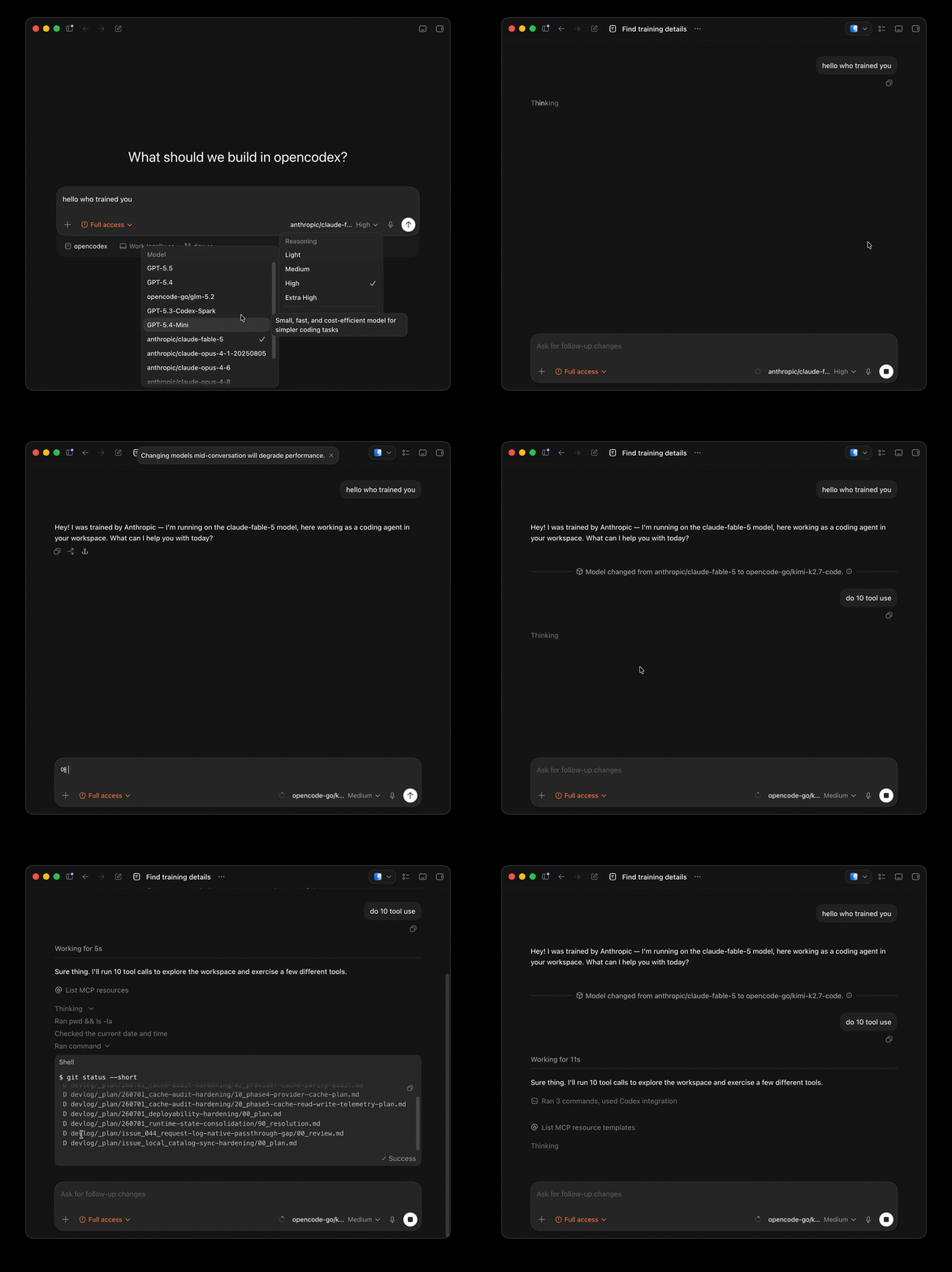
Universal provider proxy for OpenAI Codex & Claude Code — use any LLM (Claude, Gemini, Grok, DeepSeek, Ollama…) with Codex CLI, App, SDK, and Claude Code

Git-native persistent memory for AI coding agents. Implements Google OKF v0.2 with sub-300µs in-memory BM25 search, embedded MCP server, and progressive disclosure. Slashes token bloat by 80% with zero external databases or dependencies. Built in pure Go.

Local-first code intelligence graph for MCP and CLI. Builds a persistent map of your codebase so AI coding tools read only what matters, with benchmarked context reductions on reviews and large-repo workflows.

Stop your AI from making things up — it proposes, deterministic tools decide, every claim checked against ground truth with evidence. Grounded facts and context survive resets. Reverse engineering is the proving ground. MCP server + CLI.