
koala73/worldmonitorConnectors
Real-time global intelligence dashboard. AI-powered news aggregation, geopolitical monitoring, and infrastructure tracking in a unified situational awareness interface
86k
Memcord gives your agent a local memory layer for chat history. It stores conversations, creates summaries, and lets you search or query past decisions through MCP tools and slash commands.
Builders who want their agent to keep long-term memory across projects without sending data to the cloud.
You can pick up old context, search past decisions, and keep working without re-explaining everything.
Saves chat history on your machine with no cloud dependency or database.
Lets you search past conversations and ask natural-language questions about them.
Creates summaries for stored conversations with pluggable backends.
Keeps separate memory scopes for different projects and auto-detects the active slot.
Generates config for Claude Code, Claude Desktop, VSCode, and other MCP apps.
Supports importing, merging, and deduplicating conversation history.
curl -fsSL https://github.com/ukkit/memcord/raw/main/install.sh | bash
irm https://github.com/ukkit/memcord/raw/main/install.ps1 | iex
cd /path/to/memcord
uv run python scripts/generate-config.py --scope user
# 1. Once you are in claude code, initialize the project with a memory slot (one-time setup)
memcord_init "." "my-project-name"
# OR
memcord_init "my_project_name"
# Creates .memcord file containing "my-project-name"

# 2. Start saving your conversations
/memcord-save-progress  # Auto-detects slot from .memcord file
git clone https://github.com/ukkit/memcord.git
cd memcord
uv venv && uv pip install -e .
uv run python scripts/generate-config.py

This privacy-first, self-hosted MCP server helps you organize chat history, summarize messages, search across past chats with AI — and keeps everything secure and fully under your control.








Transform your Claude conversations into a searchable, organized knowledge base that grows with you
What's new in v4.3.6 — removes two unnecessary dependencies (
pandas,python-magic) from a fresh install; CSV/TSV import now uses the standard library instead of pandas.
Python 3.10+ — python.org
uv (Python package manager) — install with:
macOS / Linux:
curl -LsSf https://astral.sh/uv/install.sh | sh
Windows (PowerShell):
powershell -ExecutionPolicy ByPass -c "irm https://astral.sh/uv/install.ps1 | iex"
macOS / Linux:
curl -fsSL https://github.com/ukkit/memcord/raw/main/install.sh | bash
Windows (PowerShell):
irm https://github.com/ukkit/memcord/raw/main/install.ps1 | iex
This will:
Re-run the same installer command from Quick Start from the same folder where memcord is installed — it detects an existing installation and updates it in place instead of cloning a fresh copy:
macOS / Linux:
curl -fsSL https://github.com/ukkit/memcord/raw/main/install.sh | bash
Windows (PowerShell):
irm https://github.com/ukkit/memcord/raw/main/install.ps1 | iex
This will:
memory_slots/) and generated configs untouchedcd /path/to/memcord
git pull
uv pip install -e . --upgrade
uv run python scripts/generate-config.py # Regenerate configs
# Optional: Enable auto-save hooks (new in v2.5.0)
uv run python scripts/generate-config.py --install-hooks
The --install-hooks flag is idempotent — it merges into existing .claude/settings.json without overwriting other settings or hooks.
Fresh installs register memcord globally (~/.claude.json) by default — available in every project. If you have an older install that's still project-scoped (a local .mcp.json), switch it explicitly — re-running the updater alone won't do this for you, since it auto-detects and preserves an existing project-scoped setup on purpose:
cd /path/to/memcord
uv run python scripts/generate-config.py --scope user
Verify from a different project directory: claude mcp list should now show memcord. The original .mcp.json is left in place and still works (harmless, just redundant) — delete it only if you want that directory to stop pinning its own local copy instead of falling through to the global one.
The 17 memcord-* slash commands ship in .claude/commands/ and are already usable from inside the memcord checkout the moment you clone it. To use them from any project directory, install them globally into ~/.claude/commands/:
uv run python scripts/generate-config.py --manage-commands   # interactive picker
uv run python scripts/generate-config.py --commands all      # non-interactive: install all
Fresh installs prompt for this automatically (skipped when non-interactive, e.g. curl | bash). Re-run anytime to change your selection — only memcord's own command files are ever added or removed.
# 1. Once you are in claude code, initialize the project with a memory slot (one-time setup)
memcord_init "." "my-project-name"
# OR
memcord_init "my_project_name"
# Creates .memcord file containing "my-project-name"

# 2. Start saving your conversations
/memcord-save-progress  # Auto-detects slot from .memcord file
# Just use slash commands - no slot name needed!
/memcord-read           # Reads from bound slot
/memcord-save           # Saves to bound slot
/memcord-save-progress  # Summarizes and saves
memcord_select_entry "2 hours ago"    # Jump to a point in the timeline
memcord_list                          # List all slots
memcord_search "API design"           # Full-text search
memcord_query "What did we decide?"   # Natural language query
See Complete Tools Reference for all 23 tools with full parameters and examples.
All read and write operations follow the same slot resolution priority:
slot_name argument (always wins)memcord_use or memcord_name).memcord binding file in the current working directoryWhen the .memcord binding is used and the slot already exists, it is also auto-activated for the rest of the session — so subsequent operations skip re-detection automatically.
This means after memcord_init, a fresh session (no memcord_use call needed) will correctly route memcord_save, memcord_save_progress, memcord_configure, and memcord_read to the bound slot.
Point a slot's data file at any directory — e.g. a Dropbox/OneDrive folder — to share it across devices, via memcord_configure. Once linked, the slot's settings (summarizer backend, etc.) travel with the data too, so every device sharing the folder sees the same configuration.
New memory in an external path:
memcord_name "shared_slot"
memcord_configure action="set" key="custom_storage_path" value="D:\Dropbox\shared"
memcord_save "..."   # writes directly to the external path
Migrate an existing memory:
memcord_configure action="set" key="custom_storage_path" value="D:\Dropbox\shared"
# Existing data is moved automatically — memcord_read/memcord_list keep working
Each device needs to run the set command once with its own local path to the shared folder. See Tools Reference — memcord_configure for migration/collision details.
Memcord supports four pluggable summarizer backends (nltk, sumy, semantic, transformers), switchable per slot via memcord_configure action="set" key="summarizer_backend" value="..." — no restart required. New slots default to sumy (no downloads); existing slots keep nltk for backward compatibility.
See Tools Reference — memcord_configure and Features Guide for the full backend comparison, install instructions, and the MEMCORD_SUMMARIZER env var override.
The installer auto-configures all supported IDEs. For manual setup or troubleshooting, see the detailed guides:
| IDE / Client | Guide |
|---|---|
| Claude Code CLI | Installation Guide — Claude Code |
| Claude Desktop | Installation Guide — Claude Desktop |
| VSCode + GitHub Copilot | VSCode Setup Guide |
| Google Antigravity | Installation Guide — Other MCP Apps |
| Configuration templates | config-templates/ (README) |
git clone https://github.com/ukkit/memcord.git
cd memcord
uv venv && uv pip install -e .
uv run python scripts/generate-config.py
See the Complete Installation Guide for updating, advanced options, and custom commands.
| Guide | Description |
|---|---|
| Installation Guide | Complete setup instructions for all MCP applications |
| Feature Guide | Complete list of features |
| Tools Reference | Detailed documentation for all 23 tools |
| Import & Merge Guide | Comprehensive guide for Phase 3 features |
| Search & Query Guide | Advanced search features and natural language queries |
| Usage Examples | Real-world workflows and practical use cases |
| Data Format Specification | Technical details and file formats |
| Troubleshooting | Common issues and solutions |
| Version History | Changelog for all releases |
If you find this project helpful, consider:
MIT License - see LICENSE file for details.
Sign in to join the discussion.
No comments yet. Be the first to say what this is good for.
Real-time global intelligence dashboard. AI-powered news aggregation, geopolitical monitoring, and infrastructure tracking in a unified situational awareness interface
High-performance code intelligence MCP server. Indexes codebases into a persistent knowledge graph — average repo in milliseconds. 158 languages, sub-ms queries, 99% fewer tokens. Single static binary, zero dependencies.
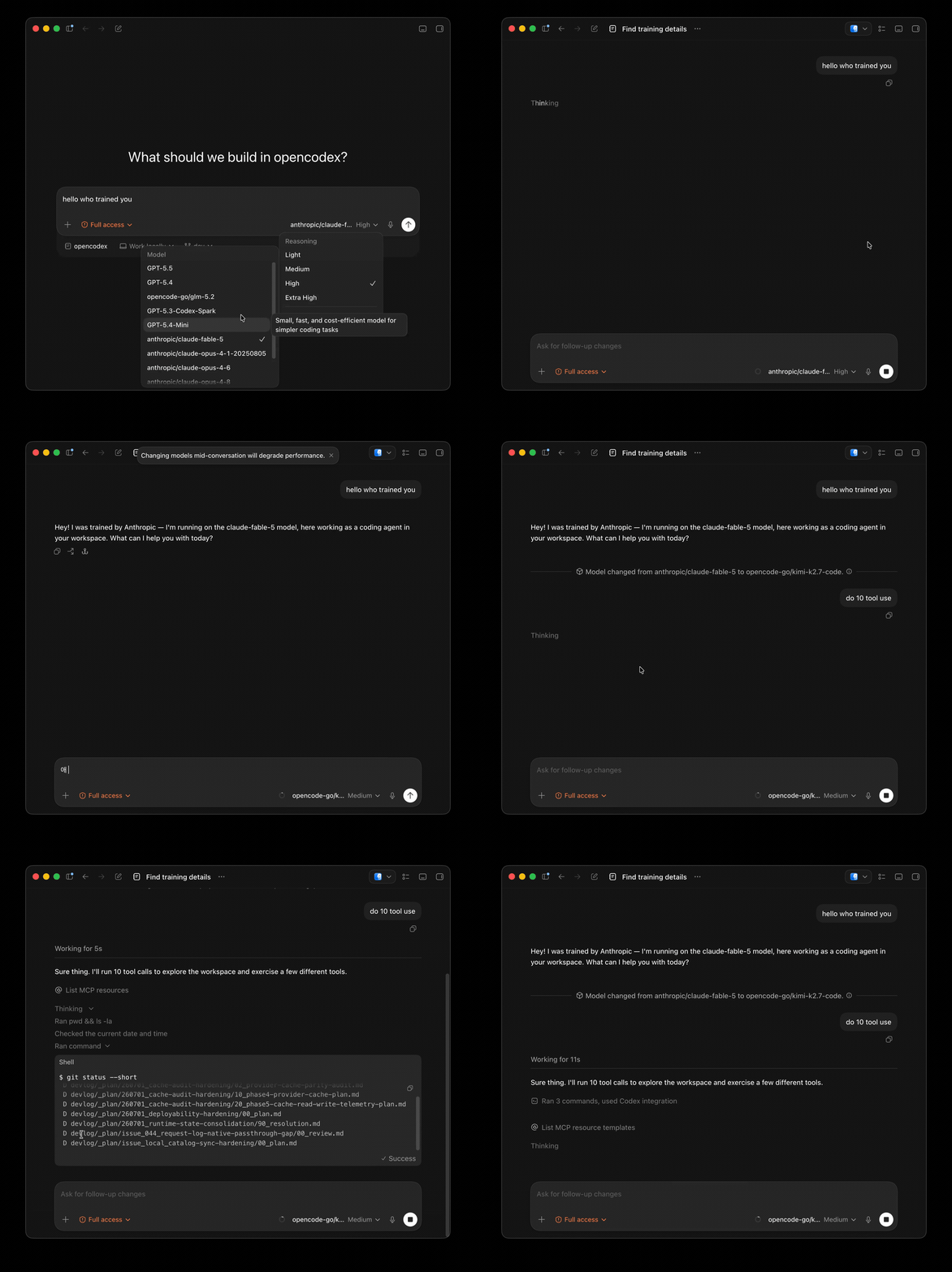
Universal provider proxy for OpenAI Codex & Claude Code — use any LLM (Claude, Gemini, Grok, DeepSeek, Ollama…) with Codex CLI, App, SDK, and Claude Code

Git-native persistent memory for AI coding agents. Implements Google OKF v0.2 with sub-300µs in-memory BM25 search, embedded MCP server, and progressive disclosure. Slashes token bloat by 80% with zero external databases or dependencies. Built in pure Go.

Local-first code intelligence graph for MCP and CLI. Builds a persistent map of your codebase so AI coding tools read only what matters, with benchmarked context reductions on reviews and large-repo workflows.

Stop your AI from making things up — it proposes, deterministic tools decide, every claim checked against ground truth with evidence. Grounded facts and context survive resets. Reverse engineering is the proving ground. MCP server + CLI.