
koala73/worldmonitorConnectors
Real-time global intelligence dashboard. AI-powered news aggregation, geopolitical monitoring, and infrastructure tracking in a unified situational awareness interface
86k
This MCP server plugs Steampipe into AI assistants so they can query cloud and SaaS data in natural language. It works with a local Steampipe install or a Turbot Pipes workspace, and all access is read-only.
Builders who want Claude Desktop, Cursor, or another MCP client to query Steampipe data.
You can ask your assistant to inspect cloud resources, review security posture, and draft SQL without leaving the chat.
Runs read-only PostgreSQL queries against Steampipe data with `steampipe_query`.
Lists available tables with `steampipe_table_list` and shows column details with `steampipe_table_show`.
Lists installed Steampipe plugins and shows details for a specific plugin with `steampipe_plugin_list` and `steampipe_plugin_show`.
Includes a `best_practices` prompt to teach the model how to work with Steampipe data.
Exposes a `status` resource with the current connection string and connected state.
git clone https://github.com/turbot/steampipe-mcp.git
cd steampipe-mcp
npm install
npm run build
Unlock the power of AI-driven infrastructure analysis with Steampipe! This Model Context Protocol server seamlessly connects AI assistants like Claude to your cloud infrastructure data, enabling natural language exploration and analysis of your entire cloud estate.
Steampipe MCP bridges AI assistants and your infrastructure data, allowing natural language:
Works with both local Steampipe installations and Turbot Pipes workspaces, providing safe, read-only access to all your cloud and SaaS data.
npx)steampipe service start)Add Steampipe MCP to your AI assistant's configuration file:
{
  "mcpServers": {
    "steampipe": {
      "command": "npx",
      "args": [
        "-y",
        "@turbot/steampipe-mcp"
      ]
    }
  }
}
By default, this connects to your local Steampipe installation at postgresql://steampipe@localhost:9193/steampipe. Make sure to run steampipe service start first.
To connect to a Turbot Pipes workspace instead, add your connection string to the args:
{
  "mcpServers": {
    "steampipe": {
      "command": "npx",
      "args": [
        "-y",
        "@turbot/steampipe-mcp",
        "postgresql://my_name:my_pw@workspace-name.usea1.db.pipes.turbot.com:9193/abc123"
      ]
    }
  }
}
| Assistant | Config File Location | Setup Guide |
|---|---|---|
| Claude Desktop | claude_desktop_config.json | Claude Desktop MCP Guide → |
| Cursor | ~/.cursor/mcp.json | Cursor MCP Guide → |
Save the configuration file and restart your AI assistant for the changes to take effect.
First, run the best_practices prompt included in the MCP server to teach your LLM how best to work with Steampipe. Then, ask anything!
Explore your cloud infrastructure:
What AWS accounts can you see?
Simple, specific questions work well:
Show me all S3 buckets that were created in the last week
Generate infrastructure reports:
List my EC2 instances with their attached EBS volumes
Dive into security analysis:
Find any IAM users with access keys that haven't been rotated in the last 90 days
Get compliance insights:
Show me all EC2 instances that don't comply with our tagging standards
Explore potential risks:
Analyze my S3 buckets for security risks including public access, logging, and encryption
Remember to:
steampipe_query
sql (string): The SQL query to execute using PostgreSQL syntaxsteampipe_table_list
schema (string): Filter tables by specific schemafilter (string): Filter tables by ILIKE pattern (e.g. '%ec2%')steampipe_table_show
name (string): The name of the table to show details for (can be schema qualified e.g. 'aws_account' or 'aws.aws_account')schema (string): The schema containing the tablesteampipe_plugin_list
steampipe_plugin_show
name (string): Name of the plugin to show details forThis resource enables AI tools to check and verify the connection status to your Steampipe instance.
git clone https://github.com/turbot/steampipe-mcp.git
cd steampipe-mcp
npm install
npm run build
To test your local development build with AI tools that support MCP, update your MCP configuration to use the local dist/index.js instead of the npm package. For example:
{
  "mcpServers": {
    "steampipe": {
      "command": "node",
      "args": [
        "/absolute/path/to/steampipe-mcp/dist/index.js",
        "postgresql://steampipe@localhost:9193/steampipe"
      ]
    }
  }
}
Or, use the MCP Inspector to validate the server implementation:
npx @modelcontextprotocol/inspector dist/index.js
The following environment variables can be used to configure the MCP server:
STEAMPIPE_MCP_LOG_LEVEL: Control server logging verbosity (default: info)STEAMPIPE_MCP_WORKSPACE_DATABASE: Override the default Steampipe connection string (default: postgresql://steampipe@localhost:9193/steampipe)This repository is published under the Apache 2.0 license. Please see our code of conduct. We look forward to collaborating with you!
Steampipe is a product produced from this open source software, exclusively by Turbot HQ, Inc. It is distributed under our commercial terms. Others are allowed to make their own distribution of the software, but they cannot use any of the Turbot trademarks, cloud services, etc. You can learn more in our Open Source FAQ.
Want to help but don't know where to start? Pick up one of the help wanted issues:
Sign in to join the discussion.
No comments yet. Be the first to say what this is good for.
Real-time global intelligence dashboard. AI-powered news aggregation, geopolitical monitoring, and infrastructure tracking in a unified situational awareness interface
High-performance code intelligence MCP server. Indexes codebases into a persistent knowledge graph — average repo in milliseconds. 158 languages, sub-ms queries, 99% fewer tokens. Single static binary, zero dependencies.
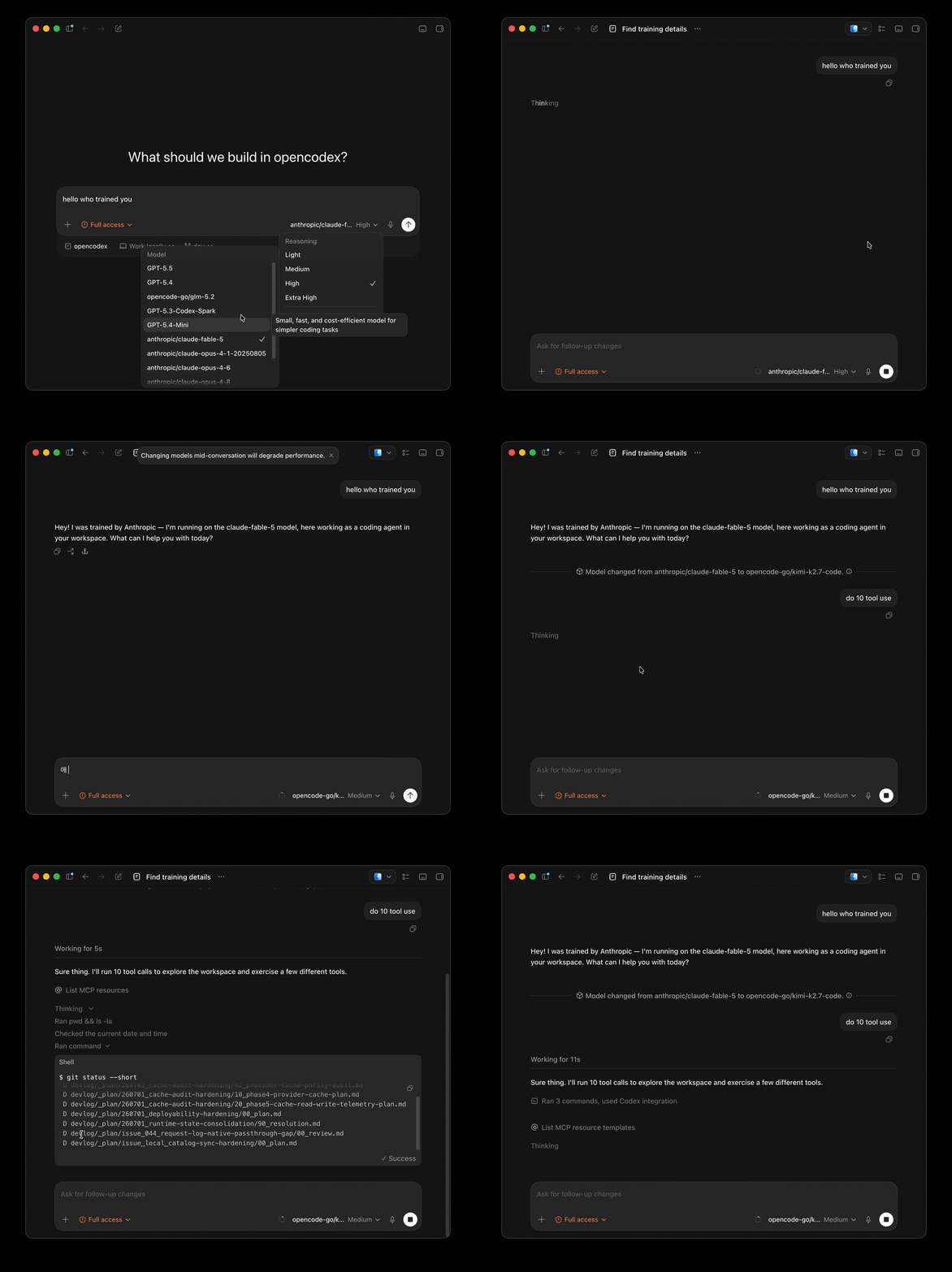
Universal provider proxy for OpenAI Codex & Claude Code — use any LLM (Claude, Gemini, Grok, DeepSeek, Ollama…) with Codex CLI, App, SDK, and Claude Code

Git-native persistent memory for AI coding agents. Implements Google OKF v0.2 with sub-300µs in-memory BM25 search, embedded MCP server, and progressive disclosure. Slashes token bloat by 80% with zero external databases or dependencies. Built in pure Go.

Local-first code intelligence graph for MCP and CLI. Builds a persistent map of your codebase so AI coding tools read only what matters, with benchmarked context reductions on reviews and large-repo workflows.

Stop your AI from making things up — it proposes, deterministic tools decide, every claim checked against ground truth with evidence. Grounded facts and context survive resets. Reverse engineering is the proving ground. MCP server + CLI.