
koala73/worldmonitorConnectors
Real-time global intelligence dashboard. AI-powered news aggregation, geopolitical monitoring, and infrastructure tracking in a unified situational awareness interface
86k
Cinema4D MCP links a running Cinema 4D app to an MCP client so you can ask for scene changes, object creation, material work, camera animation, and renders. The Cinema 4D plugin listens on a socket, while the Python MCP server exposes tools like `add_primitive`, `create_material`, `inspect_redshift_materials`, and `render_preview`.
Builders who want Claude or another MCP client to drive Cinema 4D scenes.
You can make scene edits, inspect objects, and render previews through agent commands instead of switching between tools.
Gets scene info, lists object hierarchies, groups objects, saves scenes, and loads `.c4d` files.
Adds primitives, abstract shapes, cameras, lights, and animated camera paths.
Creates materials, applies them to objects, and generates or applies stylized shaders.
Reads Redshift material setup with fallback paths for different Cinema 4D builds.
Creates cloners and effectors, applies fields, and adds soft body or rigid body behavior.
Renders frames, makes quick preview images, and captures scene snapshots with preview output.
Provides a JSONL command harness and a small GUI runner for replaying MCP commands.
git clone https://github.com/ttiimmaacc/cinema4d-mcp.git
cd cinema4d-mcp
pip install -e .
chmod +x bin/cinema4d-mcp-wrapper
Cinema4D MCP Server connects Cinema 4D to Claude, enabling prompt-assisted 3D manipulation.
To install the project, follow these steps:
git clone https://github.com/ttiimmaacc/cinema4d-mcp.git
cd cinema4d-mcp
pip install -e .
chmod +x bin/cinema4d-mcp-wrapper
To set up the Cinema 4D plugin, follow these steps:
Copy the Plugin File: Copy the c4d_plugin/mcp_server_plugin.pyp file to Cinema 4D's plugin folder. The path varies depending on your operating system:
/Users/USERNAME/Library/Preferences/Maxon/Maxon Cinema 4D/plugins/C:\Users\USERNAME\AppData\Roaming\Maxon\Maxon Cinema 4D\plugins\Start the Socket Server:
To configure Claude Desktop, you need to modify its configuration file:
Open the Configuration File:
~/Library/Application Support/Claude/claude_desktop_config.json%APPDATA%\Claude\claude_desktop_config.jsonAdd MCP Server Configuration: For development/unpublished server, add the following configuration:
"mcpServers": {
  "cinema4d": {
    "command": "python3",
    "args": ["/Users/username/cinema4d-mcp/main.py"]
  }
}
Restart Claude Desktop after updating the configuration file.
{
  "mcpServers": {
    "cinema4d": {
      "command": "cinema4d-mcp-wrapper",
      "args": []
    }
  }
}
If you use agent skills, the maintained companion skill for this MCP lives in vladmdgolam/agent-skills.
The skill captures production-oriented guidance that sits on top of the raw MCP tools, including:
inspect_redshift_materials over ad-hoc Python for Redshift inspectionexecute_python_script for full C4D API accessTo test the Cinema 4D socket server directly from the command line:
python main.py
You should see output confirming the server's successful start and connection to Cinema 4D.
The repository includes a simple test harness for running predefined command sequences:
Test Command File (tests/mcp_test_harness.jsonl): Contains a sequence of commands in JSONL format that can be executed in order. Each line represents a single MCP command with its parameters.
GUI Test Runner (tests/mcp_test_harness_gui.py): A simple Tkinter GUI for running the test commands:
python tests/mcp_test_harness_gui.py
The GUI allows you to:
This test harness is particularly useful for:
Check the log files:
tail -f ~/Library/Logs/Claude/mcp*.log
Verify Cinema 4D shows connections in its console after you open Claude Desktop.
Test the wrapper script directly:
cinema4d-mcp-wrapper
If there are errors finding the mcp module, install it system-wide:
pip install mcp
For advanced debugging, use the MCP Inspector:
npx @modelcontextprotocol/inspector uv --directory /Users/username/cinema4d-mcp run cinema4d-mcp
cinema4d-mcp/
├── .gitignore
├── LICENSE
├── README.md
├── main.py
├── pyproject.toml
├── setup.py
├── bin/
│   └── cinema4d-mcp-wrapper
├── c4d_plugin/
│   └── mcp_server_plugin.pyp
├── src/
│   └── cinema4d_mcp/
│       ├── __init__.py
│       ├── server.py
│       ├── config.py
│       └── utils.py
└── tests/
    ├── test_server.py
    ├── mcp_test_harness.jsonl
    └── mcp_test_harness_gui.py
get_scene_info: Get summary info about the active Cinema 4D scene. ✅list_objects: List all scene objects (with hierarchy). ✅group_objects: Group selected objects under a new null. ✅execute_python: Execute custom Python code inside Cinema 4D. ✅save_scene: Save the current Cinema 4D project to disk. ✅load_scene: Load a .c4d file into the scene. ✅set_keyframe: Set a keyframe on an objects property (position, rotation, etc.). ✅add_primitive: Add a primitive (cube, sphere, cone, etc.) to the scene. ✅modify_object: Modify transform or attributes of an existing object. ✅create_abstract_shape: Create an organic, non-standard abstract form. ✅create_camera: Add a new camera to the scene. ✅animate_camera: Animate a camera along a path (linear or spline-based). ✅create_light: Add a light (omni, spot, etc.) to the scene. ✅create_material: Create a standard Cinema 4D material. ✅apply_material: Apply a material to a target object. ✅apply_shader: Generate and apply a stylized or procedural shader. ✅inspect_redshift_materials: Read-only Redshift inspector with fallbacks for assignments, preview colors, readable params, a renderEngine-style node-material probe, and a Redshift GraphView fallback via redshift.GetRSMaterialNodeMaster(...). ✅
Known quirk: the top-level capabilities.redshift_module_available flag can still be false on some builds even when the per-material GraphView fallback succeeds. Treat each material's graph.backend and graph.graphview.redshift_module_imported as the authoritative signal.validate_redshift_materials: Check Redshift material setup and connections. ✅ ⚠️ (Redshift materials not fully implemented)create_mograph_cloner: Add a MoGraph Cloner (linear, radial, grid, etc.). ✅add_effector: Add a MoGraph Effector (Random, Plain, etc.). ✅apply_mograph_fields: Add and link a MoGraph Field to objects. ✅create_soft_body: Add a Soft Body tag to an object. ✅apply_dynamics: Apply Rigid or Soft Body physics. ✅render_frame: Render a frame and save it to disk (file-based output only). ⚠️ (Works, but fails on large resolutions due to MemoryError: Bitmap Init failed. This is a resource limitation.)render_preview: Render a quick preview and return base64 image (for AI). ✅snapshot_scene: Capture a snapshot of the scene (objects + preview image). ✅| Cinema 4D Version | Python Version | Compatibility Status | Notes |
|---|---|---|---|
| R21 / S22 | Python 2.7 | ❌ Not supported | Legacy API and Python version too old |
| R23 | Python 3.7 | 🔍 Not planned | Not currently tested |
| S24 / R25 / S26 | Python 3.9 | ⚠️ Possible (TBD) | Requires testing and fallbacks for missing APIs |
| 2023.0 / 2023.1 | Python 3.9 | 🧪 In progress | Targeting fallback support for core functionality |
| 2023.2 | Python 3.10 | 🧪 In progress | Aligns with planned testing base |
| 2024.0 | Python 3.11 | ✅ Supported | Verified |
| 2025.0+ | Python 3.11 | ✅ Fully Supported | Primary development target |
Sign in to join the discussion.
No comments yet. Be the first to say what this is good for.
Real-time global intelligence dashboard. AI-powered news aggregation, geopolitical monitoring, and infrastructure tracking in a unified situational awareness interface
High-performance code intelligence MCP server. Indexes codebases into a persistent knowledge graph — average repo in milliseconds. 158 languages, sub-ms queries, 99% fewer tokens. Single static binary, zero dependencies.
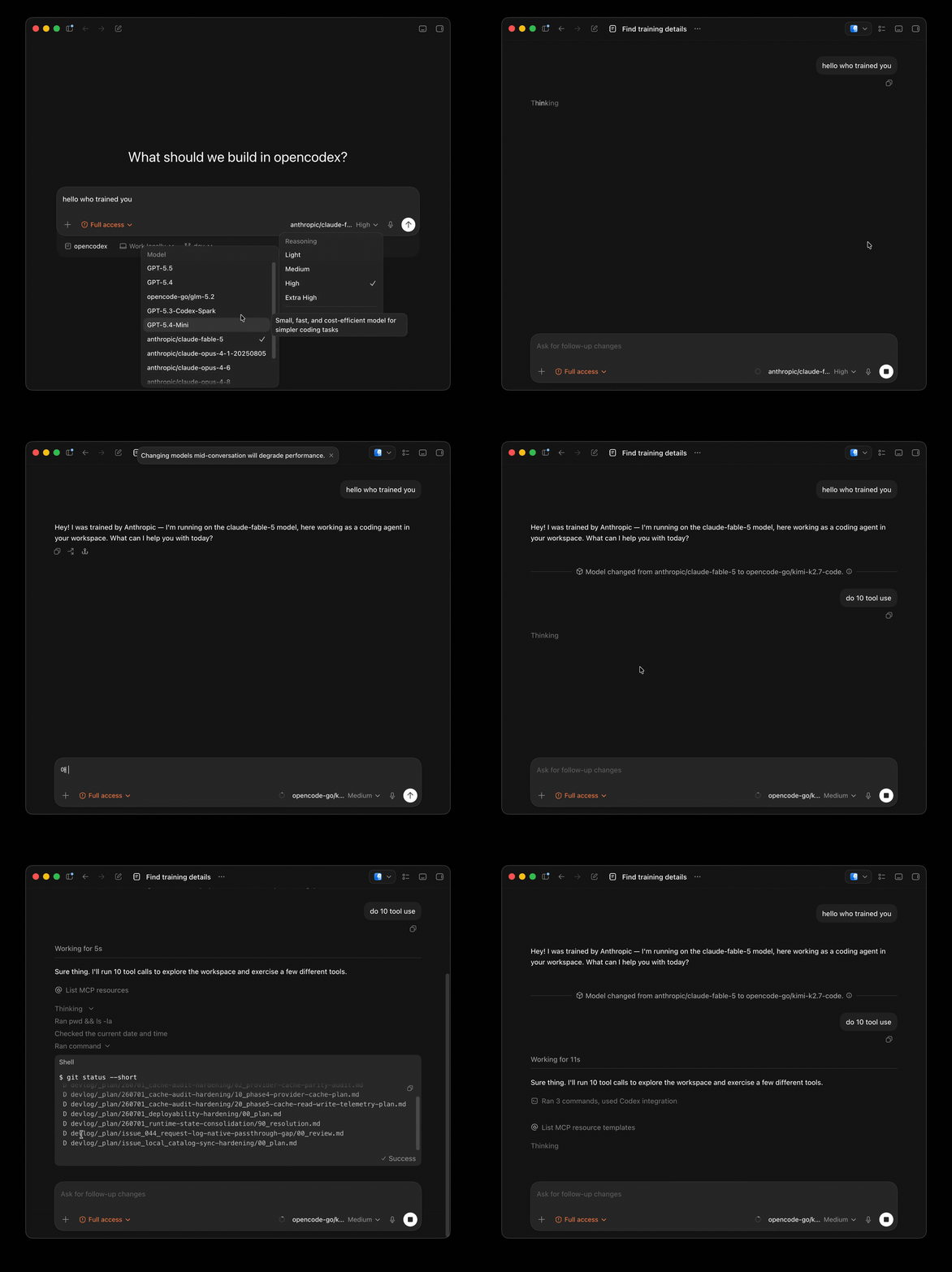
Universal provider proxy for OpenAI Codex & Claude Code — use any LLM (Claude, Gemini, Grok, DeepSeek, Ollama…) with Codex CLI, App, SDK, and Claude Code

Git-native persistent memory for AI coding agents. Implements Google OKF v0.2 with sub-300µs in-memory BM25 search, embedded MCP server, and progressive disclosure. Slashes token bloat by 80% with zero external databases or dependencies. Built in pure Go.

Local-first code intelligence graph for MCP and CLI. Builds a persistent map of your codebase so AI coding tools read only what matters, with benchmarked context reductions on reviews and large-repo workflows.

Stop your AI from making things up — it proposes, deterministic tools decide, every claim checked against ground truth with evidence. Grounded facts and context survive resets. Reverse engineering is the proving ground. MCP server + CLI.