
NousResearch/
hermes-agent

The agent that grows with you
245k
Synapse lets you create agents, connect tools, and run them through deterministic orchestration graphs. It can use local or cloud LLMs, pause for human review, schedule runs, and scale from one machine to a worker fleet.
Builders who want to turn agents into repeatable workflows with tools, routing, and human checkpoints.
You can run multi-agent workflows that use real tools and follow the path you designed instead of improvising.
Build independent agents with their own prompts, tools, models, and repositories.
Wire agents together with routing, parallel steps, loops, and human gates.
Use native tools, custom Python or HTTP tools, webhooks, and MCP servers.
Split API servers and workers, use Redis queues, and resume jobs from checkpoints.
Run cron and interval jobs and send results to Slack, Discord, Telegram, Teams, or WhatsApp.
Keep shared files available across agents and sessions.
curl -sSL https://raw.githubusercontent.com/synapseorch-ai/synapse-ai/main/setup.sh | bash
irm https://raw.githubusercontent.com/synapseorch-ai/synapse-ai/main/setup.ps1 | iex
npm install -g synapse-orch-ai
synapse
pip install synapse-orch-ai
synapse
docker run -d \
  -p 3000:3000 \
  -v synapse-data:/data \
  -v /var/run/docker.sock:/var/run/docker.sock \
  synapseorchai/synapse-ai:latest







Build AI workflows that actually ship.
Wire agents, tools, and LLMs into deterministic pipelines — without the framework lock-in. Synapse is an open-source platform for creating, connecting, and orchestrating AI agents powered by any LLM — local or cloud. Agents use real tools: browsing the web, querying databases, executing code, reading files, managing emails, and anything else you can expose through an MCP server, a webhook, or a Python script.
🌐 Website · 📖 Documentation · 💬 Discord
macOS / Linux:
curl -sSL https://raw.githubusercontent.com/synapseorch-ai/synapse-ai/main/setup.sh | bash
Windows (PowerShell):
irm https://raw.githubusercontent.com/synapseorch-ai/synapse-ai/main/setup.ps1 | iex
npm install -g synapse-orch-ai
synapse
pip install synapse-orch-ai
synapse
docker run -d \
  -p 3000:3000 \
  -v synapse-data:/data \
  -v /var/run/docker.sock:/var/run/docker.sock \
  synapseorchai/synapse-ai:latest
Then open http://localhost:3000. See the Docker guide in the docs for custom ports and environment variable configuration.
Security: publish only the frontend port
3000— the backend (8765) serves an internal API and should not be exposed on0.0.0.0(docker-compose binds it to127.0.0.1). The container auto-generates a shared internal token so that surface is authenticated by default. For any network-reachable deployment, enable login (Settings → Security) and/or setallow_stdio_mcp=false, since registering a stdio MCP server launches local commands.
| Install method | Upgrade command |
|---|---|
| Bash / PowerShell installer (recommended) | synapse upgrade |
| pip | pip install --upgrade synapse-orch-ai |
| npm | npm update -g synapse-orch-ai |
| Docker | docker pull synapseorchai/synapse-ai:latest |
Upgrade note (security hardening): the backend now auto-generates a shared internal token and, under docker-compose, binds its port to
127.0.0.1by default. The UI and its API are unaffected (the frontend proxies the backend internally). If you previously called the backend directly on:8765(e.g. external API clients), either point them at the frontend instead —http://host:3000/api/v1|v2/...— or setSYNAPSE_BACKEND_BIND=0.0.0.0in.envto keep publishing:8765.
Run unlimited agents and orchestrations concurrently. When you need to go beyond a single process, the distributed scale layer handles the load:
Three Docker images — pull only what you need:
docker pull synapseorchai/synapse-ai:latest             # full app (standalone mode)
docker pull synapseorchai/synapse-ai-api-server:latest  # stateless API server (scale mode)
docker pull synapseorchai/synapse-ai-worker:latest      # worker process (scale mode, run as many as needed)
The docker-compose.yml in the repo spins up the full stack. Production K8s manifests are in infra/k8s/.
https://github.com/user-attachments/assets/7a5ab42c-5fae-4f13-876c-13aa9b5a0366
Multi-agent pipeline that researches a topic, drafts content in a Google Doc, and returns the shared link. (Video is 2x speed)
https://github.com/user-attachments/assets/4eec5db8-70d0-47b6-8608-f52b1f7b7d68
Multi-agent system with human-in-the-loop that writes code and generates pull requests autonomously.
https://github.com/user-attachments/assets/95a511e1-e3e9-4812-b9ca-f7f4c28ef80f
Chat with the AI builder — describe what you want, and it creates the orchestration DAG for you.
https://github.com/user-attachments/assets/282cc99d-cdea-4ad0-b648-f22112c6e295
| Concept | Summary |
|---|---|
| Agents | Independent ReAct loops with their own system prompt, tools, model, and repos. Docs → |
| Orchestrations | DAGs of steps — wire agents together with routing, parallelism, loops, and human gates. Docs → |
| Tool Ecosystem | 10+ native tool servers, built-in MCP servers, remote MCP via OAuth/PAT, and custom HTTP/Python tools. Docs → |
| AI Builder | A meta-agent that designs and materializes orchestrations from natural language. Docs → |
| Schedules | Cron/interval automation with messaging notifications. Docs → |
| Messaging | Slack, Discord, Telegram, Teams, WhatsApp — with multi-agent mode. Docs → |
| Scale Mode | Distributed execution layer: Redis job queue, independent worker fleet, per-step Postgres checkpoints, S3 artifact storage, and multi-tenant quotas. Docs → |
| V2 API | Stable versioned REST API for building products on top of Synapse — enqueue, stream, cancel, webhooks. Docs → |
| Vault | Persistent file storage shared across agents and sessions. Docs → |
synapse start     # start backend + frontend, open browser
synapse stop      # stop background processes
synapse upgrade   # upgrade to the latest version
synapse uninstall # remove Synapse, wipe ~/.synapse, and uninstall the package
See CONTRIBUTING.md for dev setup, architecture details, how to add MCP tool servers, and the PR checklist.
Synapse AI is licensed under AGPL v3 — see LICENSE
Sign in to join the discussion.
No comments yet. Be the first to say what this is good for.
The agent that grows with you

Open-source coding agent for your terminal, built in Rust and on a journey of continuous community improvement. Issues and PRs welcome.
A lightweight alternative to OpenClaw that runs in containers for security. Connects to WhatsApp, Telegram, Slack, Discord, Gmail and other messaging apps,, has memory, scheduled jobs, and runs directly on Anthropic's Agents SDK

OpenSquilla — Token-Efficient AI Agent with same budget, higher intelligence density
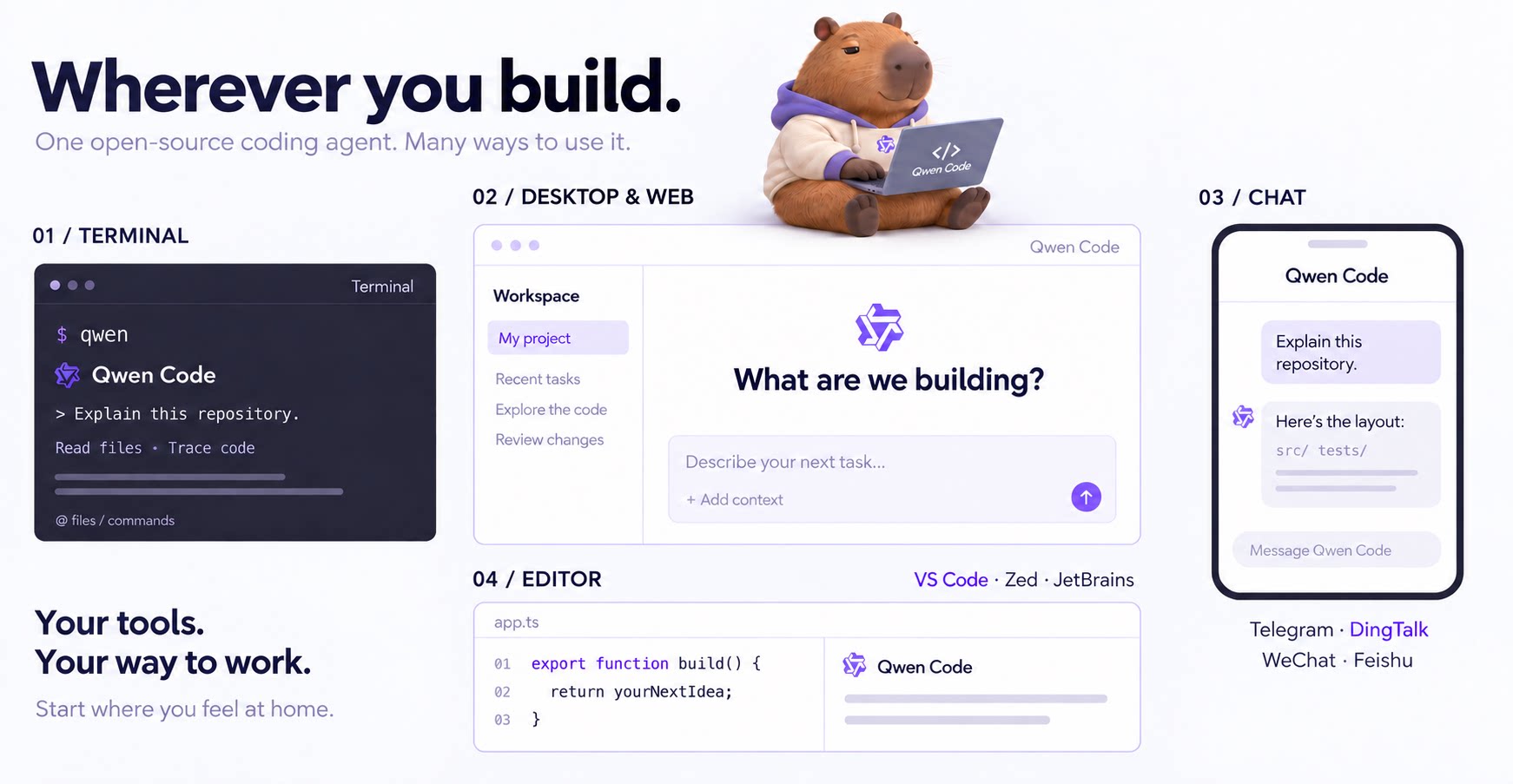
An open-source AI coding agent that lives in your terminal.

Run and supervise teams of coding agents from planning to merge. Any harness (Claude code, codex, +25 more). Desktop, web, mobile, and cloud agents.