
koala73/worldmonitorConnectors
Real-time global intelligence dashboard. AI-powered news aggregation, geopolitical monitoring, and infrastructure tracking in a unified situational awareness interface
86k
BinAssistMCP connects Binary Ninja to MCP clients so an agent can inspect functions, strings, xrefs, comments, types, and patches from an open binary. It also adds prompts, resources, and multi-binary session handling for guided reverse-engineering workflows.
Builders who want their agent to analyze and modify binaries in Binary Ninja.
You can ask an agent to inspect, document, and patch binaries without leaving Binary Ninja.
Exposes Binary Ninja through MCP over SSE and Streamable HTTP.
Provides tools for code retrieval, xrefs, comments, variables, types, strings, imports, exports, and more.
Includes prebuilt prompts for function analysis, vulnerability review, data-flow tracing, and protocol reverse engineering.
Publishes browsable binary metadata such as functions, imports, exports, strings, segments, and sections.
Tracks multiple open binaries and supports asynchronous open and status polling.
Lets you patch bytes and assemble instructions back into the binary.
# Clone the repository
git clone https://github.com/symgraph/BinAssistMCP.git
cd BinAssistMCP

# Install dependencies
pip install -r requirements.txt
http://localhost:8000/mcp
http://localhost:8000/sse
Comprehensive Model Context Protocol (MCP) server for Binary Ninja with AI-powered reverse engineering capabilities
BinAssistMCP is a powerful bridge between Binary Ninja and Large Language Models (LLMs) like Claude, providing comprehensive reverse engineering tools through the Model Context Protocol (MCP). It enables AI-assisted binary analysis by exposing Binary Ninja's advanced capabilities through Server-Sent Events (SSE) and Streamable HTTP transports.
.bndb databases open asynchronously with pollable operation statussrc/binassist_mcp/
├── server.py # FastMCP server - SSE/Streamable HTTP transport, tool registration
├── tools.py # Binary Ninja API wrapper - 45 MCP tools
├── plugin.py # Binary Ninja plugin integration
├── context.py # Thread-safe multi-binary session management
├── config.py # Pydantic configuration with Binary Ninja settings
├── prompts.py # 7 guided workflow prompts
├── resources.py # 8 MCP resource definitions
├── cache.py # Cache primitives (not currently connected to MCP tools)
├── tasks.py # Task lifecycle support (tool dispatch is not yet implemented)
├── logging.py # Binary Ninja logging integration
└── utils.py # Utility functions
__init__.py # Plugin entry point (root level)
BinAssistMCP provides 45 tools organized into functional categories. Tools include MCP annotations (readOnlyHint, idempotentHint) to help clients make informed decisions.
| Tool | Description |
|---|---|
list_binaries | Synchronize with Binary Ninja and list all loaded binary files |
get_binary_info | Check analysis status and metadata |
get_binary_status | Poll a queued open by operation ID, path, or name and report analysis progress |
open_binary | Queue a nonblocking binary or .bndb open; raw binaries require a destination bndb_path |
update_analysis_and_wait | Force analysis update and wait for completion |
export_program | Export the patched binary or Binary Ninja database to disk |
By default, open_binary validates its paths, schedules the Binary Ninja open, and immediately returns an operation_id with status="opening". Poll get_binary_status(operation_id) until it reports ready or failed. When ready, its name field is the final context name to pass to analysis tools. Concurrent requests for the same path reuse the active operation. Set wait_for_analysis=true only when legacy blocking behavior is explicitly required.
| Tool | Description |
|---|---|
get_code | Read analysis-safe code with signatures and comments; supports decompile, hlil, mlil, llil, disasm, and pseudo_c |
get_function_low_level_il | Get Low-Level IL for a function |
get_function_signature | Generate the native masked byte signature for a function |
analyze_function | Comprehensive function analysis with control flow and complexity metrics |
get_basic_blocks | Get basic block information for control flow analysis |
get_function_stack_layout | Get stack frame layout with variable offsets |
get_code behaviorget_code is a read-only query. It does not clear analysis_skipped, request IL generation, or run global analysis. For format="decompile", it returns already-loaded HLIL when available, then falls back through MLIL and LLIL to instruction-aligned disassembly. Use update_analysis_and_wait explicitly when fresh analysis is desired.
The code string starts with the current function signature and includes function-level and instruction-level Binary Ninja comments. The response contains:
function and address: resolved function identityformat: requested formatactual_format: representation actually returned, or null when an explicitly requested IL is unavailablefallback_used: whether decompile used a lower-level representationcode: rendered code, signature, and commentsnote: present when a fallback explains why and what was returned| Tool | Description |
|---|---|
xrefs | Unified cross-references with direction set to to, from, or both; optionally includes call relationships |
| Tool | Description |
|---|---|
comments | Unified comment management - actions: get, set, list, remove, set_function |
| Tool | Description |
|---|---|
variables | Unified variable management - actions: list, create, rename, set_type; rename supports local/global via scope |
| Tool | Description |
|---|---|
types | Unified type management - actions: create, create_enum, create_typedef, create_class, add_member, info, list |
get_classes | List all classes and structures |
| Tool | Description |
|---|---|
get_functions | List all functions with metadata |
search_functions_by_name | Find functions by name pattern |
get_functions_advanced | Advanced filtering by size, complexity, parameters |
search_functions_advanced | Multi-target search (name, comments, calls, variables) |
get_function_statistics | Comprehensive statistics for all functions |
| Tool | Description |
|---|---|
rename_symbol | Rename functions and data variables |
batch_rename | Rename multiple symbols in one operation |
get_namespaces | List namespaces and symbol organization |
| Tool | Description |
|---|---|
get_imports | Import table grouped by module |
get_exports | Export table with symbol information |
get_strings | Paginated string extraction |
search_strings | Search strings by pattern |
get_segments | Memory segment layout |
get_sections | Binary section information |
get_entry_points | List all binary entry points |
| Tool | Description |
|---|---|
create_data_var | Define data variables at addresses |
get_data_vars | List all defined data variables |
get_data_at | Read and analyze raw data |
search_bytes | Search for byte patterns in binary |
| Tool | Description |
|---|---|
patch_bytes | Patch raw bytes in the binary at an address |
assemble_code | Assemble instruction text at an address and optionally patch it |
| Tool | Description |
|---|---|
get_current_address | Get current cursor position with context |
get_current_function | Identify function at current address |
bookmarks | Unified bookmark management - actions: list, set, remove |
| Tool | Description |
|---|---|
start_task | Create a placeholder background task record; tool_name dispatch is not implemented yet |
get_task_status | Check status of async operations |
list_tasks | List all pending/running tasks |
cancel_task | Cancel a running task |
These APIs currently exercise task lifecycle management only. They do not execute the named MCP tool in the background.
Resources provide browsable, cacheable data that clients can access without tool calls.
| URI Pattern | Description |
|---|---|
binassist://{filename}/triage_summary | Complete binary overview |
binassist://{filename}/functions | All functions with metadata |
binassist://{filename}/imports | Import table |
binassist://{filename}/exports | Export table |
binassist://{filename}/strings | String table |
binja://{filename}/info | Binary metadata (arch, platform, entry point) |
binja://{filename}/segments | Memory segments with permissions |
binja://{filename}/sections | Binary sections |
Pre-built prompts guide LLMs through structured analysis workflows.
| Prompt | Arguments | Description |
|---|---|---|
analyze_function | function_name, filename | Comprehensive function analysis workflow |
identify_vulnerability | function_name, filename | Security audit checklist (memory safety, input validation, crypto) |
document_function | function_name, filename | Generate Doxygen-style documentation |
trace_data_flow | address, filename | Track data dependencies and taint propagation |
compare_functions | func1, func2, filename | Diff two functions for similarity analysis |
reverse_engineer_struct | address, filename | Recover structure definitions from usage patterns |
trace_network_data | filename | Trace POSIX/Winsock send/recv for protocol analysis |
The trace_network_data prompt guides analysis of network communication:
send/recv/sendto/recvfrom) and Winsock (WSASend/WSARecv) callsNOTE: Windows users should start with: BinAssistMCP on Windows
# Clone the repository
git clone https://github.com/symgraph/BinAssistMCP.git
cd BinAssistMCP

# Install dependencies
pip install -r requirements.txt
Copy to your Binary Ninja plugins directory:
| Platform | Path |
|---|---|
| Windows | %APPDATA%\Binary Ninja\plugins\ |
| macOS | ~/Library/Application Support/Binary Ninja/plugins/ |
| Linux | ~/.binaryninja/plugins/ |
Open Edit → Preferences → binassistmcp:
| Setting | Default | Description |
|---|---|---|
server.host | localhost | Server bind address |
server.port | 8000 | Server port |
server.transport | streamablehttp | Transport: streamablehttp or sse |
binary.max_binaries | 10 | Maximum concurrent binaries |
plugin.auto_startup | true | Auto-start server on file load |
export BINASSISTMCP_SERVER__HOST=localhost
export BINASSISTMCP_SERVER__PORT=8000
export BINASSISTMCP_SERVER__TRANSPORT=streamablehttp
export BINASSISTMCP_BINARY__MAX_BINARIES=10
Via Binary Ninja Menu:
BinAssistMCP server started on http://localhost:8000Auto-Startup: Server starts automatically when Binary Ninja loads a file (configurable).
Streamable HTTP (Default):
http://localhost:8000/mcp
Server-Sent Events:
http://localhost:8000/sse
Add to your Claude Desktop MCP configuration (claude_desktop_config.json):
{
  "mcpServers": {
    "binassist": {
      "url": "http://localhost:8000/mcp"
    }
  }
}
Most binary-specific tools require the context name in filename. list_binaries returns these names, but it is not an initialization requirement: direct filename-based calls refresh the context from Binary Ninja automatically when necessary.
User: "Analyze the main function and explain what it does"

Claude uses:
1. list_binaries() - obtain the context filename
2. get_functions(filename='sample.bndb') - find main
3. get_code(filename='sample.bndb', function_name_or_address='main', format='decompile')
4. xrefs(filename='sample.bndb', address_or_name='main', direction='from')
5. analyze_function(filename='sample.bndb', function_name_or_address='main')
User: "Find buffer overflow vulnerabilities in input handling functions"

Claude uses:
1. search_functions_advanced(filename='sample.bndb', search_term='strcpy', search_in='calls')
2. get_code(filename='sample.bndb', function_name_or_address='handler', format='decompile')
3. variables(filename='sample.bndb', action='list', function_name_or_address='handler')
4. comments(filename='sample.bndb', action='set', address='0x401000', text='Unchecked copy')
User: "Analyze the network protocol used by this binary"

Claude uses the trace_network_data prompt:
1. Identifies send/recv call sites
2. Traces data flow from handlers to network I/O
3. Reconstructs message structures
4. Checks for network vulnerabilities
| Problem | Solution |
|---|---|
| Server won't start | Check port 8000 availability, verify dependencies |
| Connection refused | Ensure server is running, check firewall settings |
| A requested IL is unavailable | Run update_analysis_and_wait, then retry get_code |
| Binary name is rejected | Call list_binaries and use the returned context name |
max_binaries settingget_code returns loaded analysis immediately and falls back rather than triggering analysisCheck Binary Ninja's Log panel for detailed error messages.
This project is licensed under the MIT License - see the LICENSE file for details.
Sign in to join the discussion.
No comments yet. Be the first to say what this is good for.
Real-time global intelligence dashboard. AI-powered news aggregation, geopolitical monitoring, and infrastructure tracking in a unified situational awareness interface
High-performance code intelligence MCP server. Indexes codebases into a persistent knowledge graph — average repo in milliseconds. 158 languages, sub-ms queries, 99% fewer tokens. Single static binary, zero dependencies.
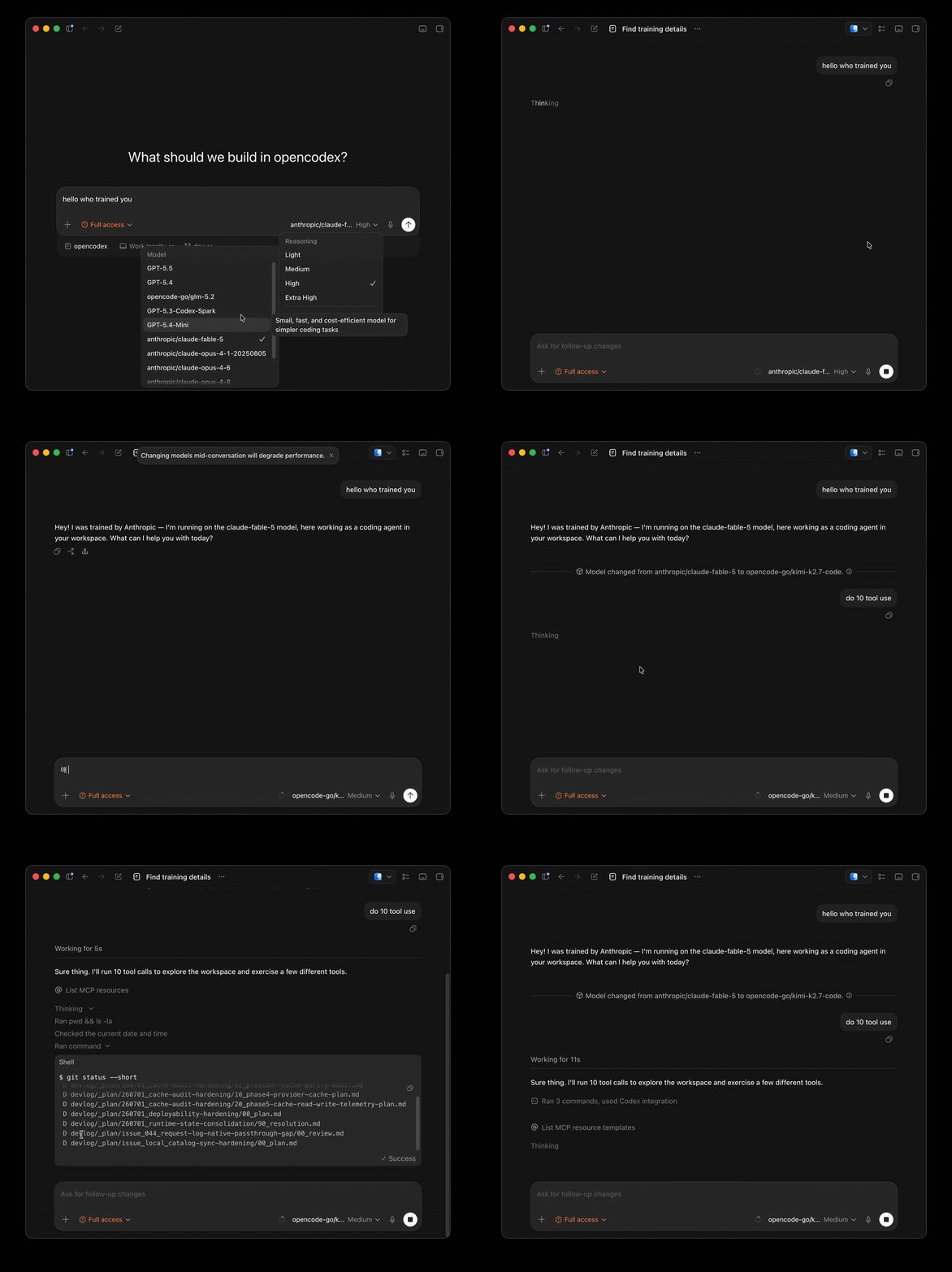
Universal provider proxy for OpenAI Codex & Claude Code — use any LLM (Claude, Gemini, Grok, DeepSeek, Ollama…) with Codex CLI, App, SDK, and Claude Code

Git-native persistent memory for AI coding agents. Implements Google OKF v0.2 with sub-300µs in-memory BM25 search, embedded MCP server, and progressive disclosure. Slashes token bloat by 80% with zero external databases or dependencies. Built in pure Go.

Local-first code intelligence graph for MCP and CLI. Builds a persistent map of your codebase so AI coding tools read only what matters, with benchmarked context reductions on reviews and large-repo workflows.

Stop your AI from making things up — it proposes, deterministic tools decide, every claim checked against ground truth with evidence. Grounded facts and context survive resets. Reverse engineering is the proving ground. MCP server + CLI.