

heygen-com/hyperframesFrameworks & SDKs
Write HTML. Render video. Built for agents.
49k
String makes Markdown into an executable surface for agents. It adds navigation, actions, state, and hints so an agent can open a page, discover what it can do, and call the next action without a separate SDK.
Builders who want their agent to use local files, web pages, apps, and shell sessions through one command model.
You can let your agent move through docs and apps with the same `/open`, `/act`, and `/info` flow instead of re-learning each surface.
Uses `/open`, `/act`, and `/info` across documents, apps, web pages, files, APIs, and shell sessions.
Supports String Flavored Markdown, which adds lightweight navigation, action blocks, response hints, and state to normal Markdown.
Runs as a CLI, a daemon, or one MCP tool named `string`.
Ships Claude Code and Codex plugin packages so the tool and skills can be added with plugin commands.
Includes topics for installed apps, shell sessions, event inboxes, and system or agent status views.
Supports local webhook events that can be read and acknowledged through the same String surface, including Claude Code channel delivery.
/plugin marketplace add string-os/string
/plugin install string@string-os
string agent add leo --home /home/ubuntu/crew/leo

STRING_AGENT_ID=leo \
claude \
  --dangerously-load-development-channels plugin:string@string-os
codex plugin marketplace add string-os/string
codex plugin add string@string-os
npm install -g @string-os/string
string --help

An app framework and browser for AI agents.
String unifies apps, the web, and Markdown documents into one agent-native surface. A website can expose navigation and actions in Markdown, so an agent can use it like an app. Ordinary web pages still open as clean Markdown. Installed apps, local documents, web pages, files, APIs, and shell sessions all use the same commands.
The core loop is intentionally small:
/open  read a document, app, web page, file, or shell session
/act   call an available action
/info  understand where you are
String can run as a CLI, a daemon, or one MCP tool named string. The agent
learns one surface and uses it everywhere.
Available String apps are maintained at github.com/string-os/apps.
Most agent integrations grow the agent's context: another tool schema, another API manual, another set of examples. String moves that knowledge into the app or page itself.
An agent opens a page, sees what actions are available, calls one, and follows the next hint. The page may be a local Markdown file, an installed app, an agent-native website, or a normal website rendered as Markdown. The interaction is the same.
What changes:
/open, /act, /info, and topics work the
same for documents, apps, web pages, files, APIs, and shell sessions./act --help; responses carry
next: hints; errors carry recovery hints./set $VAR = "...", not pasted into the agent's prompt.String calls this format SFMD: String Flavored Markdown. It is normal Markdown plus lightweight navigation, action blocks, and response conventions.
No SDK. No endpoint memorized. The surface tells the agent what it can do.
Open a web page as Markdown:
string main '/open https://docs.string-os.org/runtime/mcp'
Open an installed app and follow its actions:
string app:moltbook '/open'
# [actions] home, feed, read, comment, post, search
# next: /act.feed · /act.search "..."

string app:moltbook '/act.feed'
# Feed: @post-1 through @post-20
# next: /act.read @post-N

string app:moltbook '/act.read @post-3'
# ...post body...
# next: /act.comment @post "..."
The same interaction over MCP is one tool call:
{ "topic": "app:moltbook", "cmd": "/act.read @post-3" }
/plugin marketplace add string-os/string
/plugin install string@string-os
This installs the String MCP tool and a short skill for using it. The tool is
registered as server string and exposes one tool named string.
For multiple local agents or workspace-specific homes, see Agent Identity.
To receive local String webhook events directly inside Claude Code, launch Claude Code with the String plugin channel and select the local agent id:
string agent add leo --home /home/ubuntu/crew/leo

STRING_AGENT_ID=leo \
claude \
  --dangerously-load-development-channels plugin:string@string-os
That keeps the plugin-provided string MCP tool available and also pushes
local events for the selected String agent into the Claude Code session. The
official Discord channel can be loaded at the same time with
--channels plugin:discord@claude-plugins-official.
codex plugin marketplace add string-os/string
codex plugin add string@string-os
npm install -g @string-os/string
string --help
The daemon starts automatically on first use. Default port: 3923.
string main '/open ./README.md'
string main '/open https://docs.string-os.org/runtime/mcp'
string app:weather '/act.now Seoul'
string bash:dev 'pwd && ls'
Topics scope state:
| Topic | Use |
|---|---|
main, notes, research | free-form document/web sessions |
app:<name> | installed app session |
app:<name>:<config> | app session with config-scoped env |
bash:<name> | persistent shell session |
app, tool, bash, event, system, agent | hub topics for runtime views and management |
Hub topics are reserved. Open them to inspect runtime state, or send management commands through their hub:
string app            # installed apps + active app sessions
string event          # event inbox + local webhook URL
string system status
string agent list
Every response is wrapped so an agent can separate String output from shell noise:
<𝒞=string:main>
...
</𝒞>
String serves MCP directly. No separate MCP package is needed.
{
  "mcpServers": {
    "string": {
      "command": "npx",
      "args": ["-y", "@string-os/string", "--mcp"]
    }
  }
}
The MCP tool takes:
{ "topic": "main", "cmd": "/info" }
For local webhook event delivery into Claude Code Remote Control channels, see Events and Local Webhooks.
Use /help, /info, and /act --help to discover what is available.
A String surface can be:
The agent uses the same commands either way. When a surface includes SFMD action blocks, it becomes executable.
---
name: weather
type: app
default: now
---

# Weather

```act.now
GET https://wttr.in/{city}?format=%l:+%C+%t+%w&m
  city, -c: string (required) "City name"
```
Install that file as an app and call it:
string main '/install --app ./weather.md'
string app:weather '/act.now Seoul'
The Markdown is the interface. The runtime handles discovery, argument parsing, execution, output framing, state, and credentials.
Want a website that serves styled HTML to people and a clean .md twin to agents?
site-builder — a Claude Code / Codex plugin that scaffolds, validates, and deploys human + AI sites. Pure npx, no runtime dependency.@string-os/astro-sfmd — the Astro integration it drives: every page emits HTML + a mirrored .md.@string-os/string — CLI, daemon, MCP server, runtime@string-os/client — HTTP/SSE client for stringd@string-os/core — SFMD parser@string-os/compiler — SFMD validator/compiler@string-os/astro-sfmd — Astro integration for human + AI (SFMD) sitesMIT
Sign in to join the discussion.
No comments yet. Be the first to say what this is good for.
Write HTML. Render video. Built for agents.
Ultra-lightweight, open-source, self-hosted personal AI agent framework in Python with WebUI, tools, memory, MCP, multi-agent workflows, automation, and chat apps

SkillOpt is a text-space optimizer that trains reusable natural-language skills for frozen LLM agents through trajectory-driven edits, validation-gated updates, and deployable best_skill.md artifacts.
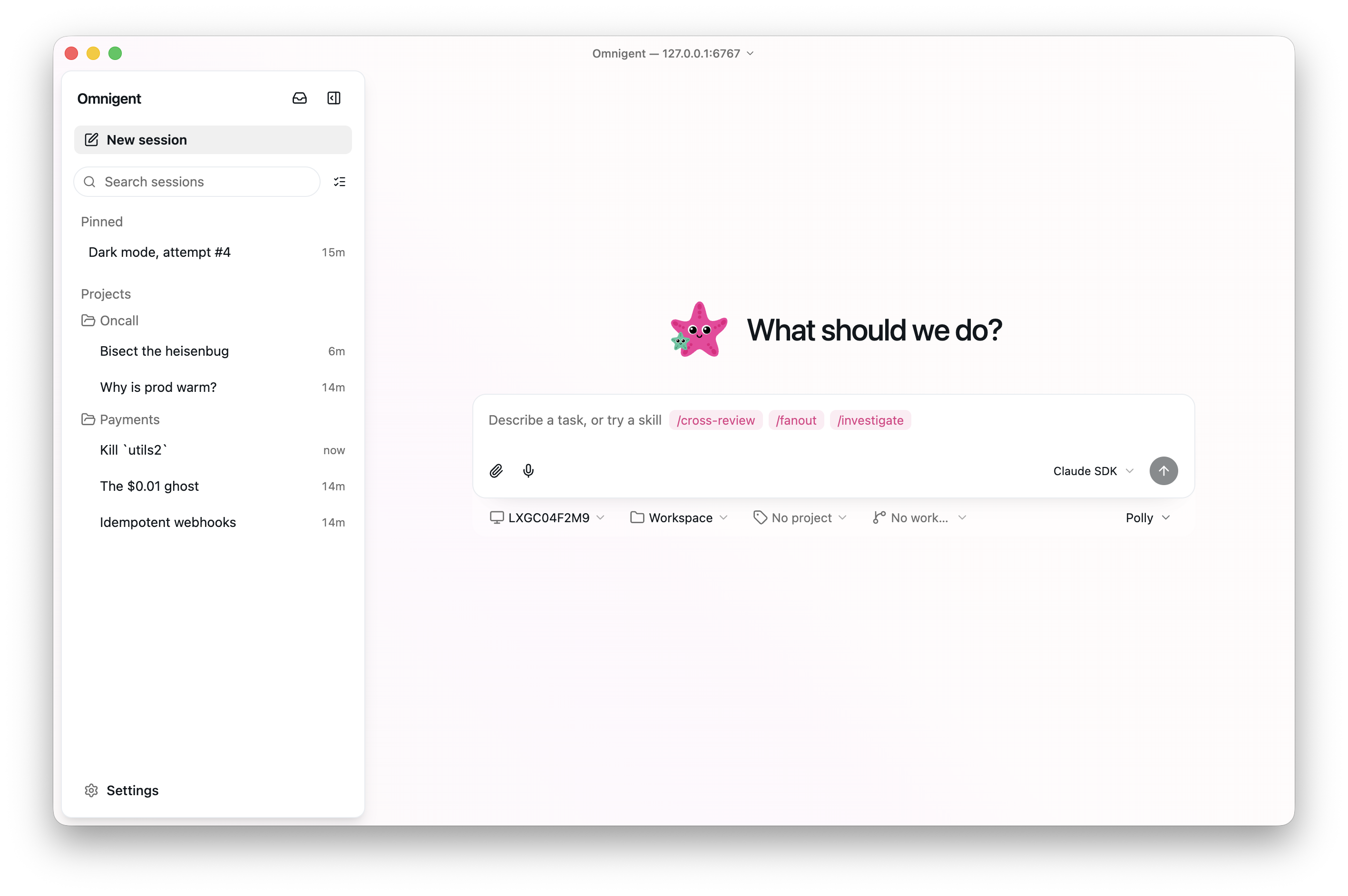
Omnigent is an open-source AI agent framework and meta-harness: orchestrate Claude Code, Codex, Cursor, Pi, and custom agents — swap harnesses without rewriting, enforce policies and sandboxing, and collaborate in real time from any device.

A theoretical reconstruction of the Claude Mythos architecture, built from first principles using the available research literature.
🕷️ An adaptive Web Scraping framework that handles everything from a single request to a full-scale crawl!