
koala73/worldmonitorConnectors
Real-time global intelligence dashboard. AI-powered news aggregation, geopolitical monitoring, and infrastructure tracking in a unified situational awareness interface
86k
Rustdocs MCP Server gives agents access to Rust crate docs, source code, dependency graphs, and module trees through MCP. It caches crates from crates.io, GitHub, or local paths, then lets you search items, inspect details, read source, and trace dependencies.
Builders who use an agent to inspect Rust crates before coding.
You can ask your agent to explore Rust crates deeply instead of guessing from stale examples.
Downloads crates from crates.io, GitHub, or local paths and stores them for later use.
Searches crate items by pattern, kind, or path, with preview and fuzzy search modes.
Returns signatures, fields, methods, docs, and source for specific Rust items.
Shows direct and transitive dependencies with metadata.
Generates hierarchical module trees through `cargo-modules` integration.
Keeps cached crates available for repeated analysis without hitting the network.
Runs as a stdio MCP server or as one-shot CLI commands like `call cache-crate` and `call search-items-fuzzy`.
curl -sSL https://raw.githubusercontent.com/snowmead/rust-docs-mcp/main/install.sh | bash
curl -sSL https://raw.githubusercontent.com/snowmead/rust-docs-mcp/main/install.sh | bash
curl -sSL https://raw.githubusercontent.com/snowmead/rust-docs-mcp/main/install.sh | bash -s -- --install-dir /usr/local/bin
cargo install rust-docs-mcp
rustup toolchain install nightly-2026-05-22
export RUST_DOCS_MCP_TOOLCHAIN=nightly





Rust is the language of AI
An MCP (Model Context Protocol) server that provides comprehensive access to Rust crate documentation, source code analysis, dependency trees, and module structure visualization. Built for agents to gain quality insights into Rust projects and build with confidence.
This is an entirely vibe coded project and was created as an experiment to see if LLMs can build a fully functional tool without human oversight.
The rise of AI agents has revolutionized software development, with new tools and libraries emerging at an unprecedented pace. However, this rapid evolution creates a critical challenge: agents cannot reliably build with tools they weren't trained on.
When an agent tries to use a new Rust crate:
This leads to frustrated developers watching their agents fail repeatedly, guessing at APIs, and producing broken code.
This MCP server gives agents the tools they need to truly understand Rust crates:
With these capabilities, agents can build confidently with any Rust crate — even ones released yesterday.
cache_crate - Download and cache a crate from various sources. Set
source_type to one of: cratesio, github, or local
version (e.g., {crate_name: "serde", source_type: "cratesio", version: "1.0.215"})github_url and either branch OR tag (e.g., {crate_name: "my-crate", source_type: "github", github_url: "https://github.com/user/repo", tag: "v1.0.0"})path, optional version (e.g., {crate_name: "my-crate", source_type: "local", path: "~/projects/my-crate"})features: Specific features to enable instead of --all-features. Use for crates with mutually exclusive features (e.g., {crate_name: "leptos-use", source_type: "cratesio", version: "0.15.8", features: ["axum"]})remove_crate - Remove cached crate versions to free disk spacelist_cached_crates - View all cached crates with versions and sizeslist_crate_versions - List cached versions for a specific crateget_crates_metadata - Batch metadata queries for multiple cratescache_operations - Manage and monitor background caching operations (list, status, cancel, clear)list_crate_items - Browse all items in a crate with optional filteringsearch_items - Full search with complete documentation (may hit token
limits)search_items_preview - Lightweight search returning only IDs, names, and
typesget_item_details - Detailed information about specific items (signatures,
fields, etc.)get_item_docs - Extract just the documentation string for an itemget_item_source - View source code with configurable context linesget_dependencies - Analyze direct and transitive dependencies with filteringstructure - Generate hierarchical module tree using integrated cargo-modulessearch_items_fuzzy - Fuzzy search with typo tolerance and semantic
similarityBy default, crates are cached in ~/.rust-docs-mcp/cache/. You can customize
this location using:
# Command line option
rust-docs-mcp --cache-dir /custom/path/to/cache
# or set the environment variable
export RUST_DOCS_MCP_CACHE_DIR=/custom/path/to/cache
rust-docs-mcp
To access private repositories or increase GitHub API rate limits, set the
GITHUB_TOKEN environment variable:
export GITHUB_TOKEN=your_github_personal_access_token
Benefits of authentication:
source/ directorymetadata.jsonmembers/ directory:
members/{member-name}/docs.json - Rustdoc JSON documentationmembers/{member-name}/dependencies.json - Cargo dependency metadatamembers/{member-name}/metadata.json - Member-specific cache metadatadocs.json - Rustdoc JSON documentationdependencies.json - Cargo dependency metadatacurl -sSL https://raw.githubusercontent.com/snowmead/rust-docs-mcp/main/install.sh | bash
curl -sSL https://raw.githubusercontent.com/snowmead/rust-docs-mcp/main/install.sh | bash
curl -sSL https://raw.githubusercontent.com/snowmead/rust-docs-mcp/main/install.sh | bash -s -- --install-dir /usr/local/bin
cargo install rust-docs-mcp
Rust nightly toolchain (for Rustdoc JSON generation)
rustup toolchain install nightly-2026-05-22
Runtime prefers nightly-2026-05-22, which provides rustc
1.97.0-nightly (e96c36b6f 2026-05-21), so documentation generation can
compile modern crates. The rustdoc-types dependency is kept in sync with
that rustdoc JSON format. If the dated toolchain is missing, the runtime
falls back to plain nightly, but only when it emits the same rustdoc JSON
format version (57); newer nightlies will be rejected. You can override the
choice with:
export RUST_DOCS_MCP_TOOLCHAIN=nightly
Network access to download crates from crates.io
git clone https://github.com/snowmead/rust-docs-mcp
cd rust-docs-mcp/rust-docs-mcp
cargo build --release
./target/release/rust-docs-mcp install
rust-docs-mcp                   # Start MCP server (same as `serve`)
rust-docs-mcp serve             # Start MCP server explicitly

# One-shot operations (stateless – print JSON to stdout and exit)
rust-docs-mcp call cache-crate \
  --params '{"crate_name":"serde","source_type":"cratesio","version":"1.0.215"}'

rust-docs-mcp call search-items-fuzzy \
  --params '{"crate_name":"serde","version":"1.0.215","query":"Deserialize","limit":10}'

rust-docs-mcp call list-cached-crates

rust-docs-mcp call list-crate-versions \
  --params '{"crate_name":"serde"}'

# Maintenance commands
rust-docs-mcp install           # Install to ~/.local/bin
rust-docs-mcp install --force   # Force overwrite existing installation
rust-docs-mcp doctor            # Verify system environment and dependencies
rust-docs-mcp doctor --json     # Output diagnostic results in JSON format
rust-docs-mcp update            # Update to latest version from GitHub
rust-docs-mcp --help            # Show help
Note:
call cache-crateis blocking — it downloads the crate, generates documentation, and builds the search index before returning. This is different from MCP mode wherecache_cratereturns a task ID immediately and completes in the background. If a one-shot tool returns an error JSON response, the CLI prints that JSON to stdout and exits with status 1.Available one-shot tools:
cache-crate,search-items-fuzzy,search-items-preview,search-items,list-crate-items,get-item-details,get-item-docs,get-item-source,list-cached-crates,list-crate-versions,get-dependencies,structure.
If you encounter issues during installation or runtime, run the doctor command to diagnose common problems:
rust-docs-mcp doctor
The doctor command checks:
For programmatic integration, use --json flag to get structured output.
Add the server to your MCP configuration:
{
  "rust-docs": {
    "command": "/path/to/rust-docs-mcp/target/release/rust-docs-mcp",
    "transport": "stdio"
  }
}
Sign in to join the discussion.
No comments yet. Be the first to say what this is good for.
Real-time global intelligence dashboard. AI-powered news aggregation, geopolitical monitoring, and infrastructure tracking in a unified situational awareness interface
High-performance code intelligence MCP server. Indexes codebases into a persistent knowledge graph — average repo in milliseconds. 158 languages, sub-ms queries, 99% fewer tokens. Single static binary, zero dependencies.
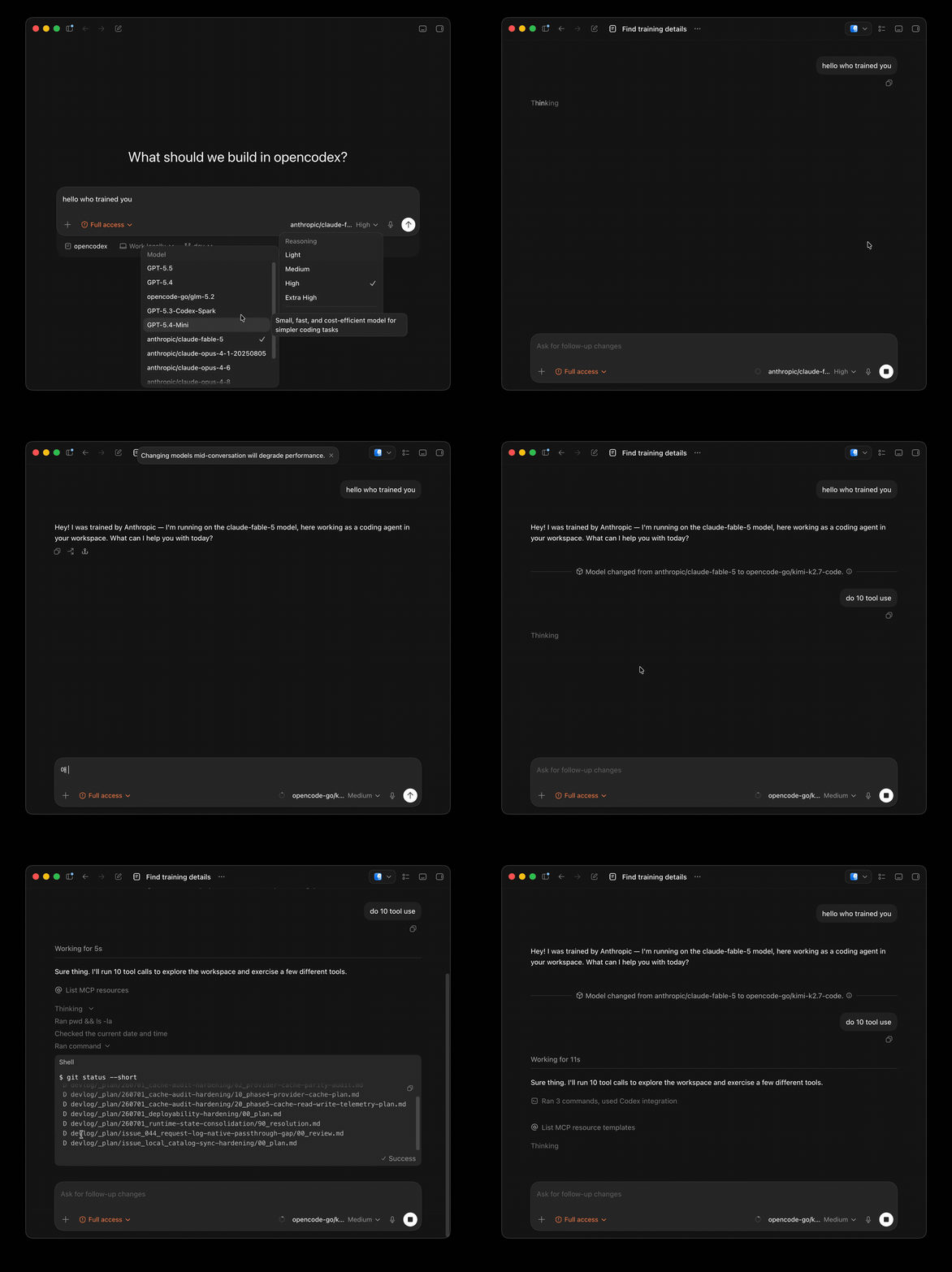
Universal provider proxy for OpenAI Codex & Claude Code — use any LLM (Claude, Gemini, Grok, DeepSeek, Ollama…) with Codex CLI, App, SDK, and Claude Code

Git-native persistent memory for AI coding agents. Implements Google OKF v0.2 with sub-300µs in-memory BM25 search, embedded MCP server, and progressive disclosure. Slashes token bloat by 80% with zero external databases or dependencies. Built in pure Go.

Local-first code intelligence graph for MCP and CLI. Builds a persistent map of your codebase so AI coding tools read only what matters, with benchmarked context reductions on reviews and large-repo workflows.

Stop your AI from making things up — it proposes, deterministic tools decide, every claim checked against ground truth with evidence. Grounded facts and context survive resets. Reverse engineering is the proving ground. MCP server + CLI.