
koala73/worldmonitorConnectors
Real-time global intelligence dashboard. AI-powered news aggregation, geopolitical monitoring, and infrastructure tracking in a unified situational awareness interface
86k
This repo packages a ServiceNow MCP server and a matching set of skill guides. The server gives an agent tools to inspect and change ServiceNow; the skills give it the workflow knowledge to use those tools with more judgment. The tool catalog can load on demand so it fits in a context window, and the repo also ships plugin and MCP config examples for common clients.
Builders who want their agent to work with ServiceNow through MCP and follow ServiceNow-specific workflows.
You can let an agent inspect and change ServiceNow records without re-explaining the process each time.
Exposes a large `snow_*` tool catalog for ServiceNow actions over stdio or streamable HTTP.
Starts with meta-tools, then loads only the tools needed for the current task so the catalog fits in context.
Adds impact analysis before changes that could affect more of the instance.
Ships 57 `SKILL.md` guides that describe workflows like ES5 compliance, update sets, and blast radius checks.
Works with any MCP client, and the README includes config examples for Claude Code, Cursor, Windsurf, and VS Code.
Can be installed as a Claude Code plugin bundle from the repository marketplace entry.
npm install -g @serac-labs/servicenow-mcp
servicenow-mcp-stdio --doctor
tool_search({query: "incident"})  → the matching tools, now enabled
tool_execute({tool: "snow_query_incidents", args: {query: "priority=1"}})/plugin marketplace add serac-labs/serac /plugin install servicenow@serac
███████╗███████╗██████╗ █████╗ ██████╗ ██╔════╝██╔════╝██╔══██╗██╔══██╗██╔════╝ ███████╗█████╗ ██████╔╝███████║██║ ╚════██║██╔══╝ ██╔══██╗██╔══██║██║ ███████║███████╗██║ ██║██║ ██║╚██████╗ ╚══════╝╚══════╝╚═╝ ╚═╝╚═╝ ╚═╝ ╚═════╝



Two packages, and nothing else:
| Package | What it is |
|---|---|
@serac-labs/servicenow-mcp | An MCP server for ServiceNow. 400+ snow_* tools over stdio or streamable HTTP, plus blast-radius impact analysis. |
@serac-labs/skills | 57 ServiceNow skill guides. Plain markdown an agent loads into its prompt so it uses those tools like a practitioner. |
The two are meant to be used together. The server gives a model the ability to act on a ServiceNow instance; the skills give it the judgement to do so without breaking one — which update set to be in, why a Business Rule needs ES5, what to check before renaming a field.
Both work with any MCP client. Neither requires the Serac product.
npm install -g @serac-labs/servicenow-mcp
Point your MCP client at the servicenow-mcp-stdio binary:
{
"mcpServers": {
"servicenow": {
"command": "servicenow-mcp-stdio",
"env": {
"SNOW_INSTANCE": "https://dev12345.service-now.com",
"SNOW_CLIENT_ID": "…",
"SNOW_CLIENT_SECRET": "…"
}
}
}
}
Credentials come from an OAuth application registry entry on your instance (System OAuth > Application Registry). A developer instance from developer.servicenow.com is enough
to try everything here.
If nothing works — an auth error, or a response that will not parse — ask the server what is wrong before changing anything:
servicenow-mcp-stdio --doctor
It names which credential source was used, whether the URL is usable, whether the instance is awake (a
hibernating developer instance answers with an HTML login page, which makes every tool look broken), whether
the OAuth exchange succeeds, and which roles the account holds. The model can ask for the same report by
calling snow_diagnose_setup.
The catalog is far larger than a context window, so tools are deferred by default: tools/list returns
two meta-tools and the model widens its own surface as it works.
tool_search({query: "incident"}) → the matching tools, now enabled
tool_execute({tool: "snow_query_incidents", args: {query: "priority=1"}})
Set SNOW_LAZY_TOOLS=false to register the whole catalog up front instead. Full options, library usage and
the multi-tenancy rules are in the package README.
The repository is also a plugin marketplace, so the server and all 70 skills arrive in one step:
/plugin marketplace add serac-labs/serac
/plugin install servicenow@serac
The server runs through npx, so nothing has to be installed first: export the same three variables as
above and it is ready. The same entry is in .mcp.json at
the repo root, which Claude Code reads for this project. Other clients each want it somewhere else: copy it
into .cursor/mcp.json (Cursor), ~/.codeium/windsurf/mcp_config.json (Windsurf), or .vscode/mcp.json
for VS Code, which names the same block servers rather than mcpServers.
A skill is a directory with a SKILL.md: YAML frontmatter naming the skill and the snow_* tools it
expects, then prose. Nothing loads them automatically — a host decides which ones to put in front of the
model. Copy the ones you want into your agent's skills directory, or read them from the package:
import { skillsRoot } from "@serac-labs/skills/root"
They are worth reading on their own, even without an agent involved. Start with
es5-compliance,
update-set-workflow or
blast-radius.
Requires Bun 1.3.14 — pinned in the root package.json packageManager field, which is
also what CI installs.
bun install
bun typecheck          # tsgo across both packages
bun run test           # both suites
bun run lint           # oxlint
Tests do not run from the repo root directly — run them per package, or through turbo with bun run test:
cd packages/servicenow-mcp && bun test
cd packages/skills && bun test
Tools live in packages/servicenow-mcp/src/servicenow-mcp-unified/tools/<domain>/snow_<name>.ts, one file
per tool, each exporting a toolDefinition and an executor. The registry is generated by walking that
directory, so a new file in the right shape is a new tool — there is no central list to edit. Regenerate the
published manifest afterwards:
bun run --cwd packages/servicenow-mcp generate:tools-json
Create packages/skills/<name>/SKILL.md with frontmatter, then regenerate the embedded map:
bun run --cwd packages/skills generate
bun test in that package fails if the embedded map drifts from the tree, or if frontmatter names a tool the
MCP server does not actually have. Both of those have shipped to users before.
packages/servicenow-mcp/tools.json and packages/servicenow-mcp/sn-roles.manifest.json are committed
generated files, and live services fetch them straight from main over raw.githubusercontent.com. They are
published by being committed. Moving or renaming either one is a production change: the consumer has to be
repointed and deployed first, and the old path removed in a separate commit afterwards. See
the package README.
@serac-labs/servicenow-mcp publishes from .github/workflows/publish-mcp.yml — a manual
workflow_dispatch, versioned from packages/servicenow-mcp/package.json and nothing else, with OIDC
trusted publishing and signed provenance. Every PR that touches the package runs the same build, test and
packaging gates without publishing, including one that copies the package out of the workspace entirely and
proves it installs, builds and tests with no monorepo around it.
The MCP registry listing is a second, separate dispatch:
.github/workflows/publish-mcp-registry.yml uploads the repo-root server.json once the npm version is
live. server.json repeats that version and the package name, so a gate on every PR touching either file
fails when the two disagree — bun run --cwd packages/servicenow-mcp check:registry-manifest.
@serac-labs/skills releases the same way, from .github/workflows/publish-skills.yml, with gates
adapted to what that package actually ships: the tarball must contain every entrypoint and every skill
directory, and every published subpath must load under node from a real npm install — skillsRoot()
hands consumers a filesystem path, so an import that merely succeeds proves nothing.
Its npm trusted publisher does not exist yet, so no version has gone out. Creating it (bound to
serac-labs/serac + publish-skills.yml) is a manual step on npmjs.com; see the workflow header.
This repository was a fork of opencode carrying a terminal AI agent,
a TUI, a desktop app and a web console. Twenty-five packages went; the two above remain. The
@serac-labs/core CLI those packages built is discontinued — it stays installable on npm at its final
version, but there are no further releases and no security fixes for it.
The ServiceNow work was always the part worth keeping, and it was the part buried deepest. It is now the whole repository.
One artifact of that era is deliberately still here: the install script at the repo root. Every CLI already
installed in the world fetches that exact URL when it self-upgrades, and serac.build/install redirects to
it. Deleting the file would pipe a GitHub 404 page into those users' shells. It stays until it is replaced
with something that tells them what happened — do not tidy it away.
Read CONTRIBUTING.md first — it is short. Every PR links an issue, and the code style rules are in AGENTS.md.
Apache License 2.0. See NOTICE for third-party attributions: this code's history
begins in the MIT-licensed opencode project.
Sign in to join the discussion.
No comments yet. Be the first to say what this is good for.
Real-time global intelligence dashboard. AI-powered news aggregation, geopolitical monitoring, and infrastructure tracking in a unified situational awareness interface
High-performance code intelligence MCP server. Indexes codebases into a persistent knowledge graph — average repo in milliseconds. 158 languages, sub-ms queries, 99% fewer tokens. Single static binary, zero dependencies.
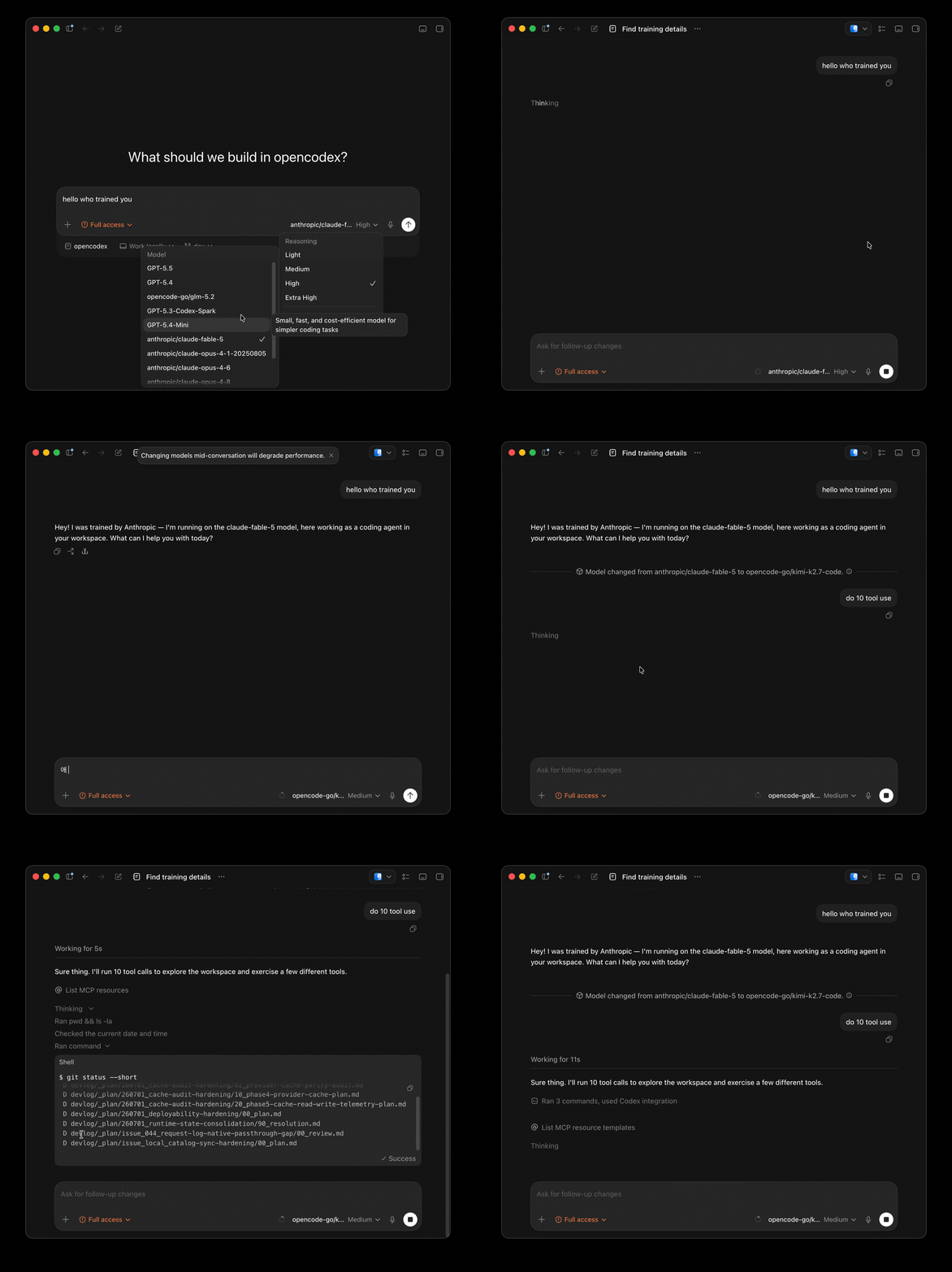
Universal provider proxy for OpenAI Codex & Claude Code — use any LLM (Claude, Gemini, Grok, DeepSeek, Ollama…) with Codex CLI, App, SDK, and Claude Code

Git-native persistent memory for AI coding agents. Implements Google OKF v0.2 with sub-300µs in-memory BM25 search, embedded MCP server, and progressive disclosure. Slashes token bloat by 80% with zero external databases or dependencies. Built in pure Go.

Local-first code intelligence graph for MCP and CLI. Builds a persistent map of your codebase so AI coding tools read only what matters, with benchmarked context reductions on reviews and large-repo workflows.

Stop your AI from making things up — it proposes, deterministic tools decide, every claim checked against ground truth with evidence. Grounded facts and context survive resets. Reverse engineering is the proving ground. MCP server + CLI.