

koala73/worldmonitorConnectors
Real-time global intelligence dashboard. AI-powered news aggregation, geopolitical monitoring, and infrastructure tracking in a unified situational awareness interface
86k
MCP System Monitor exposes live system information through a Model Context Protocol interface. It packages separate tools for CPU, memory, disk, network, host, and process data so an agent can inspect the machine during a session.
Builders who want an MCP-compatible agent to query live system metrics from the machine they are working on.
You can ask your agent for real-time CPU, memory, disk, network, host, and process details without leaving the chat.
Provides CPU usage, core count, and per-core data through `get_cpu_info`.
Returns virtual memory and swap usage through `get_memory_info`.
Reports disk usage, partitions, and I/O stats through `get_disk_info`.
Shows interfaces, connections, and traffic stats through `get_network_info`.
Reports system details, uptime, boot time, and users through `get_host_info`.
Lists processes and can return detailed data for a PID through `get_process_info`.
git clone https://github.com/seekrays/mcp-monitor.git
cd mcp-monitor
make build
./mcp-monitor


A system monitoring tool that exposes system metrics via the Model Context Protocol (MCP). This tool allows LLMs to retrieve real-time system information through an MCP-compatible interface.
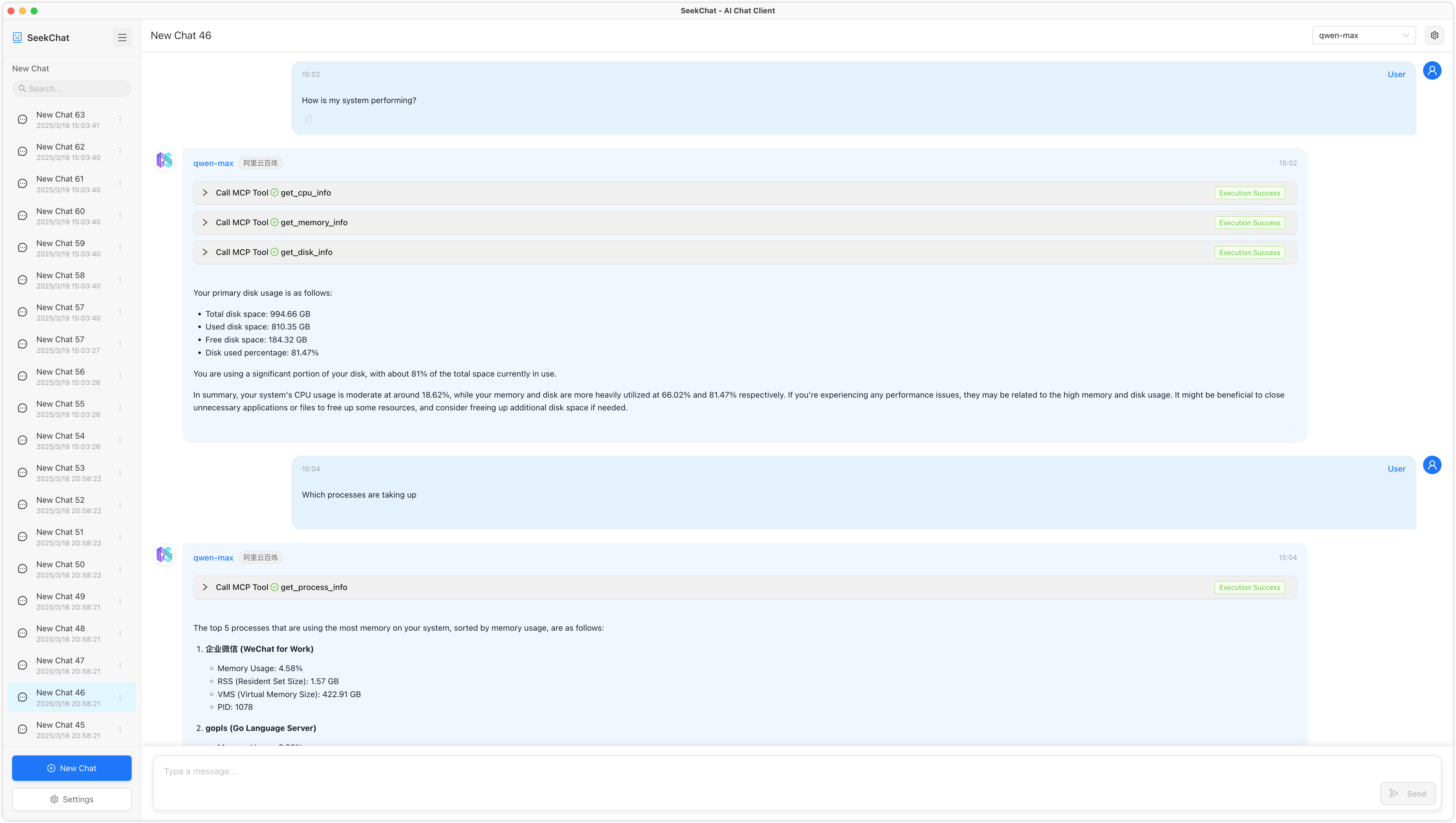
This tool provides the following monitoring capabilities:
Tool: get_cpu_info
Description: Get CPU information and usage
Parameters:
  - per_cpu (boolean, default: false): Whether to return data for each core
Tool: get_memory_info
Description: Get system memory usage information
Parameters: None
Tool: get_disk_info
Description: Get disk usage information
Parameters:
  - path (string, default: "/"): Specify the disk path to query
  - all_partitions (boolean, default: false): Whether to return information for all partitions
Tool: get_network_info
Description: Get network interface and traffic information
Parameters:
  - interface (string, optional): Specify the network interface name to query
Tool: get_host_info
Description: Get host system information
Parameters: None
Tool: get_process_info
Description: Get process information
Parameters:
  - pid (number, optional): Process ID to get detailed information for a specific process
  - limit (number, default: 10): Limit the number of processes returned
  - sort_by (string, default: "cpu"): Sort field (cpu, memory, pid, name)
git clone https://github.com/seekrays/mcp-monitor.git
cd mcp-monitor
make build
Run the compiled binary:
./mcp-monitor
The server starts in stdio mode, ready to communicate with an MCP-compatible LLM client.
Contributions are welcome! Please feel free to submit a Pull Request.
Sign in to join the discussion.
No comments yet. Be the first to say what this is good for.
Real-time global intelligence dashboard. AI-powered news aggregation, geopolitical monitoring, and infrastructure tracking in a unified situational awareness interface
High-performance code intelligence MCP server. Indexes codebases into a persistent knowledge graph — average repo in milliseconds. 158 languages, sub-ms queries, 99% fewer tokens. Single static binary, zero dependencies.
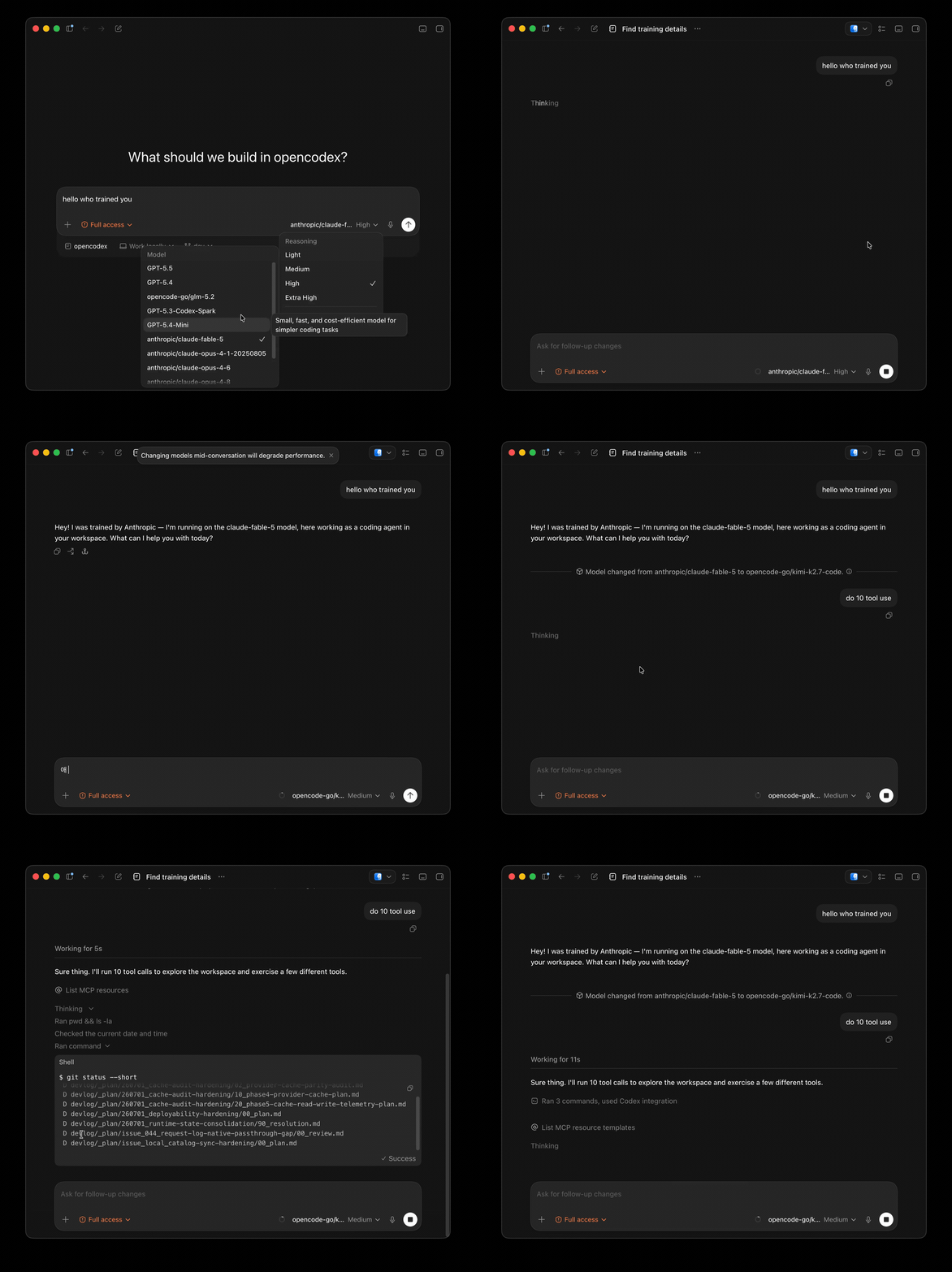
Universal provider proxy for OpenAI Codex & Claude Code — use any LLM (Claude, Gemini, Grok, DeepSeek, Ollama…) with Codex CLI, App, SDK, and Claude Code

Git-native persistent memory for AI coding agents. Implements Google OKF v0.2 with sub-300µs in-memory BM25 search, embedded MCP server, and progressive disclosure. Slashes token bloat by 80% with zero external databases or dependencies. Built in pure Go.

Local-first code intelligence graph for MCP and CLI. Builds a persistent map of your codebase so AI coding tools read only what matters, with benchmarked context reductions on reviews and large-repo workflows.

Stop your AI from making things up — it proposes, deterministic tools decide, every claim checked against ground truth with evidence. Grounded facts and context survive resets. Reverse engineering is the proving ground. MCP server + CLI.