


koala73/worldmonitorConnectors
Real-time global intelligence dashboard. AI-powered news aggregation, geopolitical monitoring, and infrastructure tracking in a unified situational awareness interface
86k
DevGlobe combines a public talent graph, an MCP server, and an editor extension. Agents can search developers and request introductions, while builders can browse a live globe, leaderboard, and profile pages backed by Cosmos DB search.
Builders who want their agent or editor to search for people, skills, and contribution history.
You can find relevant humans for a task and hand off contact requests through an agent-friendly workflow.
Search developer profiles by skill, location, language, and contribution signals.
Use the hosted `https://www.devglobe.dev/mcp` endpoint or the local `npm run mcp` connector for agent access.
Agents can request developer-approved introductions instead of guessing contact paths.
Install the DevGlobe extension to go live, search developers, and configure MCP from the editor.
Browse an interactive 3D map, ranked lists, and profile detail panels.
Uses Azure Cosmos DB vector and hybrid search to rank and retrieve developer matches.
git clone https://github.com/sajeetharan/devglobe.git
cd devglobe
npm install
npm run dev
# Open http://localhost:3000
npm run seed-emulator
npm run dev
npm run dev
The open-source talent graph for humans and AI agents.






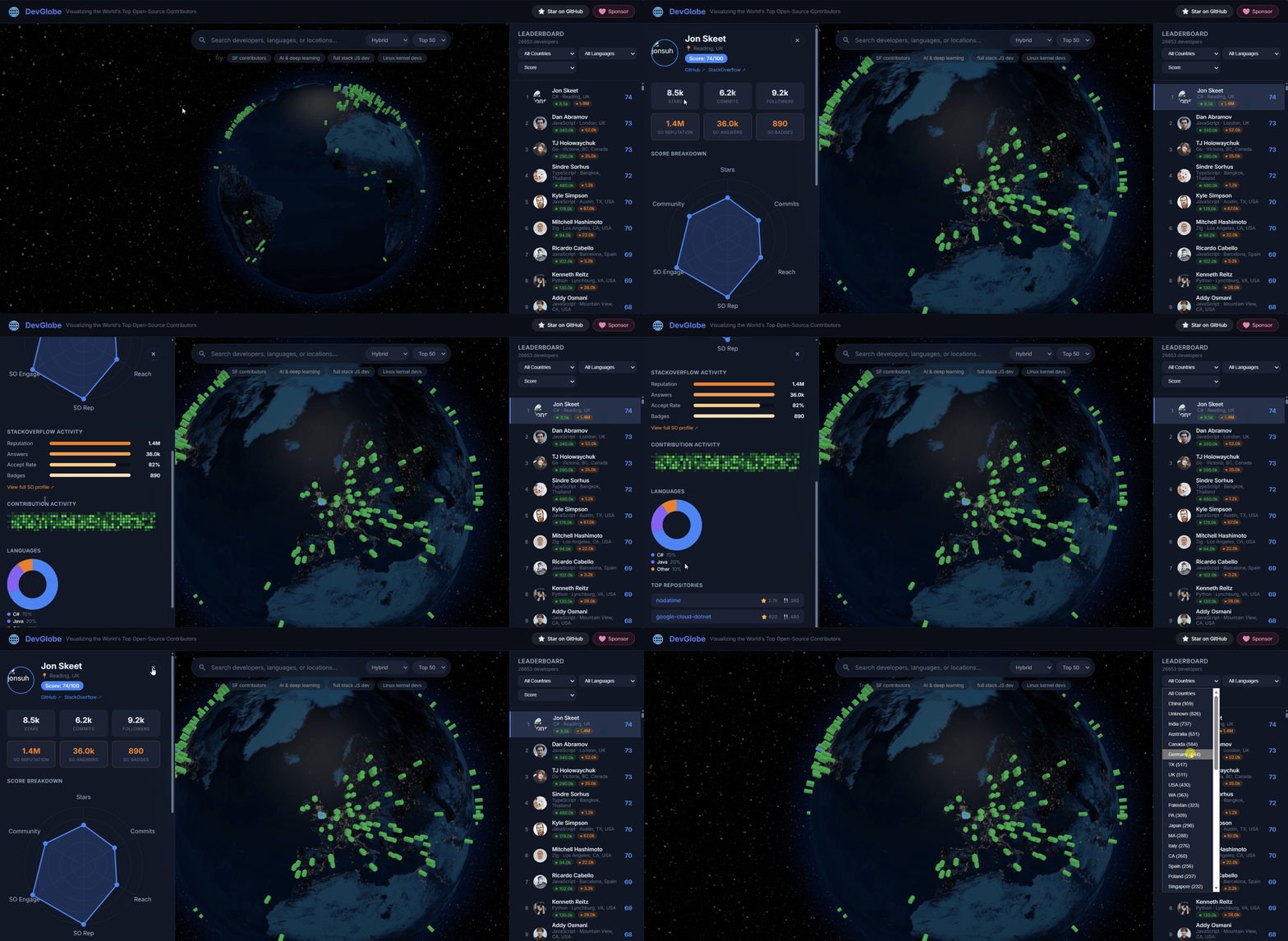
26,000+ developers · ranked by stars, commits, repo reach & StackOverflow reputation · searchable by skill, location & language
DevGlobe is the open-source talent graph for humans and AI agents. It combines a 3D developer map with Azure Cosmos DB vector and hybrid search to surface relevant expertise from real contribution signals rather than popularity alone. The long-term vision is a consent-aware discovery layer where AI agents can find the right human collaborators.
The dynamic application is hosted on Azure Container Apps. Product, API, MCP, Agent Skill, and agent-readiness documentation is published separately on GitHub Pages.
[!IMPORTANT] Connect an AI agent to DevGlobe: MCP-compatible agents can use the hosted endpoint at
https://www.devglobe.dev/mcpto search public developer profiles without credentials. Verified agents can also request developer-approved introductions. See the MCP setup guide.Show up while you code: Install DevGlobe: Live Coding Globe, choose Go Live, and appear on the globe while building private coding stats. The extension never reads source code, file paths, repositories, branches, or keystrokes.
git clone https://github.com/sajeetharan/devglobe.git
cd devglobe
npm install
npm run dev
# Open http://localhost:3000
The app automatically falls back to the bundled sample data (20 developers) when no Cosmos DB credentials are configured. No API keys, no emulator, no setup — just clone and run.
Text search works fully offline. Vector/hybrid search requires Azure OpenAI (see Option 3).
For contributors working on the API layer or data pipeline:
Install the Cosmos DB Emulator — Download here (Windows, macOS via Docker, or Linux Docker)
Start the emulator and wait for it to be ready at https://localhost:8081
Seed sample data into the emulator:
npm run seed-emulator
Create .env.local (the seed script prints this for you):
COSMOS_ENDPOINT=https://localhost:8081
COSMOS_KEY=C2y6yDjf5/R+ob0N8A7Cgv30VRDJIWEHLM+4QDU5DE2nQ9nDuVTqobD4b8mGGyPMbIZnqyMsEcaGQy67XIw/Jw==
Run the app:
npm run dev
The emulator key above is Microsoft's well-known emulator key — it is intentionally public and only works locally.
For the complete experience including AI-powered search:
# .env.local
COSMOS_ENDPOINT=https://your-account.documents.azure.com:443/
COSMOS_KEY=your-cosmos-key
AZURE_OPENAI_ENDPOINT=https://your-openai.openai.azure.com/
AZURE_OPENAI_KEY=your-openai-key
EMBEDDING_DEPLOYMENT=text-embedding-3-small
AZURE_OPENAI_CHAT_DEPLOYMENT=gpt-4o-mini
AZURE_OPENAI_CHAT_DEPLOYMENT enables generated fun facts on identity cards. Cards use factual profile copy when the chat deployment is unavailable.
Production serves the Next.js application from Azure Container Apps, high-volume public API reads from Azure Functions, and the developer snapshot from Azure Blob Storage. See docs/azure-backend.md for the resource layout, environment switches, and deployment checks.
npm run dev
| Layer | Technology |
|---|---|
| Frontend | React 19, Three.js (react-globe.gl), Next.js 15 |
| Search | Azure Cosmos DB (vector + hybrid search) |
| API | Next.js API Routes |
| Hosting | Azure Container Apps and Azure Functions |
| Data Pipeline | Node.js scripts (GitHub GraphQL, StackOverflow API, geocoding) |
| Dimension | Weight | Source |
|---|---|---|
| GitHub Stars | 20% | Total stars across repos |
| GitHub Commits | 20% | Yearly commit activity |
| Repo Reach | 15% | Forks + watchers |
| SO Reputation | 25% | StackOverflow reputation |
| SO Engagement | 15% | Answer acceptance × count |
| Community | 5% | Followers + badges |
All dimensions are log-normalized to prevent outlier domination.
Requires API keys — copy .env.example to .env and fill in your tokens.
npm run fetch-github          # Fetch top devs from GitHub GraphQL
npm run fetch-stackoverflow   # Enrich with StackOverflow reputation
npm run geocode               # Convert locations to lat/lng
npm run build-data            # Run full pipeline
npm run upload-cosmos         # Upload to Azure Cosmos DB
Verified community credentials are stored explicitly on each developer document. Do not infer them from stars, followers, or profile text.
{
   "login": "example",
   "specialTags": ["github-star", "microsoft-mvp", "aws-community-builder"]
}
Supported IDs: github-star, microsoft-mvp, google-developer-expert, docker-captain, cncf-ambassador, aws-hero, and aws-community-builder. The legacy docker-champion ID remains supported. The upload script preserves this field from source JSON, and the list, detail, and search APIs project it from Cosmos DB.
Populate exact GitHub-login matches from the official GitHub Stars, Google Developer Experts, and CNCF Ambassadors rosters:
npm run populate-special-tags             # Dry run
npm run populate-special-tags -- --apply  # Patch verified matches in Cosmos DB
The command preserves existing tags and is idempotent. Other credentials require an official profile that explicitly identifies the developer's GitHub account; do not populate them by matching display names.
├── index.html                  # Entry HTML
├── src/
│   ├── main.jsx                # Application bootstrap
│   ├── App.jsx                 # Root component, data loading
│   ├── components/
│   │   ├── Globe.jsx           # 3D globe (react-globe.gl)
│   │   ├── Leaderboard.jsx     # Ranked sidebar with filters
│   │   ├── SearchBar.jsx       # Hybrid/vector search input
│   │   ├── DetailPanel.jsx     # Developer detail card
│   │   ├── Header.jsx          # Top bar with branding
│   │   └── LoadingOverlay.jsx  # Loading state
│   └── utils/
│       ├── scoring.js          # Composite scoring algorithm
│       └── format.js           # Number formatting helpers
├── api/
│   ├── developers.js           # List all developers
│   ├── developer.js            # Single developer lookup
│   └── search.js               # Cosmos DB vector/hybrid search
├── scripts/                    # Data pipeline scripts
├── styles/main.css             # Dark theme styles
└── data/
    └── developers-sample.json  # Sample data for local dev
Pushes to main build the standalone Next.js image in Azure Container Registry and deploy it to Azure Container Apps through GitHub Actions OIDC. The deployment identity requires Contributor access scoped to the application resource group and these repository variables: AZURE_CLIENT_ID, AZURE_TENANT_ID, and AZURE_SUBSCRIPTION_ID.
Required environment variables:
| Variable | Purpose |
|---|---|
COSMOS_ENDPOINT | Azure Cosmos DB endpoint |
COSMOS_KEY | Azure Cosmos DB key |
COSMOS_DATABASE | Database name |
COSMOS_CONTAINER | Container name |
COSMOS_ACTIVITY_CONTAINER | Rolling GitHub activity container (activities) |
COSMOS_CONTACTS_CONTAINER | Private lifecycle-email contact container (developer-contacts) |
COSMOS_ENGAGEMENT_CONTAINER | Privacy-filtered engagement events (default: engagement-events) |
COSMOS_CONTRIBUTION_STATE_CONTAINER | Shared GitHub recommendation quota state (default: contribution-opportunity-state) |
ENGAGEMENT_HASH_SECRET | HMAC secret for session-window deduplication; defaults to SESSION_SECRET |
ACTIVITY_INGEST_SECRET | Bearer secret for the activity collector endpoint |
RESEND_API_KEY | Optional Resend API key for claim and approval emails |
EMAIL_FROM | Sender on a domain verified by Resend |
COSMOS_WATCHLIST_CONTAINER | Optional private watchlist container name (default: watchlists) |
COSMOS_IMPACT_HISTORY_CONTAINER | Optional impact snapshot container name (default: impact-history) |
COSMOS_LIVE_PRESENCE_CONTAINER | Opt-in live heartbeat container (default: live-presence) |
COSMOS_CODING_STATS_CONTAINER | Private daily coding aggregates (default: coding-stats) |
CRON_SECRET | Bearer token shared by protected cron endpoints and Azure Timer Functions |
EMAIL_PREFERENCE_SECRET | HMAC secret for weekly-email unsubscribe links; defaults to SESSION_SECRET |
Lifecycle emails are transactional and best-effort. Claims use the verified primary email authorized through GitHub OAuth; self-nominations collect an explicitly consented notification address. Addresses are stored only in the private developer-contacts container and are never projected by public APIs or copied into developer documents. Create the container before deployment:
npm run setup-contacts-container
See the lifecycle email PRD.
Claimed-profile visibility insights use allow-listed engagement events with hashed session IDs. Create the TTL-enabled container before deployment with node scripts/setup-engagement-container.js. See the engagement analytics contract for event semantics, privacy thresholds, and deletion behavior.
Claimed developers can also configure personalized open-source contribution recommendations. Candidates come only from public, fresh, unassigned GitHub issues in repositories with contribution guidance. Create the shared quota-state container with node scripts/setup-contribution-state-container.js before deployment. See the contribution opportunities contract.
Verified users can explicitly opt in to a Monday weekly digest from the user menu. The first run records a private comparison baseline without sending email; later messages require rank movement, a fresh contribution opportunity, or a pending introduction request and include an attributed deep link to the relevant action. The Azure Functions app invokes /api/cron/weekly-digest at 13:00 UTC each Monday; only verified contacts with productUpdatesEnabled: true are eligible. Each message uses a per-user, per-week idempotency key and includes one-click unsubscribe headers and a signed unsubscribe link.
Generate a manual-review activation queue and weekly social spotlight from public, unclaimed profiles:
npm run activation-campaign -- --limit=100 --output=data/activation-campaign.json
The command is read-only against Cosmos DB and never sends messages or retrieves private contact details. Review each draft before contacting a developer through an appropriate public channel.
The Activity tab is anonymous and shows a rolling 24-hour feed for indexed developers. Create its dedicated Cosmos container before deployment:
npm run setup-activity-container
Deploy functions/activity-ingest as an Azure Timer Function and configure these application settings:
ACTIVITY_INGEST_URL=https://your-site.example/api/activities/ingest
ACTIVITY_INGEST_SECRET=the-same-secret-configured-on-the-site
The timer invokes the collector every minute, matching GitHub's advertised polling interval. GitHub's public Events API is best-effort and may delay or omit events; the 15-second browser refresh does not guarantee GitHub source delivery within that interval. A valid GITHUB_TOKEN is required for full three-page collection; anonymous fallback inspects one page only. The Cosmos activity container uses a 48-hour TTL while the API exposes only the latest 24 hours.
The /space globe receives an opt-in heartbeat from the DevGlobe editor extension every 30 seconds while the developer is active. Heartbeats pause after one minute without editor activity. Presence is live for 90 seconds and remains visible as recently coding for up to 15 minutes. Developers can optionally share a bounded coding status, explicitly name a coding agent and model, join a 25- or 50-minute focus session, and receive rate-limited waves from signed-in users. Focused developers using the same language form temporary globe connections, and stopping presence returns a private companionship recap. Daily coding totals, streaks, achievements, language time, and editor time are derived only from consecutive valid heartbeats and are visible only to the signed-in developer. DevGlobe does not infer agent usage or collect source code, file paths, repositories, branches, prompts, responses, model traffic, or keystrokes for this feature.
Provision both TTL-enabled containers before enabling the feature in production:
npm run setup-live-presence-container
npm run setup-coding-stats-container
The editor directory provides tailored installation paths for VS Code, Cursor, Windsurf, VSCodium, Positron, Void, and Antigravity. Release v0.4.0 is available from both the Marketplace and GitHub Releases. The same VSIX supports compatible VS Code forks; Open VSX publication requires the devglobedev namespace and an OVSX_PAT repository secret.
Run the Publish editor extension workflow manually to validate and package one artifact, then select GitHub Release, Visual Studio Marketplace, or Open VSX destinations. Store publisher credentials only in the VSCE_PAT and OVSX_PAT GitHub Actions secrets.
Deploy the functions directory to an Azure Function App and configure these application settings for the 15-minute impact-history timer:
IMPACT_HISTORY_URL=https://www.devglobe.dev/api/cron/impact-history
CRON_SECRET=the-same-secret-configured-on-the-container-app
The timer resumes the current UTC day's capture in RU-bounded batches. Keep IMPACT_HISTORY_CONCURRENCY and IMPACT_HISTORY_BATCH_SIZE on the Container App because the Next.js endpoint performs the Cosmos work.
The Azure Functions app invokes the protected reminder endpoint daily at 14:00 UTC. The application sends reminders only to unverified contacts who consented to transactional email and have not received a reminder in the previous 72 hours; verified contacts stop receiving reminders immediately.
Configure these application settings on the Azure Function App:
EMAIL_VERIFICATION_REMINDERS_URL=https://www.devglobe.dev/api/cron/email-verification-reminders
WEEKLY_DIGEST_URL=https://www.devglobe.dev/api/cron/weekly-digest
CRON_SECRET=the-same-secret-configured-on-the-container-app
Deploy the complete functions directory so each timer and its function.json are included.
DevGlobe is independently maintained and free to use. GitHub sponsorship helps fund Azure hosting and observability, public-data refreshes, GitHub API-backed processing, security updates, testing, and open-source maintenance.
Sponsorship never influences developer rankings, search placement, moderation, or access to private developer information. See the funding and transparency policy for tiers, benefits, costs, and current milestones.
Contributions are welcome! See CONTRIBUTING.md for setup instructions and areas where help is needed.
DevGlobe exposes a hosted Streamable HTTP MCP endpoint for public developer discovery and consent-gated agent introductions:
https://www.devglobe.dev/mcp
Public search and profile lookup work anonymously. Introduction requests and status polling require an issued agent credential. A local stdio connector remains available for clients that do not support remote MCP:
npm run mcp
See docs/mcp-server.md for credential provisioning, Cosmos DB setup, client configuration, and the consent lifecycle. docs/agent-readiness.md documents machine-readable discovery, WebMCP, and the external DNS-AID deployment steps.
MIT — see LICENSE for details.
⭐ Star this repo if you find it useful!
Built with ❤️ by @sajeetharan
Sign in to join the discussion.
No comments yet. Be the first to say what this is good for.
Real-time global intelligence dashboard. AI-powered news aggregation, geopolitical monitoring, and infrastructure tracking in a unified situational awareness interface
High-performance code intelligence MCP server. Indexes codebases into a persistent knowledge graph — average repo in milliseconds. 158 languages, sub-ms queries, 99% fewer tokens. Single static binary, zero dependencies.
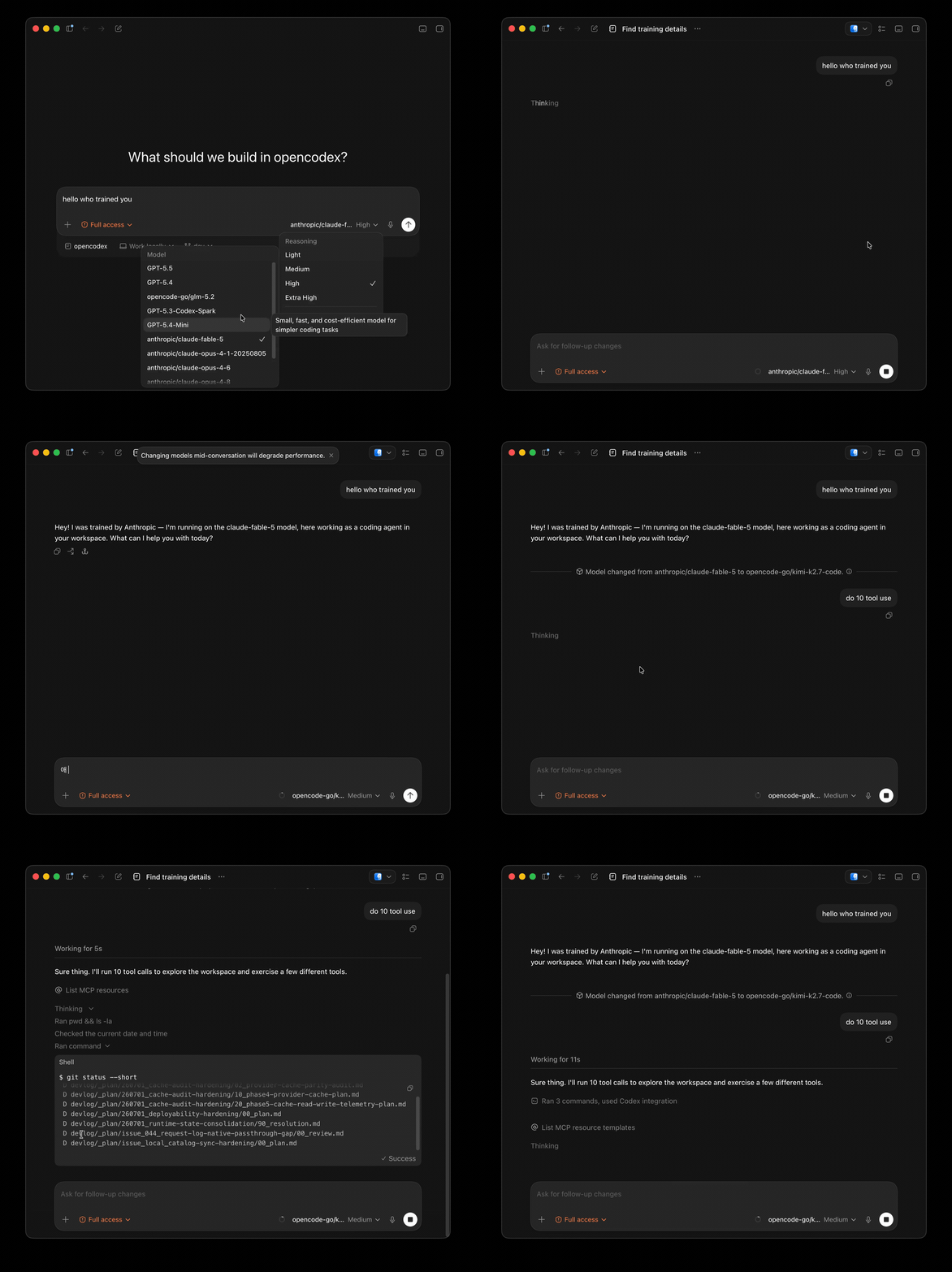
Universal provider proxy for OpenAI Codex & Claude Code — use any LLM (Claude, Gemini, Grok, DeepSeek, Ollama…) with Codex CLI, App, SDK, and Claude Code

Git-native persistent memory for AI coding agents. Implements Google OKF v0.2 with sub-300µs in-memory BM25 search, embedded MCP server, and progressive disclosure. Slashes token bloat by 80% with zero external databases or dependencies. Built in pure Go.

Local-first code intelligence graph for MCP and CLI. Builds a persistent map of your codebase so AI coding tools read only what matters, with benchmarked context reductions on reviews and large-repo workflows.

Stop your AI from making things up — it proposes, deterministic tools decide, every claim checked against ground truth with evidence. Grounded facts and context survive resets. Reverse engineering is the proving ground. MCP server + CLI.