
koala73/worldmonitorConnectors
Real-time global intelligence dashboard. AI-powered news aggregation, geopolitical monitoring, and infrastructure tracking in a unified situational awareness interface
86k
Turbular sits between an agent and a database so the agent can ask for schema details and execute SQL through one API. It supports several database types, normalizes schemas for LLM use, and can transform normalized queries back to the source layout.

Builders who want their agents to connect to PostgreSQL, MySQL, SQLite, BigQuery, Oracle, SQL Server, or Redshift.
You can let an agent inspect a database and run queries without wiring each database type by hand.
Provides one interface for PostgreSQL, MySQL, SQLite, BigQuery, Oracle, MS SQL, and Redshift.
Returns schemas in an LLM-friendly form and can map normalized queries back to the original schema.
Accepts SQL, optimizes it, and returns results with options like `max_rows` and `autocommit`.
Includes endpoints for uploading BigQuery service account keys and SQLite database files.
Includes Docker and Docker Compose files for local development and production.
git clone https://github.com/raeudigerRaeffi/turbular.git
cd turbular
docker-compose -f docker-compose.dev.yml up --build
./scripts/test_connection.py
pip install -r requirements.txt
uvicorn app.main:app --reload
docker-compose -f docker-compose.dev.yml up --build



Turbular is an open-source Model Context Protocol (MCP) server that enables seamless database connectivity for Language Models (LLMs). It provides a unified API interface to interact with various database types, making it perfect for AI applications that need to work with multiple data sources.
| Database Type | Status | Icon |
|---|---|---|
| PostgreSQL | ✅ |  |
| MySQL | ✅ |  |
| SQLite | ✅ |  |
| BigQuery | ✅ |  |
| Oracle | ✅ |  |
| MS SQL | ✅ |  |
| Redshift | ✅ | |
Clone the repository:
git clone https://github.com/raeudigerRaeffi/turbular.git
cd turbular
Start the development environment:
docker-compose -f docker-compose.dev.yml up --build
Test the connection:
./scripts/test_connection.py
Install Python 3.11 or higher
Install dependencies:
pip install -r requirements.txt
Run the server:
uvicorn app.main:app --reload
POST /get_schema
Retrieve the schema of a connected database for your LLM agent.
Parameters:
db_info: Database connection argumentsreturn_normalize_schema (optional): Return schema in LLM-friendly formatPOST /execute_query
Optimizes query and then execute SQL queries on the connected database.
Parameters:
db_info: Database connection argumentsquery: SQL query stringnormalized_query: Boolean indicating if query is normalizedmax_rows: Maximum number of rows to returnautocommit: Boolean for autocommit modePOST /upload-bigquery-key
Upload a BigQuery service account key file.
Parameters:
project_id: BigQuery project IDkey_file: JSON key filePOST /upload-sqlite-file
Upload a SQLite database file.
Parameters:
database_name: Name to identify the databasedb_file: SQLite database file (.db or .sqlite)GET /health
Verify if the API is running.
GET /supported-databases
Get a list of all supported database types.
Fork and clone the repository
Create a development environment:
docker-compose -f docker-compose.dev.yml up --build
The development server includes:
Access the API documentation:
We welcome contributions! Here's how you can help:
Run the test suite:
pytest
For development tests with the included PostgreSQL:
./scripts/test_connection.py
connection_info = {
    "database_type": "PostgreSQL",
    "username": "user",
    "password": "password",
    "host": "localhost",
    "port": 5432,
    "database_name": "mydb",
    "ssl": False
}
connection_info = {
    "database_type": "BigQuery",
    "path_cred": "/path/to/credentials.json",
    "project_id": "my-project",
    "dataset_id": "my_dataset"
}
connection_info = {
    "type": "SQLite",
    "database_name": "my_database"
}
Sign in to join the discussion.
No comments yet. Be the first to say what this is good for.
Real-time global intelligence dashboard. AI-powered news aggregation, geopolitical monitoring, and infrastructure tracking in a unified situational awareness interface
High-performance code intelligence MCP server. Indexes codebases into a persistent knowledge graph — average repo in milliseconds. 158 languages, sub-ms queries, 99% fewer tokens. Single static binary, zero dependencies.
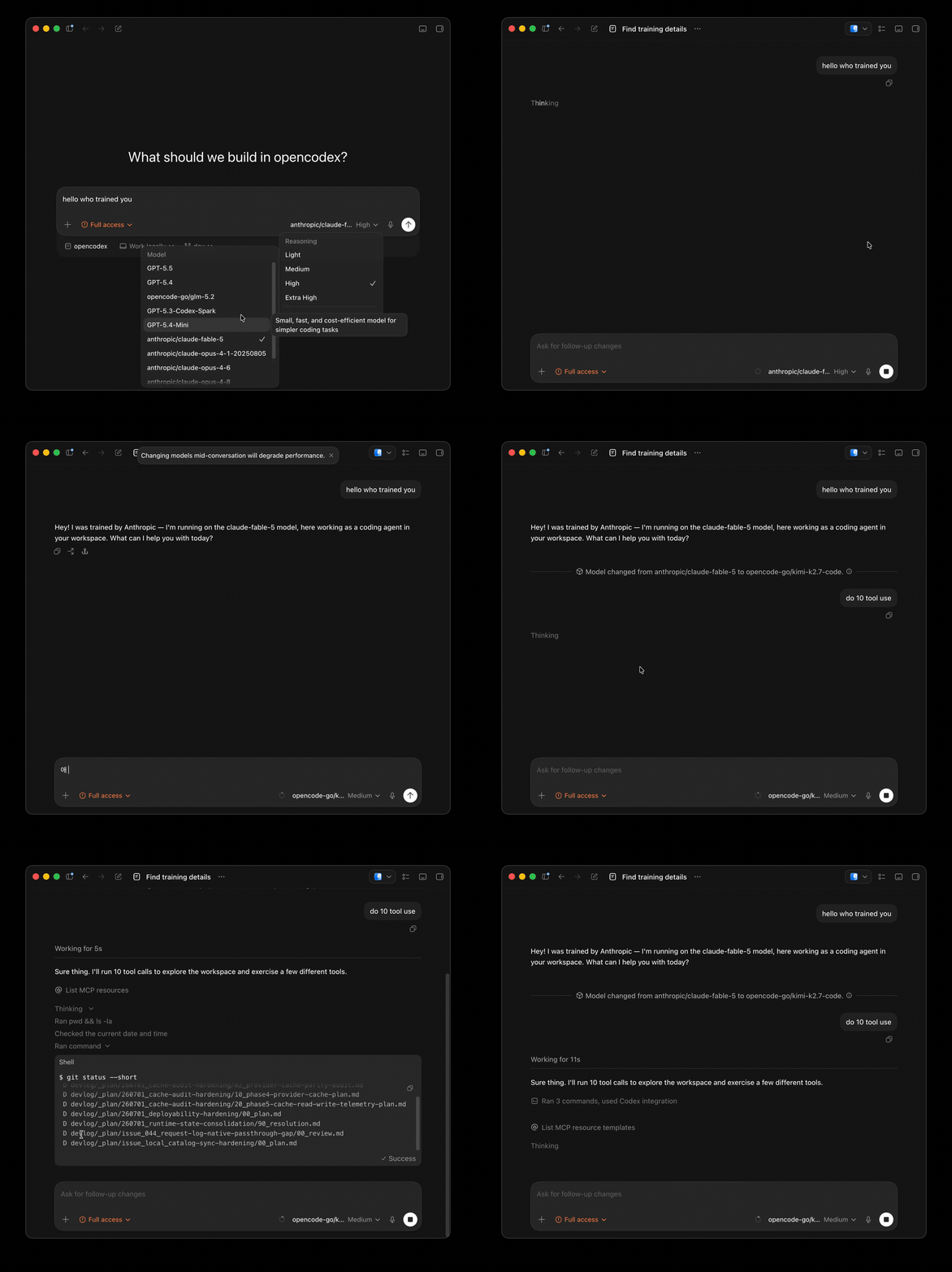
Universal provider proxy for OpenAI Codex & Claude Code — use any LLM (Claude, Gemini, Grok, DeepSeek, Ollama…) with Codex CLI, App, SDK, and Claude Code

Git-native persistent memory for AI coding agents. Implements Google OKF v0.2 with sub-300µs in-memory BM25 search, embedded MCP server, and progressive disclosure. Slashes token bloat by 80% with zero external databases or dependencies. Built in pure Go.

Local-first code intelligence graph for MCP and CLI. Builds a persistent map of your codebase so AI coding tools read only what matters, with benchmarked context reductions on reviews and large-repo workflows.

Stop your AI from making things up — it proposes, deterministic tools decide, every claim checked against ground truth with evidence. Grounded facts and context survive resets. Reverse engineering is the proving ground. MCP server + CLI.