
heygen-com/hyperframesFrameworks & SDKs
Write HTML. Render video. Built for agents.
49k
This workspace combines a Rust TUI framework with terminal apps and developer tooling. The framework supports full-screen TUIs, async readline, choice prompts, and a PTY multiplexer, while the apps show how to use those pieces for git workflows, markdown editing, and environment loading.
Builders who want reusable Rust pieces for terminal apps, CLI workflows, and developer productivity tools.
You can build richer terminal workflows and apps without wiring the low-level terminal pieces yourself.
The `tui` crate supports full-screen apps, async readline, choice prompts, spinners, and PTY multiplexing.
It includes an `App` trait, flexbox-style layout, components, styling, and markdown rendering.
`PTYMux::run()` can wrap multiple child processes in one terminal view and switch between them.
The `cmdr` crate includes `giti`, `edi`, and `env-source` as built examples.
The `build-infra` crate includes `cargo-rustdoc-fmt` for rustdoc formatting and link cleanup.
The `task/` folder and `/r3bl-task` commands organize implementation plans and progress.
# Clone the repository
git clone https://github.com/r3bl-org/r3bl-open-core.git
cd r3bl-open-core

# Run the bootstrap script
./bootstrap.sh
# Clone the extension repository
git clone https://github.com/r3bl-org/r3bl-vscode-extensions.git
cd r3bl-vscode-extensions

# Install extensions (works with both VSCode and VSCode Insiders)
./install.sh
██████╗  ██████╗  ██████╗
██╔══██╗██╔═══██╗██╔════╝
██████╔╝██║   ██║██║
██╔══██╗██║   ██║██║
██║  ██║╚██████╔╝╚██████╗
╚═╝  ╚═╝ ╚═════╝  ╚═════╝
fish and fzf (via package manager)./bootstrap.sh for automatic detectionAfter leaving Google in 2021, I (Nazmul Idris) embarked on a journey to create infrastructure for modern, powerful, async CLI and TUI experiences built from the ground up in Rust.
The core architectural innovation: a purely async, immediate mode reactive UI (every state
change triggers a render from scratch) where nothing blocks the main thread - unlike
traditional approaches using platform-specific blocking operations like POSIX
readline() on Linux/macOS or
Windows ReadConsole().
R3BL TUI is fundamentally different from vim,
neovim, and ratatui through its immediate
mode reactive UI with clean separation between rendering and state mutation, and purely
async nature.
This fully async, responsive framework works seamlessly across Linux, macOS, and Windows. It's optimized for use over SSH connections by painting only diffs, and handles complex concurrent operations with low latency while ensuring no thread blocking.
I initially tried Node.js with ink, but encountered fundamental limitations:
Our framework supports the full spectrum from CLI to hybrid TUI to full TUI experiences with deep system integration.
Key Innovation: "Applets" - A revolutionary state management system that allows processes to persist state across their lifecycle and share it with other instances or processes. And the underlying systems level infrastructure mechanisms that make this possible.
Async Readline: Unlike POSIX readline which is single-threaded and blocking, our implementation is fully async, interruptable, and non-blocking.
Choose API: Single-shot user interactions that enter raw mode without taking over the screen or disrupting the terminal's back buffer.
Full TUI: Complete raw mode with alternate screen support, fully async and non-destructive.
All components are end-to-end testable using our:
InputDevice and OutputDevice types for stdin, stdout, and stderr.PTY infrastructure.VT-100 parser / generator infrastructure.CSS-like styling with JSX-inspired declarative layoutsR3BL TUI brings the ergonomics of modern web development (React, flexbox, CSS) to
terminal applications in Rust, creating a new paradigm for command-line productivity
tools.
We are building command line apps with rich text user interfaces (TUI). We want to lean into the terminal as a place of productivity, and build all kinds of delightful, ergonomic, and useful experiences for it.
tmux in Rust (separate processes mux'd onto a single
terminal window). Rather it is to build a set of integrated "apps" (or "tasks") that run
in the same process that renders to one terminal window.r3bl_tui allows you to create application state that can be moved between
various "applets", where each "applet" can be "Full TUI" or "Partial TUI".All the crates in the r3bl-open-core monorepo
provide lots of useful functionality to help you build TUI (text user interface) apps,
along w/ general niceties & ergonomics that all Rustaceans 🦀 can enjoy 🎉.
Any top-level folder in this repository that contains a Cargo.toml file is a Rust
project, also known as a
crate. These crates are
likely published to crates.io. Together, they form a
Rust workspace.
Here's the changelog for this monorepo containing a Rust workspace. The changelog is a great place to start to get familiar with what has changed recently in each of the crates in this Rust workspace.
The r3bl_tui crate is the
main crate that contains the core functionality for building TUI apps. It allows you to
build apps that range from "full" TUI to "partial" TUI, and everything in the middle.
Here are some videos that you can watch to get a better understanding of TTY programming.
This crate provides five entry points for building interactive terminal applications. Each
internalizes terminal availability and size checks, and returns a TuiAvailability<T>
enum:
| Entry Point | Purpose | Best For |
|---|---|---|
TerminalWindow::main_event_loop() | Full TUI framework | Complex, multi-component apps with layouts, dialogs, and custom logic. |
ReadlineAsyncContext::try_new() | Async Readline | CLI-style line input, REPLs, and background logging. |
choose() | Interactive Selection | Prompting user to select one or more items from a list. |
PTYMuxBuilder::build() | Terminal Multiplexer | Wrapping existing CLI tools (like htop, bash) in a multi-pane TUI. |
Spinner::try_start() | Indeterminate Progress | Long-running tasks needing visual feedback (standalone or embedded). |
tui gives you "raw
mode", "alternate screen" and "full screen" support, while being totally async. It
provides a full-featured framework with:
App trait: Unidirectional data flow architecture.FlexBox: Responsive layout engine.An example of this is the "Full TUI" app edi in the
r3bl-cmdr crate. You can
install & run this with the following command:
cargo install r3bl-cmdr
edi
choose
allows you to build less interactive apps that ask a user user to make choices from a list
of options and then use a decision tree to perform actions.
An example of this is this "Partial TUI" app giti in the
r3bl-cmdr crate. You can
install & run this with the following command:
cargo install r3bl-cmdr
giti
readline_async
gives you the ability to easily ask for user input in a line editor. You can customize the
prompt, and other behaviors, like input history.
Using this, you can build your own async shell programs using "async readline & stdout". Use advanced features like showing indeterminate progress spinners, and even write to stdout in an async manner, without clobbering the prompt / async readline, or the spinner. When the spinner is active, it pauses output to stdout, and resumes it when the spinner is stopped.
An example of this is this "Partial TUI" app giti in the
r3bl-cmdr crate. You can
install & run this with the following command:
cargo install r3bl-cmdr
giti
Here are other examples of this:
PTYMux::run()
lets you build a terminal multiplexer similar to tmux. It manages multiple child
processes (each in its own PTY) with per-process virtual terminal buffers and instant
switching. See the
pty_mux_example
for a working example that wraps bash, htop, and other CLI tools.
You can mix and match "Full TUI" with "Partial TUI" to build for whatever use case you
need. r3bl_tui allows you to create application state that can be moved between various
"applets", where each "applet" can be "Full TUI" or "Partial TUI".
There is just one main library crate in this workspace:
r3bl_tui.
There is just one main binary crate that contains user facing apps that are built using
the library crates:
r3bl-cmdr. This crate
contains these apps:
giti: Interactive git workflows made easy.edi: Beautiful Markdown editor with advanced rendering and editing features.env-source: Fast cross-platform environment loader evaluating scripts across POSIX sh, Fish, PowerShell, and cmd.exe.You can install & run this with the following command:
cargo install r3bl-cmdr
# Interactive git workflows made easy.
giti --version
# Beautiful Markdown editor with advanced rendering and editing features.
edi --version
# Fast cross-platform environment loader.
env-source --version
The r3bl-build-infra
crate provides developer productivity tools:
cargo-rustdoc-fmt: Formats markdown tables and converts inline links to
reference-style links in rustdoc comments.You can install this binary with:
cargo install r3bl-build-infra
# Or from local source within this workspace:
fish run.fish install-build-infra
This project uses a task management system for organizing day-to-day development work
using detailed task files with implementation plans in the ./task/ directory.
./task/ - Directory
containing detailed task management files:
task_*.md files in root of ./task/ - Complex tasks currently
in progresspending/: Tasks queued for later workdone/: Completed task files moved from root after all steps are marked
[COMPLETE]archive/: Abandoned tasks retained for historical referenceAGENTS.md: Rules and format specifications for creating and maintaining task
filesDetailed task files follow a structured format defined in
./task/AGENTS.md:
Structure:
# Task Overview

High-level description, architecture, context, and the "why"

# Implementation Plan

## Step 0: Do Something [STATUS]

Detailed instructions for this step

### Step 0.0: Do Subtask [STATUS]

Details about subtask

### Step 0.1: Do Another Subtask [STATUS]

Details about another subtask

## Step 1: Do Something Else [STATUS]

More detailed steps...
Hierarchical organization:
doctocprettierStatus markers:
[COMPLETE] - Step finished and verified[WORK_IN_PROGRESS] - Currently working on this step[BLOCKED] - Cannot proceed (waiting for dependency)[DEFERRED] - Postponed to laterThe /r3bl-task slash command (defined in
AGENTS.md)
manages the task lifecycle:
Create a new task:
/r3bl-task create my_feature_name
./task/task_my_feature_name.md from your detailed planUpdate an existing task:
/r3bl-task update my_feature_name
./task/task_my_feature_name.md./task/done/ when all steps are [COMPLETE]Resume working on a task:
/r3bl-task load my_feature_name
./task/task_my_feature_name.md for continued work[WORK_IN_PROGRESS]The task organization workflow connects strategic planning with tactical execution:
docs/ folder): Feature roadmaps, architectural decSign in to join the discussion.
No comments yet. Be the first to say what this is good for.
Write HTML. Render video. Built for agents.
Ultra-lightweight, open-source, self-hosted personal AI agent framework in Python with WebUI, tools, memory, MCP, multi-agent workflows, automation, and chat apps

SkillOpt is a text-space optimizer that trains reusable natural-language skills for frozen LLM agents through trajectory-driven edits, validation-gated updates, and deployable best_skill.md artifacts.
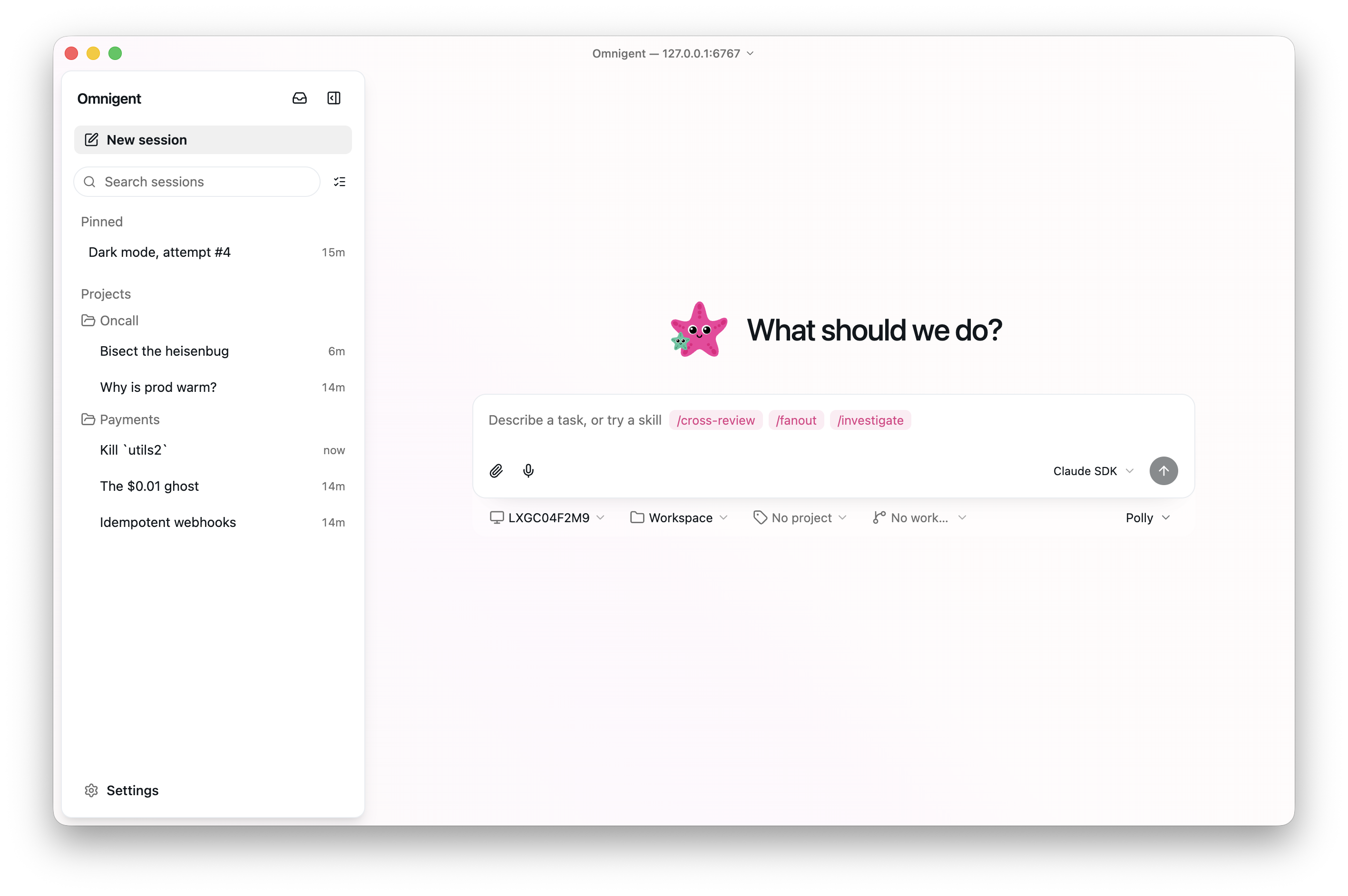
Omnigent is an open-source AI agent framework and meta-harness: orchestrate Claude Code, Codex, Cursor, Pi, and custom agents — swap harnesses without rewriting, enforce policies and sandboxing, and collaborate in real time from any device.

A theoretical reconstruction of the Claude Mythos architecture, built from first principles using the available research literature.
🕷️ An adaptive Web Scraping framework that handles everything from a single request to a full-scale crawl!