
koala73/worldmonitorConnectors
Real-time global intelligence dashboard. AI-powered news aggregation, geopolitical monitoring, and infrastructure tracking in a unified situational awareness interface
86k
pwno-mcp wraps GDB, pwndbg, and exploit-driver workflows in an MCP service. It gives agents stateful debugging sessions, execution control, snapshots of registers and stack, and helpers for working with commands, processes, Python, repos, and RetDec.
Builders who want their agent to debug binaries and drive exploit workflows through MCP.
You can inspect and steer binary analysis sessions without manually re-entering debugger context.
Keeps GDB + pwndbg sessions alive so the agent can continue from the same state.
Uses GDB/MI to control execution in a repeatable way.
Captures registers, stack, disassembly, source, and backtrace for fast agent context.
Supports interactive exploit I/O through `pwncli`.
Lets the agent run parallel analysis or exploitation workflows.
Adds helpers for commands, processes, Python, repositories, and RetDec.
Offers both HTTP and stdio endpoints for MCP clients.
mkdir -p ./workspace
cp ./path/to/your/binary ./workspace/chal
chmod +x ./workspace/chal
docker run --rm -p 5500:5500 \
  --cap-add=SYS_PTRACE \
  --cap-add=SYS_ADMIN \
  --security-opt seccomp=unconfined \
  --security-opt apparmor=unconfined \
  -v "$PWD/workspace:/workspace" \
  ghcr.io/pwno-io/pwno-mcp:latest
http://127.0.0.1:5500/mcp


stateful system for autonomous pwn and binary research, designed for LLM agents.
pwno-mcp runs GDB + pwndbg in an isolated environment and exposes stateful debugging, exploit I/O, and helper tooling over MCP for agentic coding clients.
pwncliThe full documentation is available at docs.pwno.io.
Create a local workspace directory, put your target binary there, then run the container.
mkdir -p ./workspace
cp ./path/to/your/binary ./workspace/chal
chmod +x ./workspace/chal
docker run --rm -p 5500:5500 \
  --cap-add=SYS_PTRACE \
  --cap-add=SYS_ADMIN \
  --security-opt seccomp=unconfined \
  --security-opt apparmor=unconfined \
  -v "$PWD/workspace:/workspace" \
  ghcr.io/pwno-io/pwno-mcp:latest
Default MCP endpoint:
http://127.0.0.1:5500/mcp
For stdio mode, client configs, health checks, and attach-helper details, use the docs site: docs.pwno.io/quickstart.
For local development, architecture, and contributing guidance, see docs.pwno.io/development.
oss@pwno.ioThis project is licensed under CC BY-NC-ND 4.0.
See LICENSE for details.
Issues and pull requests are welcome.
Sign in to join the discussion.
No comments yet. Be the first to say what this is good for.
Real-time global intelligence dashboard. AI-powered news aggregation, geopolitical monitoring, and infrastructure tracking in a unified situational awareness interface
High-performance code intelligence MCP server. Indexes codebases into a persistent knowledge graph — average repo in milliseconds. 158 languages, sub-ms queries, 99% fewer tokens. Single static binary, zero dependencies.
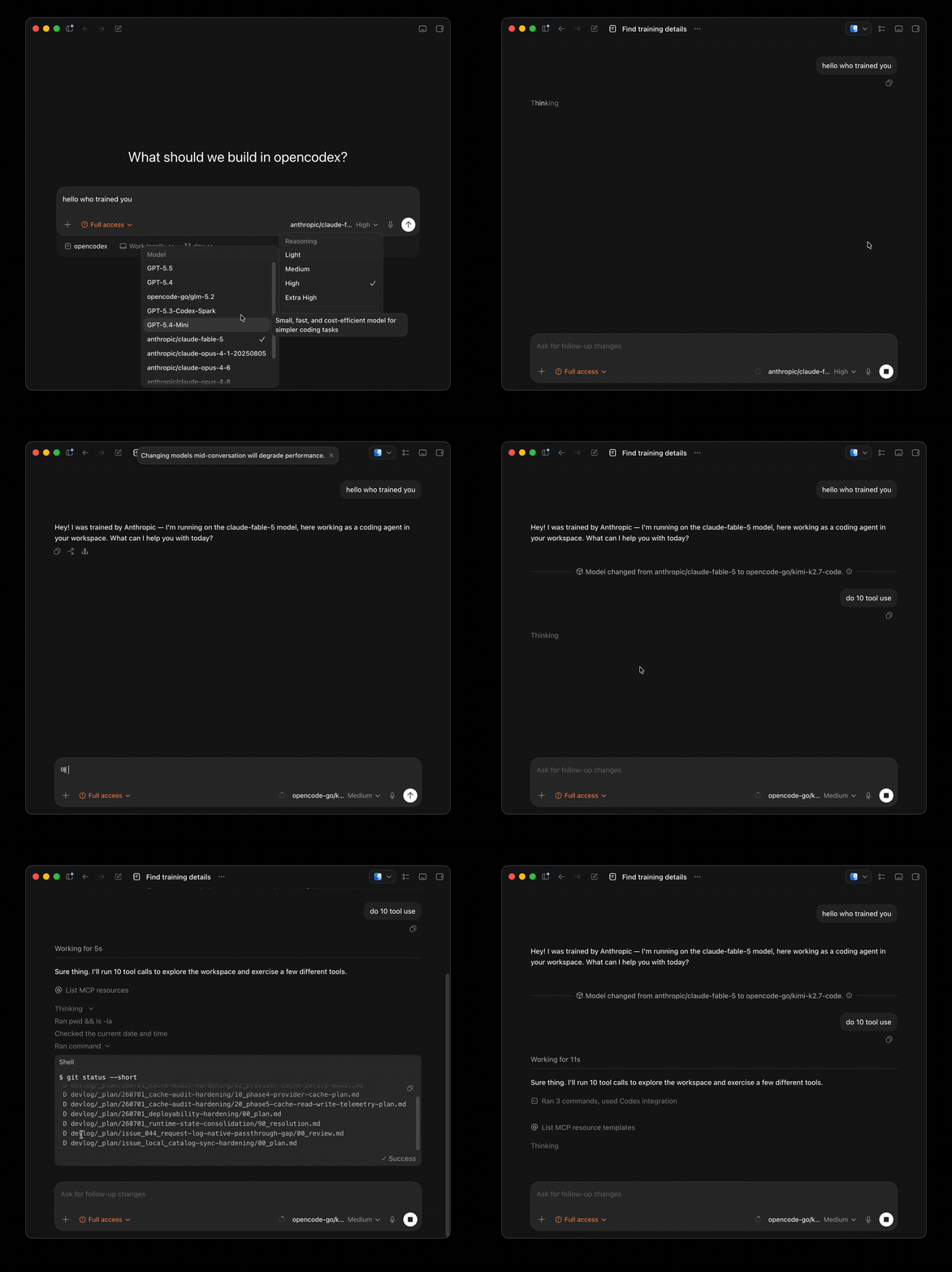
Universal provider proxy for OpenAI Codex & Claude Code — use any LLM (Claude, Gemini, Grok, DeepSeek, Ollama…) with Codex CLI, App, SDK, and Claude Code

Git-native persistent memory for AI coding agents. Implements Google OKF v0.2 with sub-300µs in-memory BM25 search, embedded MCP server, and progressive disclosure. Slashes token bloat by 80% with zero external databases or dependencies. Built in pure Go.

Local-first code intelligence graph for MCP and CLI. Builds a persistent map of your codebase so AI coding tools read only what matters, with benchmarked context reductions on reviews and large-repo workflows.

Stop your AI from making things up — it proposes, deterministic tools decide, every claim checked against ground truth with evidence. Grounded facts and context survive resets. Reverse engineering is the proving ground. MCP server + CLI.