

heygen-com/hyperframesFrameworks & SDKs
Write HTML. Render video. Built for agents.
49k
This repository provides a modular JavaScript server for the Model Context Protocol. It loads modules dynamically, serves standard MCP endpoints, and connects to model providers and module resources through a shared API.
Builders who want a reusable MCP server they can extend with their own modules.
You can stand up an MCP server and add new tools or resources without wiring each one from scratch.
Loads modules at runtime so you can add or remove capabilities without rewriting the server.
Implements routes for server info, models, inference, module lookup, tools, and resources.
Connects to OpenAI, Stability AI, Anthropic, and Hugging Face for text, image, and speech tasks.
Searches installed modules by package.json fields and returns metadata in API responses.
Includes a module template and `pnpm create-module` for starting new modules quickly.
Ships with Mocha/Chai tests, Docker files, and service scripts for local and hosted runs.
# Clone the repository
git clone https://github.com/yourusername/mcp-server.git
cd mcp-server

# Install dependencies
pnpm install
# Install dependencies
pnpm install

# Start the server
pnpm start

# Start the server in development mode (with auto-reload)
pnpm dev
# Copy the sample environment file
cp sample.env .env

# Edit the file with your favorite editor
nano .env
# OpenAI API (for GPT-4 and Whisper)
OPENAI_API_KEY=your_openai_api_key_here

# Stability AI API (for Stable Diffusion)
STABILITY_API_KEY=your_stability_api_key_here

# Anthropic API (for Claude models)
ANTHROPIC_API_KEY=your_anthropic_api_key_here
# Run all tests
pnpm test

# Run only module tests
pnpm test:modules

# Run all tests (both core and modules)
pnpm test:all
# The hooks are automatically installed when you run
pnpm install

A generic, modular server for implementing the Model Context Protocol (MCP). This server provides a framework for controlling and interacting with various models through a standardized API.

A hosted deployment is available on Fronteir AI.
This project uses ES Modules (ESM) exclusively. All imports use the import syntax rather than require().
# Clone the repository
git clone https://github.com/yourusername/mcp-server.git
cd mcp-server

# Install dependencies
pnpm install
# Install dependencies
pnpm install

# Start the server
pnpm start

# Start the server in development mode (with auto-reload)
pnpm dev
The server will start on http://localhost:3000 by default.
Copy the sample environment file and edit it with your API keys:
# Copy the sample environment file
cp sample.env .env

# Edit the file with your favorite editor
nano .env
At minimum, you'll need to add API keys for the model providers you want to use:
# OpenAI API (for GPT-4 and Whisper)
OPENAI_API_KEY=your_openai_api_key_here

# Stability AI API (for Stable Diffusion)
STABILITY_API_KEY=your_stability_api_key_here

# Anthropic API (for Claude models)
ANTHROPIC_API_KEY=your_anthropic_api_key_here
You can get these API keys from:
The server has no global authentication layer, so anything that can reach the port can call any module route. Modules that touch the filesystem or issue outbound requests are constrained as follows.
Module tokens. Routes with side effects accept a token via
Authorization: Bearer <token> or X-API-Key: <token>. When the variable is
unset the routes stay open and a warning is logged at startup.
| Variable | Guards |
|---|---|
SCANNER_API_TOKEN | /scanner/scan, /scanner/reports/:id/export, /tools/scanner |
README_BADGES_API_TOKEN | /readme-badges/update, /readme-badges/detect, /tools/readme-badges |
Path containment. readme-badges resolves readmePath and rootDir
against README_BADGES_ROOT (default: the working directory) and refuses
anything that escapes it, targets a non-markdown file, or reaches outside via a
symlink. scanner confines exports to its reports directory the same way.
Outbound request allowlists. Modules that fetch caller-named URLs reject loopback, link-local (cloud metadata), RFC1918, CGNAT and other non-public addresses, resolve hostnames and check every returned address, and re-validate each redirect hop. Where a module talks to one known service, the host is also allowlisted:
| Variable | Extends the allowlist for |
|---|---|
CONVERT2DOC_ALLOWED_HOSTS | convert2doc baseUrl (default: convert2doc.com) |
CRAIGSLIST_ALLOWED_HOSTS | /craigslist/details (default: *.craigslist.org) |
Cross-origin requests. CSRF_PROTECTION_ENABLED (default true) rejects
state-changing requests that carry a foreign Origin header, so a malicious web
page cannot drive a browser at a localhost-bound server. Clients that send no
Origin — curl, MCP clients, server-to-server calls — are unaffected. List
trusted browser origins in CORS_ORIGINS.
Run the server behind an authenticating reverse proxy if it is exposed beyond localhost.
The repository includes comprehensive testing using Mocha and Chai:
# Run all tests
pnpm test

# Run only module tests
pnpm test:modules

# Run all tests (both core and modules)
pnpm test:all
The testing infrastructure includes:
Tests are organized in a structured way:
/test/core/test/ directoryThis comprehensive testing ensures code quality and makes it easier to detect regressions when making changes.
The repository includes pre-commit hooks using Husky and lint-staged:
# The hooks are automatically installed when you run
pnpm install
The pre-commit hooks:
This ensures that all code committed to the repository follows coding standards and maintains code quality. The test suite is continuously being improved to provide better coverage and reliability, and will be enabled in the pre-commit hook once it's more stable.
The repository includes Docker support for easy containerization and deployment:
# Build and run with Docker
docker build -t mcp-server .
docker run -p 3000:3000 mcp-server

# Or use Docker Compose
docker-compose up
The Docker configuration:
The MCP server implements a standardized set of methods that all MCP servers should provide:
GET / - Basic server informationGET /status - Detailed server statusGET /health - Health check endpointGET /metrics - Server metricsGET /models - List available modelsGET /model/:modelId - Get model informationPOST /model/:modelId/activate - Activate a specific modelPOST /model/deactivate - Deactivate the current modelGET /model/active - Get information about the active modelPOST /model/infer - Perform inference with the active modelPOST /model/:modelId/infer - Perform inference with a specific modelThe MCP server supports the following model types:
| Model Type | Provider | Capabilities | Example IDs |
|---|---|---|---|
| GPT Models | OpenAI | Text generation | gpt-4, gpt-3.5-turbo |
| Whisper | OpenAI | Speech-to-text | whisper, whisper-1 |
| Stable Diffusion | Stability AI | Image generation | stable-diffusion-xl-1024-v1-0 |
| Claude Models | Anthropic | Text generation | claude-3-opus, claude-3-sonnet |
| Custom Models | Hugging Face | Various | (any Hugging Face model ID) |
Text generation with GPT-4:
# Activate the model
curl -X POST http://localhost:3000/model/gpt-4/activate \
  -H "Content-Type: application/json" \
  -d '{"config": {"temperature": 0.7}}'

# Perform inference
curl -X POST http://localhost:3000/model/infer \
  -H "Content-Type: application/json" \
  -d '{
    "prompt": "Explain quantum computing in simple terms",
    "temperature": 0.5,
    "max_tokens": 200
  }'
Image generation with Stable Diffusion:
# Activate the model
curl -X POST http://localhost:3000/model/stable-diffusion/activate \
  -H "Content-Type: application/json" \
  -d '{}'

# Generate an image
curl -X POST http://localhost:3000/model/infer \
  -H "Content-Type: application/json" \
  -d '{
    "prompt": "A beautiful sunset over mountains",
    "height": 1024,
    "width": 1024,
    "steps": 30
  }'
Streaming text generation:
# Enable streaming
curl -X POST http://localhost:3000/model/infer \
  -H "Content-Type: application/json" \
  -d '{
    "prompt": "Write a short story about a robot",
    "stream": true
  }'
GET /modules - List installed modulesGET /modules/:moduleId - Get module informationGET /modules/search/:query - Search modules by any field in their package.json or metadataGET /tools - List available toolsGET /resources - List available resourcesFor detailed information about these methods, see MCP Standard Methods.
Configuration is loaded from environment variables and stored in src/core/config.js. The easiest way to configure the server is to edit the .env file in the project root.
Key environment variables include:
| Variable | Description | Default |
|---|---|---|
| PORT | Server port | 3000 |
| HOST | Server host | localhost |
| NODE_ENV | Environment (development/production) | development |
| OPENAI_API_KEY | OpenAI API key | (required for OpenAI models) |
| STABILITY_API_KEY | Stability AI API key | (required for Stable Diffusion) |
| ANTHROPIC_API_KEY | Anthropic API key | (required for Claude models) |
| HUGGINGFACE_API_KEY | Hugging Face API key | (required for Hugging Face models) |
See sample.env for a complete list of configuration options.
The repository includes several examples to help you get started:
examples/client.js demonstrates how to interact with the MCP server from a client application.examples/custom-module/ shows how to create a custom module that adds a calculator tool to the server.To run the client example:
node examples/client.js
To use the custom module example, copy it to the modules directory:
cp -r examples/custom-module mcp_modules/calculator
Modules are the primary way to extend the MCP server. Each module is a self-contained package that can add new functionality to the server.
Modules now follow an enhanced structure with better organization:
mcp_modules/your-module/
├── assets/          # Static assets (images, CSS, etc.)
├── docs/            # Documentation files
├── examples/        # Example usage
├── src/             # Source code
│   ├── controller.js  # HTTP route handlers
│   ├── service.js     # Business logic
│   └── utils.js       # Utility functions
├── test/            # Test files
│   ├── controller.test.js
│   └── service.test.js
├── index.js         # Main module file with register function
├── package.json     # Module metadata, dependencies, and scripts
└── README.md        # Module documentation
Each module should include a package.json file with:
This structure provides better separation of concerns, makes testing easier, and improves module discoverability.
The main module file (index.js) must export a register function that will be called when the module is loaded:
/**
 * Register this module with the Hono app
 * @param {import('hono').Hono} app - The Hono app instance
 */
export async function register(app) {
  // Register routes, middleware, etc.
  app.get('/your-module/endpoint', c => {
    return c.json({ message: 'Your module is working!' });
  });
}

// Optional: Export module metadata
export const metadata = {
  name: 'Your Module',
  version: '1.0.0',
  description: 'Description of your module',
  author: 'Your Name',
};
mcp_modules/example/ to demonstrate how to create a module.examples/custom-module/.mcp_modules/health-check/ for system monitoring.mcp_modules/template/.You can create a new module using the provided script:
# Create a new module
pnpm create-module

# Or with a module name
pnpm create-module my-module
The script will:
mcp_modules/The MCP server includes a powerful search functionality that allows you to find modules based on any information in their package.json or metadata.
GET /modules/search/:query - Search for modules containing the specified query string in any field# Find modules by name or description
curl http://localhost:3000/modules/search/craigslist
# Find modules by dependency
curl http://localhost:3000/modules/search/jsdom
# Find modules by keyword
curl http://localhost:3000/modules/search/mcp
# Find modules by author
curl http://localhost:3000/modules/search/"MCP Server Team"
# Find modules by license
curl http://localhost:3000/modules/search/ISC
// Function to search modules by any field
async function searchModules(query) {
  const response = await fetch(`http://localhost:3000/modules/search/${query}`);
  const data = await response.json();

  console.log(`Found ${data.count} modules matching "${query}":`);
  data.results.forEach(module => {
    console.log(`- ${module.name} (${module.directoryName}): ${module.description}`);
  });

  return data.results;
}
The search is comprehensive and will find matches in any field, including nested objects like dependencies, keywords, and other metadata.
The MCP server integrates with several AI model providers:
OpenAI provides GPT models for text generation and Whisper for speech-to-text:
// Text generation example
const response = await fetch('http://localhost:3000/model/infer', {
  method: 'POST',
  headers: { 'Content-Type': 'application/json' },
  body: JSON.stringify({
    prompt: 'Write a poem about artificial intelligence',
    temperature: 0.7,
    max_tokens: 200,
  }),
});

// Speech-to-text example (requires multipart form data)
const formData = new FormData();
formData.append('file', audioFile);
formData.append('model', 'whisper-1');
formData.append('language', 'en');

const response = await fetch('http://localhost:3000/model/whisper/infer', {
  method: 'POST',
  body: formData,
});
Stability AI provides Stable Diffusion for image generation:
const response = await fetch('http://localhost:3000/model/infer', {
  method: 'POST',
  headers: { 'Content-Type': 'application/json' },
  body: JSON.stringify({
    prompt: 'A photorealistic image of a futuristic city',
    height: 1024,
    width: 1024,
    steps: 30,
    cfg_scale: 7,
  }),
});

// The response includes base64-encoded images
const result = await response.json();
const imageBase64 = result.response[0].base64;
Anthropic provides Claude models for text generation:
const response = await fetch('http://localhost:3000/model/infer', {
  method: 'POST',
  headers: { 'Content-Type': 'application/json' },
  body: JSON.stringify({
    prompt: 'Explain how neural networks work',
    temperature: 0.5,
    max_tokens: 300,
  }),
});
Hugging Face provides access to thousands of open-source models:
const response = await fetch('http://localhost:3000/model/custom-model-name/infer', {
  method: 'POST',
  headers: { 'Content-Type': 'application/json' },
  body: JSON.stringify({
    prompt: 'Input for the model',
    parameters: {
      // Model-specific parameters
    },
  }),
});
ISC
Sign in to join the discussion.
No comments yet. Be the first to say what this is good for.
Write HTML. Render video. Built for agents.
Ultra-lightweight, open-source, self-hosted personal AI agent framework in Python with WebUI, tools, memory, MCP, multi-agent workflows, automation, and chat apps

SkillOpt is a text-space optimizer that trains reusable natural-language skills for frozen LLM agents through trajectory-driven edits, validation-gated updates, and deployable best_skill.md artifacts.
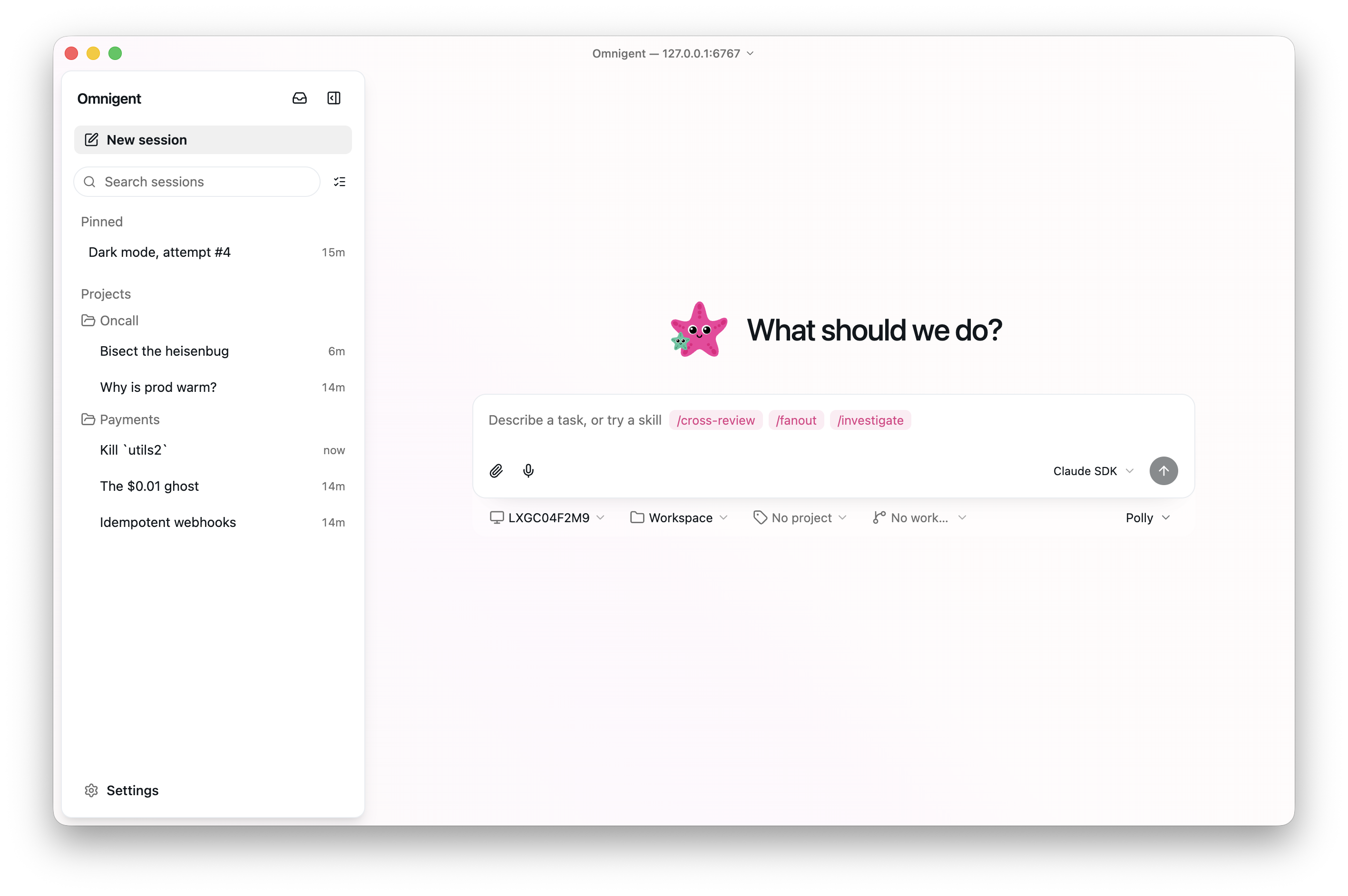
Omnigent is an open-source AI agent framework and meta-harness: orchestrate Claude Code, Codex, Cursor, Pi, and custom agents — swap harnesses without rewriting, enforce policies and sandboxing, and collaborate in real time from any device.

A theoretical reconstruction of the Claude Mythos architecture, built from first principles using the available research literature.
🕷️ An adaptive Web Scraping framework that handles everything from a single request to a full-scale crawl!