
koala73/worldmonitorConnectors
Real-time global intelligence dashboard. AI-powered news aggregation, geopolitical monitoring, and infrastructure tracking in a unified situational awareness interface
86k
streamlinear connects Claude Code to Linear through one MCP tool that dispatches seven actions. It uses startup metadata, fuzzy IDs, and smart defaults so you can find, update, and create issues with less token overhead.
Builders who use Claude Code and want a smaller Linear integration for issue work.
You can manage Linear issues from your agent with far fewer tool-definition tokens and less setup noise.
Uses one tool with `action` values like `search`, `get`, `update`, `comment`, `create`, `graphql`, and `help`.
`search` defaults to your assigned open issues, and IDs accept Linear keys, URLs, or UUIDs.
State names and assignees are matched loosely, so inputs like `done` or `me` still work.
Lets you send custom GraphQL queries for Linear actions the main commands do not cover.
Includes a `.claude-plugin` directory with a plugin manifest and skills bundle.
npm install @primeradianthq/streamlinear@1.1.3
npx streamlinear-cli help
npx streamlinear
A lightweight Linear MCP for Claude Code. One tool, seven actions.
The standard Linear MCP uses ~17,000 tokens for tool definitions.
streamlinear uses ~500 tokens.
Instead of 23 separate tools, streamlinear has one tool with action dispatch:
{"action": "search"}
{"action": "get", "id": "ABC-123"}
{"action": "update", "id": "ABC-123", "state": "Done"}
{"action": "comment", "id": "ABC-123", "body": "Fixed!"}
{"action": "create", "title": "New bug", "team": "ENG"}
{"action": "graphql", "graphql": "query { viewer { name } }"}
{"action": "help"}
| Action | Purpose |
|---|---|
search | Find issues (smart defaults: your active issues) |
get | Issue details by ABC-123, URL, or UUID |
update | Change state, priority, assignee |
comment | Add comment to issue |
create | Create new issue |
graphql | Raw GraphQL for anything else |
help | Full documentation |
Add to your .mcp.json:
{
  "mcpServers": {
    "linear": {
      "command": "npx",
      "args": ["-y", "@primeradianthq/streamlinear@1.1.3"],
      "env": {
        "LINEAR_API_TOKEN": "lin_api_xxxxx"
      }
    }
  }
}
To use streamlinear with multiple Linear workspaces, create separate MCP entries and map each secret to LINEAR_API_TOKEN:
{
  "mcpServers": {
    "linear-personal": {
      "command": "npx",
      "args": ["-y", "@primeradianthq/streamlinear@1.1.3"],
      "env": {
        "LINEAR_API_TOKEN": "${LINEAR_PERSONAL_TOKEN}"
      },
      "envFrom": ["LINEAR_PERSONAL_TOKEN"]
    },
    "linear-work": {
      "command": "npx",
      "args": ["-y", "@primeradianthq/streamlinear@1.1.3"],
      "env": {
        "LINEAR_API_TOKEN": "${LINEAR_WORK_TOKEN}"
      },
      "envFrom": ["LINEAR_WORK_TOKEN"]
    }
  }
}
When installed as a dependency, the package provides two binaries:
npm install @primeradianthq/streamlinear@1.1.3
npx streamlinear-cli help
npx streamlinear
The MCP server requires LINEAR_API_TOKEN at runtime. Consumers such as Scribble may expose their own operator-facing variable and map it to LINEAR_API_TOKEN before starting streamlinear.
search with no params → your assigned issues, not completed/canceledassignee: "me" uses the authenticated userFor anything not covered by the main actions, use raw GraphQL:
{
  "action": "graphql",
  "graphql": "query { projects { nodes { id name } } }"
}
Use {"action": "help"} for common GraphQL patterns.
MIT
Sign in to join the discussion.
No comments yet. Be the first to say what this is good for.
Real-time global intelligence dashboard. AI-powered news aggregation, geopolitical monitoring, and infrastructure tracking in a unified situational awareness interface
High-performance code intelligence MCP server. Indexes codebases into a persistent knowledge graph — average repo in milliseconds. 158 languages, sub-ms queries, 99% fewer tokens. Single static binary, zero dependencies.
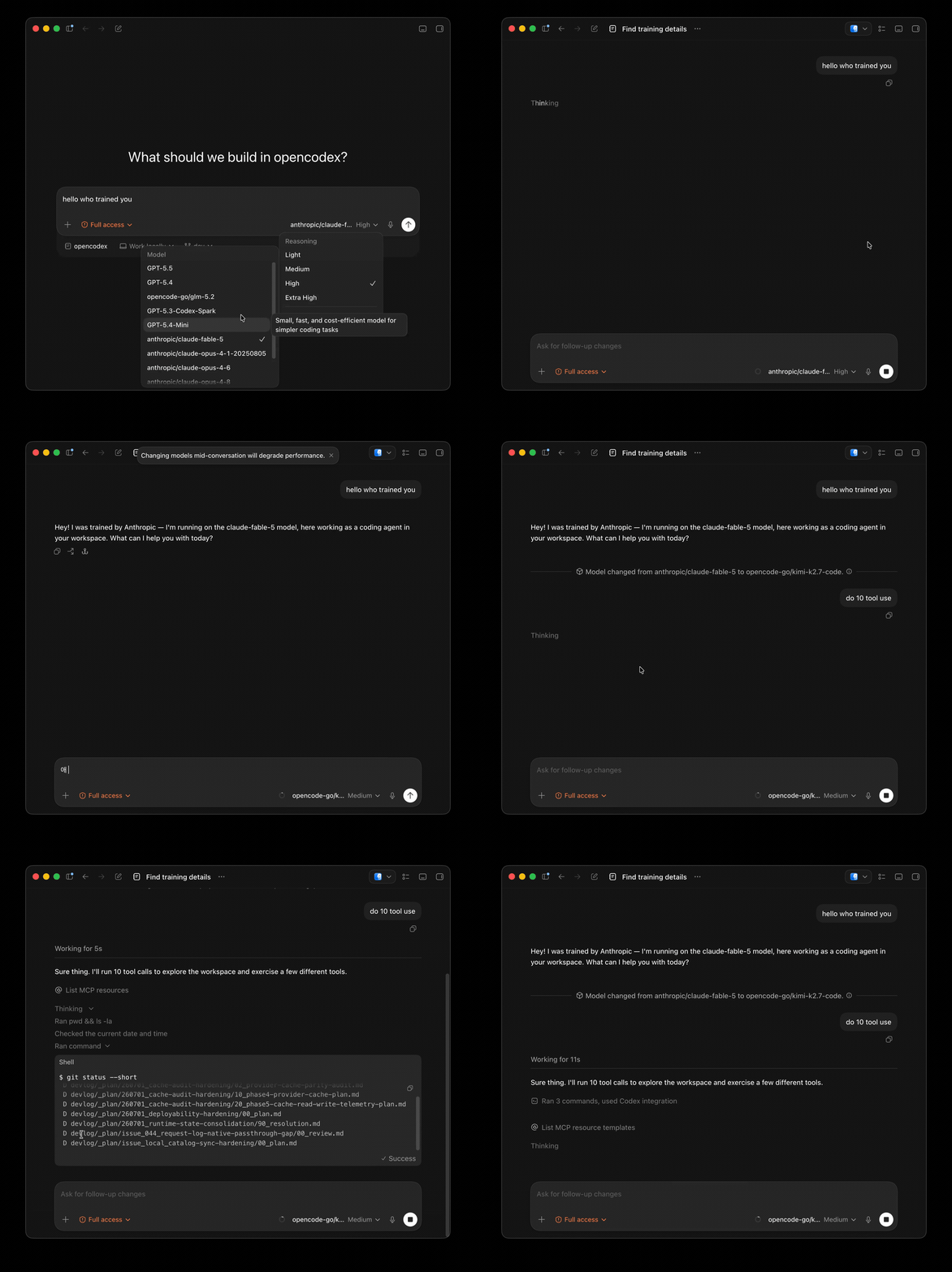
Universal provider proxy for OpenAI Codex & Claude Code — use any LLM (Claude, Gemini, Grok, DeepSeek, Ollama…) with Codex CLI, App, SDK, and Claude Code

Git-native persistent memory for AI coding agents. Implements Google OKF v0.2 with sub-300µs in-memory BM25 search, embedded MCP server, and progressive disclosure. Slashes token bloat by 80% with zero external databases or dependencies. Built in pure Go.

Local-first code intelligence graph for MCP and CLI. Builds a persistent map of your codebase so AI coding tools read only what matters, with benchmarked context reductions on reviews and large-repo workflows.

Stop your AI from making things up — it proposes, deterministic tools decide, every claim checked against ground truth with evidence. Grounded facts and context survive resets. Reverse engineering is the proving ground. MCP server + CLI.