

koala73/worldmonitorConnectors
Real-time global intelligence dashboard. AI-powered news aggregation, geopolitical monitoring, and infrastructure tracking in a unified situational awareness interface
86k
This server connects an MCP client to a running PlayCanvas Editor session. Once connected, your agent can inspect and change scenes, assets, scripts, settings, builds, runtime state, and version control inside the editor.
Builders who want their agent to control a PlayCanvas Editor project from Claude Code, Codex, or Cursor.
You can have an agent edit, test, and verify a PlayCanvas project directly in the Editor instead of copying steps by hand.
Read, search, create, duplicate, move, rename, and delete entities and scenes, with scene settings and hierarchy changes.
Inspect, upload, move, duplicate, replace, reimport, and delete assets, plus read and write script text.
Start a live app, read its logs, capture screenshots, inspect state, and send keyboard, mouse, and touch input.
Work with branches, checkpoints, merges, conflicts, restores, and diffs from inside the editor.
Search and import PlayCanvas Store, Sketchfab, and My Assets content into the current project.
claude mcp add playcanvas -- npx -y @playcanvas/editor-mcp-server
codex mcp add playcanvas -- npx -y @playcanvas/editor-mcp-server


| User Manual | API Reference | Blog | Forum |
An MCP server for automating the PlayCanvas Editor with an LLM. The MCP client is built into the Editor — no browser extension needed. Install the server into your MCP client of choice (Claude Code, Codex, Claude Desktop, Cursor, …) and connect the Editor to it.
Requires Node.js 22.18+. The server is published to npm as @playcanvas/editor-mcp-server — a self-contained, zero-dependency bundle — so every client below runs it with npx. Nothing to clone or build.
claude mcp add playcanvas -- npx -y @playcanvas/editor-mcp-server
To share the server with everyone working on a repo, commit a .mcp.json to the project root instead:
{
  "mcpServers": {
    "playcanvas": {
      "command": "npx",
      "args": ["-y", "@playcanvas/editor-mcp-server"]
    }
  }
}
The Codex CLI and the Codex app share ~/.codex/config.toml, so one command covers both:
codex mcp add playcanvas -- npx -y @playcanvas/editor-mcp-server
[!NOTE] On Windows, use
codex mcp add playcanvas -- cmd /c npx -y @playcanvas/editor-mcp-server. If the server times out on first run (whilenpxdownloads the package), raisestartup_timeout_secunder[mcp_servers.playcanvas]in~/.codex/config.toml. ChatGPT itself only supports remote MCP connectors, so Codex is the OpenAI surface to use.
Go to Claude > Settings > Developer > Edit Config and add to claude_desktop_config.json:
{
  "mcpServers": {
    "playcanvas": {
      "command": "npx",
      "args": ["-y", "@playcanvas/editor-mcp-server"]
    }
  }
}
[!NOTE] On Windows, use
"command": "cmd"and"args": ["/c", "npx", "-y", "@playcanvas/editor-mcp-server"].
Select File > Preferences > Cursor Settings > MCP > Add new global MCP server and add the same JSON as for Claude Desktop.
The server listens for the Editor on WebSocket port 52000 by default. To change it, append --port <number> to the npx args and set the same port in the Editor's MCP popover.
52000) and click CONNECT.You can now issue commands from your MCP client.
[!NOTE] Only one Editor instance can be connected to the MCP server at a time.
[!IMPORTANT] Chromium gates a public page's connection to
127.0.0.1behind a local access permission (Chrome 142+, extended to WebSockets in Chrome 147) granted per origin, so allow it when prompted. In Chrome's site settings it isApps on device(loopback) —Local networkcovers LAN addresses and is not required. Only the Editor needs it: the launch page is bridged through the Editor rather than opening a socket of its own. If the Editor sits onConnecting, open its site settings and allow it — a blocked connection fails silently and looks exactly like a server that isn't running.
All tools act on the project open in the connected Editor. The server does not discover, select, create, delete, transfer, or administer projects, and project IDs are not tool inputs.
| Category | Driver coverage | Tools |
|---|---|---|
| Entity | Exact reads, filtered lists, resolution, search, script lookup, creation, schema-safe batch edits, duplication, hierarchy changes, deletion and component lifecycle | list_entities, get_entity, resolve_entities, search_entities, find_entities_by_script, create_entities, modify_entities, duplicate_entities, reparent_entity, delete_entities, add_components, remove_components |
| Scripts | Asset text reads and writes, parsing, attachment, attributes, ordering and removal | get_asset_text, set_asset_text, set_script_text, script_parse, add_script_component_script, attach_script, add_entity_scripts, remove_entity_scripts, move_entity_script |
| Assets | Exact reads, reference graphs, native creation, streamed upload and atomic download up to 512 MiB, schema-safe edits, moves, duplication, source replacement, reimport, deletion and materials | list_assets, get_asset, get_asset_references, create_assets, upload_assets, modify_assets, move_assets, duplicate_assets, replace_asset, reimport_assets, download_asset, delete_assets, set_material_diffuse, set_material_properties |
| Templates | Instantiation and instance override inspection, application, reversion and unlinking | instantiate_template_assets, get_template_overrides, apply_template_overrides, revert_template_overrides, unlink_template_instances |
| Animation | Animation state graph reads and edits, mapping-safe state renames and animation events | get_anim_state_graph, modify_anim_state_graph, get_animation_events, modify_animation_events |
| Processing | Lightmaps, model unwrap and cancellation, texture conversion, atlases, cubemaps, fonts, metadata, compressed variants, prefiltering, sprites and bundles | bake_lightmaps, unwrap_model_asset, cancel_model_unwrap, convert_texture_asset, create_texture_atlas, create_cubemap_from_texture, process_font_asset, generate_texture_metadata, process_texture_variants, prefilter_cubemap, clear_cubemap_prefilter, modify_sprite_asset, modify_bundle_asset |
| Scene | Exact reads, listing, loading, creation, duplication, rename, deletion and scene settings | list_scenes, get_scene, load_scene, create_scene, duplicate_scene, rename_scene, delete_scene, query_scene_settings, modify_scene_settings |
| Settings | Scoped project, private, user, session and scene settings reads and edits | query_settings, modify_settings, query_project_settings, modify_project_settings |
| Viewport | Camera and viewport state, visibility, capture and focus | query_viewport_state, set_viewport_state, query_viewport_visibility, set_viewport_visibility, capture_viewport, focus_viewport, focus_camera |
| Editor | Selection, edit-time logs, transform gizmo state, undo and redo | get_selection, set_selection, clear_selection, read_editor_logs, set_transform_gizmo, undo, redo |
| Builds | Listing, exact reads, creation options, streamed downloads, primary build selection and deletion | list_builds, get_build, create_build, download_build, set_primary_build, delete_build |
| Store | PlayCanvas Store search and import, licenses, Sketchfab search and import, and My Assets search and import | store_search, store_get, store_download, list_store_licenses, sketchfab_search, sketchfab_get, sketchfab_import, my_assets_search, my_assets_import |
| Runtime | Launch lifecycle and options, engine version discovery, screenshots, logs, live state inspection and keyboard, mouse and touch input | launch_start, launch_stop, list_engine_versions, capture_runtime, read_runtime_logs, query_runtime_state, inject_input |
| VCS | Branches, checkpoints, restore and hard reset, merges, conflict resolution and checkpoint diffs | vcs_status, list_branches, create_branch, switch_branch, close_branch, open_branch, delete_branch, list_checkpoints, create_checkpoint, get_checkpoint, restore_checkpoint, hard_reset_checkpoint, start_merge, get_merge, resolve_conflicts, get_conflict_file, apply_merge, cancel_merge, diff_checkpoints |
Asset transfers over 20 MiB use 1 MiB chunks. The server reads and writes local files incrementally, while the Editor spools uploads to browser storage and consumes downloads as streams instead of buffering the entire transfer in memory.
The Runtime tools drive a real Launch instance (the Editor's Launch button) so an agent can verify that a scene actually runs: screenshot the running app, read its console output, query live entity state, and inject keyboard/mouse/touch input. Allow pop-ups for the editor origin so launch_start can open the launch window — it reuses your existing PlayCanvas login session. The Editor relays runtime:* calls to that window, so it needs no local access permission of its own. Calling launch_start with no options adopts an app that is already running (adopted: true in the response) instead of restarting it; pass any option to force a fresh launch. It also reports the engine and graphics backend it ran with (engineVersion, deviceType) and a sessionId that changes on every launch; omitting engineVersion uses the Editor's own selection, and list_engine_versions reports the available channels and that default for both launch_start and create_build. create_build normalises its result to { buildId, appId, status, url, name }, so the durable build job id that get_build, set_primary_build and delete_build take is returned directly instead of the app id.
Every tool returns a consistent { data, meta } envelope: meta.status is ok or error (with an actionable message), list tools paginate via limit/offset and meta.nextCursor, and mutating tools return the resulting entity/asset summaries so follow-up list calls are rarely needed.
To hack on the server itself, ensure you have Node.js 22.18 or later installed. Follow these steps:
Clone the repository:
git clone https://github.com/playcanvas/editor-mcp-server.git
cd editor-mcp-server
Install dependencies:
npm install
Start the server (Node runs the TypeScript source directly — no build step):
npm run watch
Point your MCP client at the checkout instead of the npm package with "command": "node" and "args": ["/path/to/editor-mcp-server/src/server.ts"].
npm run debug starts the server under the MCP Inspector and npm run build produces the self-contained bundle that gets published.
Sign in to join the discussion.
No comments yet. Be the first to say what this is good for.
Real-time global intelligence dashboard. AI-powered news aggregation, geopolitical monitoring, and infrastructure tracking in a unified situational awareness interface
High-performance code intelligence MCP server. Indexes codebases into a persistent knowledge graph — average repo in milliseconds. 158 languages, sub-ms queries, 99% fewer tokens. Single static binary, zero dependencies.
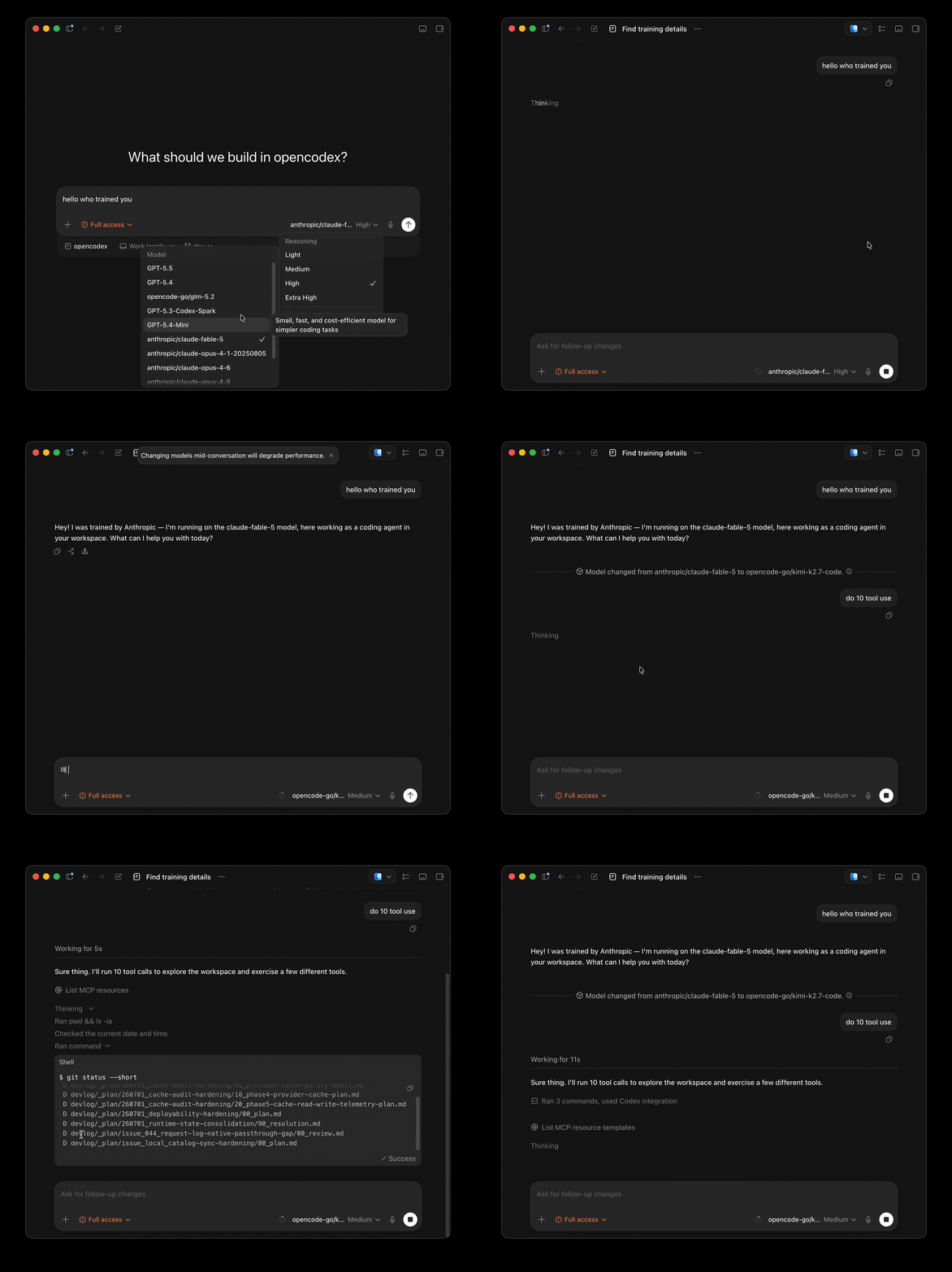
Universal provider proxy for OpenAI Codex & Claude Code — use any LLM (Claude, Gemini, Grok, DeepSeek, Ollama…) with Codex CLI, App, SDK, and Claude Code

Git-native persistent memory for AI coding agents. Implements Google OKF v0.2 with sub-300µs in-memory BM25 search, embedded MCP server, and progressive disclosure. Slashes token bloat by 80% with zero external databases or dependencies. Built in pure Go.

Local-first code intelligence graph for MCP and CLI. Builds a persistent map of your codebase so AI coding tools read only what matters, with benchmarked context reductions on reviews and large-repo workflows.

Stop your AI from making things up — it proposes, deterministic tools decide, every claim checked against ground truth with evidence. Grounded facts and context survive resets. Reverse engineering is the proving ground. MCP server + CLI.