
koala73/worldmonitorConnectors
Real-time global intelligence dashboard. AI-powered news aggregation, geopolitical monitoring, and infrastructure tracking in a unified situational awareness interface
86k
This server lets an MCP client talk to Google Drive, Docs, Sheets, Slides, and Calendar through one standardized interface. It supports search, file organization, document editing, sheet and slide creation, sharing, and calendar workflows while keeping Google credentials under your control.
Builders who want their agent to manage Google Drive and Workspace content through MCP.
You can ask your agent to find, edit, organize, and share Google files without leaving your client.
Provides tools for file management, Shared Drives, permissions, revisions, Docs editing, Sheets formatting, Slides authoring, and Calendar events.
Supports stdio for local clients, Streamable HTTP for hosted integrations, and team mode for shared deployments.
Supports local OAuth, multiple Google accounts, per-tool account selection, service accounts, and externally managed OAuth tokens.
Exposes `gdrive:///` resources for direct reading and discovery alongside tools.
Keeps OAuth credentials and tokens in the environment you operate instead of a hosted service.
~/.config/google-drive-mcp/gcp-oauth.keys.json
npx -y @piotr-agier/google-drive-mcp auth
Run authGetStatus and tell me which Google account is active.
Search my Google Drive for files modified in the last seven days.

Connect an MCP client to Google Drive, Docs, Sheets, Slides, and Calendar through one self-hosted server. Search and organize files, create and edit Workspace content, manage sharing, and automate multi-step workflows while keeping control of the Google identity and credentials used for every call.
gdrive:/// resource interface supports direct reading and discovery.This project remains focused on deep Drive and editor workflows rather than attempting to expose every Google Workspace API.
Compatibility is determined by the transport and authentication flow a client supports.
| Client type | Transport | Recommended mode |
|---|---|---|
| Claude Desktop | stdio | Local OAuth |
| Other local MCP clients, including Gemini CLI | stdio | Local OAuth |
| claude.ai custom connectors | Streamable HTTP | Team mode |
| Other remote MCP clients | Streamable HTTP | Single identity behind access control, or team mode with OAuth 2.1 |
See Client configuration for configuration examples and transport requirements.
In a Google Cloud project:
~/.config/google-drive-mcp/gcp-oauth.keys.json
The setup guide has the complete Google Cloud walkthrough and alternative credential locations.
npx -y @piotr-agier/google-drive-mcp auth
Complete the Google consent flow in the browser. Tokens are stored by default at ~/.config/google-drive-mcp/tokens.json.
For clients that use the common mcpServers configuration shape:
{
  "mcpServers": {
    "google-drive": {
      "command": "npx",
      "args": ["-y", "@piotr-agier/google-drive-mcp"]
    }
  }
}
Restart the client after saving its configuration. Claude Desktop paths and HTTP examples are documented in Client configuration.
Ask your client:
Run authGetStatus and tell me which Google account is active.
Then try a read-only Drive request:
Search my Google Drive for files modified in the last seven days.
If the identity is wrong or search returns no files, use the troubleshooting guide.
Find PDF files in /Reports, create an Archive folder there, and move files older
than one year into it.
Create a Google Sheet for monthly results, summarize it in a Google Doc, and
create a short Google Slides presentation from the summary.
Find the "Project Plan" document, replace the old launch date, format the new
date in bold, and add a comment describing the change.
Create a Calendar event with a Google Meet link and attach the project brief
from Drive.
Every section that used to live in this README is now in one of these guides.
| Guide | Contents |
|---|---|
| Setup | Requirements, Google Cloud APIs, OAuth credentials, and installation |
| Client configuration | Supported transports and client configuration |
| Authentication | Local OAuth, multi-account, service accounts, external tokens, and scopes |
| Configuration | CLI flags, environment variables, defaults, and precedence |
| Deployment | Docker, Streamable HTTP, team mode, and reverse-proxy security |
| Tool reference | All Drive, Docs, Sheets, Slides, Calendar, and account tools |
| Troubleshooting | Authentication, API, identity, Docker, and rate-limit problems |
| Development | Repository structure, build commands, tests, and contributions |
tokens.json.127.0.0.1 unless the server is protected by TLS and access control.team-store.json as a secret because it contains members' Google refresh tokens.See Authentication and Deployment for the complete security and identity model.
See the development guide to build and test the project.
Sign in to join the discussion.
No comments yet. Be the first to say what this is good for.
Real-time global intelligence dashboard. AI-powered news aggregation, geopolitical monitoring, and infrastructure tracking in a unified situational awareness interface
High-performance code intelligence MCP server. Indexes codebases into a persistent knowledge graph — average repo in milliseconds. 158 languages, sub-ms queries, 99% fewer tokens. Single static binary, zero dependencies.
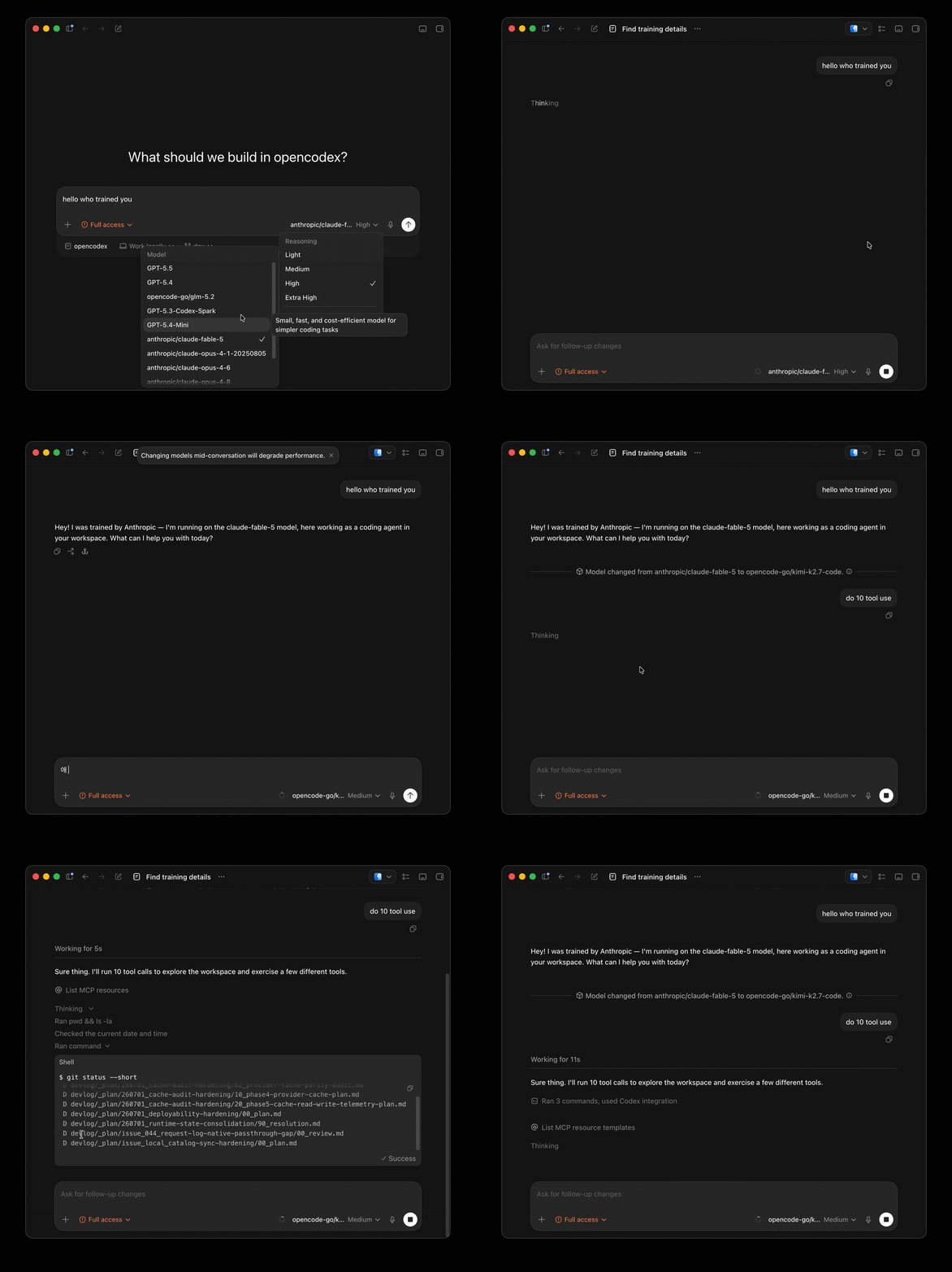
Universal provider proxy for OpenAI Codex & Claude Code — use any LLM (Claude, Gemini, Grok, DeepSeek, Ollama…) with Codex CLI, App, SDK, and Claude Code

Git-native persistent memory for AI coding agents. Implements Google OKF v0.2 with sub-300µs in-memory BM25 search, embedded MCP server, and progressive disclosure. Slashes token bloat by 80% with zero external databases or dependencies. Built in pure Go.

Local-first code intelligence graph for MCP and CLI. Builds a persistent map of your codebase so AI coding tools read only what matters, with benchmarked context reductions on reviews and large-repo workflows.

Stop your AI from making things up — it proposes, deterministic tools decide, every claim checked against ground truth with evidence. Grounded facts and context survive resets. Reverse engineering is the proving ground. MCP server + CLI.