
koala73/worldmonitorConnectors
Real-time global intelligence dashboard. AI-powered news aggregation, geopolitical monitoring, and infrastructure tracking in a unified situational awareness interface
86k
NeuroMesh sits between your repo and your coding agent. It builds a code graph, routes a task to the right symbols, and folds the rest of the file bodies into short markers that can be expanded later.
Builders who use agentic editors and want their assistant to work from a smaller, more relevant slice of a large codebase.
You can give your agent the right context without dumping entire files into the prompt.
Indexes files, symbols, imports, and call links so the agent can find the shortest path to the right code.
Keeps needed functions open and collapses the rest into reversible one-line fold markers.
Exposes tools like `get_context_packet`, `neuromesh_expand_fold`, `neuromesh_search_symbols`, and `neuromesh_trace` over stdio.
Lets you record which fix worked so similar tasks can route better next time.
Provides commands such as `neuromesh doctor`, `neuromesh connect`, `neuromesh index`, and `neuromesh monitor` for setup and inspection.
Uses tree-sitter and language overlays to work across Rust, TypeScript, Python, Go, Java, Kotlin, PHP, C#, Dart, Swift, Ruby, and more.
curl -fsSL https://raw.githubusercontent.com/pinoox/neuromesh/main/install.sh | bash
irm https://raw.githubusercontent.com/pinoox/neuromesh/main/install.ps1 | iex
neuromesh doctor          # verify binary and workspace
neuromesh connect         # write MCP configs (Cursor, VS Code, Claude, …)
neuromesh index           # build the graph (<30s typical)
Local-first MCP context engine for Cursor, VS Code, Claude, Codex, and every MCP client. NeuroMesh indexes your repo into a graph, routes your prompt to the right symbols, and sends a folded evidence packet — not thousand-line file dumps.


Cursor · VS Code · Claude · Codex · OpenCode · MiMo CLI · Antigravity · Kilo · Trae · Windsurf · Zed
The pain · Fold · Galaxy · Measured · Install · Connect · Docs · Site
You ask a simple question in a large project. The editor copies two or three thousand-line files and ships them to the model.
What you pay for:
Today’s workarounds all leak in a different place:
| Approach | What goes wrong |
|---|---|
| Vector RAG | Chunks smash functions. The shape of the code disappears. |
| “Just attach the files” | The model sees everything and understands nothing. |
| A static code graph | Better map — then it still pastes full files into the prompt. |
NeuroMesh is the missing step: route first, then fold. The graph is for finding the path. The packet is what the model actually reads.
How does nature pack two metres of DNA into a nucleus without deleting a single letter?
Not by throwing genes away — by folding.
Nature does not delete DNA to fit a nucleus. It supercoils.
NeuroMesh treats the syntax tree like a genetic strand in RAM:
/* [neuromesh:fold:fold_unused_helper_1 | 12 lines folded | fn unused_helper()] */
The agent still sees the shape of the file — signatures, imports, neighbors — without paying for every private helper. When a folded body is required, neuromesh_expand_fold unsplices it from a registry in memory. Nothing was deleted. Nothing needs a second grep of the disk.
Structure stays. Tokens sleep. Wake a fold when you need it.
| What you get | What it means for you |
|---|---|
| Smart folding | Relevant functions stay open; everything else collapses to one-line markers you can expand on demand. |
| Shortest path routing | Only the files your task needs — not the whole repo neighborhood. |
| Learns from your edits | Call record_feedback after a good fix; similar tasks route faster next time. |
| Safety modes | Balanced by default; auth and payment tasks automatically get more context. |
| Live code graph | Your repo indexed in RAM — functions, imports, and calls, not shredded text chunks. |
Curious about the biology metaphor? docs/nature.md
Pre-built binary (no Rust required). v0.9.0 defaults to engine: fast — instant graph index, no ONNX warm at startup.
macOS / Linux
curl -fsSL https://raw.githubusercontent.com/pinoox/neuromesh/main/install.sh | bash
Windows (PowerShell)
irm https://raw.githubusercontent.com/pinoox/neuromesh/main/install.ps1 | iex
Then from your project root:
neuromesh doctor          # verify binary and workspace
neuromesh connect         # write MCP configs (Cursor, VS Code, Claude, …)
neuromesh index           # build the graph (<30s typical)
Restart your IDE so MCP picks up the new server. Re-run the installer to update — then neuromesh -V should show v0.9.0.
| Platform | Binary |
|---|---|
| macOS / Linux | ~/.local/bin/neuromesh |
| Windows | %LOCALAPPDATA%\Programs\neuromesh\neuromesh.exe |
Hybrid/deep embeddings (neuromesh install embed minilm), CBM proxy, monitor port: docs/configuration.md.
NeuroMesh speaks MCP over stdio — what your IDE launches in the background.
neuromesh connect --global --agent-rules # recommended once per machine
That registers the server and copies the agent rule so the IDE actually calls NeuroMesh instead of raw Read / Grep.
Manual (when neuromesh is on PATH) — paste into ~/.cursor/mcp.json:
{
  "mcpServers": {
    "neuromesh": {
      "command": "neuromesh",
      "args": ["mcp"]
    }
  }
}
Per-client paths: docs/mcp.md.
Pass the user task as written — any language. Default engine: fast: graph + server-assisted concept expansion; no keyword tables.
get_context_packet(query / task_description / prompt / task)
  → check coverage.claim and retrieval.resolution_tier
  → neuromesh_search_symbols or neuromesh_expand_gap if seeds missed
  → neuromesh_expand_fold when a folded body is required
  → neuromesh_trace for callers and blast radius
  → neuromesh_record_feedback after a successful edit
Teach every IDE: docs/agent-guide.md · Cursor template: docs/agent-rule.mdc.
neuromesh monitor is a live map of your project: packages at a glance, then the file graph, then symbols inside a module.
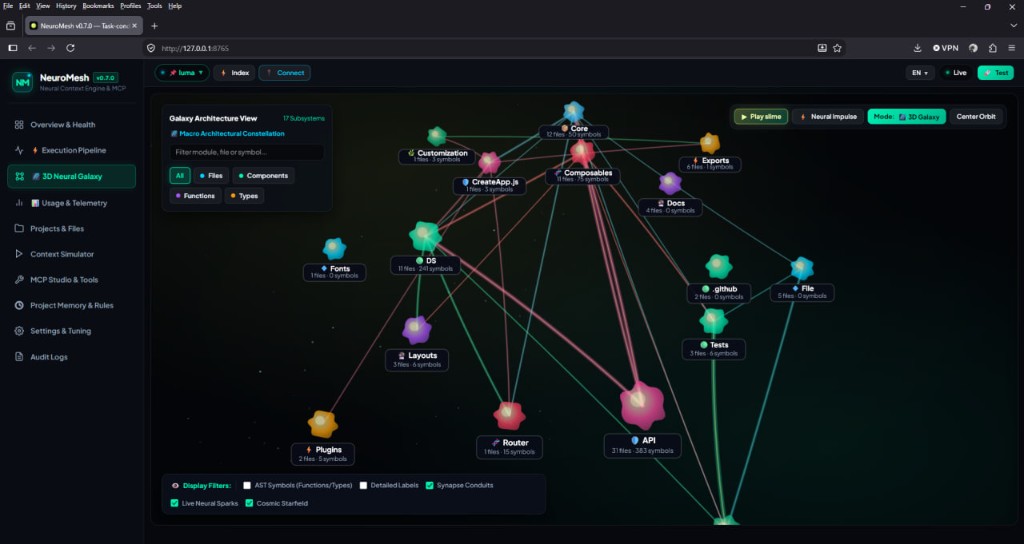
Constellation — packages and subsystems
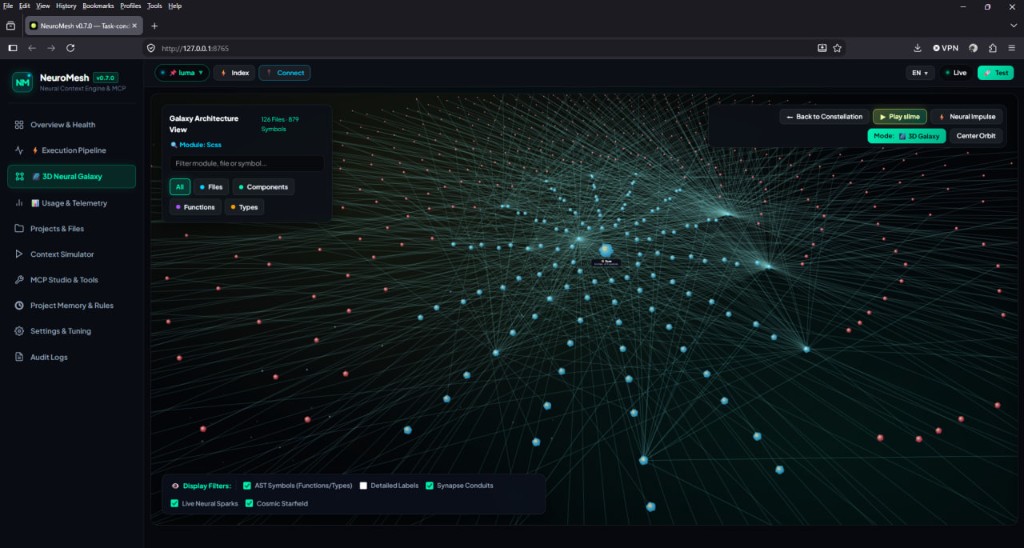
3D galaxy — files and call/import links
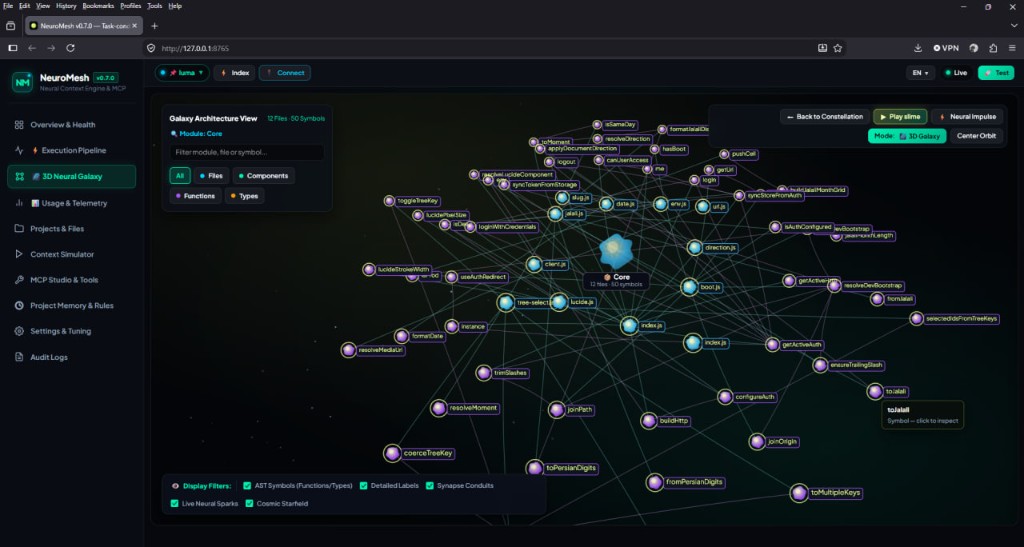
Module zoom — files and symbols in one area of your codebase
Default URL: http://127.0.0.1:8765 · neuromesh monitor · port: neuromesh port
| Tool | Use |
|---|---|
get_context_packet | Main entry — folded evidence packet |
neuromesh_expand_fold | Restore one folded body |
neuromesh_search_symbols | Ranked symbol search when seeds miss |
neuromesh_trace | Call / import chains |
neuromesh_record_feedback | Strengthen paths you actually edited |
Full reference: docs/mcp.md.
neuromesh index              # refresh graph after large changes
neuromesh status             # node / edge counts
neuromesh monitor            # 3D graph UI (see above)
neuromesh doctor --engine    # show retrieval preset
neuromesh config engine hybrid   # opt in to semantic search (needs embed install)
Command reference: docs/cli.md.
Rust, TypeScript, Python, Go, Java, Kotlin, PHP, C#, Dart, Swift, Ruby, and more via tree-sitter. Framework overlays for Laravel, Django, Next, Vue, Axum, Rails, Flutter, and others. Details: docs/architecture.md.
Savings are per task, after folding — not a marketing average. Run neuromesh eval on your own repo to see your numbers.
Example from a 650k-token monorepo (release v0.9.0, default engine: fast):
| Task (plain language) | Mode | Full repo | Before fold | Packet sent | Saved vs repo | Extra greps | ms |
|---|---|---|---|---|---|---|---|
| Fix the MCP tool handler | balanced | 650,859 | 72,428 | 17,389 | 97.3% | 0 | 22 |
| Trace graph routing code | balanced | 650,859 | 19,625 | 4,080 | 99.4% | 0 | 12 |
Index on that project: 340 files · 552 ms. Methodology and multilingual holdout: docs/quality.md.
| Doc | Start here when you want to… |
|---|---|
| Agent guide | Wire Cursor / VS Code / Claude to use NeuroMesh |
| MCP tools | See what each tool returns |
| CLI | Commands for install, index, connect, monitor |
| Configuration | Switch engines, proxy, advanced tuning |
| Engines | fast vs hybrid vs deep in one page |
| Docs index | Full map |
| Changelog | What changed in v0.9.0 |
MIT · LICENSE
Sign in to join the discussion.
No comments yet. Be the first to say what this is good for.
Real-time global intelligence dashboard. AI-powered news aggregation, geopolitical monitoring, and infrastructure tracking in a unified situational awareness interface
High-performance code intelligence MCP server. Indexes codebases into a persistent knowledge graph — average repo in milliseconds. 158 languages, sub-ms queries, 99% fewer tokens. Single static binary, zero dependencies.
Universal provider proxy for OpenAI Codex & Claude Code — use any LLM (Claude, Gemini, Grok, DeepSeek, Ollama…) with Codex CLI, App, SDK, and Claude Code

Git-native persistent memory for AI coding agents. Implements Google OKF v0.2 with sub-300µs in-memory BM25 search, embedded MCP server, and progressive disclosure. Slashes token bloat by 80% with zero external databases or dependencies. Built in pure Go.

Local-first code intelligence graph for MCP and CLI. Builds a persistent map of your codebase so AI coding tools read only what matters, with benchmarked context reductions on reviews and large-repo workflows.

Stop your AI from making things up — it proposes, deterministic tools decide, every claim checked against ground truth with evidence. Grounded facts and context survive resets. Reverse engineering is the proving ground. MCP server + CLI.