
koala73/worldmonitorConnectors
Real-time global intelligence dashboard. AI-powered news aggregation, geopolitical monitoring, and infrastructure tracking in a unified situational awareness interface
86k
Patent & Literature Search MCP connects an agent to Patsnap’s patent and academic literature databases. It supports natural-language search across patents and papers, plus semantic, keyword, BM25, and structured queries, then returns selected results in AI-readable Markdown. It works as a hosted MCP endpoint or as a local Docker bridge that forwards requests to Patsnap when `PATSNAP_API_KEY` is set.
Builders who want Claude Code, Cursor, or another MCP client to search patents and scientific literature from one place.
You can ask your agent to research prior art and scientific literature without manually switching between search sites.
Search patents with filters for assignee, inventor, IPC class, legal status, jurisdiction, dates, and citations.
Search papers and preprints with semantic, keyword, BM25, and structured search.
Run patent and paper searches in one request and combine the results for agent reasoning.
Fetch selected patent publications or literature records as Markdown, including claims, citations, legal data, and family data where available.
Use the hosted MCP endpoint directly, or run the repository’s Docker bridge with an API key.
claude mcp add --transport http search-tool \
  "https://connect.patsnap.com/2b0355/logic-mcp?apikey=YOUR_API_KEY"
Search global patents and scientific literature in natural language, directly inside Claude, Cursor, or any MCP-compatible AI tool. The MCP supports semantic, keyword, BM25, and structured search, then retrieves selected records as AI-readable Markdown.
Start free: Register on Patsnap Open Platform to receive 10,000 free credits. No credit card is required.
Patsnap is a global innovation intelligence platform covering patents, scientific literature, chemistry, life sciences, and other R&D data.
To explore Patsnap data interactively, try Eureka, Patsnap's AI-native R&D assistant. To access data programmatically, use the MCP servers or REST API via Patsnap Open Platform.
Patent & Literature Search MCP gives your AI agent direct access to Patsnap's patent and academic-literature databases. A single natural-language research request can cover both corpora and combine the results for AI reasoning.
This MCP is backed by Patsnap's global patent and scientific-literature coverage.
| Data-source group | Representative sources | Coverage |
|---|---|---|
| International and regional authorities | WIPO/PCT, EPO, ARIPO, EAPO, OAPI, GCC | Applications, grants, and regional records |
| Major national authorities | USPTO, CNIPA, JPO, KIPO, DPMA, INPI, UKIPO, CIPO, IP Australia | Applications, grants, designs, and utility models where applicable |
| Additional jurisdictions | Patent authorities across Europe, Asia-Pacific, the Americas, the Middle East, and Africa | Bibliographic records and authority-supported document types |
Patent data coverage includes:
| Data type | What it covers |
|---|---|
| Bibliography | Publication and application identifiers, titles, dates, applicants, assignees, inventors, and classifications |
| Full text | Abstracts, claims, descriptions, and other document text |
| Original patent-document coverage for supported authorities | |
| Legal events | Status changes and patent lifecycle events |
| File wrapper | Available prosecution and examination records |
| License | Available patent licensing records |
| Litigation | Available patent litigation records |
Coverage is refreshed frequently, with patent data updated daily.
| Source type | Representative data sources and publications |
|---|---|
| Biomedical and clinical literature | PubMed, The Lancet, BMJ, JAMA, Blood, Cancer Research, Journal of Clinical Oncology, Gastroenterology |
| Multidisciplinary journals | Nature, Science, Scientific Reports, PLOS ONE, Proceedings of the National Academy of Sciences |
| Chemistry and materials science | Journal of the American Chemical Society, Angewandte Chemie, Journal of Chemical Physics, Chemical & Engineering News Archive |
| Physics and engineering | Physical Review Letters, Physical Review B, Journal of Applied Physics, AIP Conference Proceedings, SPIE Proceedings |
| Preprints and repositories | arXiv, HAL, SSRN, Zenodo, DOAJ |
| Research datasets and specialist sources | ENCODE Datasets, Worldwide Protein Data Bank, OSTI, RePEc, GBIF, PsycEXTRA |
Literature records include bibliographic metadata, abstracts, citation metadata, and PDF coverage. The collection spans journal articles, preprints, conference proceedings, repositories, datasets, and other non-patent literature.
See Patsnap Global Data Coverage for the current authority-level and publication-level coverage matrix.
patsnap_search searches either patents or scientific literature in one
call. Its current input supports:
| Input | What it does |
|---|---|
semantic_query | Searches a natural-language technical description or concept |
search_strategy | Combines semantic, keyword, and filter strategies |
keywords | Runs precise keyword and BM25 matching |
source | Selects the patent or paper corpus |
filters | Applies provider-supported structured filters |
sort | Sorts by relevance or a provider-supported field |
offset, limit | Paginates results; up to 100 results per call |
Patent filters may include assignees, inventors, IPC classifications, jurisdictions, filing or publication dates, legal status, and citation conditions. Exact filter names and operators depend on the current hosted tool schema.
patsnap_fetch retrieves up to 100 selected result URLs or patent
publication numbers as Markdown.
| Module | Content that may be returned |
|---|---|
basic | Bibliographic data, title, abstract, claims, description, and other available record content |
citation | Patent citations and non-patent literature references |
legal | Available patent legal data and events |
family | Available patent-family information |
include_images | Signed patent-drawing URLs when available |
The citation module can retrieve citation data for selected patents. Where
available, this may include:
Citation direction and type should be determined from the returned record labels. Availability and completeness vary by jurisdiction and patent.
Literature records support the basic module and may include title,
abstract metadata, authors, affiliations, publication, publication date,
DOI, and other available bibliographic identifiers.
Register at Patsnap Open Platform and generate a free API key from the Patent & Literature Search MCP page. New accounts include 10,000 free credits. No credit card required.
claude mcp add --transport http search-tool \
  "https://connect.patsnap.com/2b0355/logic-mcp?apikey=YOUR_API_KEY"
Restart Claude Code and type /mcp to confirm it loaded.
Add the following to your MCP configuration file:
{
  "mcpServers": {
    "patsnap_patent_literature": {
      "url": "https://connect.patsnap.com/2b0355/logic-mcp?apikey=YOUR_API_KEY",
      "type": "streamableHttp"
    }
  }
}
Replace YOUR_API_KEY with your key from Patsnap Open Platform.
The repository includes a local stdio bridge for environments that
install or deploy MCP servers from source. It exposes static tool
definitions without credentials and forwards tool calls to the hosted
Patsnap Streamable HTTP service when PATSNAP_API_KEY is configured.
docker build -t patsnap-patent-literature-search .
docker run --rm -i \
  -e PATSNAP_API_KEY=YOUR_API_KEY \
  patsnap-patent-literature-search
MCP client configuration:
{
  "mcpServers": {
    "patsnap_patent_literature": {
      "command": "docker",
      "args": [
        "run",
        "--rm",
        "-i",
        "-e",
        "PATSNAP_API_KEY",
        "ghcr.io/patsnap/patent-literature-search-mcp:latest"
      ],
      "env": {
        "PATSNAP_API_KEY": "YOUR_API_KEY"
      }
    }
  }
}
The GitHub Actions workflow publishes version tags such as v1.1.0
to GHCR as both 1.1.0 and latest.
An optional live upstream check can be run manually from GitHub
Actions. Add PATSNAP_TEST_API_KEY as a repository Actions secret,
start the workflow with Run workflow, and enable
run_upstream. Pull requests never receive or use this secret.
patsnap_search — Search either patents or scientific literature in a
request. Supports natural-language and semantic queries, precise keyword
and BM25-based text search, and filters such as assignee, inventor, IPC
classification, legal status, jurisdiction, date range, and citations.
A single research request may invoke patent and literature searches and
combine their results.patsnap_fetch — Retrieve a patent or literature record as Markdown using
one or more result URLs. Patent records can also be fetched by publication
number and may include bibliographic data, claims, descriptions, drawings,
citations, legal data, and patent-family data. Literature records include
core bibliographic and abstract metadata.Requires Node.js 20 or newer.
npm ci
npm test
npm start
The test suite verifies:
initialize and tools/list handshake.To verify the container locally:
docker build -t patent-literature-search-mcp:test .
npm run test:docker
The server writes MCP JSON-RPC only to stdout. Application errors are returned as MCP tool results, and credentials are never included in logs.
After claiming the server on Glama:
Dockerfile.PATSNAP_API_KEY as a secret deployment environment variable.node src/index.js as the command if Glama does not infer the
Dockerfile CMD.What is Tesla actually working on in battery technology — show me
their recent patent filings, group by technology area, and identify
who is leading each.
Which GLP-1 receptor agonist patents are expiring before 2028,
and what does recent literature say about next-generation mechanisms?
My EV battery loses 40% range in cold weather. What technical
solutions exist in patents and academic papers?
Apache-2.0
Powered by Patsnap. Innovate with Confidence.
Sign in to join the discussion.
No comments yet. Be the first to say what this is good for.
Real-time global intelligence dashboard. AI-powered news aggregation, geopolitical monitoring, and infrastructure tracking in a unified situational awareness interface
High-performance code intelligence MCP server. Indexes codebases into a persistent knowledge graph — average repo in milliseconds. 158 languages, sub-ms queries, 99% fewer tokens. Single static binary, zero dependencies.
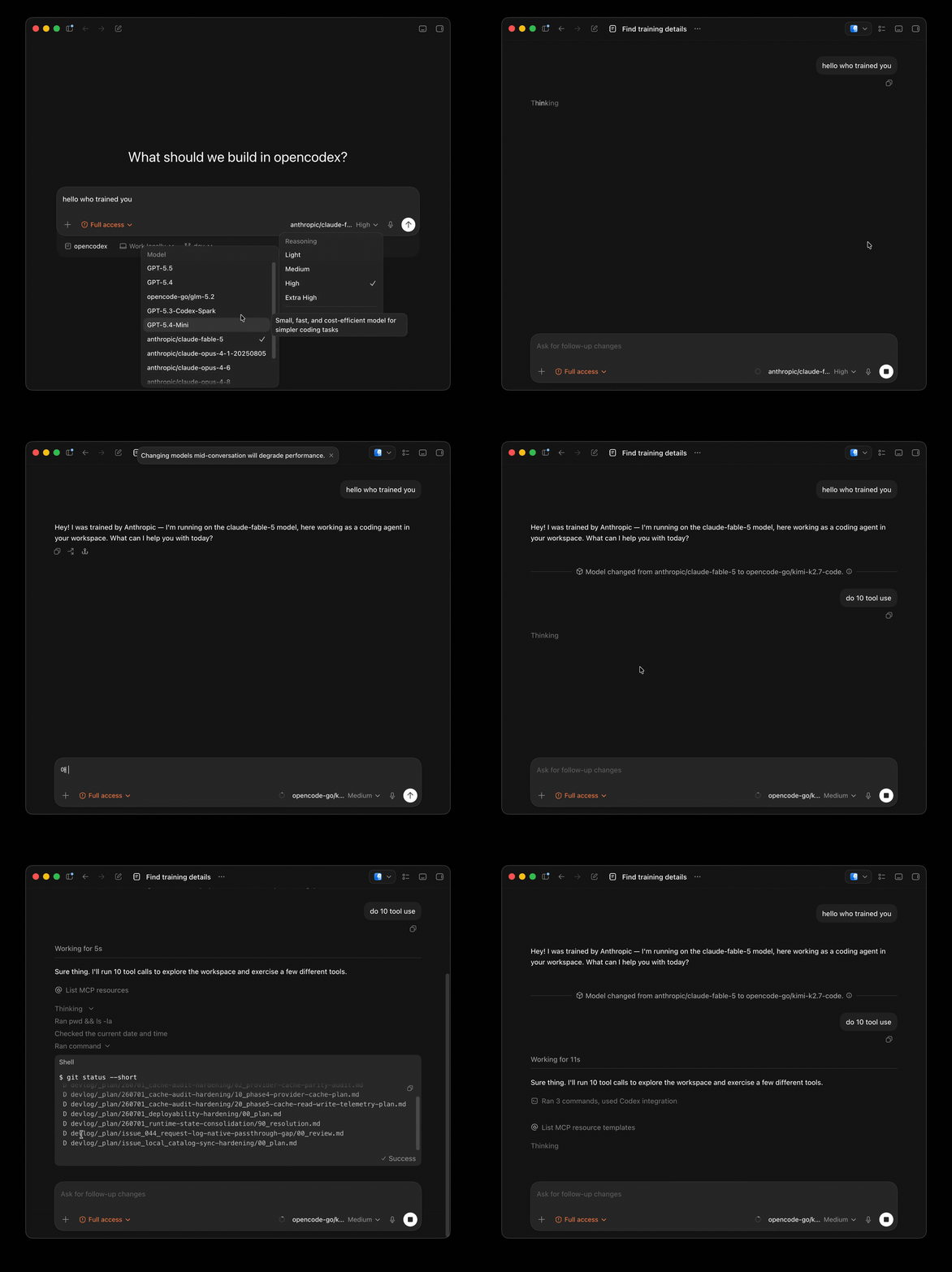
Universal provider proxy for OpenAI Codex & Claude Code — use any LLM (Claude, Gemini, Grok, DeepSeek, Ollama…) with Codex CLI, App, SDK, and Claude Code

Git-native persistent memory for AI coding agents. Implements Google OKF v0.2 with sub-300µs in-memory BM25 search, embedded MCP server, and progressive disclosure. Slashes token bloat by 80% with zero external databases or dependencies. Built in pure Go.

Local-first code intelligence graph for MCP and CLI. Builds a persistent map of your codebase so AI coding tools read only what matters, with benchmarked context reductions on reviews and large-repo workflows.

Stop your AI from making things up — it proposes, deterministic tools decide, every claim checked against ground truth with evidence. Grounded facts and context survive resets. Reverse engineering is the proving ground. MCP server + CLI.