

koala73/worldmonitorConnectors
Real-time global intelligence dashboard. AI-powered news aggregation, geopolitical monitoring, and infrastructure tracking in a unified situational awareness interface
86k
Peekaboo gives agents a way to inspect the macOS screen, capture screenshots, and control apps through the CLI or MCP. It combines screenshot, accessibility, click, type, and window commands so an agent can observe and then act. The menu-bar app adds permission onboarding and visual feedback.
Builders who want their agent to inspect macOS apps, take screenshots, and control the UI.
You can let an agent see the screen, choose a target, and carry out macOS actions without switching tools.
Captures an app window or the whole screen with CLI commands like `see` and `capture`.
Lists windows and returns structured accessibility data with stable element IDs.
Clicks, types, presses keys, scrolls, drags, and sets values in macOS apps.
Runs natural-language agent sessions that combine observation and action steps.
Exposes the same tools to MCP clients through the launcher package.
The menu-bar app helps users grant screen recording, accessibility, and input permissions.
brew install openclaw/tap/peekaboo
npx -y @steipete/peekaboo --version
peekaboo permissions status
peekaboo see --no-elements --mode screen --path /tmp/peekaboo-screen.png
peekaboo see --app Finder --json





Peekaboo is a macOS CLI and menu-bar app for screen capture, accessibility inspection, and native UI automation. Use it directly, let its agent plan multi-step work, or expose the same toolset to MCP clients.
The released CLI and app require macOS 15 or later.
brew install openclaw/tap/peekaboo
The npm package requires Node.js 22 or later and includes the CLI plus its MCP launcher.
npx -y @steipete/peekaboo --version
See MCP setup to connect it to Codex, Claude Code, Cursor, or another MCP client.
Download the signed DMG from the latest GitHub release. The menu-bar app provides permission onboarding, visual feedback, and agent sessions; install the CLI separately when you also need peekaboo on PATH.
For source builds and alternative install details, see the installation guide.
Check the permissions available to Peekaboo, then take a screenshot:
peekaboo permissions status
peekaboo see --no-elements --mode screen --path /tmp/peekaboo-screen.png
Screen capture requires Screen Recording permission. Accessibility permission enables UI inspection and control; the permissions guide covers setup and the additional permission used for synthetic input.
Inspect a running app to get a structured UI map with opaque element IDs:
peekaboo see --app Finder --json
That is the core loop: observe the current screen, choose an element from the result, and act on it.
Peekaboo 4.3.3 prevents accidental GUI host launches when the app bundle is invoked as the CLI, makes immutable Firestaff manifest reads safer with optional byte limits, and restores side-effect-free config edit --print-path queries. Generated Homebrew smoke tests now recognize the v4 help header.
List Safari's windows, copy the intended window_id (12345 below), then keep the entire interaction pinned to
that exact window:
peekaboo window list --app Safari --json
peekaboo click "Address and search bar" --app Safari --window-id 12345
peekaboo type "github.com/openclaw/Peekaboo" --app Safari --window-id 12345
peekaboo press Return --app Safari --window-id 12345
Targeted semantic and typed CLI input uses background delivery when Peekaboo can resolve the process, so the app does
not have to become frontmost. Raw CLI press chords can also stay background with an exact window selector. The CLI
also accepts a fresh exact non-dialog snapshot; that snapshot is required by background-only Agent/MCP policy.
App/PID-only and targetless chords require explicit foreground consent, as do window-selector-only Agent/MCP chords.
Prefer a semantic action such as menu click when one exists. See the
automation guide for element IDs, coordinates, snapshots, waits, and input behavior.
The agent combines the same observation and action tools into a natural-language run:
peekaboo agent "Open Safari, go to github.com, and search for Peekaboo" --allow-foreground
Agent runs need a configured model provider. See agent setup for providers and sessions, or MCP setup to expose Peekaboo's tools to another client.
| Goal | Commands | Guide |
|---|---|---|
| Observe the desktop | see, screen list, window list | Capture and inspection |
| Interact with UI | click, type, press, scroll, drag, set-value, action | Automation |
| Control macOS | app, window, menu, menubar, dock, dialog, space | Command reference |
| Run workflows | agent, capture | Agent · Capture |
| Integrate with clients | mcp, browser, tools | MCP |
Run peekaboo help <command> for live CLI help. The complete command index links to flags, examples, and troubleshooting for every command.
Peekaboo stores provider credentials and settings under ~/.peekaboo. Use peekaboo config to inspect or change them, and consult the configuration guide for profiles, environment variables, and custom providers. The provider reference covers hosted, compatible, and local model backends.
Shell completions for zsh, bash, and fish come from peekaboo completions; see the completion guide for persistent setup.
Source builds require macOS 15 or later, Swift 6.2 or later, Node.js 22 or later, and the repository's submodules.
pnpm install --frozen-lockfile
pnpm run build:cli
pnpm run lint:docs
pnpm run test:safe
More build, signing, and test details live in docs/building.md.
MIT. See LICENSE.
Sign in to join the discussion.
No comments yet. Be the first to say what this is good for.
Real-time global intelligence dashboard. AI-powered news aggregation, geopolitical monitoring, and infrastructure tracking in a unified situational awareness interface
High-performance code intelligence MCP server. Indexes codebases into a persistent knowledge graph — average repo in milliseconds. 158 languages, sub-ms queries, 99% fewer tokens. Single static binary, zero dependencies.
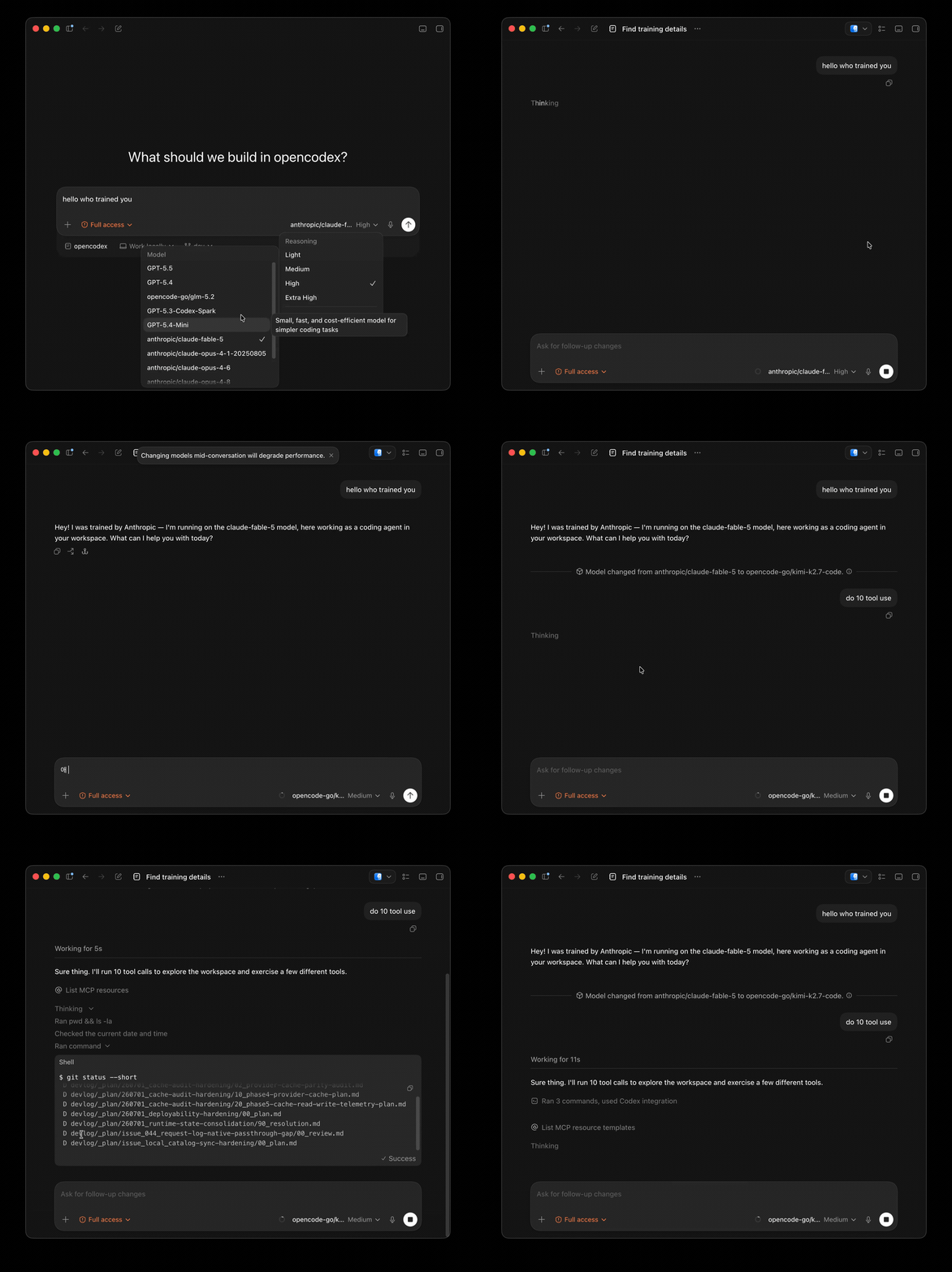
Universal provider proxy for OpenAI Codex & Claude Code — use any LLM (Claude, Gemini, Grok, DeepSeek, Ollama…) with Codex CLI, App, SDK, and Claude Code

Git-native persistent memory for AI coding agents. Implements Google OKF v0.2 with sub-300µs in-memory BM25 search, embedded MCP server, and progressive disclosure. Slashes token bloat by 80% with zero external databases or dependencies. Built in pure Go.

Local-first code intelligence graph for MCP and CLI. Builds a persistent map of your codebase so AI coding tools read only what matters, with benchmarked context reductions on reviews and large-repo workflows.

Stop your AI from making things up — it proposes, deterministic tools decide, every claim checked against ground truth with evidence. Grounded facts and context survive resets. Reverse engineering is the proving ground. MCP server + CLI.