
koala73/worldmonitorConnectors
Real-time global intelligence dashboard. AI-powered news aggregation, geopolitical monitoring, and infrastructure tracking in a unified situational awareness interface
86k
oo is a CLI that sits between your agent and OOMOL's hosted capabilities, plus the third-party accounts you connect in OOMOL Console. It lets the agent discover, inspect, and call those capabilities from the terminal, and it comes with bundled skills that tell supported hosts how to use it.
Builders who want their agent to act on connected accounts and hosted pipelines from the terminal.
You can ask your agent to handle connected apps and hosted tasks without switching tools or re-entering credentials.
Links a machine to an OOMOL account with `oo login`, then lets agents use connected services like Gmail, Calendar, Drive, Notion, Slack, and GitHub.
Exposes OOMOL-managed pipelines for OCR, translation, transcription, text-to-speech, text-to-image, subtitling, and long-document understanding.
Installs skills into supported agent hosts so they know when and how to route requests through `oo`.
Documents how to set up and use the self-hosted connector integration for local or private deployments.
curl -fsSL https://cli.oomol.com/install.sh | bash
irm https://cli.oomol.com/install.ps1 | iex
oo login

Plug AI agents into OOMOL's hosted capabilities and your connected accounts.




oo is the CLI that lets AI agents on your machine discover, inspect, and call
OOMOL's hosted capabilities and the third-party services you've already
connected.
Two kinds of capabilities are reachable through oo:
oo without re-authenticating.You don't memorize commands. The bundled skills teach supported AI agents
when and how to route out-of-workspace work through oo.
oo on this machine.oo login to link this machine to your OOMOL account.oo skill tells it when and how to call the
right capability.macOS / Linux:
curl -fsSL https://cli.oomol.com/install.sh | bash
Windows PowerShell:
irm https://cli.oomol.com/install.ps1 | iex
Other install scripts (wget, Windows CMD, etc.) are listed at
https://cli.oomol.com/install-guide.md.
oo login
Then talk to your AI agent in natural language — describe intent, not commands:
/oo summarize my latest 5 Gmail messages.
/oo is the prompt convention picked up by the bundled skill; the agent will
route the request through oo for you.
On first launch, oo installs bundled skills into any of the following AI
agent hosts that already exist on this machine: Codex, Claude Code, Hermes,
CodeBuddy, WorkBuddy, Trae, Trae CN, OpenClaw, QoderWork, and DeepSeek TUI.
Bundled skills are kept in sync with each oo release. See the
command reference for the exact skill targets and how to
manage them manually.
Agents may use a bundled skill on their own when a request matches it. To make
them wait until you ask by name, run oo skills auto-trigger off --all (or name
individual skills). The skills stay installed and invocable — /oo in Claude
Code, $oo in Codex.
oo records privacy-constrained telemetry by default. Events do not include
free-form input text, paths, usernames, hostnames, IP addresses, real OOMOL
account ids, or account names. Telemetry controls and the full boundary are
documented in PRIVACY.md.
Sign in to join the discussion.
No comments yet. Be the first to say what this is good for.
Real-time global intelligence dashboard. AI-powered news aggregation, geopolitical monitoring, and infrastructure tracking in a unified situational awareness interface
High-performance code intelligence MCP server. Indexes codebases into a persistent knowledge graph — average repo in milliseconds. 158 languages, sub-ms queries, 99% fewer tokens. Single static binary, zero dependencies.
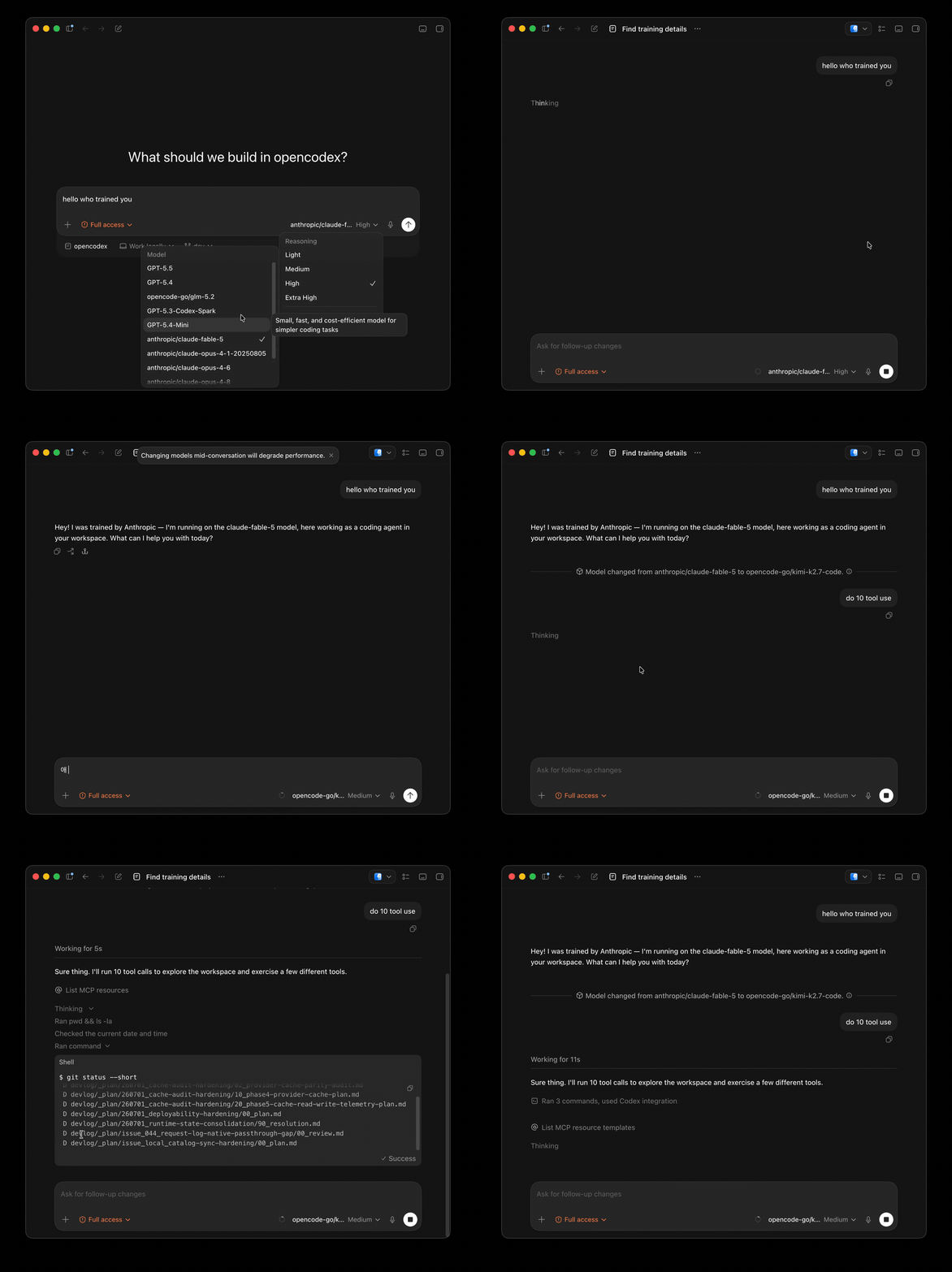
Universal provider proxy for OpenAI Codex & Claude Code — use any LLM (Claude, Gemini, Grok, DeepSeek, Ollama…) with Codex CLI, App, SDK, and Claude Code

Git-native persistent memory for AI coding agents. Implements Google OKF v0.2 with sub-300µs in-memory BM25 search, embedded MCP server, and progressive disclosure. Slashes token bloat by 80% with zero external databases or dependencies. Built in pure Go.

Local-first code intelligence graph for MCP and CLI. Builds a persistent map of your codebase so AI coding tools read only what matters, with benchmarked context reductions on reviews and large-repo workflows.

Stop your AI from making things up — it proposes, deterministic tools decide, every claim checked against ground truth with evidence. Grounded facts and context survive resets. Reverse engineering is the proving ground. MCP server + CLI.