
koala73/worldmonitorConnectors
Real-time global intelligence dashboard. AI-powered news aggregation, geopolitical monitoring, and infrastructure tracking in a unified situational awareness interface
86k
Bridge connects a terminal agent to Figma so you can describe a design, compile it, and send it to Figma with the project’s real components and tokens. It uses skills, a local compiler, hooks, and MCP transport to keep the output aligned with the design system and checked against rules before execution.
Builders who want Claude Code or Cursor to generate Figma designs from design-system rules.
You can turn natural-language design requests into Figma output that follows your design system without re-explaining tokens, variants, or component rules.
Provides `using-bridge`, `generating-figma-design`, `learning-from-corrections`, `shipping-and-archiving`, and `extracting-design-system` skills for the main workflow.
Includes `.cursor-plugin/` manifests so Cursor can use the same Bridge workflow.
Compiles scene graph JSON into Figma Plugin API code and enforces 26 rules before anything is sent to Figma.
Stores registries, recipes, learnings, and guides in the repo and keeps them synced with Figma.
Runs hook logic around a session start to load rules and health checks.
Uses GitHub Actions cron to pull Figma changes, detect drift, and open a PR when the knowledge base changes.
/plugin marketplace add noemuch/bridge
/plugin install bridge-ds
cd /path/to/ds-repo && claude
setup bridge

Compiler-grade trust for AI-generated Figma.
Deterministic compiler · Living KB · MCP-native


Discussions · Issues · Contributing · Security · Changelog
Bridge compiles your design-system intent into Figma output that's guaranteed DS-compliant by construction — not by verification. 26 Figma API rules enforced automatically by a local compiler. Zero hardcoded values, zero raw Plugin API code, zero AI hallucinations.
Three pillars: a deterministic compiler (the moat), conversational UX via Claude Code skills (make / fix / done), and a living KB continuously synchronized with Figma via cron.
Design components and screens from natural language inside Claude Code. Bridge handles the rest:
# In Claude Code, inside your DS repo:
make a settings screen for account information
Bridge produces:
Every output uses your real components, bound variables, and text styles. Zero hardcoded values.
Iterate with fix (capture manual Figma edits as learnings). Ship with done (archive + extract recipes).
Bridge keeps your knowledge base continuously synchronized with Figma.
setup bridge in Claude Code bootstraps your DS repo: registries, cron workflow, all in one flow.The KB lives in your repo at bridge-ds/knowledge-base/registries/. Point your AI client at this directory or read it programmatically. Your generated code uses tokens, variants, and composition rules correctly — because it reads the source of truth, not guesses.
In Claude Code, any session (one-time install):
/plugin marketplace add noemuch/bridge
/plugin install bridge-ds
In your DS repo:
cd /path/to/ds-repo && claude
setup bridge
One phrase. The skill handles pre-flight, scaffolding, extraction, GitHub secret, first commit, and optional cron test. ~10 minutes end-to-end.
Upgrading from v5.x? See BREAKING.md for the v6 migration guide.
| Layer | Technology | Description |
|---|---|---|
| Workflow | Claude Code Skills | Five focused skills (see Skills below) |
| Spec | CSpec YAML | Structured, human-readable compilable specifications |
| Compiler | TypeScript | Scene graph JSON → Figma Plugin API code (26 rules enforced) |
| Transport | MCP | figma-console-mcp (preferred) or official Figma MCP server |
| Target | Figma Desktop / Cloud | Production-ready designs in your real DS library |
| Memory | Knowledge Base | Registries, guides, recipes, learnings — per-project |
You describe → Claude writes CSpec → Compiler resolves tokens → MCP → Figma
| Skill | Trigger | Purpose |
|---|---|---|
using-bridge | SessionStart (auto) | Force-loaded rules, command map, drop/status procedures |
generating-figma-design | make <description> | Spec + compile + execute + verify |
learning-from-corrections | fix | Diff Figma corrections, extract learnings, patch recipes |
shipping-and-archiving | done | Final gate, archive, extract recipes |
extracting-design-system | setup bridge | Bootstrap a DS repo end-to-end |
Every scene graph JSON goes through a deterministic pipeline:
bridge-ds compile --input scene.json --kb <kb-path> --transport <console|official>
| Stage | Purpose |
|---|---|
| Parse | Load scene graph JSON, validate schema |
| Resolve | Look up every $token reference against the knowledge base registries |
| Validate | Check structure, detect missing tokens with fuzzy suggestions, flag hardcoded values, validate requested variants against registry metadata |
| Plan | Chunk large graphs for transport limits; bridge nodeIds across chunks |
| Generate | Emit Figma Plugin API code respecting all 26 rules |
| Wrap | Adapt output for the target transport (console IIFE vs. official top-level await) |
Errors are caught at compile time, before anything touches Figma.
Compiler reference → · Transport adapter → · Verification gates →
Direct CLI commands (typically invoked under the hood by skills):
| Command | Purpose |
|---|---|
bridge-ds setup --ds-name <name> --figma-key <key> | Headless scaffold (used by setup bridge) |
bridge-ds compile --input <json> --kb <path> | Compile a scene graph JSON |
bridge-ds doctor | Diagnose config, connectivity, KB health |
bridge-ds extract --headless | Figma REST extraction (CI-friendly, FIGMA_TOKEN required) |
bridge-ds migrate | Upgrade a legacy knowledge base to the current schema |
bridge-ds cron | Run the cron orchestrator (KB sync, opens PR on diff) |
Recipes are parameterized scene graph templates the compiler reuses across sessions. The fastest way to build one: generate a screen with make, then done to archive — Bridge auto-extracts a recipe when the layout is reusable.
Recipes live under bridge-ds/knowledge-base/recipes/ in your repo. Schema: { id, name, archetype, tags, scene_graph, confidence }. Each recipe is scored against the user's description on four axes (archetype match, tag overlap, structural similarity, confidence). High-scoring recipes pre-fill the CSpec.
Full schema: references/compiler-reference.md.
bin/                                 CLI entry (bridge-ds binary)
lib/
  cli/                               Typed CLI (main, setup-orchestrator, token-handling, …)
  compiler/                          Scene graph compiler (TypeScript)
  config/                            YAML config parsing
  cron/                              GitHub Actions cron orchestrator (KB sync)
  extractors/                        Figma REST + MCP extractors
  kb/                                Knowledge base (registries, hashing, auto-detect)
  mcp/                               MCP transport adapter (console/official)

references/                          Shared repo-level references
  compiler-reference.md
  transport-adapter.md
  verification-gates.md
  red-flags-catalog.md

skills/
  using-bridge/                      Force-loaded process skill
  generating-figma-design/           make
  learning-from-corrections/         fix
  shipping-and-archiving/            done
  extracting-design-system/          setup

hooks/                               SessionStart health-line hook
scripts/                             validate-skills, bump-version
test/                                Integration + security tests

.claude-plugin/                      Claude Code plugin manifest
.cursor-plugin/                      Cursor plugin manifest
Bridge DS works as a plugin for:
.claude-plugin/ and SessionStart hook injection..cursor-plugin/.Both use the same MCP transport and compiler infrastructure.
See CONTRIBUTING.md for development setup, code guidelines, and PR process.
Built by Noé Chagué — Design System @Finary
Sign in to join the discussion.
No comments yet. Be the first to say what this is good for.
Real-time global intelligence dashboard. AI-powered news aggregation, geopolitical monitoring, and infrastructure tracking in a unified situational awareness interface
High-performance code intelligence MCP server. Indexes codebases into a persistent knowledge graph — average repo in milliseconds. 158 languages, sub-ms queries, 99% fewer tokens. Single static binary, zero dependencies.
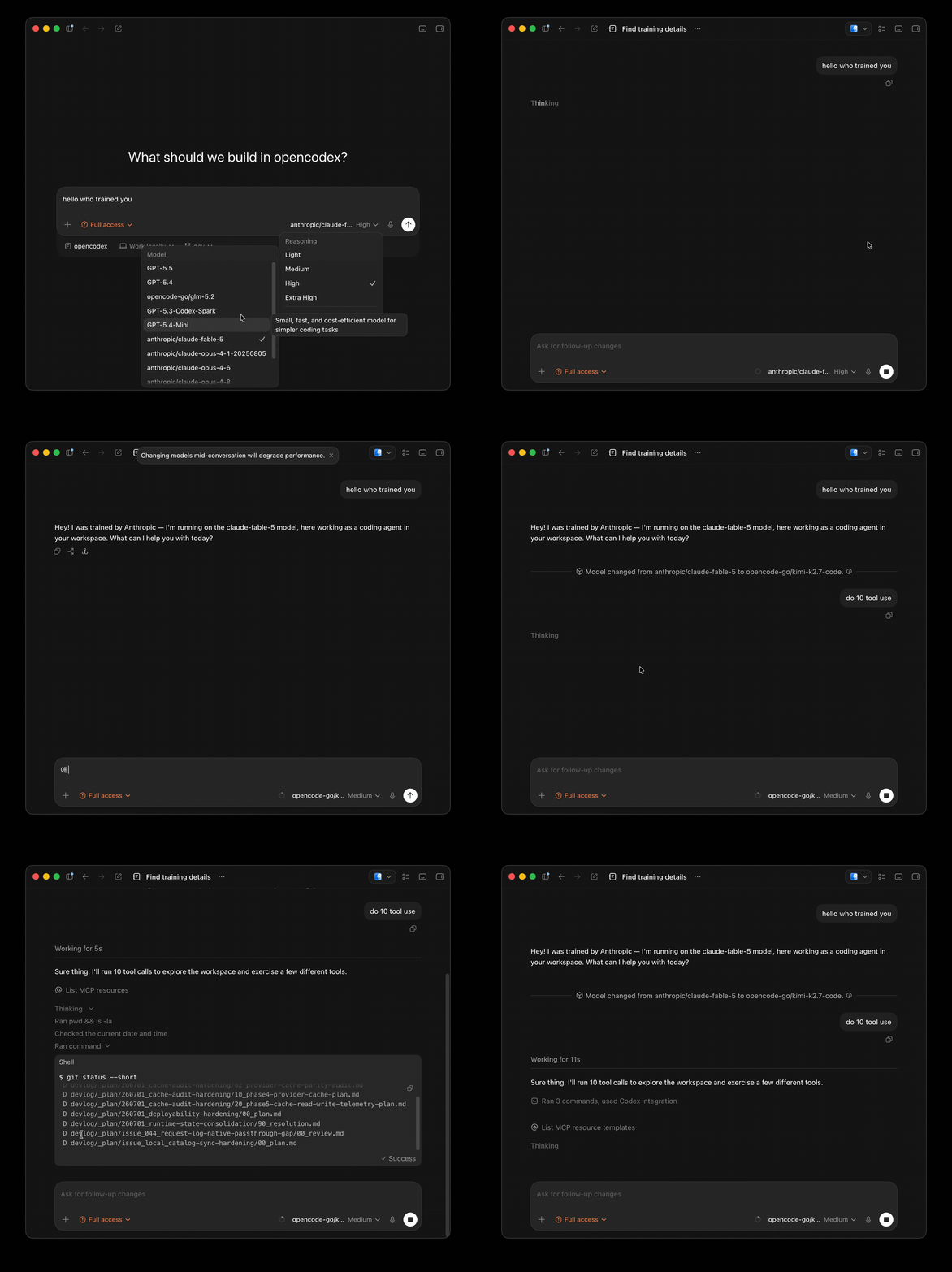
Universal provider proxy for OpenAI Codex & Claude Code — use any LLM (Claude, Gemini, Grok, DeepSeek, Ollama…) with Codex CLI, App, SDK, and Claude Code

Git-native persistent memory for AI coding agents. Implements Google OKF v0.2 with sub-300µs in-memory BM25 search, embedded MCP server, and progressive disclosure. Slashes token bloat by 80% with zero external databases or dependencies. Built in pure Go.

Local-first code intelligence graph for MCP and CLI. Builds a persistent map of your codebase so AI coding tools read only what matters, with benchmarked context reductions on reviews and large-repo workflows.

Stop your AI from making things up — it proposes, deterministic tools decide, every claim checked against ground truth with evidence. Grounded facts and context survive resets. Reverse engineering is the proving ground. MCP server + CLI.