
koala73/worldmonitorConnectors
Real-time global intelligence dashboard. AI-powered news aggregation, geopolitical monitoring, and infrastructure tracking in a unified situational awareness interface
86k
CRASH is an MCP server that helps an agent break complex work into explicit steps instead of one long chain of thought. It adds confidence scores, revision support, branching, dependency checks, and session handling so the reasoning stays organized and reviewable.
Builders who want their MCP agent to work through complex tasks with visible steps and cleaner decision trails.
You can guide an agent through hard problems with trackable reasoning instead of re-explaining context each time.
Tracks step number, purpose, context, thought, outcome, next action, and rationale for each reasoning turn.
Lets a step carry a 0-1 confidence score and warns when confidence is low.
Marks earlier steps as revised and records why a correction was needed.
Lets an agent split into alternate solution paths with branch IDs, names, and depth limits.
Checks that a step declares the steps it depends on before continuing.
Groups related reasoning chains and can clean them up after a timeout.
Outputs the reasoning flow in console, JSON, or Markdown form.
Supports strict mode for rigid input rules or flexible mode for more natural language.
npm install crash-mcp
npx crash-mcp
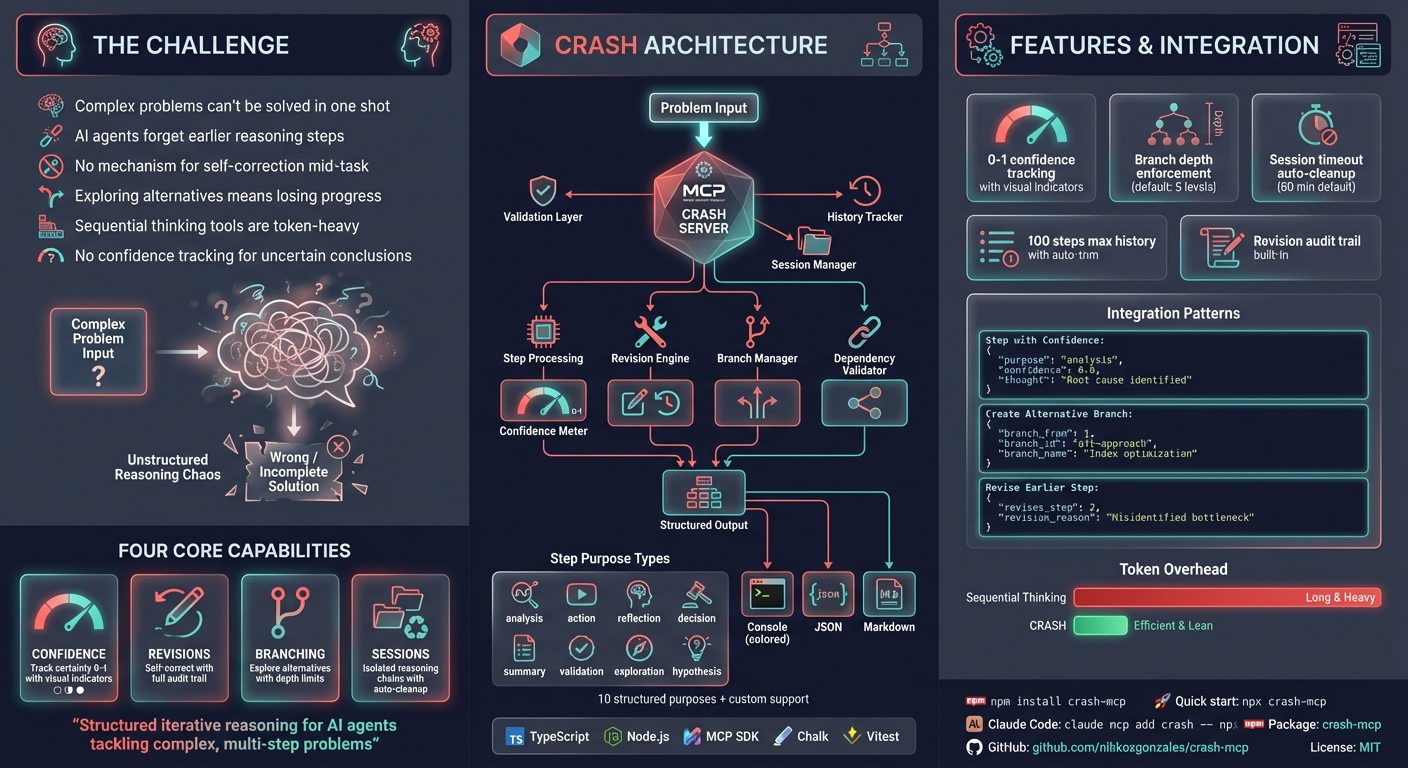
An MCP (Model Context Protocol) server for structured, iterative reasoning. CRASH helps AI assistants break down complex problems into trackable steps with confidence tracking, revision support, and branching for exploring alternatives.
Inspired by MCP Sequential Thinking Server
I created this because typing "use sequential_thinking" was cumbersome. Now I can simply say "use crash" instead.
CRASH is more token-efficient than sequential thinking - it doesn't include code in thoughts and has streamlined prompting. It's my go-to solution when an agent can't solve an issue in one shot or when plan mode falls short.
CRASH helped significantly for this specific task:

Where CRASH helped:
- Systematic analysis: Forced me to break down the issue methodically
- Solution exploration: Explored multiple approaches before settling on the best one
- Planning validation: Each step built on the previous one logically

The key difference:
CRASH forced me to be more thorough in the analysis phase. Without it, I might have
rushed to implement the first solution rather than exploring cleaner approaches.

Verdict: CRASH adds value for complex problems requiring systematic analysis of
multiple solution paths. For simpler tasks, internal planning is sufficient and faster.
npm install crash-mcp
Or use directly with npx:
npx crash-mcp
Most MCP clients use this JSON configuration:
{
  "mcpServers": {
    "crash": {
      "command": "npx",
      "args": ["-y", "crash-mcp"]
    }
  }
}
| Client | Setup Method |
|---|---|
| Claude Code | claude mcp add crash -- npx -y crash-mcp |
| Cursor | Add to ~/.cursor/mcp.json |
| VS Code | Add to settings JSON under mcp.servers |
| Claude Desktop | Add to claude_desktop_config.json |
| Windsurf | Add to MCP config file |
| JetBrains | Settings > Tools > AI Assistant > MCP |
| Others | Use standard MCP JSON config above |
Use the cmd wrapper:
{
  "mcpServers": {
    "crash": {
      "command": "cmd",
      "args": ["/c", "npx", "-y", "crash-mcp"]
    }
  }
}
{
  "mcpServers": {
    "crash": {
      "command": "npx",
      "args": ["-y", "crash-mcp"],
      "env": {
        "CRASH_STRICT_MODE": "false",
        "MAX_HISTORY_SIZE": "100",
        "CRASH_OUTPUT_FORMAT": "console",
        "CRASH_SESSION_TIMEOUT": "60",
        "CRASH_MAX_BRANCH_DEPTH": "5"
      }
    }
  }
}
FROM node:18-alpine
WORKDIR /app
RUN npm install -g crash-mcp
CMD ["crash-mcp"]
{
  "mcpServers": {
    "crash": {
      "command": "docker",
      "args": ["run", "-i", "--rm", "crash-mcp"]
    }
  }
}
Bun:
{ "command": "bunx", "args": ["-y", "crash-mcp"] }
Deno:
{
  "command": "deno",
  "args": ["run", "--allow-env", "--allow-net", "npm:crash-mcp"]
}
| Variable | Default | Description |
|---|---|---|
CRASH_STRICT_MODE | false | Enable strict validation (requires specific prefixes) |
MAX_HISTORY_SIZE | 100 | Maximum steps to retain in history |
CRASH_OUTPUT_FORMAT | console | Output format: console, json, markdown |
CRASH_NO_COLOR | false | Disable colored console output |
CRASH_SESSION_TIMEOUT | 60 | Session timeout in minutes |
CRASH_MAX_BRANCH_DEPTH | 5 | Maximum branch nesting depth |
CRASH_ENABLE_SESSIONS | false | Enable session management |
| Parameter | Type | Description |
|---|---|---|
step_number | integer | Sequential step number (starts at 1) |
estimated_total | integer | Estimated total steps (adjustable) |
purpose | string | Step category: analysis, action, validation, exploration, hypothesis, correction, planning, or custom |
context | string | What's already known to avoid redundancy |
thought | string | Current reasoning process |
outcome | string | Expected or actual result |
next_action | string/object | Next action (simple string or structured with tool details) |
rationale | string | Why this next action was chosen |
| Parameter | Type | Description |
|---|---|---|
is_final_step | boolean | Mark as final step to complete reasoning |
confidence | number | Confidence level 0-1 (warnings below 0.5) |
uncertainty_notes | string | Describe doubts or assumptions |
revises_step | integer | Step number being corrected |
revision_reason | string | Why revision is needed |
branch_from | integer | Step to branch from |
branch_id | string | Unique branch identifier |
branch_name | string | Human-readable branch name |
dependencies | integer[] | Step numbers this depends on |
session_id | string | Group related reasoning chains |
tools_used | string[] | Tools used in this step |
external_context | object | External data relevant to step |
{
  "step_number": 1,
  "estimated_total": 3,
  "purpose": "analysis",
  "context": "User requested optimization of database queries",
  "thought": "I need to first understand the current query patterns before proposing changes",
  "outcome": "Identified slow queries for optimization",
  "next_action": "analyze query execution plans",
  "rationale": "Understanding execution plans will reveal bottlenecks"
}
{
  "step_number": 3,
  "estimated_total": 3,
  "purpose": "summary",
  "context": "Analyzed queries and tested index optimizations",
  "thought": "The index on user_id reduced query time from 2s to 50ms",
  "outcome": "Performance issue resolved with new index",
  "next_action": "document the change",
  "rationale": "Team should know about the optimization",
  "confidence": 0.9,
  "is_final_step": true
}
{
  "step_number": 4,
  "estimated_total": 5,
  "purpose": "correction",
  "context": "Previous analysis missed a critical join condition",
  "thought": "The join was causing a cartesian product, not the index",
  "outcome": "Corrected root cause identification",
  "next_action": "fix the join condition",
  "rationale": "This is the actual performance issue",
  "revises_step": 2,
  "revision_reason": "Overlooked critical join in initial analysis"
}
{
  "step_number": 3,
  "estimated_total": 6,
  "purpose": "exploration",
  "context": "Two optimization approaches identified",
  "thought": "Exploring the indexing approach first as it's lower risk",
  "outcome": "Branch created for index optimization testing",
  "next_action": "test index performance",
  "rationale": "This approach has lower risk than query rewrite",
  "branch_from": 2,
  "branch_id": "index-optimization",
  "branch_name": "Index-based optimization"
}
Good fit:
Not needed:
npm install        # Install dependencies
npm run build      # Build TypeScript
npm run dev        # Run with MCP inspector
npm start          # Start built server
Try using bunx instead of npx:
{ "command": "bunx", "args": ["-y", "crash-mcp"] }
Try the experimental VM modules flag:
{ "args": ["-y", "--node-options=--experimental-vm-modules", "crash-mcp"] }
Nikko Gonzales - nikkoxgonzales
MIT
Sign in to join the discussion.
No comments yet. Be the first to say what this is good for.
Real-time global intelligence dashboard. AI-powered news aggregation, geopolitical monitoring, and infrastructure tracking in a unified situational awareness interface
High-performance code intelligence MCP server. Indexes codebases into a persistent knowledge graph — average repo in milliseconds. 158 languages, sub-ms queries, 99% fewer tokens. Single static binary, zero dependencies.
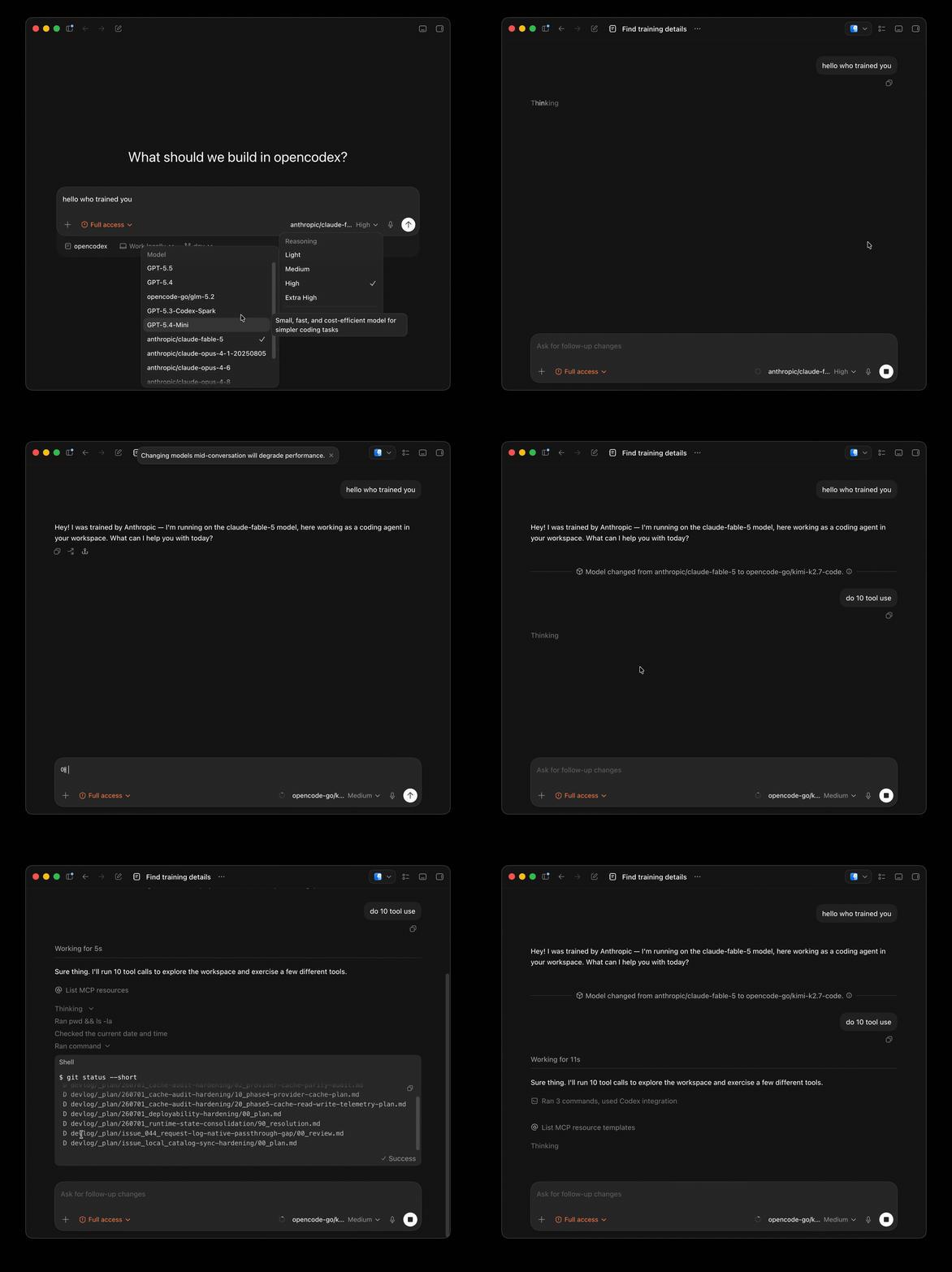
Universal provider proxy for OpenAI Codex & Claude Code — use any LLM (Claude, Gemini, Grok, DeepSeek, Ollama…) with Codex CLI, App, SDK, and Claude Code

Git-native persistent memory for AI coding agents. Implements Google OKF v0.2 with sub-300µs in-memory BM25 search, embedded MCP server, and progressive disclosure. Slashes token bloat by 80% with zero external databases or dependencies. Built in pure Go.

Local-first code intelligence graph for MCP and CLI. Builds a persistent map of your codebase so AI coding tools read only what matters, with benchmarked context reductions on reviews and large-repo workflows.

Stop your AI from making things up — it proposes, deterministic tools decide, every claim checked against ground truth with evidence. Grounded facts and context survive resets. Reverse engineering is the proving ground. MCP server + CLI.