

heygen-com/hyperframesFrameworks & SDKs
Write HTML. Render video. Built for agents.
49k
This repo provides the official Go implementation of the Model Context Protocol for clients and servers. You use the `mcp` package for the main APIs, `jsonrpc` for custom transports, and `auth` and `oauthex` for OAuth-related support.
Builders who want to add MCP support to Go tools, services, or agents.
You can build MCP servers and clients in Go instead of wiring the protocol yourself.
The `mcp` package defines `NewServer`, `NewClient`, session handling, tools, prompts, resources, and transports.
The SDK includes stdin/stdout, command-based, SSE, and streamable HTTP transport code, plus support for custom transport implementations.
The `auth` package and `oauthex` extensions cover authorization code flows, protected resource metadata, audience handling, and token exchange.
The repo includes protocol docs, conformance fixtures, and tests that track supported MCP spec versions.
The `examples/` directory shows client, server, HTTP, and auth examples you can copy into your own project.

This repository contains an implementation of the official Go software development kit (SDK) for the Model Context Protocol (MCP).
The SDK consists of several importable packages:
github.com/modelcontextprotocol/go-sdk/mcp
package defines the primary APIs for constructing and using MCP clients and
servers.github.com/modelcontextprotocol/go-sdk/jsonrpc package is for users implementing
their own transports.github.com/modelcontextprotocol/go-sdk/auth
package provides some primitives for supporting OAuth.github.com/modelcontextprotocol/go-sdk/oauthex
package provides extensions to the OAuth protocol, such as ProtectedResourceMetadata.The SDK endeavors to implement the full MCP spec. The docs/ directory
contains feature documentation, mapping the MCP spec to the packages above.
The following table shows which versions of the Go SDK support which versions of the MCP specification:
| SDK Version | Latest MCP Spec | All Supported MCP Specs |
|---|---|---|
| v1.7.0+ | 2026-07-28 | 2026-07-28, 2025-11-25*, 2025-06-18, 2025-03-26, 2024-11-05 |
| v1.4.0 - v1.6.1 | 2025-11-25* | 2025-11-25*, 2025-06-18, 2025-03-26, 2024-11-05 |
| v1.2.0 - v1.3.1 | 2025-11-25** | 2025-11-25**, 2025-06-18, 2025-03-26, 2024-11-05 |
| v1.0.0 - v1.1.0 | 2025-06-18 | 2025-06-18, 2025-03-26, 2024-11-05 |
* Client side OAuth has experimental support.
** Partial support for 2025-11-25 (client side OAuth and Sampling with tools not available).
The roots, sampling, and logging features are deprecated as of protocol version 2026-07-28 by SEP-2577. The SDK continues to support them for compatibility during the deprecation window (at least twelve months). See the individual feature documentation for migration guidance.
New releases of the SDK target only supported versions of Go. See https://go.dev/doc/devel/release#policy for more information.
To get started creating an MCP server, create an mcp.Server instance, add
features to it, and then run it over an mcp.Transport. For example, this
server adds a single simple tool, and then connects it to clients over
stdin/stdout:
package main

import (
	"context"
	"log"

	"github.com/modelcontextprotocol/go-sdk/mcp"
)

type Input struct {
	Name string `json:"name" jsonschema:"the name of the person to greet"`
}

type Output struct {
	Greeting string `json:"greeting" jsonschema:"the greeting to tell to the user"`
}

func SayHi(ctx context.Context, req *mcp.CallToolRequest, input Input) (
	*mcp.CallToolResult,
	Output,
	error,
) {
	return nil, Output{Greeting: "Hi " + input.Name}, nil
}

func main() {
	// Create a server with a single tool.
	server := mcp.NewServer(&mcp.Implementation{Name: "greeter", Version: "v1.0.0"}, nil)
	mcp.AddTool(server, &mcp.Tool{Name: "greet", Description: "say hi"}, SayHi)
	// Run the server over stdin/stdout, until the client disconnects.
	if err := server.Run(context.Background(), &mcp.StdioTransport{}); err != nil {
		log.Fatal(err)
	}
}
To communicate with that server, create an mcp.Client and connect it to the
corresponding server, by running the server command and communicating over its
stdin/stdout:
package main

import (
	"context"
	"log"
	"os/exec"

	"github.com/modelcontextprotocol/go-sdk/mcp"
)

func main() {
	ctx := context.Background()

	// Create a new client, with no features.
	client := mcp.NewClient(&mcp.Implementation{Name: "mcp-client", Version: "v1.0.0"}, nil)

	// Connect to a server over stdin/stdout.
	transport := &mcp.CommandTransport{Command: exec.Command("myserver")}
	session, err := client.Connect(ctx, transport, nil)
	if err != nil {
		log.Fatal(err)
	}
	defer session.Close()

	// Call a tool on the server.
	params := &mcp.CallToolParams{
		Name:      "greet",
		Arguments: map[string]any{"name": "you"},
	}
	res, err := session.CallTool(ctx, params)
	if err != nil {
		log.Fatalf("CallTool failed: %v", err)
	}
	if res.IsError {
		log.Fatal("tool failed")
	}
	for _, c := range res.Content {
		log.Print(c.(*mcp.TextContent).Text)
	}
}
The examples/ directory contains more example clients and
servers.
We welcome contributions to the SDK! Please see CONTRIBUTING.md for details of how to contribute.
Several third party Go MCP SDKs inspired the development and design of this official SDK, and continue to be viable alternatives, notably mcp-go, originally authored by Ed Zynda. We are grateful to Ed as well as the other contributors to mcp-go, and to authors and contributors of other SDKs such as mcp-golang and go-mcp. Thanks to their work, there is a thriving ecosystem of Go MCP clients and servers.
This project is licensed under Apache 2.0 for new contributions, with existing code under MIT - see the LICENSE file for details.
Sign in to join the discussion.
No comments yet. Be the first to say what this is good for.
Write HTML. Render video. Built for agents.
Ultra-lightweight, open-source, self-hosted personal AI agent framework in Python with WebUI, tools, memory, MCP, multi-agent workflows, automation, and chat apps

SkillOpt is a text-space optimizer that trains reusable natural-language skills for frozen LLM agents through trajectory-driven edits, validation-gated updates, and deployable best_skill.md artifacts.
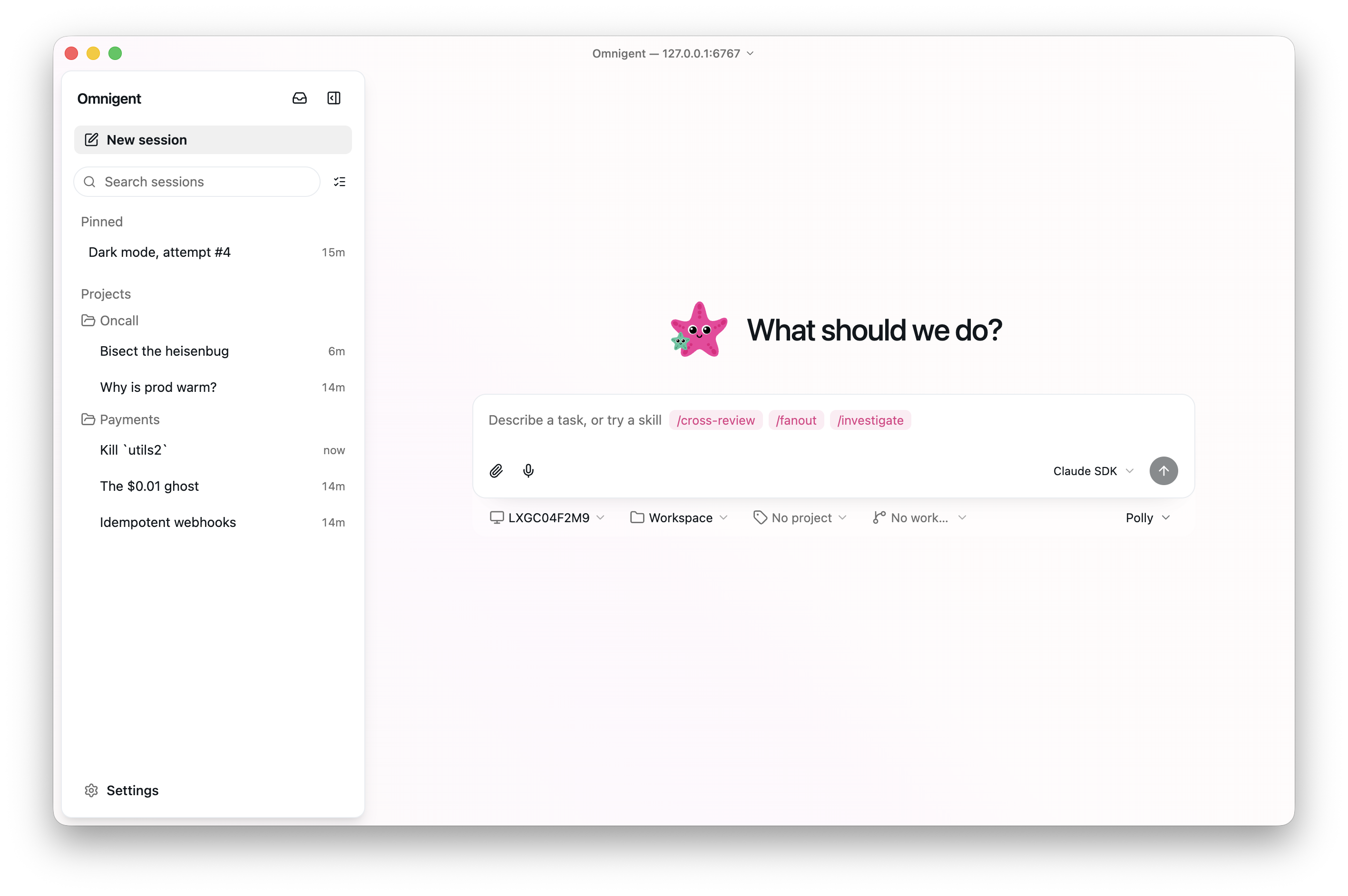
Omnigent is an open-source AI agent framework and meta-harness: orchestrate Claude Code, Codex, Cursor, Pi, and custom agents — swap harnesses without rewriting, enforce policies and sandboxing, and collaborate in real time from any device.

A theoretical reconstruction of the Claude Mythos architecture, built from first principles using the available research literature.
🕷️ An adaptive Web Scraping framework that handles everything from a single request to a full-scale crawl!