Table of Contents
MCP Server: code-to-tree
The code-to-tree server's goals are:
- Give LLMs the capability of accurately converting source code into
AST(Abstract Syntax Tree), regardless of language.
- One standalone binary should be everything the MCP client needs.
These goals imply:
- The underlying syntax parser should be versatile enough. Here we
choose tree-sitter, and languages are: C, C++, Rust, Ruby, Go, Java, Python.
- The server should be able to carry all capabilities within
itself, imposing minimum software dependencies on the end user's
machine. Here we choose mcpc.
Screenshots:
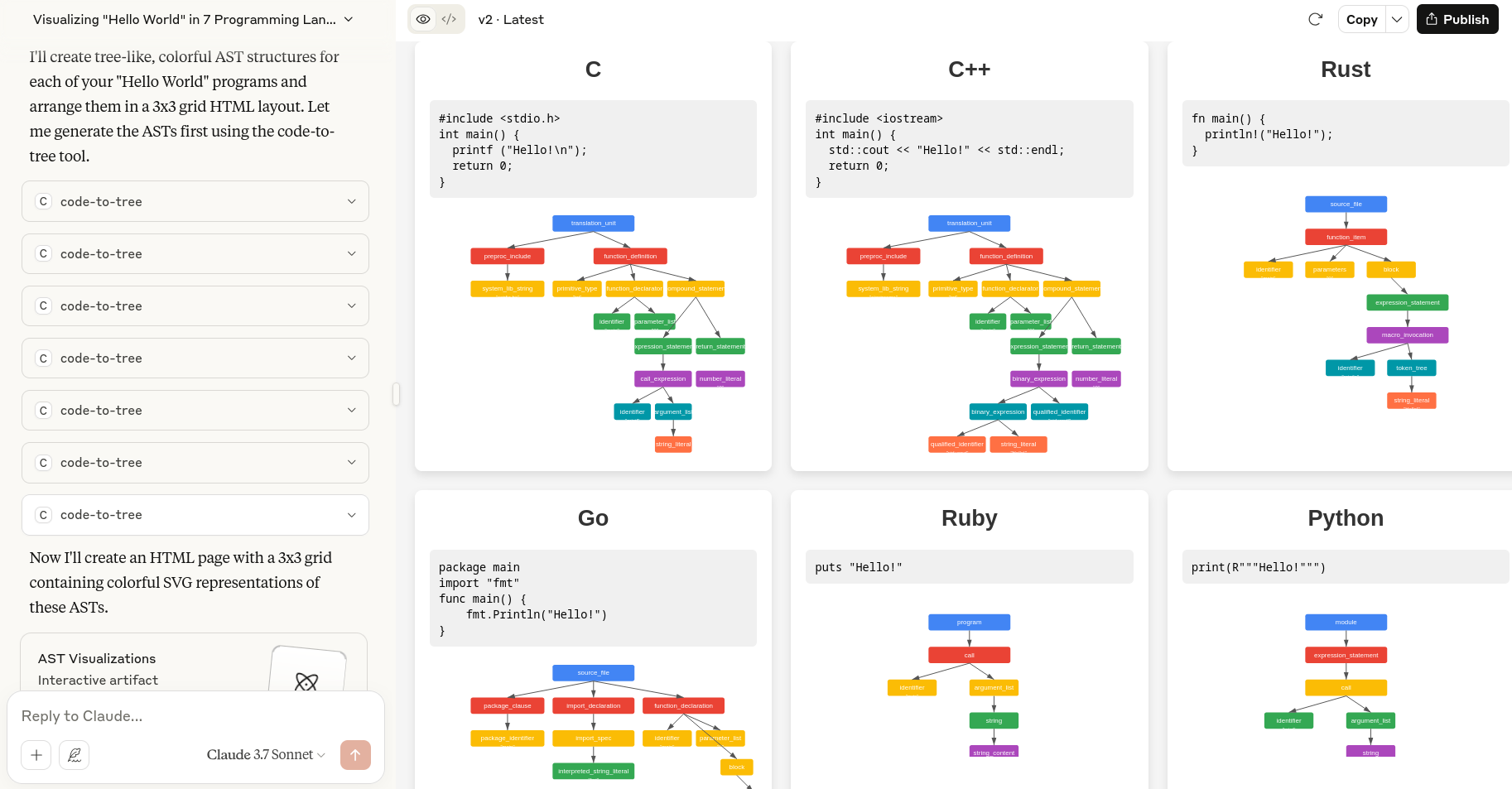
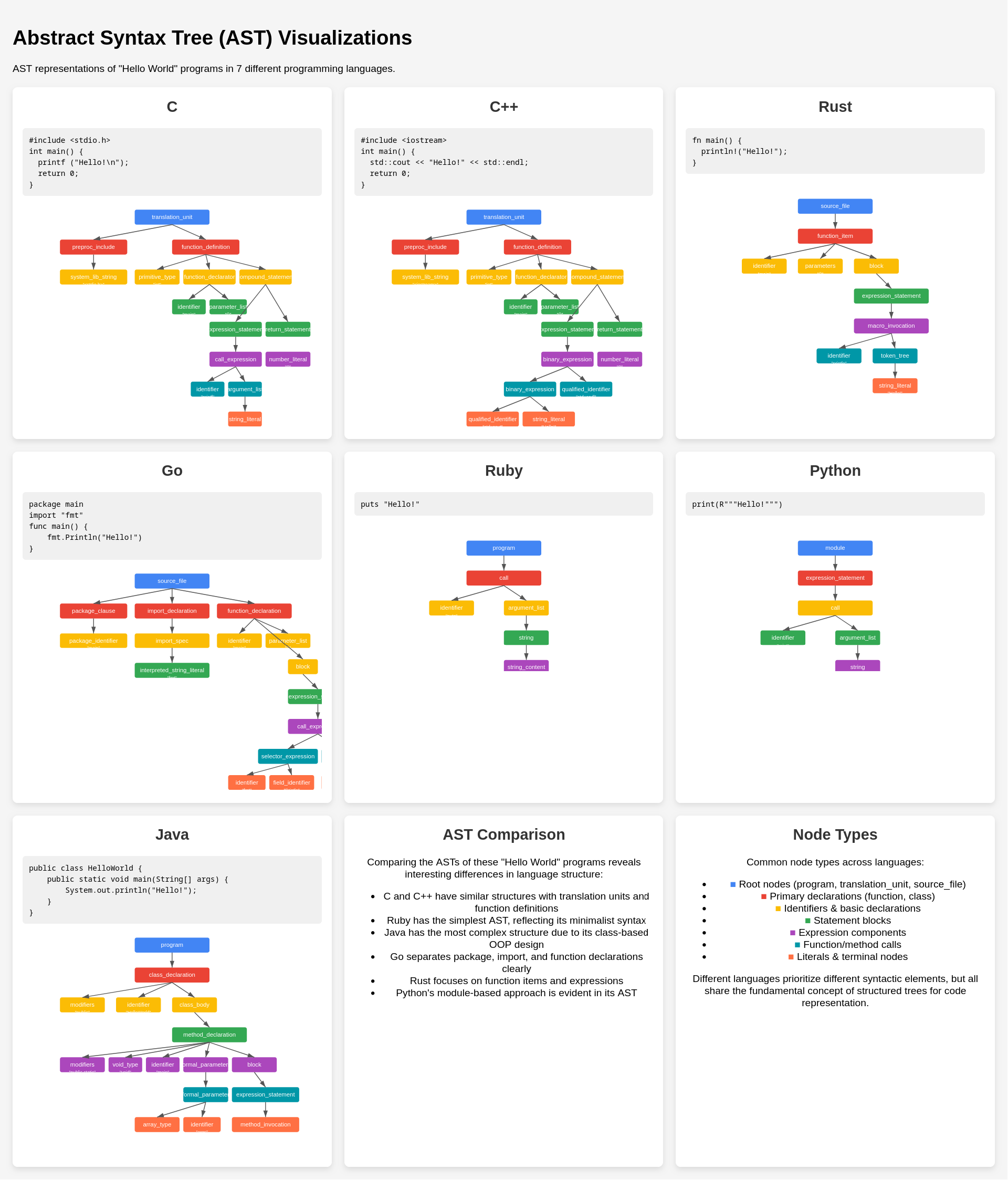
The above screenshots are obtained by asking the question specified
in q.md.
(IMPORTANT NOTE: LLMs have no responsibility of generating the identical
result for the same question, you will likely get a completely different
style or content. The screenshots or questions provided here are just for the reference)
Using code-to-tree
Before everthing, you need to have the code-to-tree executable on your
machine (code-to-tree.exe for Windows, code-to-tree for macOS),
you can download at GitHub release page or build it yourself. Once
downloaded, you configure your MCP clients to install it, check the section
"Configure MCP Clients" for more details.
Configure MCP Clients
Here we use Claude as the example.
Windows
In your Claude configuration
(C:\Users\YOUR_NAME\AppData\Roaming\Claude\claude_desktop_config.json),
specify the location of code-to-tree.exe:
{
    "mcpServers": {
	    "code-to-tree": { "command": "C:\\path\\to\\code-to-tree.exe" }
    }
}
macOS
In your Claude configuration,
(~/Library/Application Support/Claude/claude_desktop_config.json)
specify the location of code-to-tree
{
    "mcpServers": {
	    "code-to-tree": { "command": "/path/to/code-to-tree" }
    }
}
Building (Windows)
1. Prepare environment
- download & install MSYS2.
- open application "MSYS2 MINGW64"
- run
pacman -S make gcc git
2. Prepare tree-sitter libraries
Here we need to compile and install tree-sitter and all related grammars.
Clone them:
git clone https://github.com/tree-sitter/tree-sitter
git clone https://github.com/tree-sitter/tree-sitter-c
git clone https://github.com/tree-sitter/tree-sitter-cpp
git clone https://github.com/tree-sitter/tree-sitter-rust
git clone https://github.com/tree-sitter/tree-sitter-ruby
git clone https://github.com/tree-sitter/tree-sitter-go
git clone https://github.com/tree-sitter/tree-sitter-java
Compile and install them:
cd tree-sitter && OS=1 make install
cd tree-sitter-c && OS=1 make install
cd tree-sitter-cpp && OS=1 make install
cd tree-sitter-rust && OS=1 make install
cd tree-sitter-ruby && OS=1 make install
cd tree-sitter-go && OS=1 make install
cd tree-sitter-java && OS=1 make install
3. Build code-to-tree
Install mcpc:
git clone https://github.com/micl2e2/mcpc
cd mcpc && make install
Compile code-to-tree:
cd mcpc/example/code-to-tree
CFLAGS="-I/usr/local/include -L/usr/local/lib" make
# Check the binary
file code-to-tree.exe
# Remember the binary's location
pwd
# Assume the output is: /c/path/to/code-to-tree.exe
Building (macOS)
1. Prepare environment
- Xcode Command Line Tools
2. Prepare tree-sitter libraries
Here we need to compile and install tree-sitter and all related grammars.
Clone them:
git clone https://github.com/tree-sitter/tree-sitter
git clone https://github.com/tree-sitter/tree-sitter-c
git clone https://github.com/tree-sitter/tree-sitter-cpp
git clone https://github.com/tree-sitter/tree-sitter-rust
git clone https://github.com/tree-sitter/tree-sitter-ruby
git clone https://github.com/tree-sitter/tree-sitter-go
git clone https://github.com/tree-sitter/tree-sitter-java
Compile and install them:
cd tree-sitter && make install
cd tree-sitter-c && make install
cd tree-sitter-cpp && make install
cd tree-sitter-rust && make install
cd tree-sitter-ruby && make install
cd tree-sitter-go && make install
cd tree-sitter-java && make install
3. Build code-to-tree
Install mcpc:
git clone https://github.com/micl2e2/mcpc
cd mcpc && make install
Compile code-to-tree:
cd mcpc/example/code-to-tree

make

# Check the binary
file ./code-to-tree

# Remember the binary's location
pwd
# Assume the output is: /path/to/code-to-tree