

heygen-com/hyperframesFrameworks & SDKs
Write HTML. Render video. Built for agents.
49k
Meta Context Engineering is a Python framework that treats context engineering as something an agent can improve through training. It separates a meta agent that evolves skills from a base agent that uses those skills to build context for a task. The repo includes task environments, validation, orchestration code, and shell scripts for running the symptom diagnosis experiments. It is aimed at people exploring agent systems that adapt their own context strategy rather than following a fixed prompt pattern.
Builders who want to test agent systems that improve their own context strategy.
You can train an agent workflow that discovers better context representations and optimization steps instead of hand-coding them.
Uses a meta agent to evolve skills and a base agent to apply them during task runs.
Provides environment interfaces and example environments under `env/` for running experiments.
Builds context as files and code, with validation and evaluation around the loop.
Includes shell scripts for one-step, two-step, and agent-based symptom diagnosis runs.
Contains `mce/llm_client.py` and environment variables for OpenRouter, OpenAI, and Claude agent SDK use.
git clone https://github.com/metaevo-ai/meta-context-engineering
cd meta-context-engineering

# Download uv if not installed
curl -LsSf https://astral.sh/uv/install.sh | sh

# Install with uv
uv sync
cp .env.template .env
# Run training on the symptom diagnosis task
bash scripts/train_symptom_diagnosis.sh         # Optimize context for one-step inference
bash scripts/train_symptom_diagnosis_twostep.sh # Optimize context for a two-step workflow
bash scripts/train_symptom_diagnosis_agent.sh   # Optimize context for an agent
Superseding Static Harnesses with Learnable Skills for Context Optimization




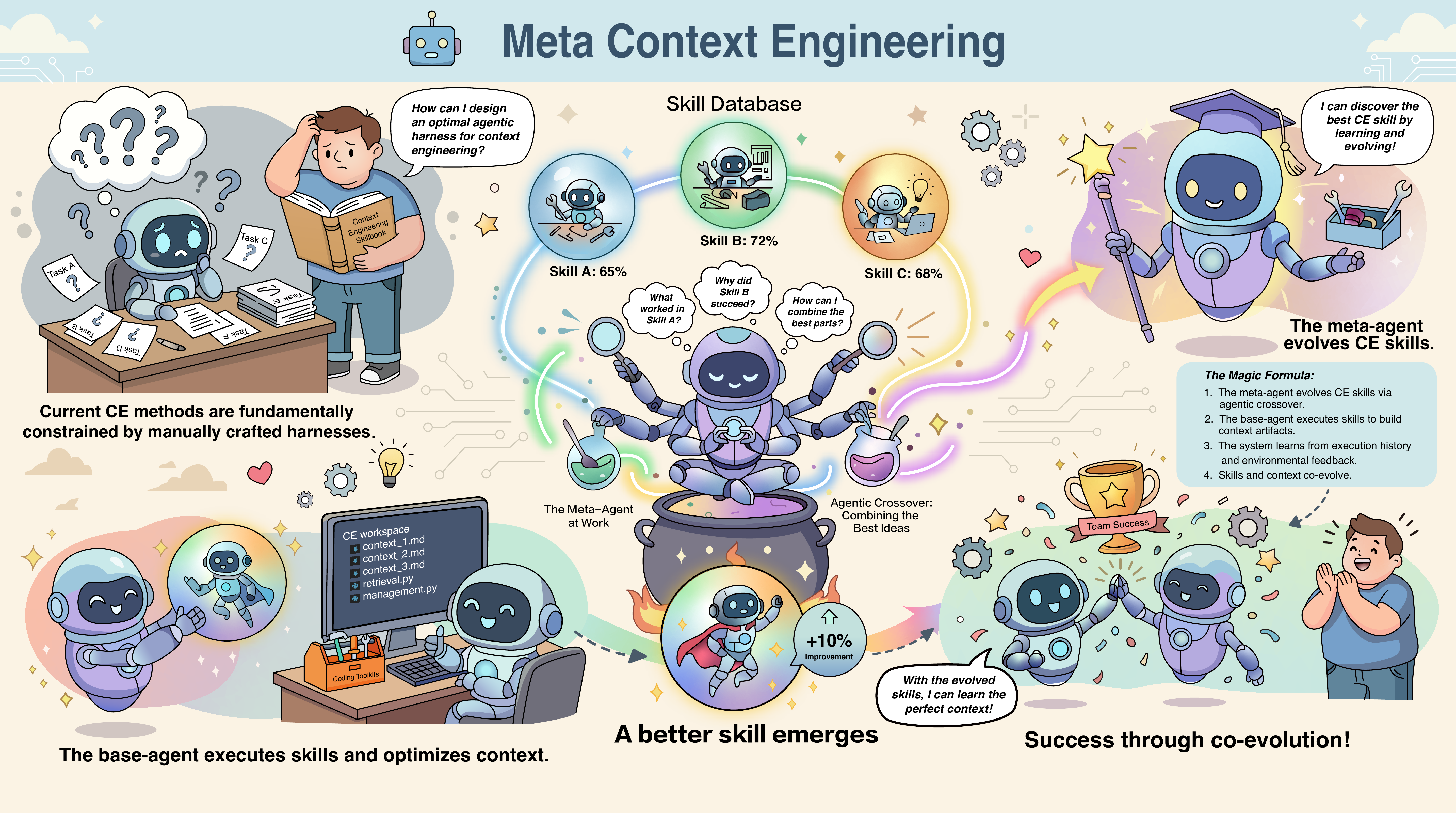
This repository accompanies the paper Meta Context Engineering via Agentic Skill Evolution. Meta Context Engineering (MCE) is a bi-level agentic framework that co-evolves context engineering skills and context artifacts, replacing rigid CE heuristics with learnable skills that automatically discover optimal context representations and optimization procedures.
MCE achieves consistent improvements across five diverse domains (finance, chemistry, medicine, law, AI safety):
| Setting | Metric | MCE | Best Baseline | Improvement |
|---|---|---|---|---|
| Offline | Avg. Relative Gain vs Base | 89.1% | 70.7% (ACE) | +18.4% |
| Online | Avg. Relative Gain vs Base | 74.1% | 41.1% (ACE) | +33.0% |
Efficiency gains:
Reproduce experiments: See mce-artifact for code and data used in our paper.
Current context engineering methods are fundamentally limited by manually crafted harnesses, for example:
MCE breaks free by treating the context engineering skill itself as a learnable object:
Traditional CE:  Fixed workflow → Optimized context
MCE:             Learnable skill + fully agentic CE → Optimized context function
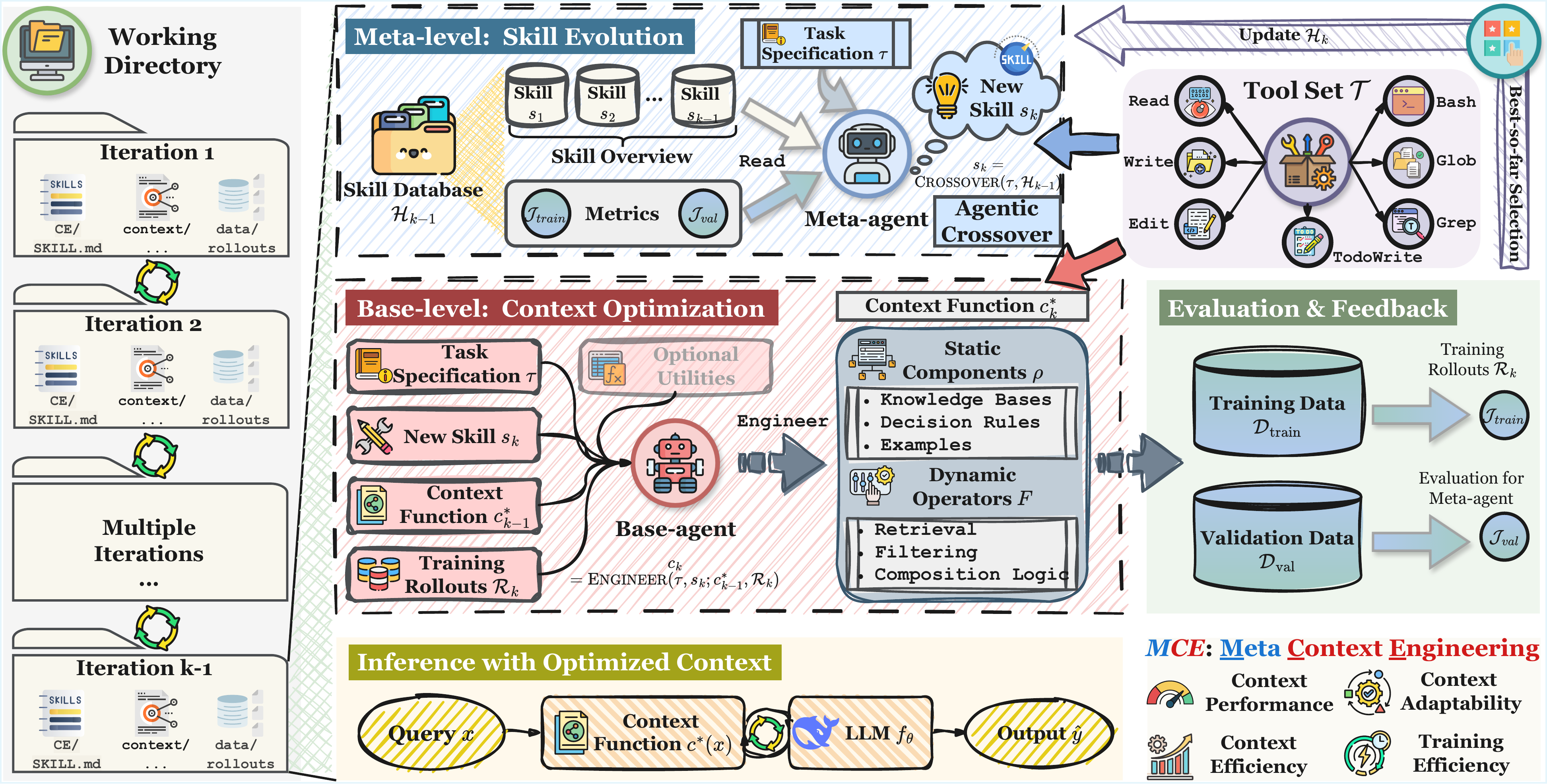
MCE formalizes context as a context function c(x) = (F_k ∘ ... ∘ F_1)(x; ρ):
Meta-Level (Agentic Skill Evolution):
Base-Level (Fully Agentic Context Optimization):
git clone https://github.com/metaevo-ai/meta-context-engineering
cd meta-context-engineering

# Download uv if not installed
curl -LsSf https://astral.sh/uv/install.sh | sh

# Install with uv
uv sync
Copy .env.template to .env and set your API keys:
cp .env.template .env
The system uses OpenRouter by default with automatic fallback to OpenAI:
# Option 1: OpenRouter (recommended)
export OPENROUTER_API_KEY="your-api-key"
export OPENROUTER_API_BASE="https://openrouter.ai/api/v1"

# Option 2: OpenAI (fallback if OpenRouter not set)
export OPENAI_API_KEY="your-api-key"
export OPENAI_API_BASE="https://api.openai.com/v1"  # Optional

# To use Claude agent SDK
export ANTHROPIC_API_KEY="your-anthropic-api-key"

# If you are using OpenRouter
export ANTHROPIC_BASE_URL=https://openrouter.ai/api
export ANTHROPIC_AUTH_TOKEN="$OPENROUTER_API_KEY"
export ANTHROPIC_API_KEY=""

# Set default models for Claude agent SDK
export ANTHROPIC_DEFAULT_SONNET_MODEL=
export ANTHROPIC_DEFAULT_OPUS_MODEL=
export ANTHROPIC_DEFAULT_HAIKU_MODEL=
# Run training on the symptom diagnosis task
bash scripts/train_symptom_diagnosis.sh         # Optimize context for one-step inference
bash scripts/train_symptom_diagnosis_twostep.sh # Optimize context for a two-step workflow
bash scripts/train_symptom_diagnosis_agent.sh   # Optimize context for an agent
Example Results: Boost DeepSeek V3.1 performance from 45% to 70% accuracy with only 100 training rollouts on symptom diagnosis!
meta-context-engineering/
├── env/                        # Task environments
│   ├── base.py                 # InterfaceSignature, TaskEnvironment
│   ├── registry.py             # Environment registry
│   ├── TUTORIAL.md             # Guide for adding new environments
│   └── symptom_diagnosis*/     # Example environments
├── mce/                        # Core framework
│   ├── main.py                 # Training orchestration
│   ├── meta_agent.py           # Meta-level: skill evolution
│   ├── base_agent.py           # Base-level: context optimization
│   └── validation.py           # Interface validation
├── scripts/                    # Training & evaluation scripts
└── assets/                     # Paper and figures
See env/TUTORIAL.md for a comprehensive guide on creating custom task environments.
Quick steps:
TaskEnvironment subclassenv/registry.pyuv run python -m mce.main \
--workspace "workspace/my_task" # Output directory
--env "my_task" # Environment name
--train-data "path/to/train.jsonl" # Training data
--val-data "path/to/val.jsonl" # Validation data
--model "deepseek/deepseek-chat-v3.1" # Inference LLM
--iterations 3 # Meta-iterations
--train-limit 50 # Training samples
--val-limit 20 # Validation samples
If you find this work useful, please kindly give it a star and cite:
@misc{ye2026mce,
    title={Meta Context Engineering via Agentic Skill Evolution},
    author={Haoran Ye and Xuning He and Vincent Arak and Haonan Dong and Guojie Song},
    year={2026},
    eprint={2601.21557},
    archivePrefix={arXiv},
    primaryClass={cs.AI},
    url={https://arxiv.org/abs/2601.21557},
    note={Code available at \url{https://github.com/metaevo-ai/meta-context-engineering}},
}
MIT License
Sign in to join the discussion.
No comments yet. Be the first to say what this is good for.
Write HTML. Render video. Built for agents.
Ultra-lightweight, open-source, self-hosted personal AI agent framework in Python with WebUI, tools, memory, MCP, multi-agent workflows, automation, and chat apps

SkillOpt is a text-space optimizer that trains reusable natural-language skills for frozen LLM agents through trajectory-driven edits, validation-gated updates, and deployable best_skill.md artifacts.
Omnigent is an open-source AI agent framework and meta-harness: orchestrate Claude Code, Codex, Cursor, Pi, and custom agents — swap harnesses without rewriting, enforce policies and sandboxing, and collaborate in real time from any device.

A theoretical reconstruction of the Claude Mythos architecture, built from first principles using the available research literature.
🕷️ An adaptive Web Scraping framework that handles everything from a single request to a full-scale crawl!