

koala73/worldmonitorConnectors
Real-time global intelligence dashboard. AI-powered news aggregation, geopolitical monitoring, and infrastructure tracking in a unified situational awareness interface
86k
VoiceMode adds natural voice conversations to Claude Code and other MCP-capable agents. It combines a Claude Code plugin with an MCP server and local voice services so you can speak, listen, and keep working without typing.
Builders who want to use Claude Code or another MCP agent hands-free while working, walking, or cooking.
You can talk to your agent by voice and keep the same workflow whether you use local speech services or cloud fallback.
Ships a marketplace plugin and Claude commands for installing and starting VoiceMode from inside Claude Code.
Provides an MCP launcher so agents can reach the VoiceMode service through standard MCP connection flows.
Supports Whisper.cpp for speech-to-text and Kokoro for text-to-speech when you want an offline path.
Handles listening, silence detection, transcription, and spoken responses for natural back-and-forth chat.
Includes Claude settings examples and guides for API keys, permissions, and service options.
sudo apt update
sudo apt install -y ffmpeg gcc libasound2-dev libasound2-plugins libportaudio2 portaudio19-dev pulseaudio pulseaudio-utils python3-dev
sudo dnf install alsa-lib-devel ffmpeg gcc portaudio portaudio-devel python3-devel
brew install ffmpeg node portaudio
# Use development shell
nix develop github:mbailey/voicemode

# Or install system-wide
nix profile install github:mbailey/voicemode
git clone https://github.com/mbailey/voicemode.git
cd voicemode
uv tool install -e .
Natural voice conversations with Claude Code (and other MCP capable agents)


VoiceMode enables natural voice conversations with Claude Code. Voice isn't about replacing typing - it's about being available when typing isn't.
Perfect for:

Requirements: Computer with microphone and speakers
The fastest way for Claude Code users to get started:
# Add the VoiceMode marketplace
claude plugin marketplace add mbailey/voicemode

# Install VoiceMode plugin
claude plugin install voicemode@voicemode

## Install dependencies (CLI, Local Voice Services)

/voicemode:install

# Start talking!
/voicemode:converse
Installs dependencies and the VoiceMode Python package.
# Install UV package manager (if needed)
curl -LsSf https://astral.sh/uv/install.sh | sh

# Run the installer (sets up dependencies and local voice services)
uvx voice-mode-install

# Add to Claude Code
claude mcp add --scope user voicemode -- uvx --refresh --from voice-mode voicemode-mcp-launcher

# Optional: Add OpenAI API key as fallback for local services
export OPENAI_API_KEY=your-openai-key

# Start a conversation
claude converse
For manual setup, see the Getting Started Guide.
Platforms: Linux, macOS, Windows (native or WSL), NixOS Python: 3.10-3.14
VoiceMode works out of the box. For customization:
# Set OpenAI API key (if using cloud services)
export OPENAI_API_KEY="your-key"

# Or configure via file
voicemode config edit
See the Configuration Guide for all options.
To use VoiceMode without permission prompts, add to ~/.claude/settings.json:
{
  "permissions": {
    "allow": [
      "mcp__voicemode__converse",
      "mcp__voicemode__service"
    ]
  }
}
See the Permissions Guide for more options.
For privacy or offline use, install local speech services:
These provide the same API as OpenAI, so VoiceMode switches seamlessly between them.
sudo apt update
sudo apt install -y ffmpeg gcc libasound2-dev libasound2-plugins libportaudio2 portaudio19-dev pulseaudio pulseaudio-utils python3-dev
WSL2 users: The pulseaudio packages above are required for microphone access.
sudo dnf install alsa-lib-devel ffmpeg gcc portaudio portaudio-devel python3-devel
brew install ffmpeg node portaudio
# Use development shell
nix develop github:mbailey/voicemode

# Or install system-wide
nix profile install github:mbailey/voicemode
git clone https://github.com/mbailey/voicemode.git
cd voicemode
uv tool install -e .
# In /etc/nixos/configuration.nix
environment.systemPackages = [
  (builtins.getFlake "github:mbailey/voicemode").packages.${pkgs.system}.default
];
| Problem | Solution |
|---|---|
| No microphone access | Check terminal/app permissions. WSL2 needs pulseaudio packages. |
| UV not found | Run curl -LsSf https://astral.sh/uv/install.sh | sh |
| OpenAI API error | Verify OPENAI_API_KEY is set correctly |
| No audio output | Check system audio settings and available devices |
export VOICEMODE_SAVE_AUDIO=true
# Files saved to ~/.voicemode/audio/YYYY/MM/
Full documentation: voicemode.dev

MIT - A Failmode Project
mcp-name: dev.voicemode/voicemode
Sign in to join the discussion.
No comments yet. Be the first to say what this is good for.
Real-time global intelligence dashboard. AI-powered news aggregation, geopolitical monitoring, and infrastructure tracking in a unified situational awareness interface
High-performance code intelligence MCP server. Indexes codebases into a persistent knowledge graph — average repo in milliseconds. 158 languages, sub-ms queries, 99% fewer tokens. Single static binary, zero dependencies.
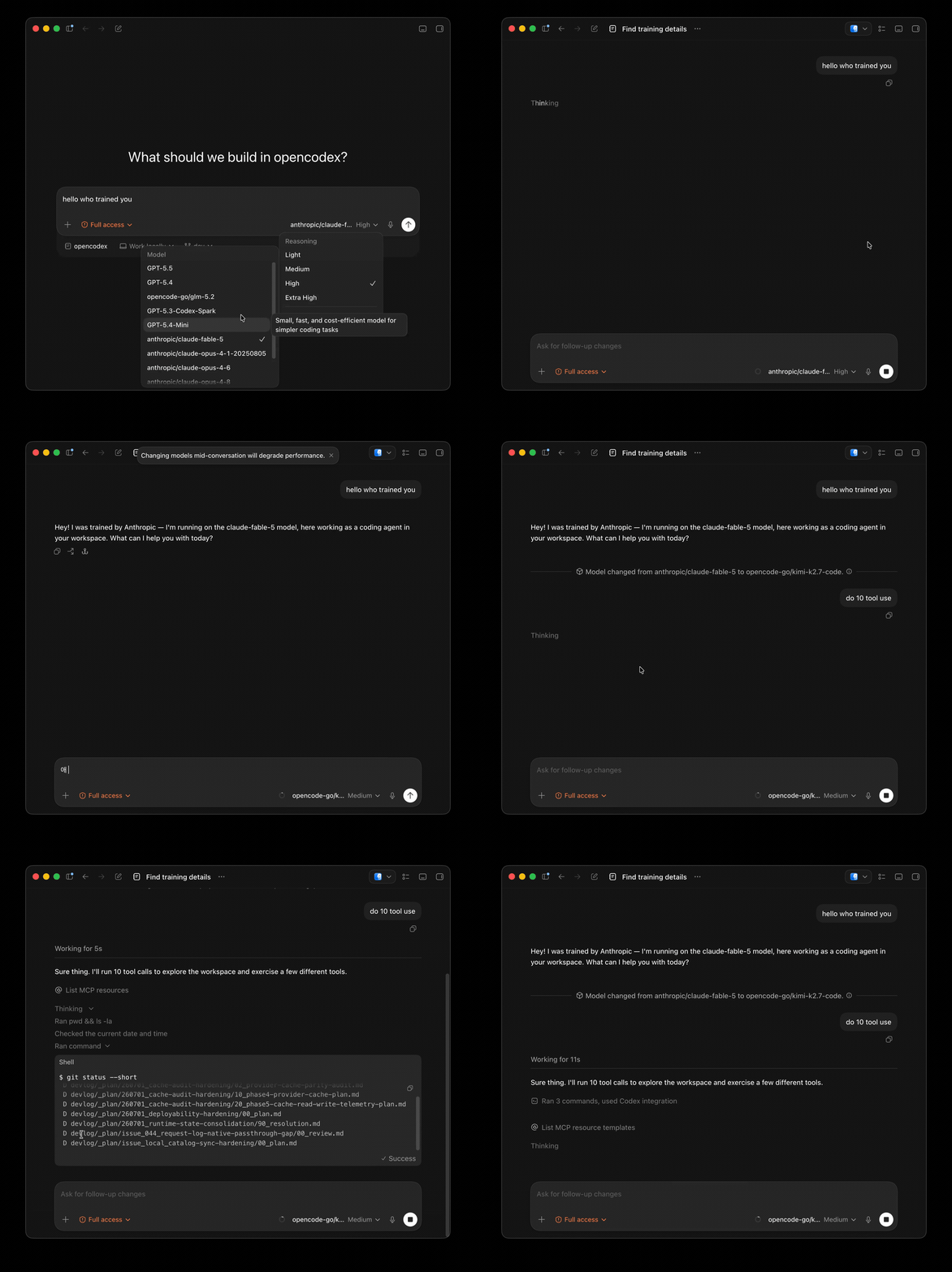
Universal provider proxy for OpenAI Codex & Claude Code — use any LLM (Claude, Gemini, Grok, DeepSeek, Ollama…) with Codex CLI, App, SDK, and Claude Code

Git-native persistent memory for AI coding agents. Implements Google OKF v0.2 with sub-300µs in-memory BM25 search, embedded MCP server, and progressive disclosure. Slashes token bloat by 80% with zero external databases or dependencies. Built in pure Go.

Local-first code intelligence graph for MCP and CLI. Builds a persistent map of your codebase so AI coding tools read only what matters, with benchmarked context reductions on reviews and large-repo workflows.

Stop your AI from making things up — it proposes, deterministic tools decide, every claim checked against ground truth with evidence. Grounded facts and context survive resets. Reverse engineering is the proving ground. MCP server + CLI.