Bifrost AI Gateway







The fastest way to build AI applications that never go down
Bifrost is a high-performance AI gateway that unifies access to 23+ providers (OpenAI, Anthropic, AWS Bedrock, Google Vertex, and more) through a single OpenAI-compatible API. Deploy in seconds with zero configuration and get automatic failover, load balancing, semantic caching, and enterprise-grade features.
Quick Start
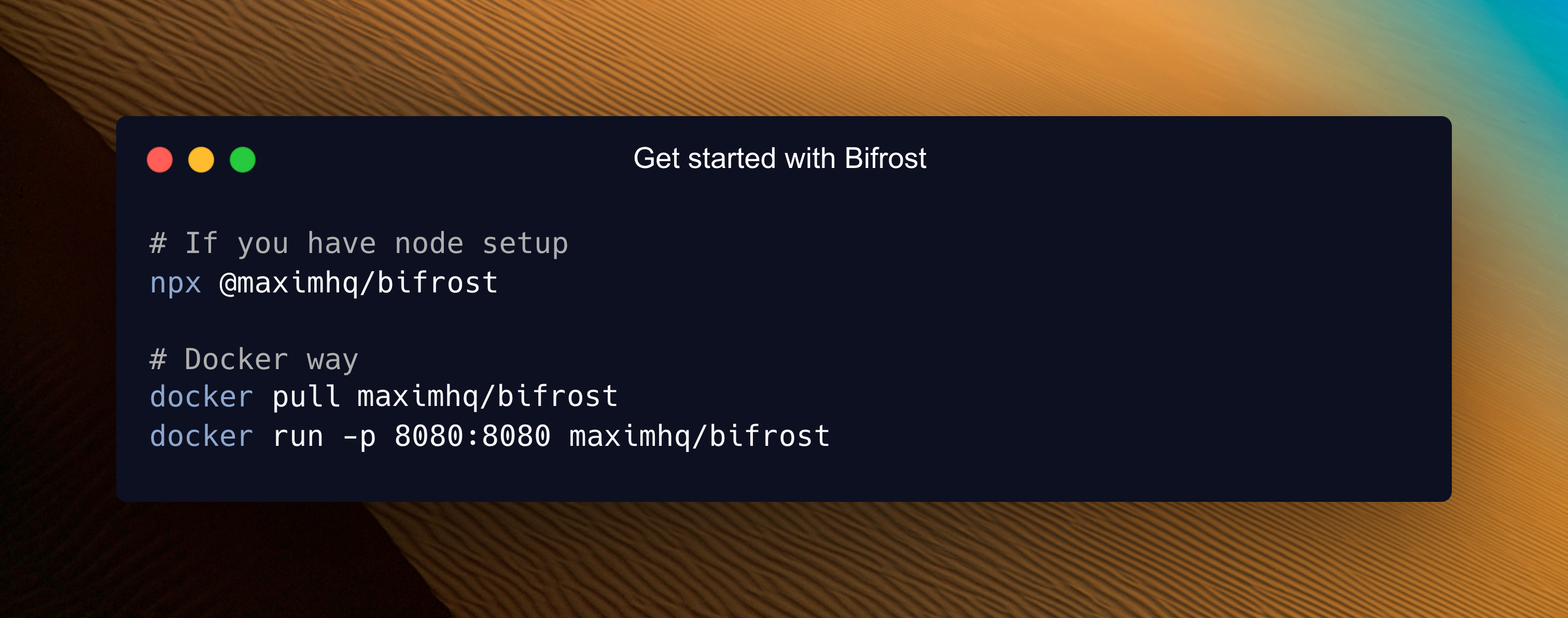
Go from zero to production-ready AI gateway in under a minute.
Step 1: Start Bifrost Gateway
# Install and run locally
npx -y @maximhq/bifrost

# Or use Docker
docker run -p 8080:8080 maximhq/bifrost
Step 2: Configure via Web UI
# Open the built-in web interface
open http://localhost:8080
Step 3: Make your first API call
curl -X POST http://localhost:8080/v1/chat/completions \
  -H "Content-Type: application/json" \
  -d '{
    "model": "openai/gpt-4o-mini",
    "messages": [{"role": "user", "content": "Hello, Bifrost!"}]
  }'
That's it! Your AI gateway is running with a web interface for visual configuration, real-time monitoring, and analytics.
Complete Setup Guides:
Enterprise Deployments
Bifrost supports enterprise-grade, private deployments for teams running production AI systems at scale.
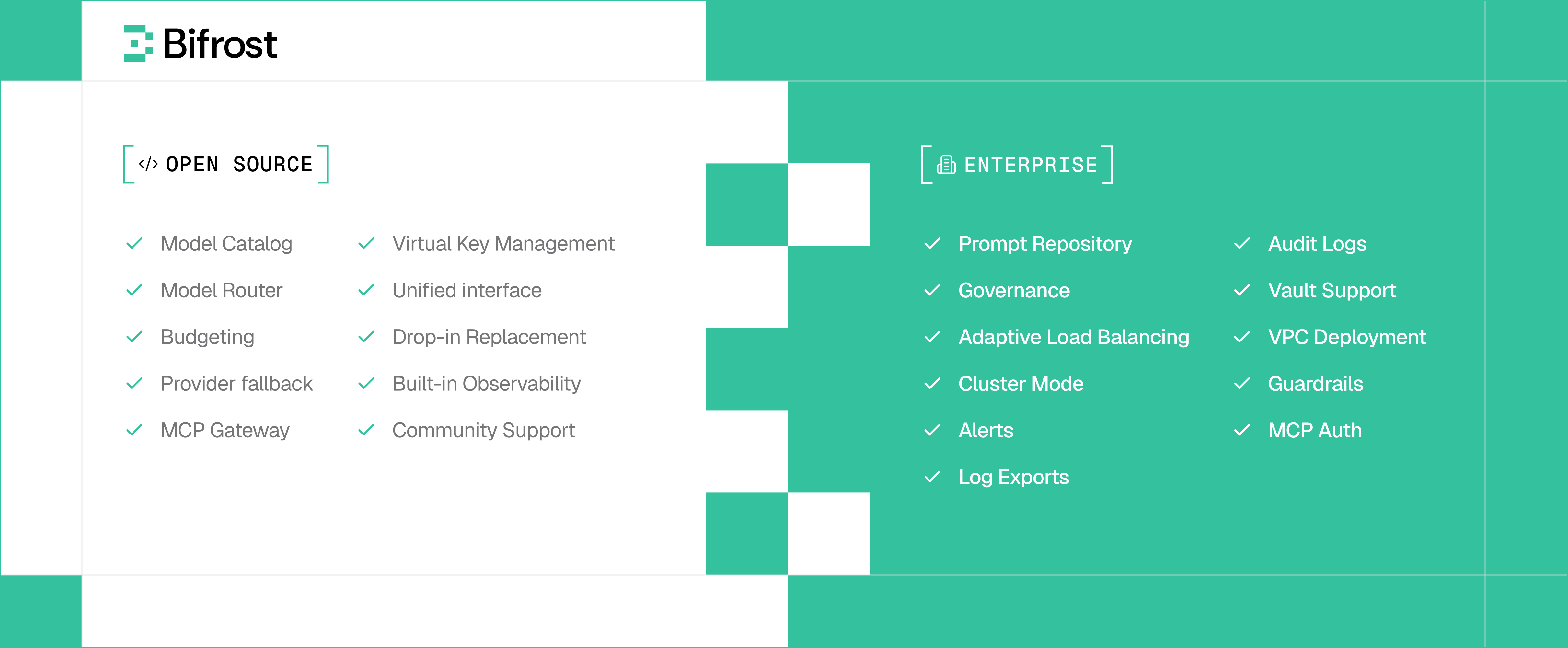
In addition to private networking, custom security controls, and governance, enterprise deployments unlock advanced capabilities including adaptive load balancing, clustering, guardrails, MCP gateway, and other features designed for enterprise-grade scale and reliability.
Key Features
Core Infrastructure
- Unified Interface - Single OpenAI-compatible API for all providers
- Multi-Provider Support - OpenAI, Anthropic, AWS Bedrock, Google Vertex, Azure, Cerebras, Cohere, Mistral, Ollama, Groq, and more
- Automatic Fallbacks - Seamless failover between providers and models with zero downtime
- Load Balancing - Intelligent request distribution across multiple API keys and providers
Advanced Features
- Model Context Protocol (MCP) - Enable AI models to use external tools (filesystem, web search, databases)
- Semantic Caching - Intelligent response caching based on semantic similarity to reduce costs and latency
- Multimodal Support - Support for text, images, audio, and streaming, all behind a common interface.
- Custom Plugins - Extensible middleware architecture for analytics, monitoring, and custom logic
- Governance - Usage tracking, rate limiting, and fine-grained access control
Enterprise & Security
- Budget Management - Hierarchical cost control with virtual keys, teams, and customer budgets
- User Provisioning (OIDC) - OAuth 2.0 / OIDC login with background directory sync for teams, roles, and business units
- Observability - Native Prometheus metrics, distributed tracing, and comprehensive logging
- Secrets Management - Secure API key management with environment variables and deployment secrets
Developer Experience
Repository Structure
Bifrost uses a modular architecture for maximum flexibility:
bifrost/
├── npx/ # NPX script for easy installation
├── core/ # Core functionality and shared components
│ ├── providers/ # Provider-specific implementations (OpenAI, Anthropic, etc.)
│ ├── schemas/ # Interfaces and structs used throughout Bifrost
│ └── bifrost.go # Main Bifrost implementation
├── framework/ # Framework components for data persistence
│ ├── configstore/ # Configuration storage backends
│ ├── logstore/ # Request logging storage backends
│ └── vectorstore/ # Vector storages
├── transports/ # HTTP gateway and other interface layers
│ └── bifrost-http/ # HTTP transport implementation
├── ui/ # Web interface for HTTP gateway
├── plugins/ # Extensible plugin system
│ ├── governance/ # Budget management and access control
│ ├── jsonparser/ # JSON parsing and manipulation utilities
│ ├── logging/ # Request logging and analytics
│ ├── maxim/ # Maxim's observability integration
│ ├── mocker/ # Mock responses for testing and development
│ ├── semanticcache/ # Intelligent response caching
│ └── telemetry/ # Monitoring and observability
├── docs/ # Documentation and guides
└── tests/ # Comprehensive test suites
Getting Started Options
Choose the deployment method that fits your needs:
1. Gateway (HTTP API)
Best for: Language-agnostic integration, microservices, and production deployments
# NPX - Get started in 30 seconds
npx -y @maximhq/bifrost

# Docker - Production ready
docker run -p 8080:8080 -v $(pwd)/data:/app/data maximhq/bifrost
Features: Web UI, real-time monitoring, multi-provider management, zero-config startup
Learn More: Gateway Setup Guide
2. Go SDK
Best for: Direct Go integration with maximum performance and control
go get github.com/maximhq/bifrost/core
Features: Native Go APIs, embedded deployment, custom middleware integration
Learn More: Go SDK Guide
3. Drop-in Replacement
Best for: Migrating existing applications with zero code changes
# OpenAI SDK
- base_url = "https://api.openai.com"
+ base_url = "http://localhost:8080/openai"

# Anthropic SDK
- base_url = "https://api.anthropic.com"
+ base_url = "http://localhost:8080/anthropic"

# Google GenAI SDK
- api_endpoint = "https://generativelanguage.googleapis.com"
+ api_endpoint = "http://localhost:8080/genai"
Learn More: Integration Guides
Performance
Bifrost adds virtually zero overhead to your AI requests. In sustained 5,000 RPS benchmarks, the gateway added only 11 µs of overhead per request.
| Metric | t3.medium | t3.xlarge | Improvement |
|---|
| Added latency (Bifrost overhead) | 59 µs | 11 µs | -81% |
| Success rate @ 5k RPS | 100% | 100% | No failed requests |
| Avg. queue wait time | 47 µs | 1.67 µs | -96% |
| Avg. request latency (incl. provider) | 2.12 s | 1.61 s | -24% |
Key Performance Highlights:
- Perfect Success Rate - 100% request success rate even at 5k RPS
- Minimal Overhead - Less than 15 µs additional latency per request
- Efficient Queuing - Sub-microsecond average wait times
- Fast Key Selection - ~10 ns to pick weighted API keys
Complete Benchmarks: Performance Analysis
Documentation
Complete Documentation: https://docs.getbifrost.ai
Quick Start
Features
Integrations
Enterprise
Need Help?
Join our Discord for community support and discussions.
Get help with:
- Quick setup assistance and troubleshooting
- Best practices and configuration tips
- Community discussions and support
- Real-time help with integrations
Contributing
We welcome contributions of all kinds! See our Contributing Guide for:
- Setting up the development environment
- Code conventions and best practices
- How to submit pull requests
- Building and testing locally
For development requirements and build instructions, see our Development Setup Guide.
License
This project is licensed under the Apache 2.0 License - see the LICENSE file for details.
Built with ❤️ by Maxim