
koala73/worldmonitorConnectors
Real-time global intelligence dashboard. AI-powered news aggregation, geopolitical monitoring, and infrastructure tracking in a unified situational awareness interface
86k
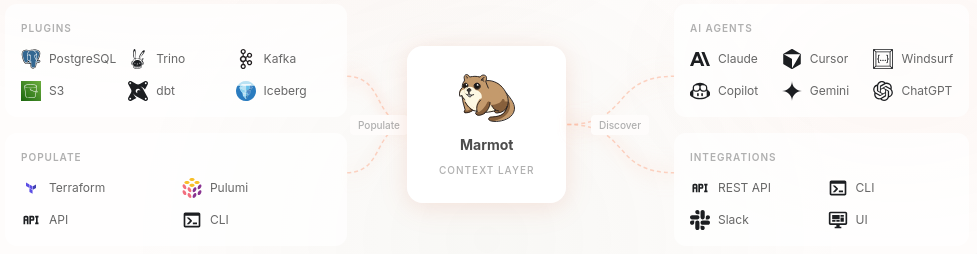
Marmot is a data catalog that turns tables, topics, queues, APIs, and dashboards into context that agents can read. It exposes that context through MCP, plus an API and UI, so agents can work from real metadata instead of partial guesses.
Builders who want their agents to inspect data assets, lineage, and ownership before they act.
You can give your agent certified metadata about your data stack instead of re-explaining the same context in every session.
Find data assets with full-text search, structured queries, boolean logic, and metadata filters.
Trace data flow from source to destination and check impact before making changes.
Store context for tables, topics, queues, APIs, and dashboards in one place.
Assign ownership, add business context, and maintain shared glossaries.
Expose catalog context to AI agents through MCP, the API, and the UI.
Extend the catalog with plugins for systems like BigQuery, Kafka, Postgres, OpenAPI, and many more.

Discover any data asset in seconds. Then let your AI do the same.
The open-source context layer for your AI. Catalog your tables, topics, queues and APIs then expose real metadata to your AI agents.
Marmot is an open-source data catalog for teams who want powerful data discovery without enterprise complexity. Catalog every data asset, enrich it with the context that matters and make it accessible to your team and your AI tools.
Unlike traditional catalogs that require extensive infrastructure and configuration, Marmot ships as a single binary with an intuitive UI, making it easy to deploy and start cataloging in minutes.
New to Marmot? Follow the Deploy documentation for a guided setup.
See Local Development for how to get started developing locally.
Join our Discord community for help, feedback and updates on new features.
All types of contributions are encouraged and valued!
Before contributing, please check out the Contributing Guide.
Marmot is an open-source data catalog for teams who want powerful data discovery without enterprise complexity. It catalogs every data asset (tables, topics, queues, APIs), enriches it with context, and makes it accessible to both your team and AI tools. Unlike traditional catalogs requiring extensive infrastructure, Marmot ships as a single binary with an intuitive UI.
| Feature | Benefit |
|---|---|
| Search Everything | Find any data asset in seconds with full-text search, structured queries, boolean logic, and metadata filters |
| Interactive Lineage | Trace data flows from source to destination, analyze impact before making changes |
| Metadata-First | Store rich metadata for any asset type (tables, topics, APIs, dashboards) |
| Team Collaboration | Assign ownership, document business context, maintain shared glossaries |
| AI-Ready | Expose certified context through MCP, API, and UI |
| Single Binary | No complex infrastructure required, deploy in minutes |
Marmot exposes certified context through MCP (Model Context Protocol), enabling AI agents to query real metadata about your data assets. This allows AI tools to understand your data landscape, trace lineage, and make informed decisions based on actual metadata rather than guessing.
Marmot supports cataloging various data asset types through its plugin system:
Quick Start Options:
| Method | Description |
|---|---|
| Documentation Guide | Follow the Deploy guide for step-by-step setup |
| Single Binary | Download and run the single binary for your platform |
Yes! Marmot is open-source software licensed under the MIT License. You can use, modify, and distribute it freely. Self-hosting is completely free with no licensing costs.
All contributions are welcome:
| Resource | Link |
|---|---|
| Documentation | marmotdata.io/docs |
| Discord Community | Join Discord |
| GitHub Issues | Report issues |
Marmot is open-source software licensed under the MIT License.
Sign in to join the discussion.
No comments yet. Be the first to say what this is good for.
Real-time global intelligence dashboard. AI-powered news aggregation, geopolitical monitoring, and infrastructure tracking in a unified situational awareness interface
High-performance code intelligence MCP server. Indexes codebases into a persistent knowledge graph — average repo in milliseconds. 158 languages, sub-ms queries, 99% fewer tokens. Single static binary, zero dependencies.
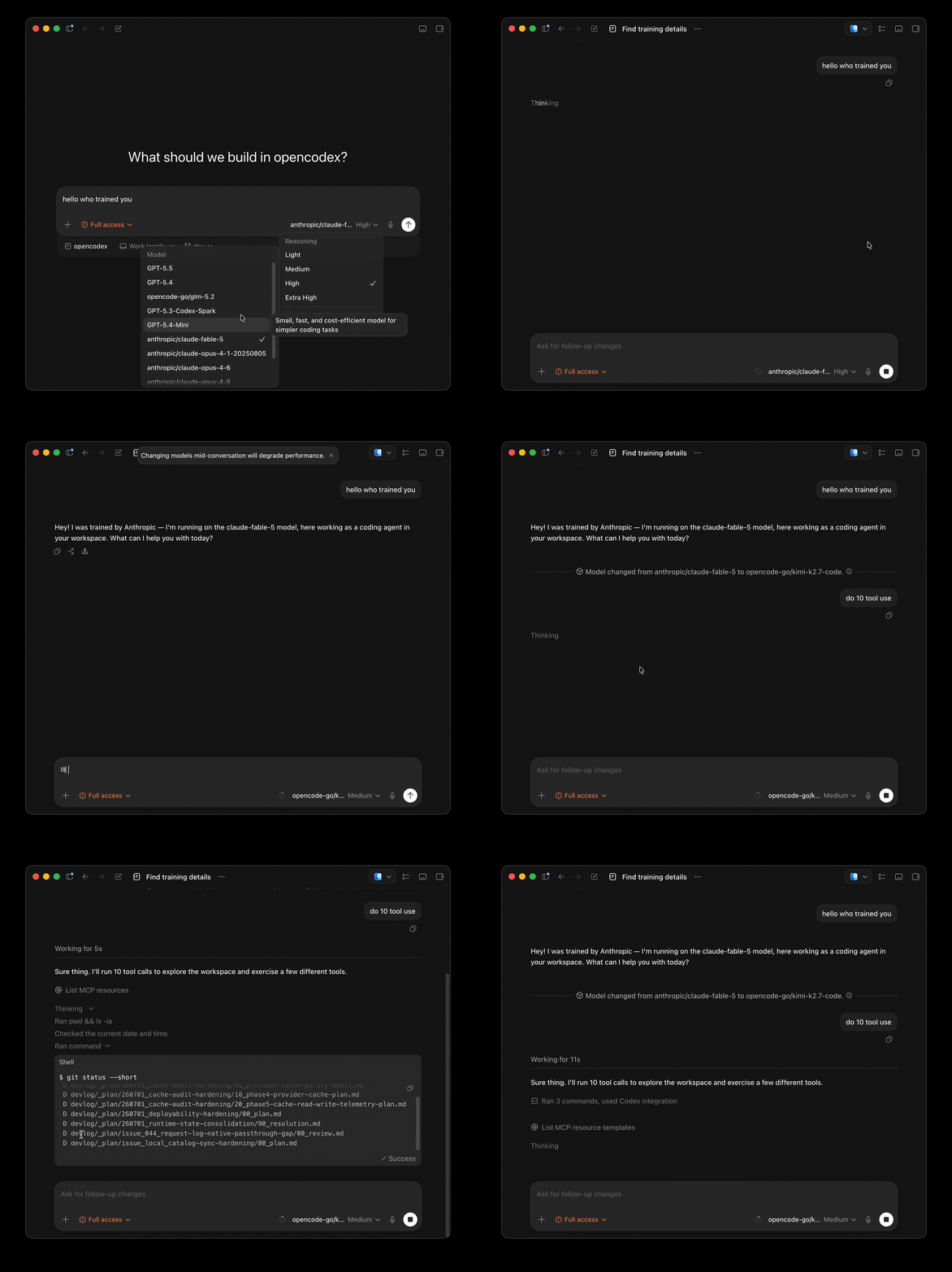
Universal provider proxy for OpenAI Codex & Claude Code — use any LLM (Claude, Gemini, Grok, DeepSeek, Ollama…) with Codex CLI, App, SDK, and Claude Code

Git-native persistent memory for AI coding agents. Implements Google OKF v0.2 with sub-300µs in-memory BM25 search, embedded MCP server, and progressive disclosure. Slashes token bloat by 80% with zero external databases or dependencies. Built in pure Go.

Stop your AI from making things up — it proposes, deterministic tools decide, every claim checked against ground truth with evidence. Grounded facts and context survive resets. Reverse engineering is the proving ground. MCP server + CLI.
20 MB lightweight cross-platform database client for 90+ databases, including MySQL, PostgreSQL, SQLite, Redis, MongoDB, DuckDB, SQL Server, and Dameng. Built-in AI, MCP Server, CLI, desktop and Docker. | 轻量级跨平台数据库管理工具,支持 MySQL、PostgreSQL、SQLite、Redis、MongoDB、达梦等 90+ 数据库,提供桌面端、Docker、CLI、内置 AI 助手和 MCP Server。