
koala73/worldmonitorConnectors
Real-time global intelligence dashboard. AI-powered news aggregation, geopolitical monitoring, and infrastructure tracking in a unified situational awareness interface
86k
rtfmbro-mcp connects coding agents to package documentation fetched from GitHub at the exact version your project uses. It works through MCP tools that return README files, documentation trees, file contents, and repository search results. The repo also provides project instruction files for Claude Code, Copilot, and Cursor so the agent knows when to use it.
Builders who want their agent to fetch the right package docs from the package version they are actually using.
You can ask your agent for current, version-matched docs instead of relying on stale training data or guessing from source files.
Returns the README for a specific package, version, and ecosystem with `get_readme`.
Lists the documentation folders and files in a package repo with `get_documentation_tree`.
Reads selected docs files, with optional line ranges, through `read_files`.
Searches GitHub repositories from the MCP server with `search_github_repositories`.
Includes `CLAUDE.md`, `.github/copilot-instructions.md`, and `.cursor/rules` for project-level guidance.
claude mcp add-json rtfmbro '{ "type": "http", "url": "https://rtfmbro.smolosoft.dev/mcp/" }'rtfmbro provides always-up-to-date, version-specific package documentation as context for coding agents. An alternative to context7.
https://github.com/user-attachments/assets/dbe0b3b4-a42c-4e91-8bcd-a94d430ef0b8
Demonstration of rtfmbro in use, fetching a specific version (3.1.1) of Flask's readme and docs.
rtfmbro is a Model Context Protocol (MCP) server that provides real-time, version-aware documentation fetching for packages across multiple ecosystems. It bridges the gap between AI agents and accurate, up-to-date package documentation by fetching docs directly from GitHub repositories at the exact version your project uses.
| Ecosystem | Registry | Status |
|---|---|---|
| Python | PyPI | ✅ Full Support |
| Node.js | npm | ✅ Full Support |
| Swift | SPM | 🚧 Alpha |
| GitHub | Direct | ⚠️ Fallback |
node_modules etc. lacks high-level documentation, browsing it is usually token-consuming and inefficientrtfmbro tries to solve these issues by:
.md, .mdx, .txt, .rst, .html) from the repositoryThe server exposes four primary tools to AI agents:
| Tool | Purpose | Parameters | Returns |
|---|---|---|---|
get_readme | Fetches and returns the README file for a specific package version | package, version, ecosystem | README content as string |
get_documentation_tree | Generates a comprehensive folder structure of all documentation files | package, version, ecosystem | Tree structure as string |
read_files | Reads specific documentation files with optional line range slicing | package, version, ecosystem, requests[] | Dictionary mapping paths to content |
search_github_repositories | Searches for GitHub repositories using the GitHub Search API | query, sort, order, per_page | Formatted repository search results |
claude mcp add-json rtfmbro '{ "type": "http", "url": "https://rtfmbro.smolosoft.dev/mcp/" }'
Add the remote server to your MCP configuration:
{
  "rtfmbro": {
    "type": "http",
    "url": "https://rtfmbro.smolosoft.dev/mcp/"
  }
}

To truly integrate rtfmbro with your AI coding agent of choice, copy the appropriate meta-instruction file to your project:
.github/copilot-instructions.md to your projectCLAUDE.md to your project root.cursor/rules to your project root| Aspect | context7 | rtfmbro |
|---|---|---|
| Actuality | Scrapes documentation ahead-of-time at intransparent intervals or upon user trigger. As of writing, the "latest" Next.js docs are already 2 days old. | Fetches documentation just-in-time, ensuring it's always up-to-date. |
| Version-specific docs | Theoretically allows scraping older versions (useful for legacy or longtime projects), but the process is complicated, limiting practical availability effectively to latest versions. | Fetches older documentation just-in-time, and always remains current, identical to latest docs. |
| Search strategy | Uses either A) optionally token-limited RAG search to filter/preprocess docs which can be hit-or-miss, or B) dumps all content into LLM's context, resulting in excessive token-use. | Employs agentic discovery (as used by Claude Code itself) |
| Developer Experience | Requires explicitly mention of context7 in every prompt. | Operates via defined rules/instructions, auto-selecting appropriate package name/version from lock file ("set and forget"). |
| Support | Language/ecosystem independent. | Currently language/ecosystem-specific; planned additional languages/ecosystems and language-independent fallback mechanism soon. |
Sign in to join the discussion.
No comments yet. Be the first to say what this is good for.
Real-time global intelligence dashboard. AI-powered news aggregation, geopolitical monitoring, and infrastructure tracking in a unified situational awareness interface
High-performance code intelligence MCP server. Indexes codebases into a persistent knowledge graph — average repo in milliseconds. 158 languages, sub-ms queries, 99% fewer tokens. Single static binary, zero dependencies.
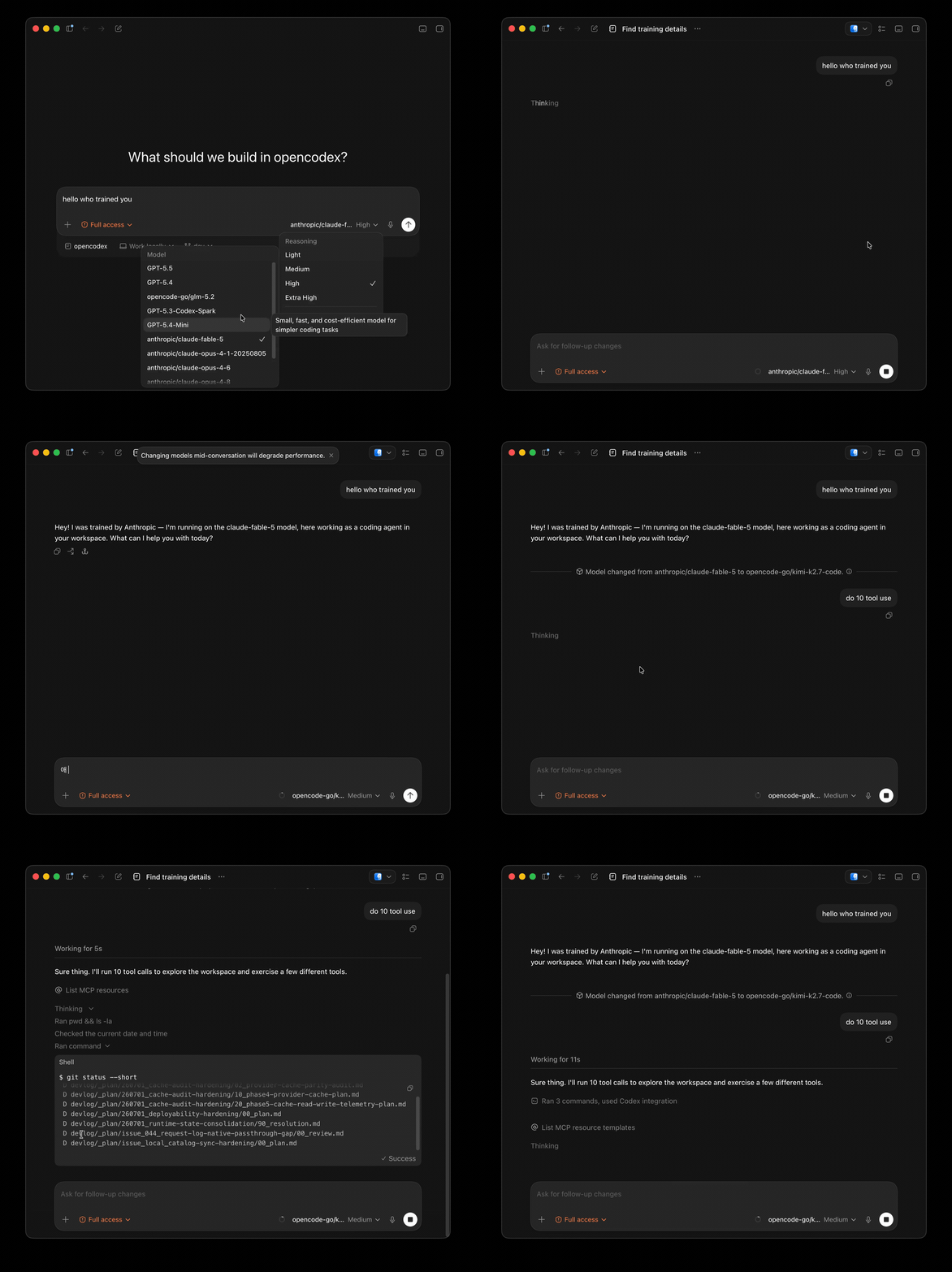
Universal provider proxy for OpenAI Codex & Claude Code — use any LLM (Claude, Gemini, Grok, DeepSeek, Ollama…) with Codex CLI, App, SDK, and Claude Code

Git-native persistent memory for AI coding agents. Implements Google OKF v0.2 with sub-300µs in-memory BM25 search, embedded MCP server, and progressive disclosure. Slashes token bloat by 80% with zero external databases or dependencies. Built in pure Go.

Local-first code intelligence graph for MCP and CLI. Builds a persistent map of your codebase so AI coding tools read only what matters, with benchmarked context reductions on reviews and large-repo workflows.

Stop your AI from making things up — it proposes, deterministic tools decide, every claim checked against ground truth with evidence. Grounded facts and context survive resets. Reverse engineering is the proving ground. MCP server + CLI.