
koala73/worldmonitorConnectors
Real-time global intelligence dashboard. AI-powered news aggregation, geopolitical monitoring, and infrastructure tracking in a unified situational awareness interface
86k
This server plugs Plane into any MCP-capable agent so the agent can read and change Plane projects, work items, cycles, and other workspace objects. It supports local stdio, remote HTTP, and SSE transports, with either OAuth or API key authentication.
Builders who want their agent to manage Plane work items and projects.
You can ask your agent to inspect and update Plane without leaving your MCP client.
Exposes one tool per Plane resource, covering 204 operations through an action parameter.
Runs over local stdio, hosted HTTP, and deprecated SSE for backward compatibility.
Supports OAuth for hosted use and API key or personal access token flows for direct access.
Lets list, count, and search actions use Plane Query Language filters and grouping.
Each tool description lists its supported actions and required or optional parameters at call time.
Includes tests that validate tool behavior against stand-in clients without network access.
PLANE_API_KEY=... PLANE_WORKSPACE_SLUG=... uvx plane-mcp-server stdio
export PLANE_OAUTH_ALLOWED_REDIRECT_URIS="https://newclient.com/cb,https://other.app/oauth/*"
export LOG_USER_INFO=false    # also log the display name (PII);
export LOG_PAYLOADS=false    # keep request payloads out of logs; default true
git clone https://github.com/makeplane/plane-mcp-server
cd plane-mcp-server
uv pip install -e ".[dev]"
PLANE_API_KEY=... PLANE_WORKSPACE_SLUG=... python -m plane_mcp stdio
python -m plane_mcp http            # port 8211
pytest                              # no network or credentials needed
ruff format plane_mcp/ tests/       # line length 120
ruff check plane_mcp/ tests/        # rules E, F, I, UP, B
A Model Context Protocol server for Plane. Gives an AI agent tools to read and manage projects, work items, cycles, modules, releases, customers and more.
Built on FastMCP and the official
plane-sdk.
Get an API key from Plane: Workspace Settings → API tokens.
Add this to your MCP client's configuration:
{
  "mcpServers": {
    "plane": {
      "command": "uvx",
      "args": ["plane-mcp-server", "stdio"],
      "env": {
        "PLANE_API_KEY": "<your-api-key>",
        "PLANE_WORKSPACE_SLUG": "<your-workspace-slug>"
      }
    }
  }
}
uvx needs no install step. Requires Python 3.10+.
For a self-hosted Plane, add "PLANE_BASE_URL": "https://plane.example.com".
Runs as a subprocess of your MCP client. Configuration as shown above; needs
PLANE_API_KEY and PLANE_WORKSPACE_SLUG.
PLANE_API_KEY=... PLANE_WORKSPACE_SLUG=... uvx plane-mcp-server stdio
https://mcp.plane.so/http/mcp
The OAuth flow is handled on connect; no credentials in your config. For clients
without native remote MCP support, bridge with mcp-remote:
{
  "mcpServers": {
    "plane": {
      "command": "npx",
      "args": ["mcp-remote@latest", "https://mcp.plane.so/http/mcp"]
    }
  }
}
Requires Node.js 22+.
https://mcp.plane.so/http/api-key/mcp
| Header | Value |
|---|---|
Authorization | Bearer <PAT> |
X-Workspace-slug | <workspace-slug> |
{
  "mcpServers": {
    "plane": {
      "command": "npx",
      "args": ["mcp-remote@latest", "https://mcp.plane.so/http/api-key/mcp"],
      "headers": {
        "Authorization": "Bearer <PAT>",
        "X-Workspace-slug": "<workspace-slug>"
      }
    }
  }
}
https://mcp.plane.so/sse is maintained for backward compatibility only. Use an
HTTP transport instead.
The server advertises 30 tools, one per resource. Each takes an action
parameter that selects the operation:
workitem(action="create", project_id=..., name="Fix login")
workitem(action="list", project_id=..., pql='state__group = "started"')
cycle(action="archive", project_id=..., cycle_id=...)
Every tool's description lists its actions with their required and optional parameters, so the catalogue is self-documenting at call time.
→ Full tool and action reference
List, count and search accept PQL, Plane's query language:
workitem(action="list", project_id=..., pql='state__group = "started" AND priority = "urgent"')
workitem(action="count", pql='assignees__id = "<member id>"', group_by="state_id")
Call get_pql_reference for the full syntax, operators and worked examples.
Earlier releases exposed one tool per API operation. Existing integrations keep
working: 169 of those 177 names still resolve to the consolidated tool, so a
saved prompt or script calling create_work_item or list_cycles needs no
change. They are no longer advertised, and they keep the parameter names they
shipped with (work_item_id, not workitem_id).
Seven names chose between two operations with a parameter
(manage_project_archive(archive=False)), which one tool-and-action pair cannot
reproduce; calling one tells you its replacement. get_pql_reference is
unchanged.
| Variable | Required for | Purpose |
|---|---|---|
PLANE_API_KEY | stdio | API key |
PLANE_WORKSPACE_SLUG | stdio | Target workspace |
PLANE_BASE_URL | optional | Plane API URL (default https://api.plane.so) |
The remote transports carry credentials in the connection — the OAuth flow or the PAT headers — and need none of these.
Self-hosting the server itself:
| Variable | Purpose |
|---|---|
PLANE_INTERNAL_BASE_URL | Internal URL for server-to-server calls, preferred over PLANE_BASE_URL |
REDIS_URL | OAuth token storage as one connection URL (redis:// or rediss:// for TLS); wins over host/port |
REDIS_HOST / REDIS_PORT | OAuth token storage; falls back to in-memory |
PLANE_OAUTH_PROVIDER_* | OAuth client credentials and base URL |
MCP_PATH_PREFIX | Path prefix for the HTTP routes, when mounted behind a proxy — /plane serves /plane/http/mcp |
The OAuth transports validate each client's redirect URI against an allowlist. Common clients (Cursor, VS Code, Claude.ai, ChatGPT connectors, localhost) are allowed by default.
To onboard a new client without a release, append patterns:
export PLANE_OAUTH_ALLOWED_REDIRECT_URIS="https://newclient.com/cb,https://other.app/oauth/*"
* matches any port, path segment or subdomain. Keep the host pinned and
wildcard only the port or path.
Structured JSON. Each tool call logs its name, duration, status and — when available — an opaque user id and the workspace slug.
export LOG_USER_INFO=false    # also log the display name (PII);
export LOG_PAYLOADS=false    # keep request payloads out of logs; default true
Only the OAuth and PAT transports carry a display name; stdio is unaffected.
git clone https://github.com/makeplane/plane-mcp-server
cd plane-mcp-server
uv pip install -e ".[dev]"
Run the server against a workspace:
PLANE_API_KEY=... PLANE_WORKSPACE_SLUG=... python -m plane_mcp stdio
python -m plane_mcp http            # port 8211
Tests, format, lint:
pytest                              # no network or credentials needed
ruff format plane_mcp/ tests/       # line length 120
ruff check plane_mcp/ tests/        # rules E, F, I, UP, B
The suite runs fully offline — every action of every resource is
executed against a stand-in that binds each call against the genuine plane-sdk
signature. See plane_mcp/tools/README.md.
Live integration tests are skipped unless you point them at a running server:
export PLANE_TEST_API_KEY=... PLANE_TEST_WORKSPACE_SLUG=...
export PLANE_TEST_MCP_URL=http://localhost:8211    # optional; this is the default
pytest tests/test_integration.py -v
They write real data to that workspace.
| Path | Contents |
|---|---|
plane_mcp/__main__.py | entry point; picks the transport from argv[1] |
plane_mcp/server.py | one factory per transport |
plane_mcp/client.py | resolves credentials into a plane-sdk client |
plane_mcp/auth/ | OAuth provider and header auth |
plane_mcp/tools/ | the tool surface: one module per Plane resource |
plane_mcp/toolkit/ | shared building blocks for the tool surface |
plane_mcp/pql_reference.py | PQL syntax reference served to models |
Pull requests welcome. Please run pytest and ruff check before submitting; new
tools should come with the invariants described in
plane_mcp/tools/README.md.
See CONTRIBUTING.md and CODE_OF_CONDUCT.md.
@makeplane/plane-mcp-server (Node.js) is deprecated and unmaintained. This
Python implementation replaces it.
| Node.js | Python |
|---|---|
PLANE_API_KEY | PLANE_API_KEY |
PLANE_API_HOST_URL | PLANE_BASE_URL |
PLANE_WORKSPACE_SLUG | PLANE_WORKSPACE_SLUG |
Replace the command and args with the stdio configuration in
Quick start.
MIT — see LICENSE.
Sign in to join the discussion.
No comments yet. Be the first to say what this is good for.
Real-time global intelligence dashboard. AI-powered news aggregation, geopolitical monitoring, and infrastructure tracking in a unified situational awareness interface
High-performance code intelligence MCP server. Indexes codebases into a persistent knowledge graph — average repo in milliseconds. 158 languages, sub-ms queries, 99% fewer tokens. Single static binary, zero dependencies.
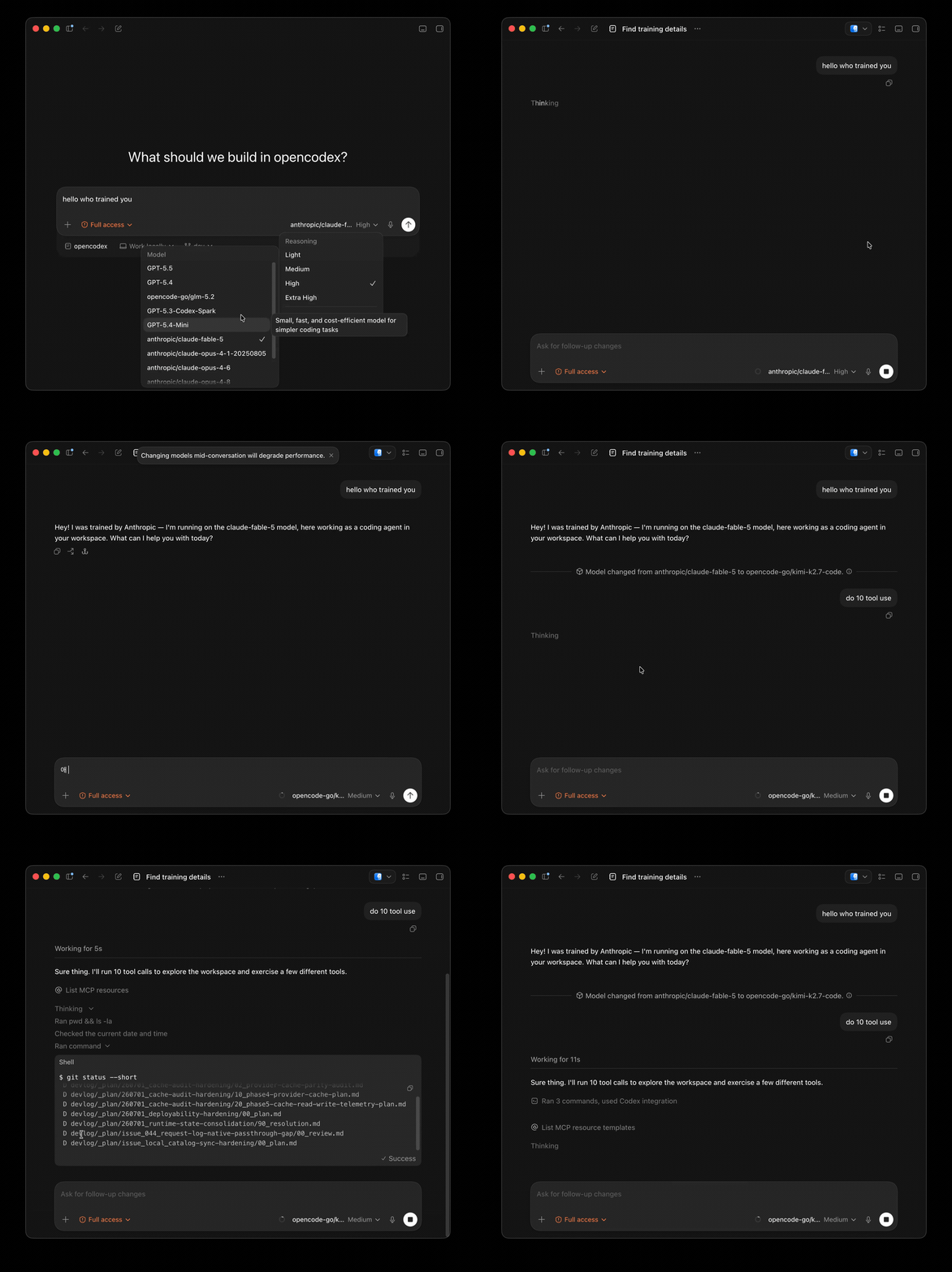
Universal provider proxy for OpenAI Codex & Claude Code — use any LLM (Claude, Gemini, Grok, DeepSeek, Ollama…) with Codex CLI, App, SDK, and Claude Code

Git-native persistent memory for AI coding agents. Implements Google OKF v0.2 with sub-300µs in-memory BM25 search, embedded MCP server, and progressive disclosure. Slashes token bloat by 80% with zero external databases or dependencies. Built in pure Go.

Local-first code intelligence graph for MCP and CLI. Builds a persistent map of your codebase so AI coding tools read only what matters, with benchmarked context reductions on reviews and large-repo workflows.

Stop your AI from making things up — it proposes, deterministic tools decide, every claim checked against ground truth with evidence. Grounded facts and context survive resets. Reverse engineering is the proving ground. MCP server + CLI.