

heygen-com/hyperframesFrameworks & SDKs
Write HTML. Render video. Built for agents.
49k
SkillFoundry is a framework for building and validating reusable skills from scientific resources. It uses a domain tree, resource mining, skill compilation, and multi-level testing to grow a skill library over time.
Builders who want a scientific agent to discover and validate reusable skills from heterogeneous research resources.
You can turn scattered scientific knowledge into tested skills your agent can reuse instead of rebuilding each time.
Builds a rooted domain and subdomain tree that guides what skills to search for next.
Searches for relevant repositories, APIs, papers, notebooks, and databases for a chosen focus branch.
Extracts operational contracts and packages them as reusable skills with metadata, dependencies, and tests.
Runs execution testing, system testing, and synthetic-data testing before a skill is added.
Revises, merges, or prunes weak skills and then repeats the discovery loop.
Provides commands for status checks, cycle runs, skill design, evaluation, and long campaigns.
git clone https://github.com/ma-compbio-lab/SkillFoundry.git
cd SkillFoundry
pip install -e .       # Install the skillfoundry package
make validate        # Validate repository structure
make build-site      # Build the project page
make test            # Run unit tests
python3 scripts/sciskill_framework.py --json status --focus-limit 10
# Single loop
python3 scripts/sciskill_framework.py cycle --loops 1 --verification-mode standard

# Parallel workers with custom focus
python3 scripts/sciskill_framework.py cycle \
  --loops 2 --focus-limit 12 --stage-workers 4 \
  --stages tree_check,resource_search,skill_build,skill_test,refresh \
  --extra-context "Prioritize uncovered leaves in robotics and physics."
python3 scripts/sciskill_framework.py design-skill \
  --prompt "Design a skill for literature-backed pathway enrichment benchmarking." \
  --verification-mode validate
# Single skill
python3 scripts/sciskill_framework.py evaluate-skills \
  --skill-slug openalex-literature-search \
  --verification-mode validate

# Full library
python3 scripts/sciskill_framework.py evaluate-skills --all --verification-mode none
Shuaike Shen*, Wenduo Cheng*, Mingqian Ma, Alistair Turcan, Martin Jinye Zhang, Jian Ma†
Ray & Stephanie Lane Computational Biology Department, School of Computer Science, Carnegie Mellon University
[*Equal contribution · †Correspondence: jianma@cs.cmu.edu]




Modern scientific ecosystems are rich in procedural knowledge — repositories, APIs, scripts, notebooks, documentation, databases, and papers — yet much of this knowledge remains fragmented and difficult for agents to operationalize. SkillFoundry bridges this gap with a self-evolving framework that converts heterogeneous scientific resources into validated, reusable agent skills.
| 267+ skills | mined across 28 scientific domains and 254 subdomains |
| 71.1% novelty | vs. existing skill libraries (SkillHub, SkillSMP) |
| 5/6 datasets improved | on MoSciBench benchmark |
| Genomics boost | substantial gains on two challenging genomics tasks |
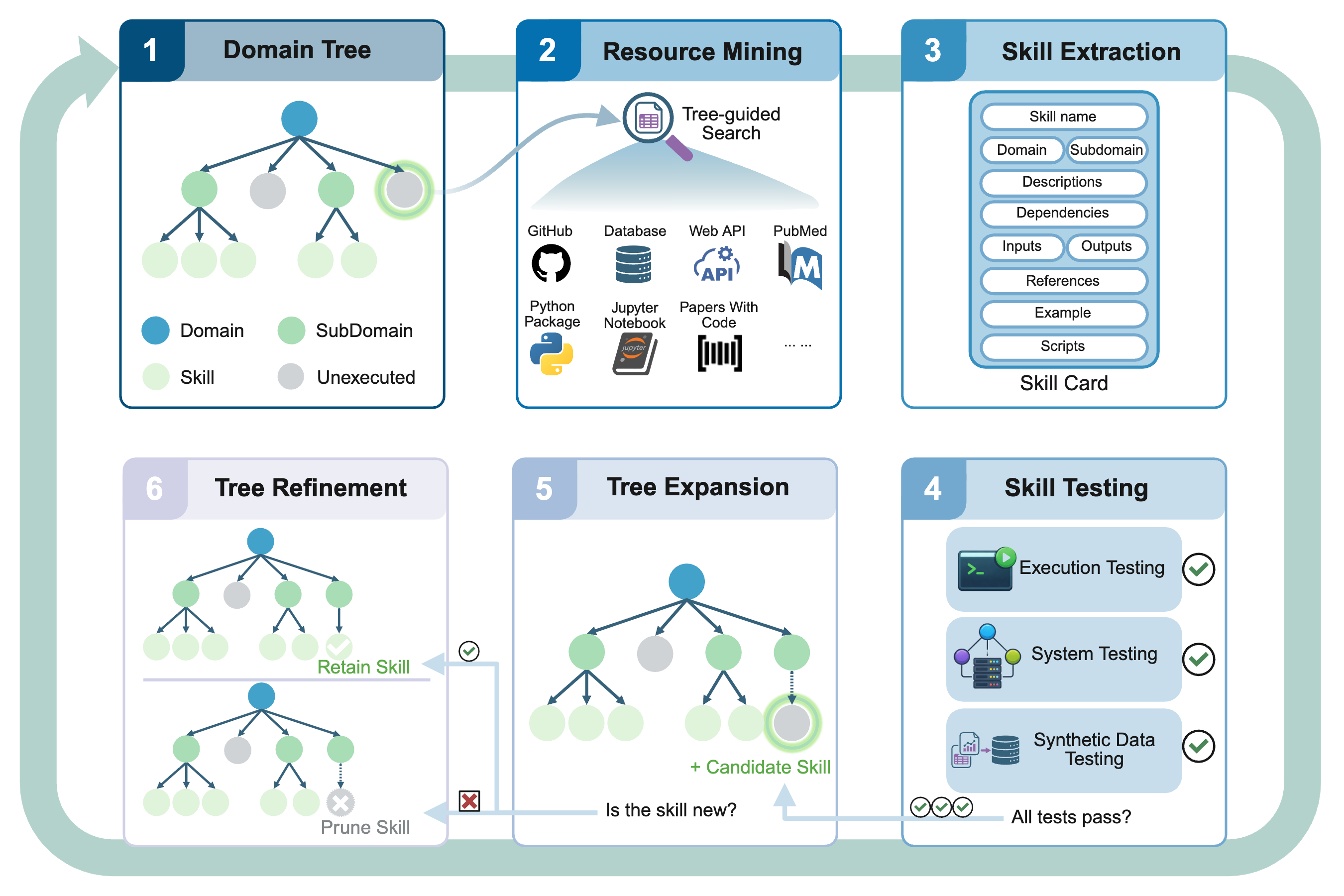
SkillFoundry uses a domain knowledge tree as both a search prior and the evolving structure being updated, turning open-ended skill collection into a closed-loop acquisition process:
| Step | Stage | Description |
|---|---|---|
| 1 | Tree Construction | Build a rooted tree where internal nodes are domains/subdomains and leaves are actionable skill targets |
| 2 | Resource Mining | Select focus branches and retrieve relevant resources (repos, APIs, papers, notebooks, databases) |
| 3 | Skill Compilation | Extract operational contracts and compile into reusable skill packages with metadata, dependencies, and tests |
| 4 | Multi-Level Validation | Apply execution testing, system testing, and synthetic-data testing |
| 5 | Tree Expansion | Insert validated skills as new leaves, expanding domain coverage |
| 6 | Refinement & Loop | Revise, merge, or prune failing/redundant skills; repeat from step 2 |
SkillFoundry/
├── skillfoundry/             # Core automation framework (Python package)
│   ├── cli.py                #   CLI entry point
│   ├── orchestrator.py       #   Skill automation orchestrator
│   ├── campaign.py           #   Long-running campaign runner
│   ├── evaluation.py         #   Hierarchical skill evaluation
│   └── ...
├── scripts/                  # Utility & validation scripts
├── registry/                 # Taxonomy, resource registry, skill index
├── skills/                   # Reusable skill folders grouped by domain (27 domains)
├── tests/                    # Test suites (smoke, integration, regression)
├── site/                     # Generated project page (static HTML/JS/CSS)
├── ref/                      # Reference materials
└── Makefile                  # Build, validate, test, and smoke targets
git clone https://github.com/ma-compbio-lab/SkillFoundry.git
cd SkillFoundry
pip install -e .       # Install the skillfoundry package
make validate        # Validate repository structure
make build-site      # Build the project page
make test            # Run unit tests
The skillfoundry package provides a CLI for automated skill discovery, compilation, and evaluation. It orchestrates the closed-loop tree_check -> resource_search -> skill_build -> skill_test -> refresh pipeline.
Inspect the current repository summary and identify high-value frontier leaves:
python3 scripts/sciskill_framework.py --json status --focus-limit 10
Run one or more automation loops to discover and build new skills:
# Single loop
python3 scripts/sciskill_framework.py cycle --loops 1 --verification-mode standard

# Parallel workers with custom focus
python3 scripts/sciskill_framework.py cycle \
  --loops 2 --focus-limit 12 --stage-workers 4 \
  --stages tree_check,resource_search,skill_build,skill_test,refresh \
  --extra-context "Prioritize uncovered leaves in robotics and physics."
Design a skill from a specific task description:
python3 scripts/sciskill_framework.py design-skill \
  --prompt "Design a skill for literature-backed pathway enrichment benchmarking." \
  --verification-mode validate
Run hierarchical evaluation (correctness repair, benchmarking, novelty checking):
# Single skill
python3 scripts/sciskill_framework.py evaluate-skills \
  --skill-slug openalex-literature-search \
  --verification-mode validate

# Full library
python3 scripts/sciskill_framework.py evaluate-skills --all --verification-mode none
Run a long checkpointable campaign targeting specific domains:
python3 scripts/sciskill_framework.py campaign \
  --focus-term genomics --focus-term proteomics \
  --max-iterations 100 --max-runtime-minutes 450 \
  --stage-workers 6 --evaluation-workers 6
Citation information will be available once the paper is published. Check back later.
This project is licensed under the Apache License 2.0 and developed at Ma Lab, Carnegie Mellon University.
Sign in to join the discussion.
No comments yet. Be the first to say what this is good for.
Write HTML. Render video. Built for agents.
Ultra-lightweight, open-source, self-hosted personal AI agent framework in Python with WebUI, tools, memory, MCP, multi-agent workflows, automation, and chat apps

SkillOpt is a text-space optimizer that trains reusable natural-language skills for frozen LLM agents through trajectory-driven edits, validation-gated updates, and deployable best_skill.md artifacts.
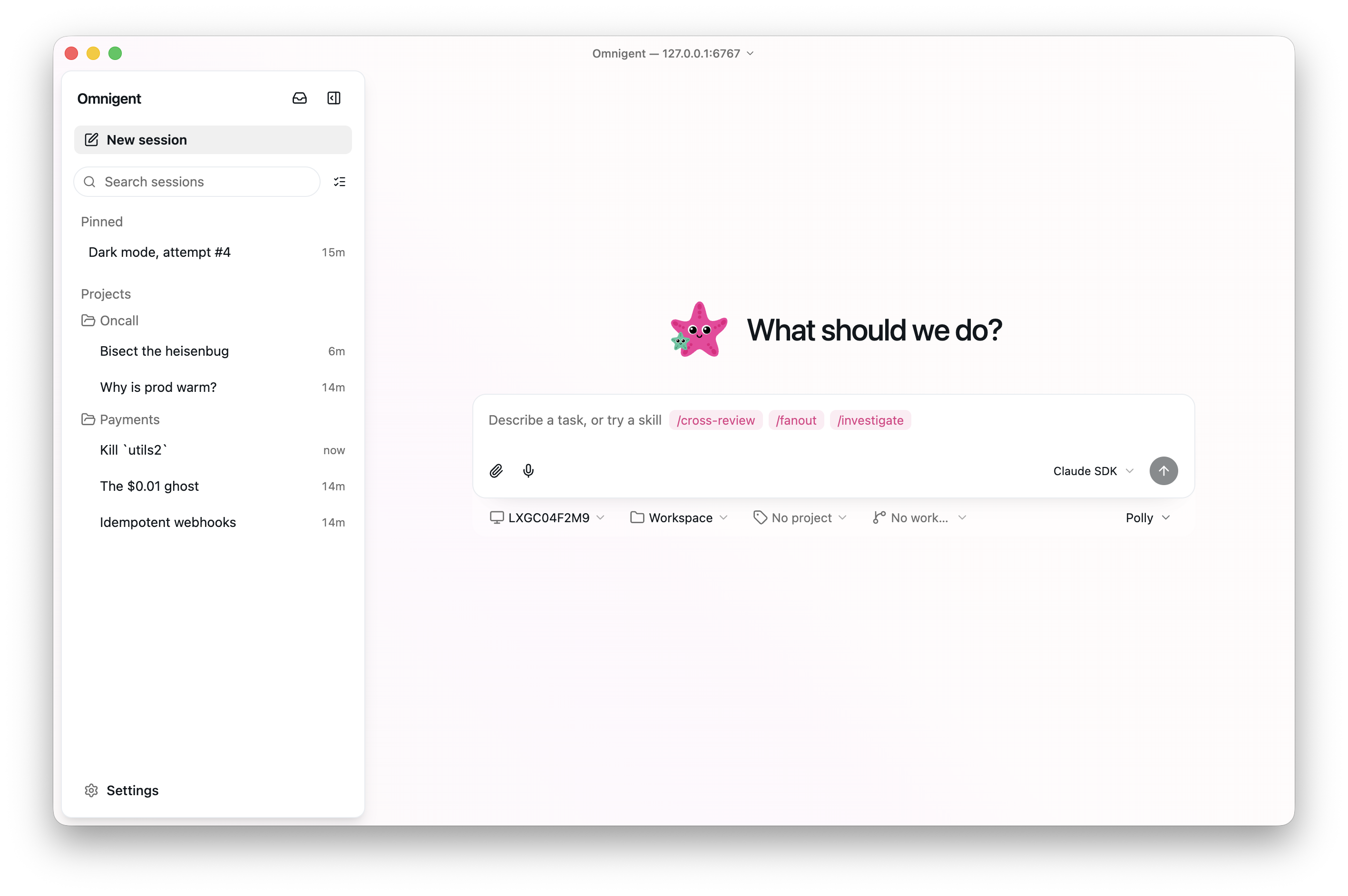
Omnigent is an open-source AI agent framework and meta-harness: orchestrate Claude Code, Codex, Cursor, Pi, and custom agents — swap harnesses without rewriting, enforce policies and sandboxing, and collaborate in real time from any device.

A theoretical reconstruction of the Claude Mythos architecture, built from first principles using the available research literature.
🕷️ An adaptive Web Scraping framework that handles everything from a single request to a full-scale crawl!