
koala73/worldmonitorConnectors
Real-time global intelligence dashboard. AI-powered news aggregation, geopolitical monitoring, and infrastructure tracking in a unified situational awareness interface
86k
CCXT MCP Server sits between an MCP client and cryptocurrency exchange APIs. It uses CCXT to expose market data, orders, balances, position sizing, and trading analysis through a standard tool interface.
Builders who want their MCP client to read exchange data and place trades without writing exchange-specific code.
You can ask an AI assistant to fetch market data, analyze trades, and send exchange orders through one standardized connector.
Lists exchanges, reads market details, gets prices, order books, and historical OHLCV data.
Creates market and limit orders, cancels orders, checks order status, and reads balances and trading history.
Calculates win rate, profit and loss ratios, return periods, and trade pattern metrics.
Supports capital-based sizing, leverage settings, volatility-based sizing, and split buy or sell strategies.
Includes stop loss, take profit, and loss-limit logic based on indicators and volatility.
Runs through `npx`, Docker Compose, or behind Nginx for HTTP+SSE clients.
# Install the package globally
npm install -g @lazydino/ccxt-mcp

# Run with default settings
ccxt-mcp

# or run without installation
npx @lazydino/ccxt-mcp
# Install the package globally
npm install -g @lazydino/ccxt-mcp
# Using default settings
npx @lazydino/ccxt-mcp

# Using custom configuration file
npx @lazydino/ccxt-mcp --config /path/to/config.json
npx @lazydino/ccxt-mcp --help




CCXT MCP Server is a server that allows AI models to interact with cryptocurrency exchange APIs through the Model Context Protocol (MCP). This server uses the CCXT library to provide access to more than 100 cryptocurrency exchanges and their trading capabilities.
# Install the package globally
npm install -g @lazydino/ccxt-mcp

# Run with default settings
ccxt-mcp

# or run without installation
npx @lazydino/ccxt-mcp
# Install the package globally
npm install -g @lazydino/ccxt-mcp
You can run it directly without installation:
# Using default settings
npx @lazydino/ccxt-mcp

# Using custom configuration file
npx @lazydino/ccxt-mcp --config /path/to/config.json
View help:
npx @lazydino/ccxt-mcp --help
Open Claude Desktop Settings:
Add a New MCP Server:
ccxt-mcpnpx @lazydino/ccxt-mcp--config /path/to/config.jsonSave and Test the Server:
This method includes CCXT account information directly in the Claude Desktop settings file (claude_desktop_config.json):
{
  "mcpServers": {
    "ccxt-mcp": {
      "command": "npx",
      "args": ["-y", "@lazydino/ccxt-mcp"],
      "mcpBearerToken": "YOUR_MCP_TOKEN",
      "accounts": [
        {
          "name": "bybit_main",
          "exchangeId": "bybit",
          "apiKey": "YOUR_API_KEY",
          "secret": "YOUR_SECRET_KEY",
          "defaultType": "spot"
        },
        {
          "name": "bybit_futures",
          "exchangeId": "bybit",
          "apiKey": "YOUR_API_KEY",
          "secret": "YOUR_SECRET_KEY",
          "defaultType": "swap"
        }
      ]
    }
  }
}
Using this method, you don't need a separate configuration file. All settings are integrated into the Claude Desktop configuration file.
To separate account information into a separate configuration file, set up as follows:
ccxt-config.json):{
"mcpBearerToken": "YOUR_MCP_TOKEN",
"accounts": [
{
"name": "bybit_main",
"exchangeId": "bybit",
"apiKey": "YOUR_API_KEY",
"secret": "YOUR_SECRET_KEY",
"defaultType": "spot"
},
{
"name": "bybit_futures",
"exchangeId": "bybit",
"apiKey": "YOUR_API_KEY",
"secret": "YOUR_SECRET_KEY",
"defaultType": "swap"
}
]
}
Important: The configuration file must contain an
accountsarray at the root level, as shown above.
Important: If you run the server in HTTP+SSE mode (
--sse), setmcpBearerTokenin the same config file. Clients must sendAuthorization: Bearer <mcpBearerToken>on requests.
{
  "mcpServers": {
    "ccxt-mcp": {
      "command": "npx",
      "args": [
        "-y",
        "@lazydino/ccxt-mcp",
        "--config",
        "/path/to/ccxt-config.json"
      ]
    }
  }
}
Note: When using a separate configuration file with the
--configoption, the server will look for theaccountsarray directly in the root of the JSON file, not inmcpServers.ccxt-mcp.accountspath.
# Using custom configuration file
npx @lazydino/ccxt-mcp --config /path/to/ccxt-config.json
You can find an example configuration file at config/ccxt-config.example.json in the repository.
Reasons to Use a Separate Configuration File:
- Prevents recursive reference issues
- Separates sensitive information like API keys
- Easier multi-environment configuration (development, testing, production)
- Improved configuration file version control
Market Information Retrieval:
Trading Functions:
Trading Analysis:
Position Management:
Risk Management:
User <--> AI Model(Claude/GPT) <--> MCP Protocol <--> CCXT MCP Server <--> Cryptocurrency Exchange API
When registered with Claude Desktop, you can make the following types of requests to AI models:
When using AI models, consider the following cautions and use the prompt below for effective trading:
Your goal is to execute trades using the ccxt tools as much as possible
Cautions:
- Accurately identify whether it's a futures market or spot market before proceeding with trades
- If there's no instruction about percentage of capital or amount to use, always calculate and execute trades using the entire available capital
Notes:
Check and compare the current Bitcoin price on binance and coinbase.
Position Management
Open a long position on BTC/USDT futures market in my Bybit account (bybit_futures) with 5% of capital using 10x leverage.
Enter based on moving average crossover strategy and set stop loss at the lowest point among the 12 most recent 5-minute candles.
Performance Analysis
Analyze my Binance account (bybit_main) trading records for the last 7 days and show me the win rate, average profit, and maximum consecutive losses.
Detailed Trading Analytics
Analyze my trading performance on the bybit_futures account for BTC/USDT over the last 30 days. Calculate win rate, profit factor, and identify any patterns in my winning trades.
Show me the monthly returns for my bybit_main account over the past 90 days and identify my best and worst trading months.
Analyze my consecutive wins and losses on my bybit_futures account and tell me if I have any psychological patterns affecting my trading after losses.
# Clone repository
git clone https://github.com/lazy-dinosaur/ccxt-mcp.git

# Navigate to project directory
cd ccxt-mcp

# Install dependencies
npm install

# Build
npm run build
cp config/ccxt-config.example.json config/ccxt-config.json
Then fill in your real API keys in config/ccxt-config.json.
Also set mcpBearerToken in that same config file.
2. Build image:
docker compose build
docker compose up -d
curl -H "Authorization: Bearer YOUR_MCP_TOKEN" http://127.0.0.1:2298/healthz
This Compose setup runs MCP over HTTP+SSE (/sse + /messages) on localhost:2298 for reverse proxying.
If your MCP client runs on another host, use an Nginx reverse proxy on this machine.
ccxt-mcp.nginx to your Nginx config location and update certificate paths:sudo cp ccxt-mcp.nginx /etc/nginx/conf.d/ccxt-mcp.conf
/etc/nginx/conf.d/ccxt-mcp.conf and set:ssl_certificatessl_certificate_keysudo nginx -t && sudo systemctl reload nginx
https://YOUR_HOSTNAME_OR_IP:42299/ssehttps://YOUR_HOSTNAME_OR_IP:42299/messagesAuthorization: Bearer YOUR_MCP_TOKENYou can generate a strong token with:
openssl rand -hex 32
Config example:
{
  "mcpBearerToken": "YOUR_MCP_TOKEN",
  "accounts": [
    {
      "name": "bybit_main",
      "exchangeId": "bybit",
      "apiKey": "YOUR_API_KEY",
      "secret": "YOUR_SECRET_KEY"
    }
  ]
}
Port note:
42298 is HTTP (redirect only)42299 is HTTPS2298 comes from CCXT on a phone keypadIf your MCP client accepts command-based MCP servers instead of URL configuration, configure ccxt-mcp with:
docker[
"run",
"--rm",
"-i",
"-p",
"127.0.0.1:2298:2298",
"-v",
"/absolute/path/to/ccxt-mcp/config/ccxt-config.json:/config/ccxt-config.json:ro",
"ccxt-mcp:local",
"--sse",
"--host",
"0.0.0.0",
"--port",
"2298",
"--config",
"/config/ccxt-config.json"
]
Build the image first with docker compose build.
Contributions are welcome! Please feel free to submit a Pull Request.
Distributed under the MIT License. See the LICENSE file for more information.
If you find this project useful, please consider giving it a ⭐️ on GitHub!
Sign in to join the discussion.
No comments yet. Be the first to say what this is good for.
Real-time global intelligence dashboard. AI-powered news aggregation, geopolitical monitoring, and infrastructure tracking in a unified situational awareness interface
High-performance code intelligence MCP server. Indexes codebases into a persistent knowledge graph — average repo in milliseconds. 158 languages, sub-ms queries, 99% fewer tokens. Single static binary, zero dependencies.
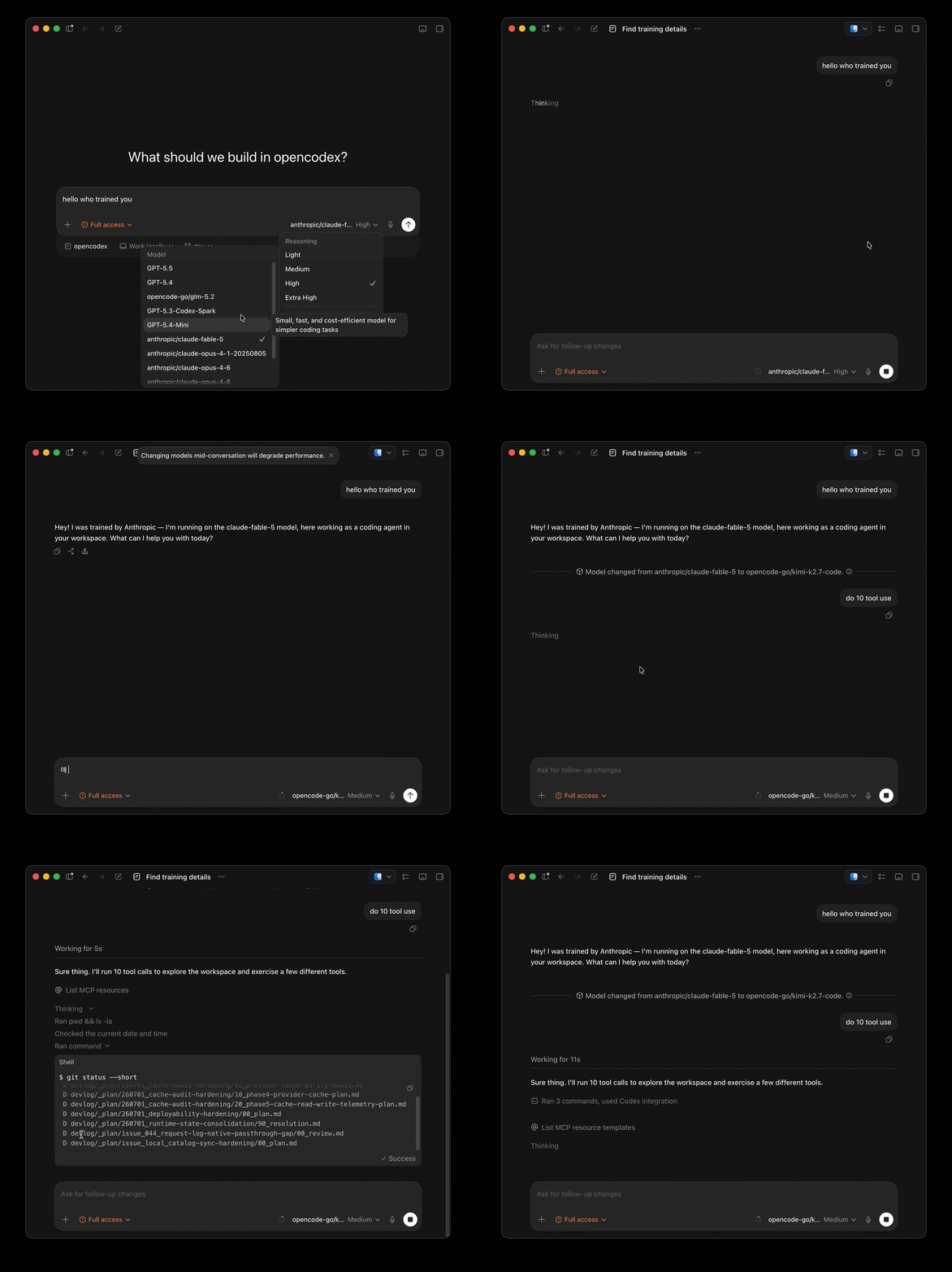
Universal provider proxy for OpenAI Codex & Claude Code — use any LLM (Claude, Gemini, Grok, DeepSeek, Ollama…) with Codex CLI, App, SDK, and Claude Code

Git-native persistent memory for AI coding agents. Implements Google OKF v0.2 with sub-300µs in-memory BM25 search, embedded MCP server, and progressive disclosure. Slashes token bloat by 80% with zero external databases or dependencies. Built in pure Go.

Stop your AI from making things up — it proposes, deterministic tools decide, every claim checked against ground truth with evidence. Grounded facts and context survive resets. Reverse engineering is the proving ground. MCP server + CLI.
20 MB lightweight cross-platform database client for 90+ databases, including MySQL, PostgreSQL, SQLite, Redis, MongoDB, DuckDB, SQL Server, and Dameng. Built-in AI, MCP Server, CLI, desktop and Docker. | 轻量级跨平台数据库管理工具,支持 MySQL、PostgreSQL、SQLite、Redis、MongoDB、达梦等 90+ 数据库,提供桌面端、Docker、CLI、内置 AI 助手和 MCP Server。