
koala73/worldmonitorConnectors
Real-time global intelligence dashboard. AI-powered news aggregation, geopolitical monitoring, and infrastructure tracking in a unified situational awareness interface
86k
mcpdoc turns llms.txt files into an MCP tool source for agents. You point it at one or more documentation indexes, and it serves those docs through a `fetch_docs` tool that host apps like Cursor, Windsurf, and Claude Code can call.
Builders who want their agent to fetch project docs through MCP instead of hidden built-in retrieval.
You can make your agent read docs from approved sources and audit every tool call and result.
Loads llms.txt sources from `--urls`, `--yaml`, or `--json`, and you can combine them in one server.
Provides a `fetch_docs` tool so the host app can read linked markdown pages from the chosen llms.txt files.
Restricts remote fetches to approved domains, with explicit `--allowed-domains` overrides for local or broader access.
Runs as `mcpdoc` with transport options like `stdio` and `sse`, plus host and port settings.
README includes ready-to-paste MCP config snippets and rule examples for each of those apps.
curl -LsSf https://astral.sh/uv/install.sh | sh
uvx --from mcpdoc mcpdoc \
    --urls "LangGraph:https://langchain-ai.github.io/langgraph/llms.txt" "LangChain:https://python.langchain.com/llms.txt" \
    --transport sse \
    --port 8082 \
--host localhostnpx @modelcontextprotocol/inspector
for ANY question about LangGraph, use the langgraph-docs-mcp server to help answer --
+ call list_doc_sources tool to get the available llms.txt file
+ call fetch_docs tool to read it
+ reflect on the urls in llms.txt
+ reflect on the input question
+ call fetch_docs on any urls relevant to the question
+ use this to answer the question
what are types of memory in LangGraph?
for ANY question about LangGraph, use the langgraph-docs-mcp server to help answer --
+ call list_doc_sources tool to get the available llms.txt file
+ call fetch_docs tool to read it
+ reflect on the urls in llms.txt
+ reflect on the input question
+ call fetch_docs on any urls relevant to the question
llms.txt is a website index for LLMs, providing background information, guidance, and links to detailed markdown files. IDEs like Cursor and Windsurf or apps like Claude Code/Desktop can use llms.txt to retrieve context for tasks. However, these apps use different built-in tools to read and process files like llms.txt. The retrieval process can be opaque, and there is not always a way to audit the tool calls or the context returned.
MCP offers a way for developers to have full control over tools used by these applications. Here, we create an open source MCP server to provide MCP host applications (e.g., Cursor, Windsurf, Claude Code/Desktop) with (1) a user-defined list of llms.txt files and (2) a simple fetch_docs tool read URLs within any of the provided llms.txt files. This allows the user to audit each tool call as well as the context returned.
You can find llms.txt files for langgraph and langchain here:
| Library | llms.txt |
|---|---|
| LangGraph Python | https://langchain-ai.github.io/langgraph/llms.txt |
| LangGraph JS | https://langchain-ai.github.io/langgraphjs/llms.txt |
| LangChain Python | https://python.langchain.com/llms.txt |
| LangChain JS | https://js.langchain.com/llms.txt |
uv.curl -LsSf https://astral.sh/uv/install.sh | sh
llms.txt file to use.llms.txt file.Note: Security and Domain Access Control
For security reasons, mcpdoc implements strict domain access controls:
Remote llms.txt files: When you specify a remote llms.txt URL (e.g.,
https://langchain-ai.github.io/langgraph/llms.txt), mcpdoc automatically adds only that specific domain (langchain-ai.github.io) to the allowed domains list. This means the tool can only fetch documentation from URLs on that domain.Local llms.txt files: When using a local file, NO domains are automatically added to the allowed list. You MUST explicitly specify which domains to allow using the
--allowed-domainsparameter.Adding additional domains: To allow fetching from domains beyond those automatically included:
- Use
--allowed-domains domain1.com domain2.comto add specific domains- Use
--allowed-domains '*'to allow all domains (use with caution)This security measure prevents unauthorized access to domains not explicitly approved by the user, ensuring that documentation can only be retrieved from trusted sources.
llms.txt file(s) of choice:uvx --from mcpdoc mcpdoc \
--urls "LangGraph:https://langchain-ai.github.io/langgraph/llms.txt" "LangChain:https://python.langchain.com/llms.txt" \
--transport sse \
--port 8082 \
--host localhost
npx @modelcontextprotocol/inspector
tool calls.Cursor Settings and MCP tab.~/.cursor/mcp.json file.langgraph-docs-mcp name and link to the LangGraph llms.txt).{
"mcpServers": {
"langgraph-docs-mcp": {
"command": "uvx",
"args": [
"--from",
"mcpdoc",
"mcpdoc",
"--urls",
"LangGraph:https://langchain-ai.github.io/langgraph/llms.txt LangChain:https://python.langchain.com/llms.txt",
"--transport",
"stdio"
]
}
}
}
Cursor Settings/MCP tab.Settings/Rules and update User Rules with the following (or similar):for ANY question about LangGraph, use the langgraph-docs-mcp server to help answer --
+ call list_doc_sources tool to get the available llms.txt file
+ call fetch_docs tool to read it
+ reflect on the urls in llms.txt
+ reflect on the input question
+ call fetch_docs on any urls relevant to the question
+ use this to answer the question
CMD+L (on Mac) to open chat.agent is selected.Then, try an example prompt, such as:
what are types of memory in LangGraph?
CMD+L (on Mac).Configure MCP to open the config file, ~/.codeium/windsurf/mcp_config.json.langgraph-docs-mcp as noted above.Windsurf Rules/Global rules with the following (or similar):for ANY question about LangGraph, use the langgraph-docs-mcp server to help answer --
+ call list_doc_sources tool to get the available llms.txt file
+ call fetch_docs tool to read it
+ reflect on the urls in llms.txt
+ reflect on the input question
+ call fetch_docs on any urls relevant to the question
Then, try the example prompt:
Settings/Developer to update ~/Library/Application\ Support/Claude/claude_desktop_config.json.langgraph-docs-mcp as noted above.[!Note] If you run into issues with Python version incompatibility when trying to add MCPDoc tools to Claude Desktop, you can explicitly specify the filepath to
pythonexecutable in theuvxcommand.Example configuration
{ "mcpServers": { "langgraph-docs-mcp": { "command": "uvx", "args": [ "--python", "/path/to/python", "--from", "mcpdoc", "mcpdoc", "--urls", "LangGraph:https://langchain-ai.github.io/langgraph/llms.txt", "--transport", "stdio" ] } } }
[!Note] Currently (3/21/25) it appears that Claude Desktop does not support
rulesfor global rules, so appending the following to your prompt.
<rules>
for ANY question about LangGraph, use the langgraph-docs-mcp server to help answer --
+ call list_doc_sources tool to get the available llms.txt file
+ call fetch_docs tool to read it
+ reflect on the urls in llms.txt
+ reflect on the input question
+ call fetch_docs on any urls relevant to the question
</rules>
Then, try the example prompt:
claude mcp add-json langgraph-docs '{"type":"stdio","command":"uvx" ,"args":["--from", "mcpdoc", "mcpdoc", "--urls", "langgraph:https://langchain-ai.github.io/langgraph/llms.txt", "LangChain:https://python.langchain.com/llms.txt"]}' -s local
~/.claude.json updated.$ Claude
$ /mcp
[!Note] Currently (3/21/25) it appears that Claude Code does not support
rulesfor global rules, so appending the following to your prompt.
<rules>
for ANY question about LangGraph, use the langgraph-docs-mcp server to help answer --
+ call list_doc_sources tool to get the available llms.txt file
+ call fetch_docs tool to read it
+ reflect on the urls in llms.txt
+ reflect on the input question
+ call fetch_docs on any urls relevant to the question
</rules>
Then, try the example prompt:
The mcpdoc command provides a simple CLI for launching the documentation server.
You can specify documentation sources in three ways, and these can be combined:
sample_config.yaml file in this repo.mcpdoc --yaml sample_config.yaml
sample_config.json file in this repo.mcpdoc --json sample_config.json
name:url.--urls parameter multiple times.llms.txt for the MCP server above.mcpdoc --urls LangGraph:https://langchain-ai.github.io/langgraph/llms.txt --urls LangChain:https://python.langchain.com/llms.txt
You can also combine these methods to merge documentation sources:
mcpdoc --yaml sample_config.yaml --json sample_config.json --urls LangGraph:https://langchain-ai.github.io/langgraph/llms.txt --urls LangChain:https://python.langchain.com/llms.txt
--follow-redirects: Follow HTTP redirects (defaults to False)--timeout SECONDS: HTTP request timeout in seconds (defaults to 10.0)Example with additional options:
mcpdoc --yaml sample_config.yaml --follow-redirects --timeout 15
This will load the LangGraph Python documentation with a 15-second timeout and follow any HTTP redirects if necessary.
Both YAML and JSON configuration files should contain a list of documentation sources.
Each source must include an llms_txt URL and can optionally include a name:
# Sample configuration for mcp-mcpdoc server
# Each entry must have a llms_txt URL and optionally a name
- name: LangGraph Python
  llms_txt: https://langchain-ai.github.io/langgraph/llms.txt
[
  {
    "name": "LangGraph Python",
    "llms_txt": "https://langchain-ai.github.io/langgraph/llms.txt"
  }
]
from mcpdoc.main import create_server

# Create a server with documentation sources
server = create_server(
    [
        {
            "name": "LangGraph Python",
            "llms_txt": "https://langchain-ai.github.io/langgraph/llms.txt",
        },
        # You can add multiple documentation sources
        # {
        #     "name": "Another Documentation",
        #     "llms_txt": "https://example.com/llms.txt",
        # },
    ],
    follow_redirects=True,
    timeout=15.0,
)

# Run the server
server.run(transport="stdio")
Sign in to join the discussion.
No comments yet. Be the first to say what this is good for.
Real-time global intelligence dashboard. AI-powered news aggregation, geopolitical monitoring, and infrastructure tracking in a unified situational awareness interface
High-performance code intelligence MCP server. Indexes codebases into a persistent knowledge graph — average repo in milliseconds. 158 languages, sub-ms queries, 99% fewer tokens. Single static binary, zero dependencies.
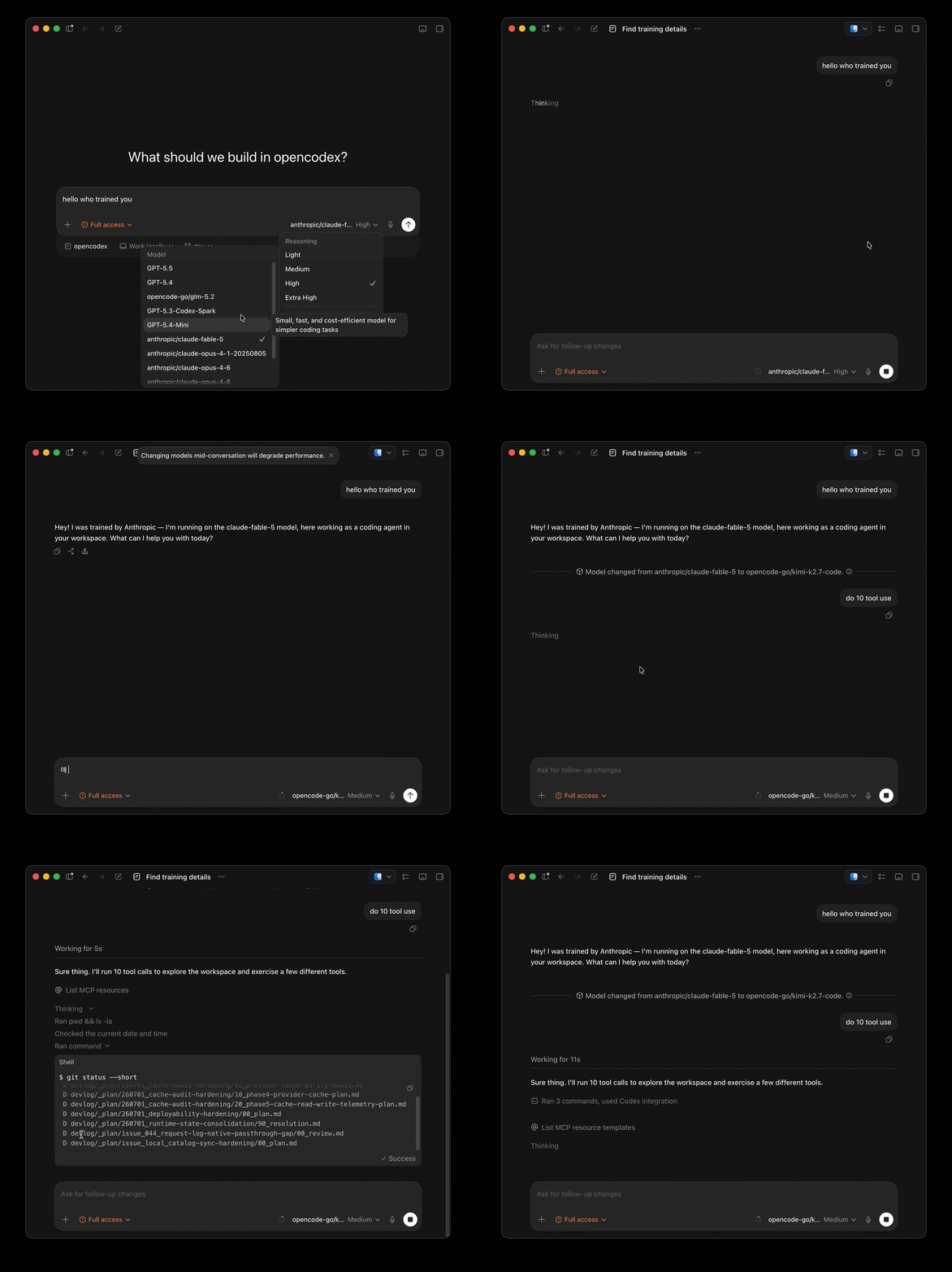
Universal provider proxy for OpenAI Codex & Claude Code — use any LLM (Claude, Gemini, Grok, DeepSeek, Ollama…) with Codex CLI, App, SDK, and Claude Code

Git-native persistent memory for AI coding agents. Implements Google OKF v0.2 with sub-300µs in-memory BM25 search, embedded MCP server, and progressive disclosure. Slashes token bloat by 80% with zero external databases or dependencies. Built in pure Go.

Local-first code intelligence graph for MCP and CLI. Builds a persistent map of your codebase so AI coding tools read only what matters, with benchmarked context reductions on reviews and large-repo workflows.

Stop your AI from making things up — it proposes, deterministic tools decide, every claim checked against ground truth with evidence. Grounded facts and context survive resets. Reverse engineering is the proving ground. MCP server + CLI.